The Chilean Navy UFO Video: CEFAA, the Cougar Helicopter Infrared Footage and Flight IB6830 (11 November 2014)
A Chilean Navy helicopter filmed an object off the coast west of Santiago for nine minutes on 11 November 2014, in infrared and in visible light, and twice recorded it trailing a dense plume. The Chilean government agency CEFAA studied the footage for two years, could not identify it, and released it in January 2017 as an unidentified aerial phenomenon. Within days civilian analysts had named a specific airliner, and the journalist who broke the story published the geometry that supported them.
What did witnesses see at Off the coast between San Antonio and Quintero?
On the afternoon of 11 November 2014 a Chilean Navy helicopter filmed an unidentified object off the coast west of Santiago for nine minutes. The aircraft was an Airbus AS-532 Cougar flying a routine daytime coastal patrol, and the recording it brought back became the most widely argued piece of official UAP footage ever released by a South American government.
The flight parameters are consistent across every account of the case. The helicopter was at about 4,500 feet, making roughly 120 knots, tracking north along the coastline west of Santiago. The cloud base was at 10,000 feet with a layer of cloud below the aircraft, horizontal visibility was given as 30 nautical miles, and the air temperature at altitude was about 10 degrees Celsius. Two men were aboard: a Navy captain with many years of flying experience, and a Navy technician who was operating the aircraft's forward looking infrared camera.
At about 1:52 in the afternoon the technician noticed an object while filming the terrain. Both men then saw it with the naked eye. They judged that its speed and altitude looked similar to the helicopter's own, and they estimated it at 35 to 40 miles away, which was an unaided estimate rather than an instrument reading. That estimate matters more than it looks, because every later analysis turns on how far away the object actually was.
The technician kept the camera on the object for nine minutes and twelve seconds, mostly in infrared. The pilot called two radar stations, one on the coast and the main civil aviation control radar at Santiago, and neither could see the object, though both saw the helicopter without difficulty. Controllers reported no civil or military traffic authorised in that airspace. The helicopter's own radar did not detect it, the camera's radar could not lock onto it, and repeated radio calls on the international distress and hailing frequency drew no reply.
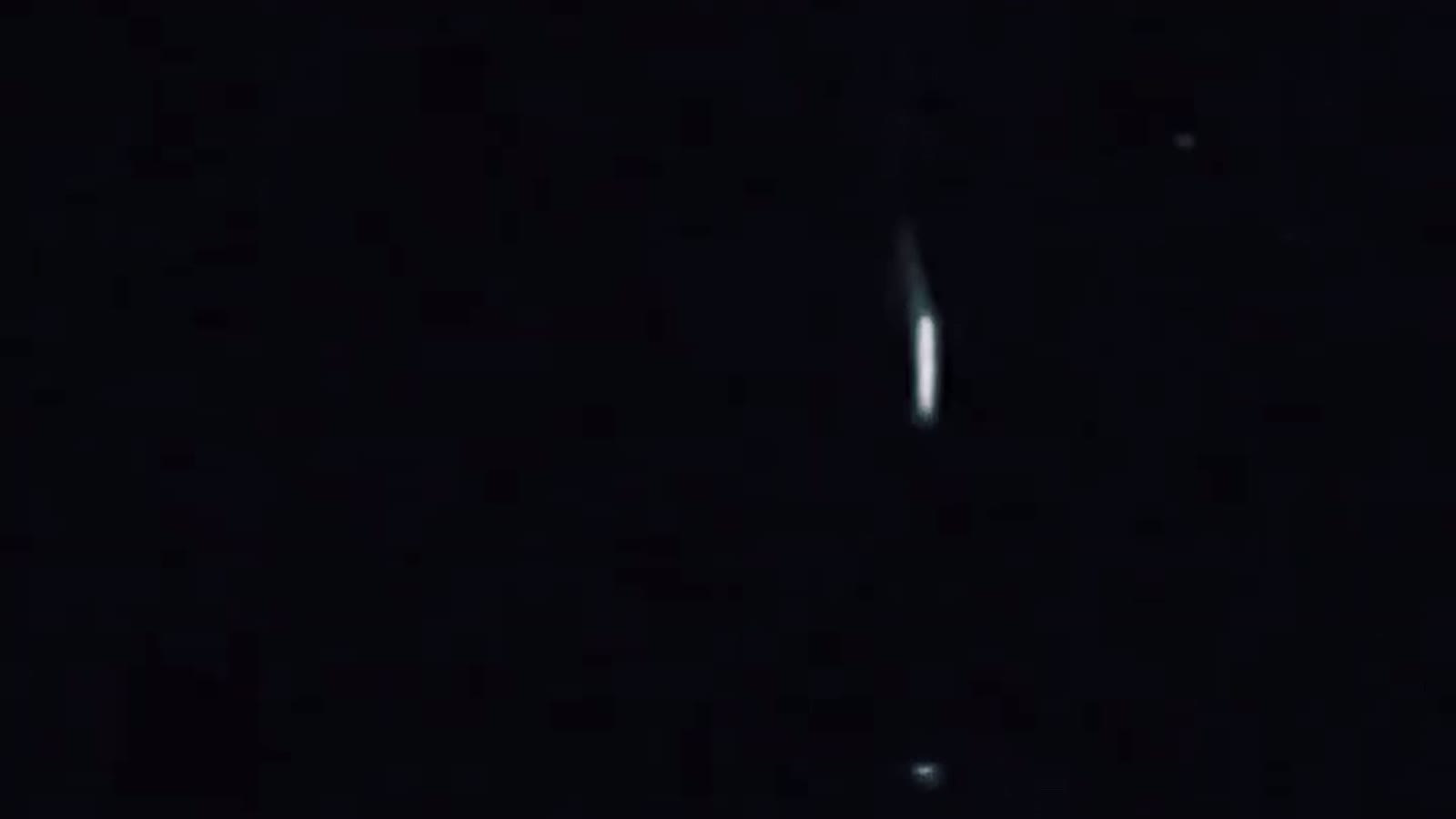
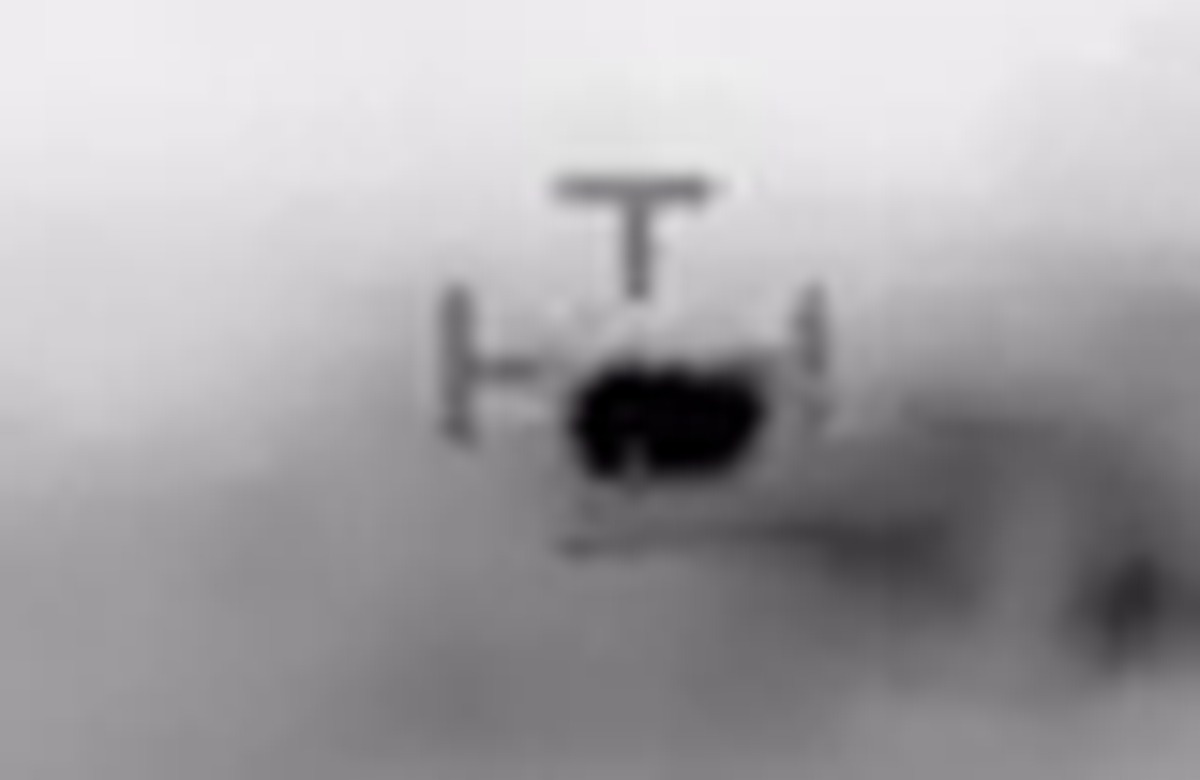
Twice near the end of the recording the object trailed a dense plume behind it, dark in the infrared image, and then moved away from the material it had left hanging in the air. Those two events are what lifted the footage above the ordinary. The camera stopped when the crew had to return to base and the object went behind cloud.
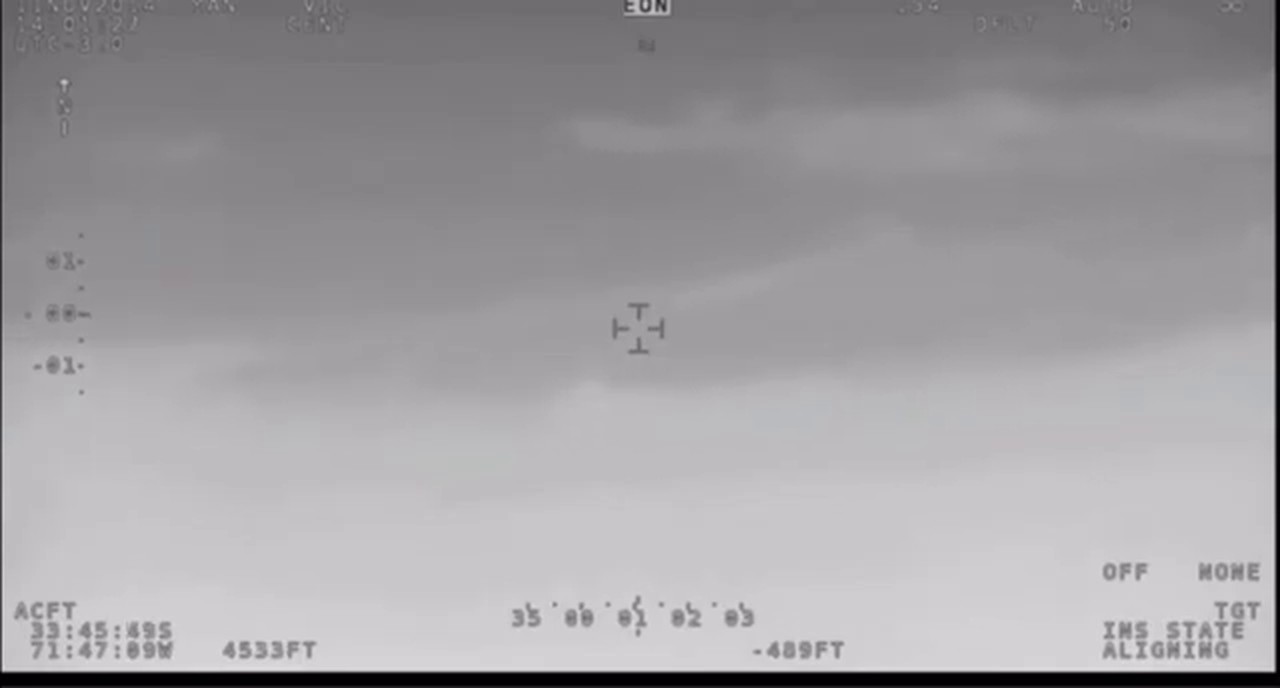
This archive did not take those details on trust from the reporting. The released nine minute video was pulled and the camera on screen display was read directly, frame by frame. It reads 11NOV2014 on a UTC-3.0 time base, with the object first framed at 13:52:53 and the last plume frames at 14:01:51. Aircraft altitude is shown as 4,531 to 4,535 feet throughout, matching the reported 4,500 feet. The aircraft position readout moves from 34:03:38S 71:53:57W early in the sequence to 33:44:57S 71:46:49W at the end, which is a track running north and slightly east up the coast, exactly as described. The mode indicator switches between IR and EOW, confirming the reported changes between the thermal and visible light cameras. The instrument agrees with the witnesses on every checkable point.
One limitation has to be stated plainly. The copy of the video in general circulation, including the copy held here, is a re-encode a few hundred pixels wide. The original release is 1920 by 1088, and the infrared sensor itself is 680 by 512. Fine structure visible in the analyses below was measured on the original, not on the circulating copy, and no claim on this page rests on detail read from the low resolution version.
More footage and images of this sighting
What is the official explanation?
Chile is one of very few countries with a standing government office for this subject, and that office is the reason the footage exists in public at all. The CEFAA, the Committee for the Study of Anomalous Aerial Phenomena, sits inside the DGAC, the Chilean civil aviation authority, which is under the jurisdiction of the Chilean Air Force. It has no research staff of its own. It collects data and puts it to committees of military officers, technicians and academics, and it makes its cases public when it finishes with them.
The Navy handed the footage to CEFAA immediately. General Ricardo Bermudez, the agency director during the investigation, interviewed both officers at their Navy base together with Mario Avila, a nuclear chemist on the CEFAA scientific committee. Both officers also filed written reports. Over the following two years the committee met at least eight times on this one case, on occasion with the serving Air Force general who directs the DGAC, General Victor Villalobos, in attendance. According to Jose Lay, the agency's international affairs director, the tone of those meetings was astonishment rather than agreement.
Written analyses were contributed by the astrophysicist Luis Barrera, an image specialist from the Air Force photogrammetric service, the French analysts Francois Louange and colleagues arranged through the French government agency GEIPAN, the Chilean Air Force meteorologist Luis Salazar, a DGAC aeronautical engineer, a digital imaging specialist from the National Museum of Aeronautics and Space in Santiago, and Avila. Radar records, satellite weather data and air traffic details for the sector were supplied to them.
The committee ruled out a long list of explanations. Meteorologists reported no weather balloons aloft and noted that the wind was from the west, so a balloon would not have tracked with the helicopter. Comparison against infrared satellite imagery with known temperature values led them to state that the object had to be hotter than about 50 degrees Celsius. Drones were excluded on the ground that Chilean drone flights are registered with the DGAC and would appear on radar. A Navy admiral confirmed there were no joint exercises with any foreign country underway. Barrera checked and excluded space debris re-entry, and two independent explosives specialists told CEFAA staff that a pressurised vessel venting at that altitude would have burst and the gas would have flashed. Alberto Vergara, the lead analyst at the Air Force Photogrammetric Department, wrote that the object was a real three dimensional form with volume, that it showed control in its movements, that there was no evidence of hoaxing or of digital alteration, and that it could be classified as an unidentified aerial phenomenon.
General Bermudez summed the result up to the journalist Leslie Kean in a sentence that became the headline of the case: "We do not know what it was, but we do know what it was not." CEFAA released the video through Kean on 5 January 2017 and it has never withdrawn or amended that classification.
One part of the official record deserves more attention than it usually gets. CEFAA did not merely fail to find an aircraft explanation; it commissioned one, received it, and rejected it. The French IPACO team produced its report at CEFAA's request and concluded the object was an airliner. CEFAA declined that conclusion on procedural grounds: an aircraft would have appeared on primary radar, would have needed landing clearance, would probably have answered the radio, and in Chile a pilot must request permission from the DGAC before jettisoning anything. Those are arguments about what an aircraft is supposed to do, not about what the images show.
There is also a straightforward inconsistency in the record that anyone re-examining the case should know about. Kean's reporting describes the sensor as a WESCAM MX-15 forward looking infrared camera. The IPACO report, written for CEFAA, lists the camera as a EUROFLIR 350-3 and gives its specifications. IPACO also states in its own note that the report was prepared with no information at all provided about the infrared camera model and its characteristics. Focal length is the input every angular measurement depends on, so the identity of the camera is not a trivia question, and the public record does not settle it.
What did the witnesses think it was?
Neither officer has been named publicly. Both filed written statements at their base, as Chilean Navy procedure requires, and those statements are the closest thing the case has to primary testimony.
The captain described a "flat, elongated structure" with "two thermal spotlights like discharges that did not coincide with the axel of motion." The technician described it as "white with a semi-oval shape on the horizontal axis." On the plume, the technician wrote that "in two instances it discharged some type of gas or liquid with a high thermal track or signal."
Mario Avila, who sat in on the interviews, told Kean that he was impressed by both men, that they were highly trained professionals with many years of experience, and that they were certain they could not explain what they had seen.
Two things in that testimony are worth separating carefully, because the case has often been argued as though they were the same. The descriptions of shape are descriptions of what the men saw on a thermal display of a distant object, not of a structure seen close up. The captain's phrase about two thermal spotlights that did not line up with the direction of travel is a genuinely specific observation and it is also, on its face, compatible with more than one explanation. What the officers were certain about was that they could not identify it, which is what an unidentified report properly means, and neither man claimed more than that.
The distance estimate of 35 to 40 miles was made by eye. The crew had no ranging on the object, since neither the aircraft's radar nor the camera's tracker would hold it. Every quantitative reconstruction of this case, in both directions, has had to solve for that distance rather than read it.
Is the Chilean Navy UFO Video: CEFAA, the Cougar Helicopter Infrared Footage and Flight IB6830 (11 November 2014) real? The two-pass assessment
Pass one, how this could be ordinary. Two independent technical teams examined the footage and both concluded it showed an aircraft. They disagreed about which aircraft, and that disagreement is the most interesting feature of the case.
The first was IPACO, the French image analysis group, working at CEFAA's request. Antoine Cousyn, Francois Louange and Geoff Quick reported on 26 November 2015. Their method was angular measurement of the separation between the two infrared hot spots across the sequence. They recorded 0.0170 degrees at 13:55:46, 0.0148 at 13:56:38, 0.0135 at 13:57:18, 0.0121 at 13:58:15 and 0.0091 at 14:01:36. Converted to a ratio of distance against the size of the segment joining the hot spots, that runs from 3,368 to 6,319, rising almost perfectly linearly at about 8.4 units per second. Two conclusions follow from that curve alone, independent of what the object was: the distance between helicopter and object nearly doubled during the six minutes of interest, and the object was receding at a constant velocity. Their verdict was that the object was most probably a medium haul twin jet airliner in a landing phase, that the white oval appearance was halation from a sunlit white fuselage, that the plume was either a condensation trail or jettisoned cabin waste water depending on the object's true height, and that a third hot spot visible in a few frames could be an infrared reflection off the fuselage or an auxiliary power unit running before landing. IPACO revised the report on 9 January 2017 after a remark from the American analyst Tim Printy about the object's possible height, adding a section that works the height out trigonometrically from the elevation angle.
The second was an open analysis on the Metabunk forum led by Mick West, with substantial work from contributors posting as Trailblazer and Trailspotter, in the days after the release. They started from flight records and found only two candidate aircraft in that airspace at that time: LA330, a twin engined A320 to La Serena, and IB6830, a four engined Iberia A340 to Madrid. LA330 looked the better fit when the tracks were viewed from overhead. A three dimensional reconstruction reversed that. Using the FlightAware GPS track for IB6830, other examples of the same departure and the published departure charts, West built the route in Google Earth, then matched the camera view against the coastline and mountains visible in the wide shots to fix the camera heading. In that reconstruction IB6830 sits where the object is.
The Metabunk account also explains the details that had made the footage look anomalous. The two blobs are not the size of the object; they are glare, the infrared image of hot engine sections, which bloom far larger than the engines themselves. West demonstrated the effect with candles and a FLIR ONE camera. The banked configuration visible in one motion blurred frame, where the individual engines separate out, matches a four engine layout and matches the point on the track where IB6830 turns north. The plume is an aerodynamic contrail, the kind that forms and stops on a climbing aircraft, and it reads dark for the same reason the other clouds in the frame read dark: the camera is exposing for a very cold sky, so anything warmer than that sky appears dark, and the trail is an ice cloud far warmer than the background. The near static bearing that struck the crew is what the geometry predicts, since the angle between helicopter and aircraft changes only from about 2.93 degrees to about 1.94 degrees across the sequence. The radar failure is explained by the object being much further away and much higher than the crew believed they were looking, and the radio silence by the ordinary practice that the guard frequency is often not selected soon after departure and that a call without a callsign draws no answer.
The strongest test of that identification came from the people arguing against it, and it is the reason this case is filed as disputed rather than left open. Robert Powell, of the Scientific Coalition for UAP Studies and formerly head of the MUFON Science Review Board, was given the radar data by CEFAA through Kean. He verified that the camera clock and the radar clock matched exactly, then measured the camera bearing, given on the video as roughly nine degrees right of the helicopter nose, and measured the bearing to IB6830 on the radar images as about eighteen degrees. On that arithmetic IB6830 was nine degrees too far east to be in the camera field of view at all, and the identification failed.
Then Rob Jeffs, a British programmer working with the same radar images, approached the bearing from the other end. Rather than trusting the camera azimuth readout, he took landscape features from the video, found reference points on the coastline, and derived the absolute bearing of the camera from the geography. That produced a discrepancy of about seven degrees against what the camera was reporting. Adding that correction aligns the camera view with the track of IB6830 along the whole sequence, with the values staying consistent rather than drifting. There is supporting evidence that the camera azimuth was in fact unreliable: the internal compass was not working or not switched on during the recording, and the helicopter's own bearing is not displayed where it should be, so the instrument was not fully configured.
Kean published all of that herself, in a follow up on 17 January 2017, in terms she chose carefully. Of the aircraft explanation she wrote: "It is now becoming clear that this possibility is a legitimate one, and needs to be explored further." She then withdrew from the case and left it to the analysts. That is worth stating plainly, because this archive has repeatedly had to correct pages where a reporter hedge was stripped out downstream. Here the reporter did not hedge and then get overtaken; she published the counter evidence against her own story within twelve days.
Pass two, what survives if it is not an aircraft. The honest residue is smaller than the case's reputation suggests, but it is not nothing. The primary radar record has never been published in full, so the claim that the object was invisible to radar rests on what controllers said at the time rather than on a record anyone outside the investigation has examined. Vergara's photogrammetric finding that the images show no sign of alteration is not in dispute and rules out fabrication. The crew were experienced and their instrument agrees with them on every parameter that can be checked. And CEFAA, having been handed a specific aircraft explanation by analysts it had itself commissioned, rejected it and has never revisited that decision, which means the only official verdict on the record still reads unidentified.
Against that, the aircraft account is specific, quantitative and falsifiable in a way the anomaly account is not. It names a flight number, produces a GPS track, predicts where the object should appear in the frame at any given second, and explains the plume, the two hot spots, the static bearing, the radar and the radio in one mechanism. It survived the one serious geometric objection raised against it, and the correction that rescued it was independently motivated by a documented instrument fault rather than invented to fit. No published analysis has since refuted it with data.
The archive files this as strongly disputed rather than resolved. CEFAA's classification stands unretracted and this site does not treat a government agency verdict as erased by a forum thread, however well argued. But a reader deciding what to believe should know that the specific identification is the only account of this footage that makes testable predictions, that it has been tested, and that the journalist who released the video to the world reported the same thing within a fortnight of releasing it.
Sources
- www.huffpost.com/entry/groundbreaking-ufo-video-just-released-from-chilean_b_586d37bce4b014e7c72ee56b
- www.huffpost.com/entry/the-chilean-navy-ufo-video-is-it-a-plane_b_587e7277e4b06a0baf6490ef
- www.ipaco.fr/ReportChileanNavyCEFAA.pdf
- www.metabunk.org/threads/explained-chilean-navy-ufo-video-aerodynamic-contrails-flight-ib6830.8306/
- www.metabunk.org/threads/recreating-the-missing-section-of-ib6830s-ads-b-track.8320/
- skeptoid.com/episodes/4838
- www.youtube.com/watch?v=1dX4e1xy0EM
More cases from this region: UFO sightings in Chile