The Yukon Giant UFO: Fox Lake, Carmacks and Pelly Crossing, and the Cosmos 2335 Rocket Re-entry (11 December 1996)
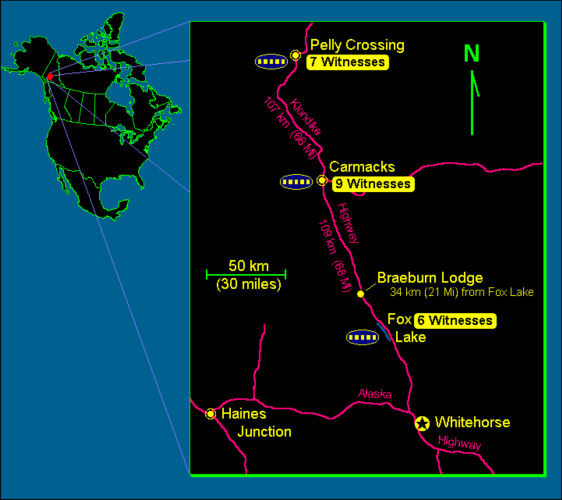
More than thirty people along 216 km of the Klondike Highway watched a silent row of lights cross the northern sky on 11 December 1996, and sixteen years later satellite analysts matched it to a decaying Russian rocket stage
What did witnesses see at Klondike Highway?
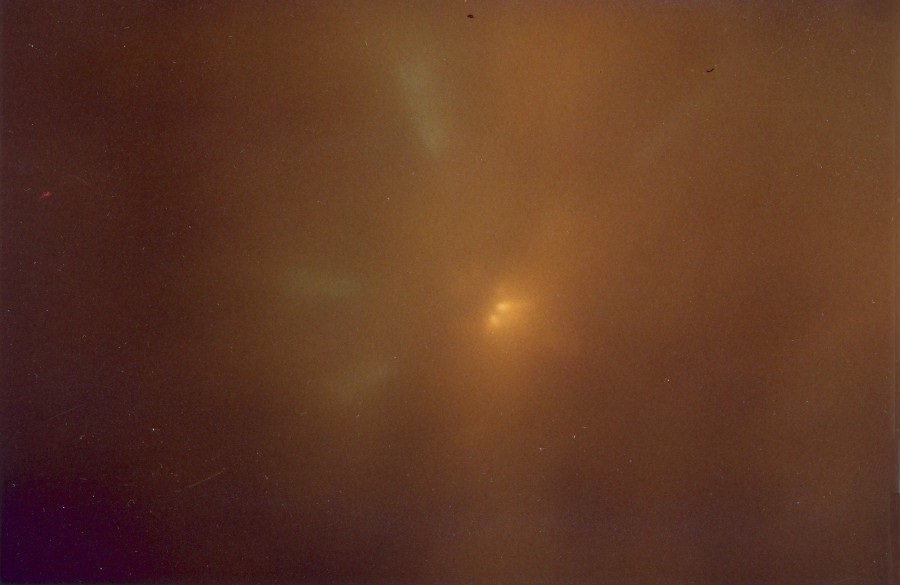
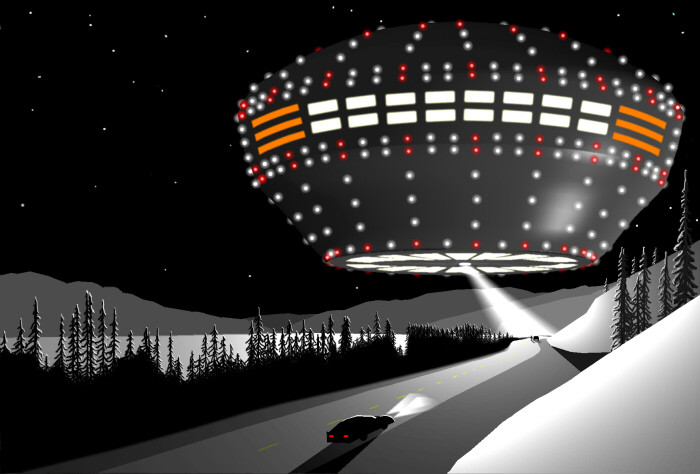
On the evening of 11 December 1996, more than thirty people in Canada's Yukon Territory watched a formation of lights cross the northern sky. The sightings fell into three clusters along a 216 km (134 mile) stretch of the Klondike Highway, at Fox Lake, at the village of Carmacks and at the village of Pelly Crossing, and nearly every account described the same thing, a long row or rows of lights moving slowly and in complete silence.
The case was documented by Martin Jasek, a Whitehorse based engineer with an M.Sc. who investigated for UFO*BC. His report, posted in October 1999 and updated through February 2000, names 22 witnesses in the online version and 31 in the printed 43 page edition, and it is unusually methodical for civilian UFO work. Jasek interviewed 19 of the 22 in person between February and September 1999, obtained drawings from 14 of them, took several back to their vantage points, photographed the scenes with a standard 50 mm lens so that angular sizes would not be distorted, and built maps of every witness position and estimated trajectory.
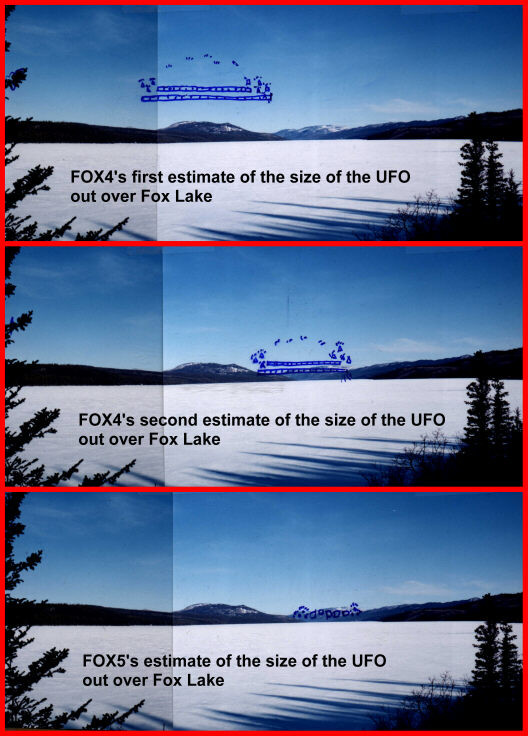
At Fox Lake, six witnesses. Two cousins, coded FOX2 and FOX3, were driving north from Whitehorse to Carmacks in separate vehicles when they saw a large object out over the frozen lake. They stopped 570 metres apart, a distance Jasek later measured on site. FOX2 got out and found himself almost directly beneath the object as it drifted across the highway and away over the hills to the east. FOX3 noted the time at the end of the sighting as 8:30 pm. At the same moment, further south, a couple coded FOX4 and FOX5 were approaching the southern tip of the lake with their two year old son in the back seat and saw a huge row of lights moving slowly over the ice. They first took it for a distant truck, then for a Boeing 747 coming down, then realised it was moving far too slowly for either. FOX5 read the car clock at 8:23 pm. A fifth witness, FOX1, had passed the same stretch about half an hour earlier and seen a light illuminating a long smooth curved surface, then a group of rectangular lights moving behind a hill. A sixth, FOX6, reported a glow on her dashboard, then a large arrangement of coloured lights overhead, with her interior lights dimming and her tape deck slowing down. Several of them stopped at Braeburn Lodge, 34 km further up the highway, and described what they had seen to the owner, Steve Watson. It was Watson who later confirmed the sequence to Jasek and supplied the first additional witness names.
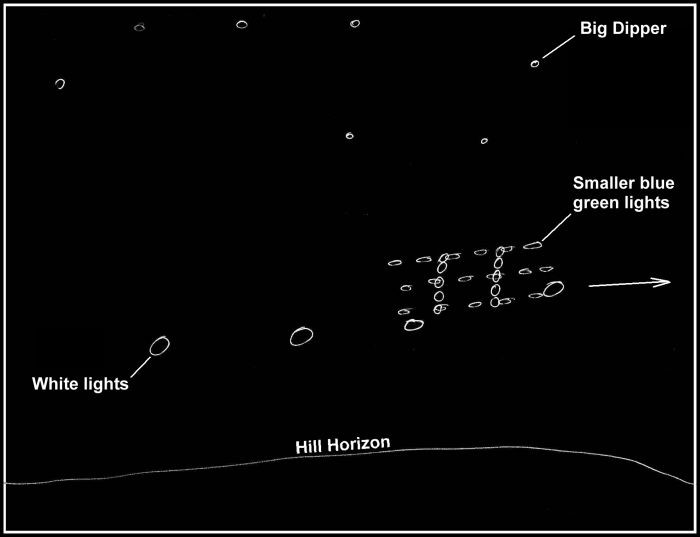
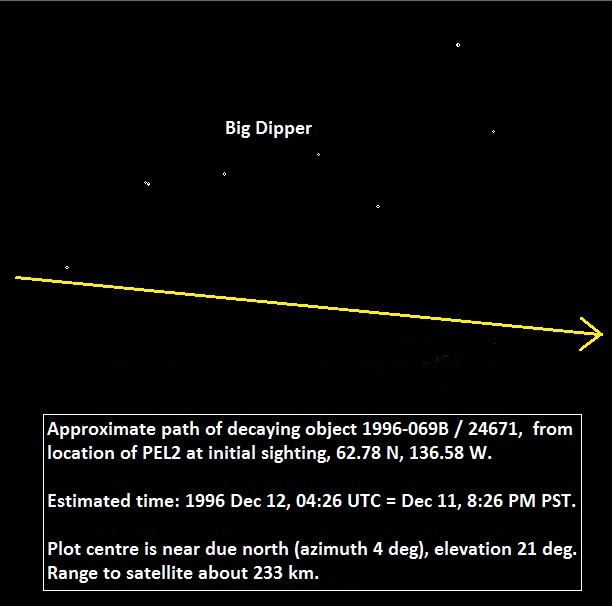
At Pelly Crossing, about two hours north, seven witnesses. A trapper working his line 9 km northeast of the village saw a long row of lights moving over the hills to the southwest. He is the only witness who agreed to be named: Don Trudeau, coded PEL1. Two others, a brother and sister coded PEL2 and PEL3, pulled over at a gravel pit south of the village and watched a row of lights move from left to right. PEL2 made the single most useful observation in the entire case, comparing the length of the row to the width of the Big Dipper, which was just above it. Four women taking an evening course at the local satellite campus of Yukon College, coded PEL4 to PEL7, were out on the front deck on a break and watched the same row of lights move slowly to the north and disappear behind a hill.
At Carmacks, nine witnesses in two groups. Four men driving north in a pickup pulled over near the landfill and watched a silent object come out from behind a mountain to the northwest, curve around to the south and fade out up a valley beside the microwave tower. A family of five saw a row of lights just above the treeline out of their window while watching television. The three children, two weeks before Christmas, thought it was Santa Claus and his reindeer.
Because several groups were watching at the same time from known positions, Jasek was able to run triangulation, which needs at least two vantage points plus an angular size estimate from one of them. He obtained six independent size calculations. Using FOX3's on site arm span estimate of the object's extent when it was over his cousin, 113 degrees at a range of 570 metres, he calculated 1.7 km. FOX4's two estimates marked on panoramic photographs gave 1.8 km and 1.2 km, FOX5's gave 0.88 km, and PEL2's Big Dipper comparison gave 1.2 km and 2.0 km against two candidate trajectories. The same photographic method put the bottom of the object 65 metres above FOX2, which matched FOX3's independent guess of four or five lamppost heights. For scale, Jasek noted that the Toronto SkyDome is 0.21 km at its widest.
More footage and images of this sighting
What is the official explanation?
There was no official investigation. No Canadian military or civil aviation authority examined the case, no government statement was ever issued, and the event drew almost no attention outside the Yukon at the time. Two witnesses were interviewed on the local station CHON FM on 12 December 1996, the day after, and that was the extent of the contemporary record. Jasek only learned of the wider event in 1998, when a Carmacks witness placed an anonymous call to another Yukon investigator, Lorraine Bretlyn, and mentioned that his sighting had happened the same evening as the Fox Lake one he had heard described on the radio.
The identification, when it came, arrived from outside ufology and sixteen years late. In April 2012 the British writer Ian Ridpath asked a group of skeptical researchers whether anyone could account for the case. James Oberg passed the question to Ted Molczan, a Toronto based satellite observer widely regarded as the leading civilian analyst of Earth satellite orbits and re-entries. Molczan posted his answer to the SeeSat-L mailing list on 30 April 2012.
He checked the United States Strategic Command Space Track database for decays on the date in question and found exactly one. The second stage of the Tsiklon-2 rocket that had launched Cosmos 2335 from Baykonur at 12:00 UTC that same day, 11 December 1996, carrying international designation 1996-069B and catalogue number 24671, re-entered over northern Canada that evening. The stage is 9.4 m long, 3 m in diameter and has an empty mass of 3,700 kg. Seven sets of orbital elements exist for it, with epochs running from 16:19 UTC on 11 December to 02:39 UTC on 12 December, and the same seven sets are independently archived in Jonathan McDowell's public element catalogue, which was checked directly for this case file and returns all seven.
Molczan propagated those elements to decay with Alan Pickup's Satana and Satevo programs, which implement the orbital decay work of Desmond King-Hele. The final three elements gave a decay at 04:26 UTC on 12 December, which is 8:26 pm PST on 11 December. Running all ten combinations of the third through seventh element sets produced ten estimates between 03:34 and 05:13 UTC, eight of them between 04:10 and 04:33, with a mean and median of 04:22 UTC, or 8:22 pm PST. Harro Zimmer, a Berlin analyst, then propagated the same elements with an independent special perturbations program and the NRL-MSISE-00 atmosphere model, and put the object at 80 km altitude at 04:25:30 UTC and at 10 km at 04:31:06 UTC. Molczan called the two results nearly identical.
Molczan then computed when the object would have been visible from each witness location. At Fox Lake it rose above 8 degrees elevation at 20:25:29 PST, culminated at 11 degrees at 20:26:09 and set at 20:26:50, a window of 1.4 minutes. At Carmacks the corresponding figures were 20:25:11, 16 degrees, and 20:27:00. At Pelly Crossing, 20:25:05, 22 degrees, and 20:27:07. At Mayo, 20:25:08, 35 degrees, and 20:27:17. The ground track ran west to east, from 63.3 N 147.2 W to 65.1 N 125.7 W across those two minutes, passing 200 to 400 km north of the observers at roughly 90 km altitude. Witnesses at all three documented locations overwhelmingly described motion from west to east, low toward the northern horizon, beginning in the northwest or north and ending in the northeast or east.
Molczan also checked the single best angular measurement in the case. At PEL2's range of about 233 km, her 25 degree Big Dipper comparison corresponds to a real length of about 100 km, which is the scale of a re-entry plasma trail and debris stream. His computed sky path from her position, plotted against the same stars, sits close to where she drew it, though he noted her Big Dipper is drawn roughly horizontal when it was in fact tilted. Robert Sheaffer published the identification in his Psychic Vibrations column in Skeptical Inquirer, volume 36 issue 5, September and October 2012, under the headline that the case was busted.
What did the witnesses think it was?
The witnesses do not come across as people building a story. Only two of the twenty two approached anyone at the time; the rest had to be found, and Jasek records that most were reluctant to talk until assured of anonymity. Twenty of them have never been publicly named.
FOX3 wrote his own account roughly a month after the event, years before any explanation existed to argue with, and its value is that it is timed against ordinary domestic events rather than reconstructed later. He records his cousin knocking at the door around 7:00 pm, leaving at 7:30, stopping at Lake Laberge about 7:50, and arriving at Fox Lake at 8:25 pm, with the sighting in the next five minutes. He describes hanging out of his window as FOX2 drove beneath the object, calls it an astronomical silent presence passing slowly over them, and says plainly that it bothered him afterwards that he could not estimate its size, offering only that it was about as large as a football stadium.
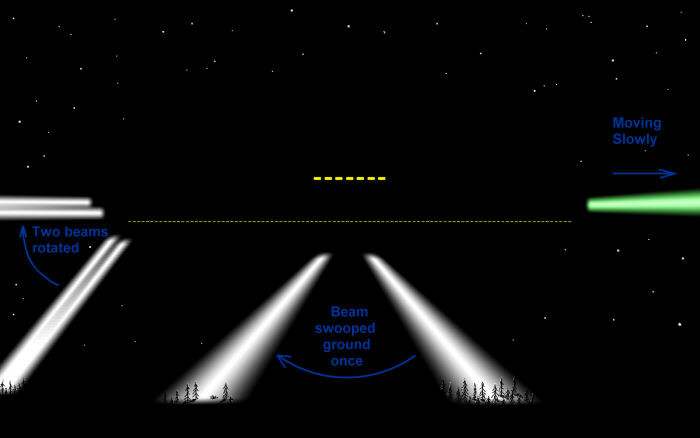
Don Trudeau, the trapper at Pelly Crossing, gave the most extreme account in the case. He was on foot on a dark, moonless, clear night with ice crystals in the air. He first thought the row of lights was a large aircraft going down, then realised it was too slow and silent. His flashlight happened to swing toward it and, as he described it, the object began moving rapidly toward him across the valley; he instinctively cupped the end of the flashlight, and it stopped instantly, hovering an estimated 274 metres in front of him. He said he had to turn his head from side to side to take it all in, estimated it at three quarters of a mile long, and reported about a hundred rectangular lights in a row with seven larger ones above them, all white or slightly yellow. He described a white beam sweeping the ground beneath it once, other beams visible in the ice crystals, and stars blacked out in a large oval area around the lights. He also said he was not frightened.
CRM1 at Carmacks put his own sighting at about 7:00 pm and reached that figure by a specific route: he heard the Fox Lake sighting described on CHON FM the following day and worked out that his had been about an hour and a half earlier. He described three dark orange flashing lights spread wide apart in a horizontal row with a group of smaller white lights to the right, an object taking up roughly 90 degrees of sky, and the odd detail that the truck's loud exhaust seemed to make no noise while it was overhead even though conversation was audible normally.
Jasek addressed the obvious objection himself in a set of questions added to the report in January 2000. Asked why the drawings differ so much, he offered four reasons, that two to three years had passed before most drawings were made, that witnesses at different positions saw different aspects and different distances, that some spent seconds on a sketch and others minutes, and that the object may have shown different lights at different times. Asked how he knew the witnesses were not inventing it, he did not claim proof; he argued from their demeanour, from the fact that twenty of the twenty two had to be sought out, and from the implausibility of a hoax whose participants stopped one after another at the same lodge that night to tell the owner about it.
Among ufologists the case was rated very highly. Michael Swords of the Center for UFO Studies wrote on the NICAP case directory that it might be one of the best cases ever and one he would take into war with him, while noting he did not know Jasek personally. Stanton Friedman called it emblematic of what a good case should be in the documentary Best Evidence: Top 10 UFO Sightings, which ranked it eighth. Jasek's own write up ran as the February 2000 cover story of the MUFON UFO Journal, issue 382.
Is the Yukon Giant UFO: Fox Lake, Carmacks and Pelly Crossing, and the Cosmos 2335 Rocket Re-entry (11 December 1996) real? The two-pass assessment
Pass one, how this could be ordinary. The re-entry identification is the strongest prosaic explanation on any case in this archive, and it should be stated plainly rather than hedged. It is not a guess that something might have re-entered. A specific catalogued object, the Tsiklon-2 second stage 1996-069B, decayed on that date, its orbital elements are public and were checked here in two independent archives, and two analysts using different software and different atmosphere models placed its final descent over the Yukon within seconds of each other.
The times are what make it decisive. Two witnesses checked a clock at the time: FOX5 read her car clock at 8:23 pm and FOX3 noted 8:30 pm at the end of his sighting, and FOX3's own written statement a month later puts his arrival at Fox Lake at 8:25 pm with the sighting immediately after. The computed visibility window at Fox Lake is 8:25:29 to 8:26:50 pm. Those clock readings were recorded in 1996 and 1999, more than a decade before anyone proposed a satellite, so they cannot have been fitted to it. The direction agrees too, west to east, low in the north, which is what the ground track requires and what nearly every witness described. So does the geometry of who saw it: all six of the sightings made from moving vehicles were made while driving north, toward a trajectory lying 200 to 400 km to the north, and none were made while driving south.
Three of the reported anomalies also become expected rather than strange. A row or several rows of separate lights is what a rocket body breaking up produces, because a re-entering stage orients itself heavy end forward and sheds debris that trails behind it, and Zimmer's altitude profile puts the final break-up between 75 and 80 km at about the moment the object came into view from the Yukon. Silence is expected at a slant range of 145 miles. And the size estimates carry no weight at all on their own, because triangulation only works if the witnesses were looking at the same object at the same moment and the angular estimates are sound; run against a debris trail 233 km away, PEL2's 25 degrees gives about 100 km of glowing trail, which is an ordinary length for one.
Pass two, what survives. Three things are not accounted for, and the honest position is to name them rather than absorb them.
The first is the time spread. The computed event lasts under two minutes at any location. FOX1's sighting is placed at 7:45 to 8:15 pm, a half hour or more before the window, and it is a different observation, a light illuminating a long curved surface rather than a row of lights. CRM1 puts Carmacks at about 7:00 pm and derives that figure from a radio broadcast rather than from memory alone. Molczan acknowledged that reported durations, between 30 seconds and five to ten minutes with a median of four, run two to five times longer than the decay was visible, and attributed that to the known unreliability of after the fact duration estimates. That is a reasonable argument and it may well be right, but it is an argument about witness error, not a measurement.
The second is Don Trudeau's account, which does not resemble a re-entry in any respect that matters. A decaying rocket stage does not stop, does not hover, does not respond to a flashlight, does not project a beam that sweeps the ground and then remain in place. Sheaffer's answer is direct: the reaction was in the observer's imagination and the object was 233 km away. That is a coherent position and it may be correct, but it converts the single most detailed testimony in the case into pure confabulation, and it is worth saying that this is a claim about the witness rather than a finding about the sky.
The third is the reported electrical effects, FOX6's dimming interior lights and slowing tape deck and CRM1's silenced exhaust. These are unverifiable and were reported years after the fact, and they are also a recurring motif in UFO testimony generally, which cuts both ways.
This archive tiers the case Strongly Disputed rather than Discredited. The identification is method shown, comes from named analysts with public working, rests on primary orbital data that anyone can re-check, and matches the two clock checked times almost exactly. Against that, Jasek's investigation was careful and honest, he never retracted it, the witnesses were sought out rather than self selected, and at least one detailed account has no re-entry reading at all. What is not in dispute is that something real crossed that sky, that a great many people saw it, and that this is one of the clearest demonstrations on record of how far a genuine stimulus and a sincere description of it can diverge.
Sources
- www.ufobc.ca/yukon/22index.htm
- www.ufobc.ca/yukon/22eventsum.htm
- www.ufobc.ca/yukon/22ufosize.htm
- www.ufobc.ca/yukon/22witnesstable.htm
- www.ufobc.ca/yukon/22faqs.htm
- www.ufobc.ca/yukon/22pel1.htm
- www.ufobc.ca/yukon/22fox3.htm
- satobs.org/seesat/Apr-2012/0331.html
- satobs.org/seesat/May-2012/0015.html
- satobs.org/seesat/May-2012/0022.html
- skepticalinquirer.org/wp-content/uploads/sites/29/2012/09/p22.pdf
- planet4589.org/space/elements/24600/S24671
- www.nicap.org/961211yukondir.htm
- www.nicap.org/articles/MUJ_GiantUFOYukon.pdf
More cases from this region: UFO sightings in Canada