The Coast Guard UFO Photograph
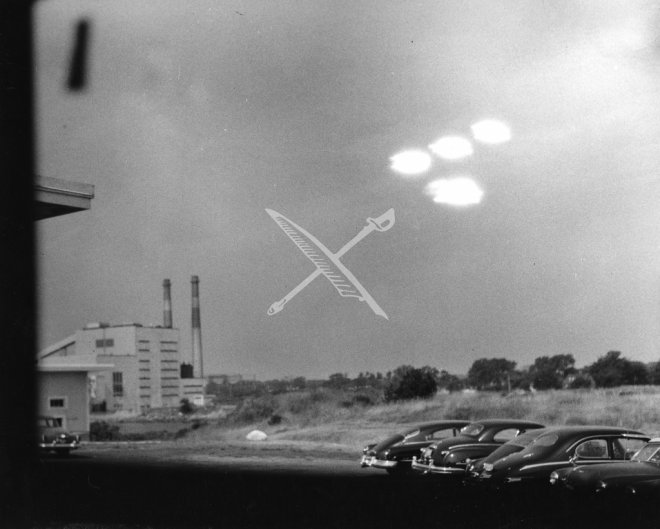
On the morning of 16 July 1952, around 9:35 a.m., Seaman Shell R. Alpert was on duty in the photographic laboratory of the U.S. Coast Guard Air Station at Salem, Massachusetts. This case file covers what witnesses reported, the official narrative, and a two-pass assessment with its evidence tier.
What did witnesses see at U.S. Coast Guard Air Station?
On the morning of 16 July 1952, around 9:35 a.m., Seaman Shell R. Alpert was on duty in the photographic laboratory of the U.S. Coast Guard Air Station at Salem, Massachusetts. By his own account he was sitting with his back to the window, filing negatives, when something bright outside caught his eye. "I was sitting in the photo office filing negatives with my back toward the window when I turned slightly in the direction of the window and noticed something bright outside," he said. What he saw was a cluster of brilliant lights low in the sky, off to the right of the power-plant smokestacks that stood across the lot from the lab.
Alpert watched the lights for several seconds. They wavered and dimmed, then brightened again. He called to another Coast Guardsman nearby, Hospitalman Thomas E. Flaherty, who came over from the sick bay and also saw the lights in the sky. Alpert grabbed a 4x5 press camera that was sitting on a nearby table loaded with Super XX cut film, and when the lights flared bright once more he made a single exposure through the laboratory window, which carried an insect screen. After a momentary flash the lights faded and were gone.
The resulting black-and-white photograph shows four roughly elliptical blobs of light strung across the upper sky in a loose, gently curving line. The foreground is unmistakably a working Coast Guard station: a multi-story building with two tall smokestacks at the left, an open lot, a row of parked late-1940s and early-1950s automobiles along the bottom edge of the frame, and the dark interior of the photo lab framing the left side where the window opening cuts the picture. The four lights sit well above the rooftops and the horizon. Two men, Alpert and Flaherty, watched the objects with the naked eye before the shutter was tripped, and both were Coast Guard personnel on station at the time.
What is the official explanation?
The Coast Guard treated the photograph as significant from the first day. A print was flown to Coast Guard Headquarters in Washington and then forwarded to Wright-Patterson Air Force Base in Ohio, the home of the Air Force's UFO investigation, then less than five months old and run under the name Project Blue Book by Captain Edward J. Ruppelt. The case entered the Blue Book files. The cover sheet that survives with the photograph in the declassified record at the National Archives is a simple chronology card: "Chron. 24-185-1-35 X, July 16, 1952, Salem, Massachusetts, 1 Photo." The photograph itself is the second page of that file. Researchers commonly cite the case as Blue Book serial 1501, held in Record Group 341 at the National Archives and Records Administration.
Blue Book's analysts worked the image more than once and changed their minds. An early evaluation leaned toward the photograph being a double exposure, in effect a darkroom hoax or accident. A later evaluation dropped that and proposed instead that the four blobs were reflections of interior lights, or of street lamps, bouncing off the window glass through which Alpert had shot. Neither explanation was ever demonstrated for this specific frame. In the end the Air Force did not stand behind either one. The case was carried in the Blue Book record as unidentified, the category the project reserved for sightings that survived analysis without a settled prosaic cause.
The photograph passed into the official visual record of the event. The U.S. Naval Institute photo archive holds a print captioned "Four UFO's sighted above the Salem, Massachusetts Coast Guard Air Station on July 16, 1952. Photo by Seaman Shell R. Alpert. Also present was Hospitalman Thomas E. Flaherty." The Library of Congress catalogs the same image under the title "First daylight photo of - what are they?" dated July 16, 1952, a phrase lifted from the wire-service caption that carried the picture into newspapers during the saucer wave of that summer. The image ran repeatedly in the Salem Evening News in the years that followed.
What did the witnesses think it was?
Seaman Shell R. Alpert (photographer) and Hospitalman Thomas E. Flaherty (corroborating witness), both U.S. Coast Guard, Air Station Salem
Is the Coast Guard UFO Photograph real? The two-pass assessment
Pass one, the ordinary explanations. The Air Force itself supplied the two leading ones, and the strongest skeptical reading of the picture follows them. The first is a double exposure: two frames laid over one another in the camera or the darkroom, which could in principle drop bright shapes into an otherwise normal scene. The second, which Blue Book preferred later, is reflection: Alpert shot through a window, and interior lights or exterior lamps glinting off the glass can produce soft, out-of-focus bright blobs that float above the real scene. The four lights do sit in a loose row, which is the kind of pattern a row of ceiling fixtures or lamps could throw back at a camera. Donald Menzel, the Harvard astronomer who was the era's most prominent saucer skeptic, argued in general that reflections and refractions could account for most photographic saucers, and the reflection reading of Salem fits that template exactly. Any honest file has to put this front and center.
But fit is not proof, and here the prosaic case never closed. The double-exposure idea was raised and then abandoned by the same analysts who raised it. The reflection idea was never demonstrated for this frame by anyone, official or independent. No one reproduced the four blobs by shooting Alpert's window under matched conditions, no one identified the specific lamps or fixtures that supposedly reflected, and no one produced a method-shown reconstruction of the image. It remained an assertion. Crucially, two witnesses reported watching the lights in the open sky with the naked eye before the photograph was taken, which a pure in-glass reflection does not explain, and the photographer was a darkroom professional, which weakens the accidental double-exposure story. There is no confession, no recovered hoax apparatus, and no positive identification of a real-world object, balloon, aircraft, or lamp that this picture actually shows.
Pass two, if the lights were real. Then Salem is one of the very few daylight photographs from the explosive 1952 wave taken by a trained military photographer, on a military base, witnessed by a second serviceman, and processed through official channels within hours. The objects would be four self-luminous things, bright enough to register in daylight, that hovered and pulsed in brightness over a Coast Guard station for several seconds and then vanished. The Air Force, having tried two debunks and dropped both, filed it as unidentified.
The material is authenticated and officially documented, and the object in it was left unexplained by the very body whose mandate was to explain it. The counter-explanations on record are weak, partial, and were not sustained even by the agency that floated them. That puts the case in Verified Unexplained. The photograph is real, its provenance is clean and governmental, and after seventy years no one has shown what the four lights were.
Sources
- photos.usni.org/content/1083864jpg
- www.loc.gov/item/2007680837/
- ufologie.patrickgross.org/htm/bluebookpics1501.htm
- www.openminds.tv/coast-guard-ufo-photo-from-1952-video/22112
- theufodatabase.com/incidents/1952-salem-ufo-photo
- saucerco.com/blogs/saucer-encounters/the-salem-ufo
More cases from this region: UFO sightings in United States