The Florida Scoutmaster Encounter
On the night of 19 August 1952, a Boy Scout troop meeting at a church near West Palm Beach, Florida broke up early, and the scoutmaster, thirty year old D.S. "Sonny" DesVergers of Troop 33, offered four boys a ride home. This case file covers what witnesses reported, the official narrative, and a two-pass assessment with its evidence tier.
What did witnesses see at Military Trail?
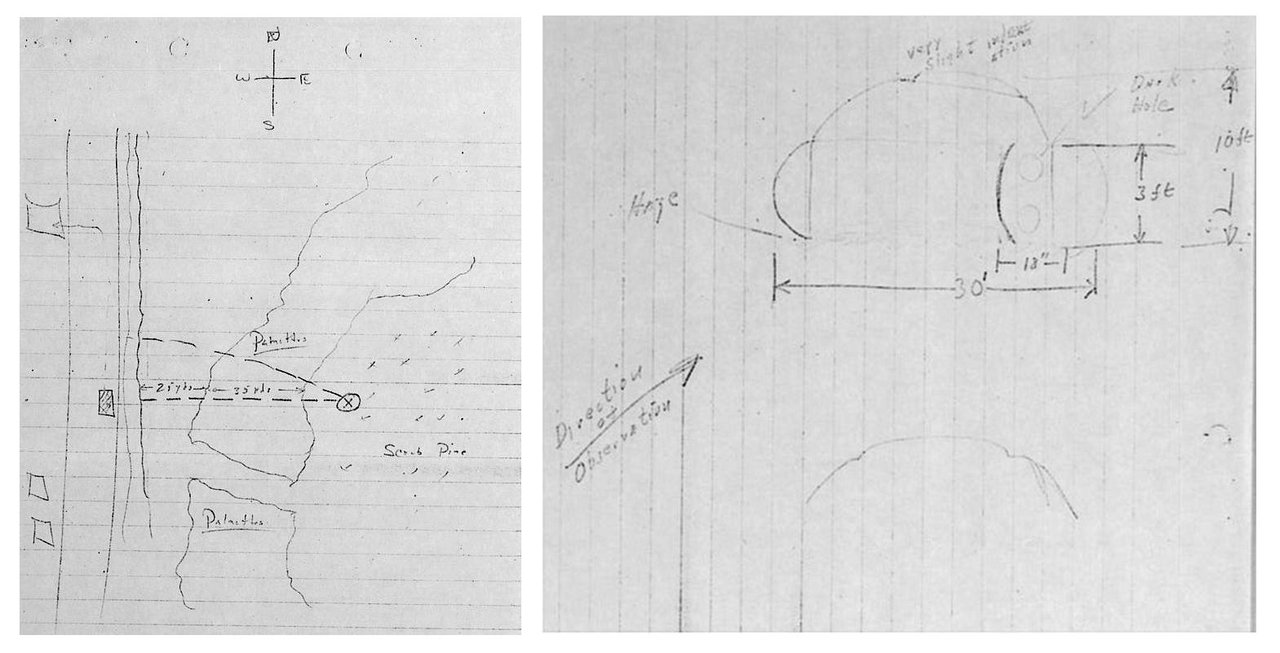
On the night of 19 August 1952, a Boy Scout troop meeting at a church near West Palm Beach, Florida broke up early, and the scoutmaster, thirty year old D.S. "Sonny" DesVergers of Troop 33, offered four boys a ride home. After dropping one boy off and detouring to look at a flooded stock car track, DesVergers was driving south on Military Trail, a blacktop road about ten miles inland from the coastal highway, through sparse scrub pine and palmetto. He told investigators he noticed a light off to his left in the pines, slowed, and asked the boys if they had seen it. On a second pass all three boys saw the lights too, so he stopped and parked opposite where the glow had appeared.
DesVergers said the lights looked like an airplane crashing into the woods, and that as a scoutmaster his conscience would not let him drive on without checking. A fifteen minute radio program had just started, so he told the boys that if he was not back by the time it ended they should run to a farmhouse they had passed and get help. He set off into the brush wearing a faded denim billed cap and carrying a machete and two flashlights, one a spare in his back pocket. About fifty yards in he hit a waist high palmetto thicket and pushed through it, checking the north star to keep heading east.
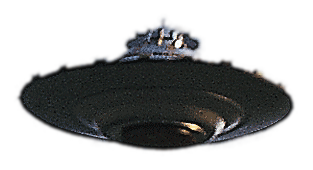
After roughly thirty more yards he became aware of a faint sharp or pungent odor and a slight warmth, "like walking by a brick building in the evening after the sun has set." Stepping into a clearing, the heat became, in his words, "oppressively moist, making it hard to breathe." He got the feeling of being watched, looked up for the north star, and found almost the whole sky blanked out by a large dark shape about thirty feet above him. Backing out from under it, he shone his light up and got a quick look: a circular object, slightly concave on the bottom, smooth and grayish like a "gray linoleum topped desk," with a dome or turret on top and a thick rim carrying vanes spaced about every foot "like buckets on a turbine wheel," with a small nozzle like opening between each. He felt a surge of fury and an urge to strike at it with the machete. Then he heard a sound "like the opening of a well oiled safe door," saw a small ball of red fire drift toward him and expand into a red mist, dropped his light and machete, threw his arms over his face, and passed out.
The three boys in the car, Bobby Ruffing (12), Charles "Chuck" Stevens (11) and David Rowan (11), had watched the scoutmaster's flashlight bobbing through the trees. They said they saw him stop at the clearing, shine his light up, and then a big red ball of fire engulfed him and he fell. They bolted down the road to the farmhouse. The farmer phoned the Florida State Highway Patrol, which relayed the alarm to the sheriff's office, and Deputy Sheriff Mott N. Partin and Lake Worth constable Louis Carroll arrived within minutes. DesVergers, who had come to leaning against a tree on wet grass with no idea how long he had been out, ran toward their headlights. Partin later said that in all his years in law enforcement he had never seen anyone as terrified. Back at the spot the officers found one flashlight still burning in a clump of grass beside a flattened patch where someone had been lying. The second flashlight was gone and was never recovered. On the drive to town DesVergers noticed his arms and face stinging, and at the sheriff's office his arms, face and cap were found to be burned.
What is the official explanation?
The case fell to Project Blue Book, the Air Force's UFO investigation at Wright-Patterson, and it was worked personally by the project's director, Captain Edward J. Ruppelt. An "operational immediate" wire from a Florida air base reached Ruppelt on the morning of 20 August, calling the scoutmaster a "solid citizen" and reporting that he had been burned. Ruppelt flew down the same day in an Air Force B-25 with his assistant, Second Lieutenant Robert M. Olsson, and pilots Captain Bill Hoey and Captain David Douglas, calling it "one of the weirdest UFO reports that I came up against."
Ruppelt's own account in The Report on Unidentified Flying Objects (1956), chapter thirteen, "Hoax or Horror?", is the fullest official record. His team interviewed DesVergers and ran a deliberate test: six listeners each picked an insignificant detail and requestioned him afterward, on the theory that a liar will either repeat invented details perfectly or forget them. Ruppelt wrote, "He passed the test with flying colors. His story sounded good to all of us." The flight surgeon who examined DesVergers found only minor burns on the arms and backs of the hands, possible burning inside the nostrils, and singed hair indicating a flash heat, the degree "compared to a light sunburn." Crucially, the surgeon added that the burns "could have even been done with a cigarette lighter, and he took his lighter and singed a small area of his arm to demonstrate," and he urged Ruppelt to check the man's Marine records because "something didn't ring true."
The investigators combed the clearing with a Geiger counter and inch by inch for spent matches, flare drippings or fireworks residue, and found nothing; the grass blades directly under where the object had hovered were not burned and the trees showed no lightning strike. The machete was sent to the Wright-Patterson materials lab and came back "a plain, unmagnetized, unradioactive, unheated, common, everyday knife." The cap went to a laboratory in Washington, which found the scorch pattern showed the hat was flat when scorched and that small holes the field team had missed "had very probably been made by an electrical spark." Ruppelt admitted plainly, "To be very honest, we were trying to prove that this was a hoax, but were having absolutely no success."
The turn came from two directions. A deputy doing his own checking told Ruppelt that DesVergers had been "booted out of the Marines after a few months for being AWOL and stealing an automobile, and had spent some time in a federal reformatory in Chillicothe, Ohio." Meanwhile a front page newspaper story had DesVergers claiming "high brass" from Washington had grilled him (there was none, only four captains, a lieutenant and a sergeant) and saying he knew what he had seen but could not tell because "it would create a national panic," and he had hired a press agent. On a second trip, made between hurricanes, Olsson and Ruppelt heard "story after story about the man's aptitude for dreaming up tall tales," and a nighttime reenactment under matching light showed that "not even by standing on top of the car could you see a person silhouetted in the clearing where the scoutmaster supposedly fell." On those grounds Ruppelt wrote, "we wrote off the incident as a hoax. The best hoax in UFO history." The team considered a polygraph but experts advised against it for this type of case. Yet Ruppelt was candid that the verdict was unproven: "we didn't make step one in proving the incident to be a hoax. We thought up dozens of ways that the man could have set up the hoax but couldn't prove one."
What did the witnesses think it was?
DesVergers maintained that he had been physically attacked by the object, and his demeanor convinced the first responders. Deputy Mott Partin described him as more terrified than anyone he had encountered in his career, and DesVergers kept asking the investigators, "What did I see?", apparently believing the Air Force knew. He had no military aviation career to protect and at the time was working as a hardware store clerk, having previously been an auto mechanic, a turpentine plant worker and a failed gas station owner. The following year he sold his version of the story to the American Weekly, which his critics treated as proof of a money motive.
The three scouts corroborated the core of the event. They independently described the lights in the pines and the red ball of fire that engulfed their leader, and the few facts they blurted to the farmer and his wife before they could have coordinated with DesVergers matched his account. Ruppelt was firm that the boys were not knowing accomplices: "None of us ever believed the boy scouts were in on the hoax. They were undoubtedly so impressed by the story that they imagined a few things they didn't actually see." When re-interviewed weeks later at a scout meeting, the boys still described seeing their scoutmaster knocked down by fire, though they were "not as positive of details as they had been previously."
Among later researchers, retired Army intelligence officer and author Kevin Randle examined the file in detail and reached a split verdict. He catalogs DesVergers' demonstrable lies, including a fabricated war record and a claim to have been a "PFC test pilot," a rank that does not exist, and notes the AWOL discharge and auto theft, and he accepts that the reenactment undercuts the boys' line of sight. Randle wrote that he "would be enthusiastic in labeling this case a hoax if not for one thing," the charred grass roots, which no one has explained. The physical trace researcher Jeffrey Wilson of the Independent Crop Circle Researchers' Association has said the subsurface root charring with undamaged blades is "the only recorded example" of its kind he is aware of.
The dispute
The dispute is the Air Force's own conclusion, advanced by Project Blue Book director Edward Ruppelt, that the encounter was a hoax staged by DesVergers, "the best hoax in UFO history." The evidence behind it is real and serious. DesVergers had a documented criminal and disciplinary record (AWOL discharge from the Marines, automobile theft, time in the federal reformatory at Chillicothe, Ohio), a local reputation for inventing tall tales that Olsson and Ruppelt heard repeated by many acquaintances on their second trip, and post event behavior that looked mercenary and self dramatizing: a false claim that "high brass" had interrogated him, a "national panic" cover story, a hired press agent, and a paid magazine account the following year. Kevin Randle, reviewing the file decades later, adds that DesVergers fabricated a war record and claimed a nonexistent rank of "PFC test pilot," further undermining his credibility.
The single most damaging technical point is the reenactment. Standing where the boys' car was parked, and even standing on top of the car, under matching light the investigators found you could not see a person silhouetted in the clearing where DesVergers said he fell. That removes the scouts as independent eyewitnesses to the central event and recasts their "big red ball of fire" as excitement and suggestion. Ruppelt was explicit that the boys were not accomplices but had "imagined a few things they didn't actually see." The burns, the other apparent corroboration, were dismissed when the flight surgeon reproduced equivalent singeing on his own arm with a cigarette lighter.
What keeps this in the "barely" tier rather than "strongly" is that the hoax verdict was never demonstrated, only inferred, and two pieces of physical evidence were never explained. Ruppelt himself wrote that his team "didn't make step one in proving the incident to be a hoax" and could only "think up dozens of ways" it might have been staged without proving any of them. The burned holes in the cap were attributed by a lab to an electrical spark, and the grass roots were found charred beneath undamaged blades in undisturbed soil, an effect the lab could reproduce only by heating soil to roughly 300 degrees Fahrenheit and could not explain happening in an open field without heavy equipment that left no trace. There is no confession, no recovered hoax apparatus, and no positive identification of a specific staged mechanism or natural cause for those traces. An official assertion of hoax plus a plausible but unproven reconstruction is a strong dispute of the story, but it does not meet the bar of a confession, a recantation, recovered props or a positive identification, so the case is logged as Barely Disputed and largely standing on its unexplained physical residue.
Is the Florida Scoutmaster Encounter real? The two-pass assessment
Pass one, the ordinary readings. The mundane case here is unusually strong on the human side. DesVergers was not a disinterested witness: he had a documented record of being discharged from the Marines for going AWOL and stealing a car, time in a federal reformatory, a local reputation for tall tales ("If he told me the sun was shining, I'd look up to make sure," one man told Ruppelt), and within days he was claiming a national panic cover up, hiring a press agent and, the next year, selling the story to a magazine. The burns were trivial and the flight surgeon reproduced comparable singeing on his own arm with a cigarette lighter. The nighttime reenactment showed the boys could not actually have seen a man fall in that clearing, which means their "red ball of fire" was very likely suggestion and excitement rather than direct sight. The lights and odd glows in the area were run down to prosaic causes, a farmer arc-welding at night and aircraft landing lights. On character and circumstance, a staged event is entirely plausible, and the Air Force, having tried hard to prove exactly that, formally logged it as a hoax.
Pass two, if the core trace is real. Even after building that case against the man, Ruppelt conceded his team "didn't make step one in proving the incident to be a hoax." Two physical items resisted every test and stayed, in his words, "in the scoutmaster's favor." The small holes in the cap were judged by a Washington lab to have "very probably been made by an electrical spark." More stubbornly, an agronomy lab found the grass roots charred while the blades above were undamaged, duplicated the effect only by heating soil to about 300 degrees Fahrenheit over a burner, and could not say how it was done in an open field without big equipment and disturbed ground that simply were not there. Ruppelt could only float induction heating from an unknown source as speculation he himself did not believe. If those traces are genuine and uncontaminated, no shown hoax method accounts for them, and the encounter remains a real physical event of unknown cause.
The two passes leave a case that is contested but not closed. There is an official hoax verdict and a genuinely impeached witness, which is why this is not Verified Unexplained. But the verdict is an admitted assertion without a demonstrated method: nobody ever showed how DesVergers, or anyone, produced charred roots under undamaged grass or spark holes in a cap, there is no confession, no recovered props and no identification of a specific real world object or cause. Under the tiering rules a plausible but unproven hoax reconstruction and an official finding without a shown method are Barely Disputed, not Strongly Disputed. The dispute is logged honestly and the physical anomalies are logged honestly alongside it. Tier: Barely Disputed.
Sources
- web.archive.org/web/20260714125341/https://www.gutenberg.org/ebooks/17346
- www.history.com/articles/ufo-encounter-florida-desvergers-scoutmaster-burned
- www.saturdaynightuforia.com/html/articles/articlehtml/thescoutmasterstale.html
- kevinrandle.blogspot.com/2019/02/project-blue-book-episode-seven-sonny.html
- exonews.org/this-scoutmaster-had-a-run-in-with-a-ufo-the-kids-saw-it-too/
More cases from this region: UFO sightings in United States