The Puerto Maldonado Smoking Saucer
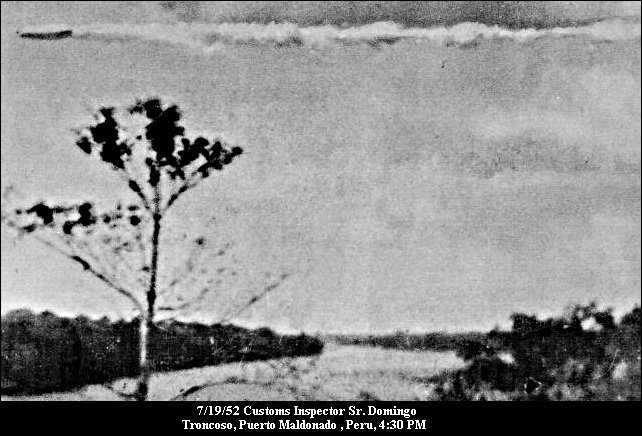
On the afternoon of 19 July, around 4:30 PM, in the Madre de Dios jungle region of southeastern Peru near the frontier town of Puerto Maldonado, a customs inspector named Domingo Troncoso photographed a long, cigar shaped or dirigible shaped object crossing the sky over the river plain. This case file covers what witnesses reported, the official narrative, and a two-pass assessment with its evidence tier.
What did witnesses see at Puerto Maldonado?
On the afternoon of 19 July, around 4:30 PM, in the Madre de Dios jungle region of southeastern Peru near the frontier town of Puerto Maldonado, a customs inspector named Domingo Troncoso photographed a long, cigar shaped or dirigible shaped object crossing the sky over the river plain. The object flew horizontally and fairly low, moving from the witness's right to left, and it trailed a dense ribbon of thick white smoke or vapor behind it. Troncoso reached for a camera and got one frame before the thing moved off into the distance. The single surviving photograph shows exactly that, a thin dark streak with a heavy contrail strung across an open sky above scrubland and a river, with a bare tree in the foreground.
The other half of the account comes from a farm in the same Madre de Dios district. The agricultural engineer Pedro Bardi Zena, the farm owner Pedro Arellano, and others present said they saw a round object going by at high speed, which Bardi judged to be a little smaller than a DC-3 and flying at roughly 100 meters. Bardi said it made a buzzing sound as it passed. Just before the sighting, by Bardi's account, the radio they were using to talk to Lima went dead. The estimate that the object was over a hundred feet long, and the often repeated figure of about 1,100 miles per hour, both come from this combined testimony: witnesses reported the same object passing a point roughly 120 kilometers away only about four minutes later, and the speed was computed from that gap. James Moseley, who collected the story, put the figure at 1,117 miles per hour.
There is also an angel hair element. Witnesses said that when the smoke trail eventually drifted down it settled into a mass of thin fibrous threads on the ground, the gossamer filament that has shown up around many cigar and smoke trail sightings of the early 1950s and that tends to evaporate before anyone can keep a sample. The trail itself was said to hang in the air for more than fifteen minutes after the object had gone.
What is the official explanation?
The case entered the official record through United States Air Force channels rather than a Peruvian public inquiry. The Peruvian Air Force passed the matter to the American Air Attache in Lima, Col. McHenry Hamilton Jr., who filed an Air Intelligence Information Report that was folded into the Project Blue Book file. That file dates the photograph to July 1951, not the 1952 that later became the popular date.
Hamilton's report is the source of the central counter claim. It records that the Peruvian Air Force spoke of a total of three photographs, supposedly taken by three different individuals, and that the Peruvian service's opinion was that the affair was "a fairly clever attempt at trick photography" done for "commercial reasons." In other words the official line, relayed secondhand by the attache, was that this was a press or commercial hoax rather than a real object. That is as far as the documentation goes. The report names no analyst, describes no examination of the negative, and shows no method by which the trick was supposedly produced. Crucially, the two additional photographs that the Peruvian Air Force cited as proof of a coordinated stunt were never located or published, and the single Troncoso frame is the only image anyone has ever actually seen.
This is an official-apparatus assessment of the kind the early UFO bureaucracy produced routinely, an opinion forwarded up the chain that closes a file without showing its work. It tells us the case was taken seriously enough to be reported by a foreign air force to a US attache and logged by Blue Book, and it records a debunking claim, but it does not itself demonstrate a hoax. No civilian, method-shown technical analysis of the photograph has ever been published that identifies the object, recovers the props, or reconstructs the trick.
What did the witnesses think it was?
Domingo Troncoso, the customs inspector at Puerto Maldonado, is credited with the surviving photograph and said he took it as the object flew past the port. He was a government official on duty at a remote frontier customs post, not a known UFO promoter, and his single image is the durable artifact of the case.
The man who carried the story to the wider world was Pedro Bardi Zena. By James Moseley's own account, Moseley was in Peru in May 1954 on a treasure hunting trip when Bardi, hearing of his interest in flying saucers, sought him out in Lima and presented both the story and the photograph. Bardi described the farm sighting in the first person, the round fast object a little smaller than a DC-3, the buzzing sound, and the radio that went dead, and he placed himself and the farm owner Pedro Arellano among the witnesses. Moseley first published the picture and the account in his magazine Nexus, retitled Saucer News, in April 1955.
Moseley's own verdict matters because he is the closest thing this case has to a hands-on investigator and he was not credulous about it. He wrote that "it seems obvious to me that the photo is genuine," meaning he saw no sign of fakery in the image itself, while adding that he strongly doubted the object was anything but earth-made. So the chief civilian witness chain treated the photograph as a real picture of a real flying thing, while reserving judgment on what that thing was. None of the people who reported the sighting are known to have recanted, and the hostile claim of a commercial hoax came not from any of them but from the Peruvian Air Force as relayed by the US attache.
The dispute
The dispute is a single official counter claim and nothing more solid behind it. The United States Air Attache in Lima, Col. McHenry Hamilton Jr., filed an Air Intelligence Information Report, later part of the Project Blue Book file, recording the Peruvian Air Force's opinion that the affair was "a fairly clever attempt at trick photography" carried out for "commercial reasons." The report frames it as a press or commercial stunt, citing a total of three photographs supposedly taken by three different individuals as evidence of a coordinated fake.
The reasons this does not close the case are concrete. First, no method was ever shown. The report names no photo analyst, describes no examination of Troncoso's negative, and never explains how the alleged trick was produced. It is an opinion forwarded up a chain of command, the standard form of an early Cold War era debunk, not a demonstrated fabrication. Second, the linchpin of the hoax claim, the two additional photographs supposedly proving a staged commercial effort, were never located or published. As the researcher who reproduced the Blue Book material put it, those extra photos "have not been seen since." The only image that has ever actually existed in public is the single Troncoso frame, and the man who studied it most closely, James Moseley, concluded the photo itself was genuine even while doubting the object was extraterrestrial.
There is a second, lesser strand to the dispute that is about reliability rather than fakery. The date is muddled, July 1951 in the official file against the July 1952 that Moseley printed and that propagated through the literature, and the witness testimony reached print only through Moseley's 1955 magazine after Bardi approached him on a 1954 treasure hunting trip, well after the event. A UFO historian writing on The Big Study research blog stresses that Moseley's report is shaky and could be wrong in places, while separately judging the photograph itself to be impressive and apparently untampered. Taken together this is enough to flag the case as disputed but not enough to overturn it. An official assertion of a commercial hoax, with no analyst, no shown method, and no production of the very corroborating photos it relies on, is a weak and partial finding. That is why this sits at Barely Disputed rather than anything stronger, and why no proposed discredit is warranted on the present evidence.
Is the Puerto Maldonado Smoking Saucer real? The two-pass assessment
Pass one, the ordinary explanations. The object plus heavy contrail is consistent with several mundane causes that were common in the early 1950s: a high flying aircraft laying a condensation trail seen at a low angle, a rocket or test vehicle, or a fireball or bolide with a persistent smoke train, any of which can leave a long ribbon that lingers in the air and can drift down as the gossamer filament people call angel hair. The single grainy black and white frame does not let anyone measure the object cleanly, and the dramatic speed figure of around 1,100 miles per hour rests entirely on witness reports of timing across about 120 kilometers, not on anything in the photograph. And there is the official claim itself, the Peruvian Air Force's stated opinion, forwarded by Col. McHenry Hamilton Jr., that this was trick photography produced for commercial reasons, with three photos supposedly staged by three people. If that were ever substantiated, the case would collapse outright.
Pass two, if it is real. What survives every reduction is one genuine looking period photograph, taken by a named government customs officer at a remote jungle port, of a silent low object trailing a thick smoke ribbon, backed by independent farm witnesses in the same district who described a fast round object with a buzzing sound and a radio that died as it approached. The UFO historian behind the research blog The Big Study called the picture "really quite good, very impressive missile and smoke trail," while flatly noting that Moseley's surrounding report is shaky and the year is muddled. That captures the case well. The image is strong, the paperwork around it is weak.
This lands at Barely Disputed. There is a real counter explanation on the record, the Peruvian Air Force hoax assessment, and it is not nothing, but it is an official assertion relayed secondhand with no analyst named, no method shown, and no recovery of the two corroborating fake photos it depends on. The case is also genuinely muddied by the date discrepancy, 1951 in the Blue Book file versus the 1952 Moseley printed, and by the fact that the witness testimony reached print through a single enthusiast years after the event. None of that rises to a confession, a recovered prop, or a positive identification of the real object, which is what a stronger dispute would require. The authenticated artifact, an apparently untampered contemporary photograph, still stands, and what it shows remains unexplained, so the case largely holds with an honest official cloud over it.
Sources
- thesaucersthattimeforgot.blogspot.com/2018/08/jim-moseley-case-of-smoking-saucer.html
- www.jimmoseley.com/2014/11/the-case-of-the-smoking-saucer/
- thebiggeststudy.blogspot.com/2012/07/can-we-learn-anything-from-ufo-photos_18.html
- ufoevidence.org/cases/case876.htm
- rr0.org/time/2/0/0/5/05/27/PeruvianAirForceConcealsUfoInformation/index_en.html
- www.ufoinsight.com/ufos/sightings/flying-saucers-and-men-from-mars-little-known-ufo-and-alien-encounters-from-the-1950s
- web.archive.org/web/20240303092032/https://www.ufocasebook.com/peru1952.html
More cases from this region: UFO sightings in Peru