The Seat Pleasant Occupant Sighting
On a hot evening in August 1952, at about 9:30 p.m., Mrs. Suzanne E. Knight, a young housewife and mother, was in the kitchen of her home in Seat Pleasant, Maryland, just east of the Washington, D.C. line. This case file covers what witnesses reported, the official narrative, and a two-pass assessment with its evidence tier.
What did witnesses see at Seat Pleasant?
On a hot evening in August 1952, at about 9:30 p.m., Mrs. Suzanne E. Knight, a young housewife and mother, was in the kitchen of her home in Seat Pleasant, Maryland, just east of the Washington, D.C. line. She heard a peculiar "bzzt" noise, as if something had struck the screen of the kitchen window. The sound came again, and thinking a large insect was caught on the screen she went to the window and looked out.
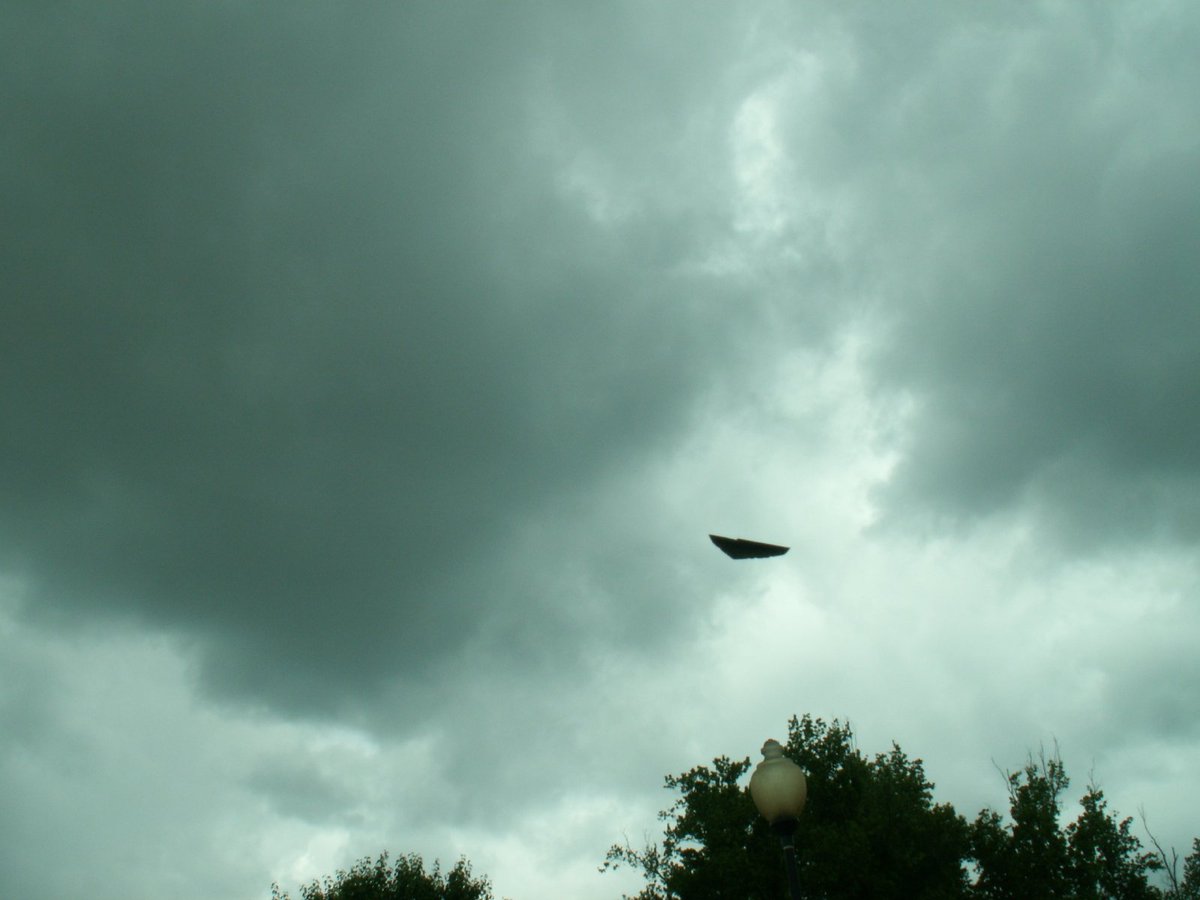
She saw a bright object dropping fast at roughly a 45 degree angle. Her first thought was that an aeroplane was about to crash. Instead the object pulled up and came to a hovering stop, about half a city block away from her and around 300 feet above the ground. It hung there at right angles to her line of sight, which gave her a long, broadside view.
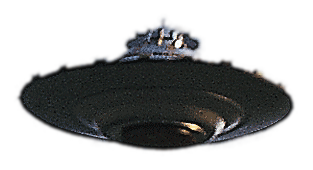
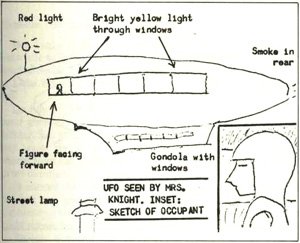
The object looked to her like the wingless fuselage of a plane, dull silver in colour, with something like smoke trailing from the rear. The side facing her carried a row of square windows lit from within by a brilliant yellow light. On top of the body, toward the front, was a small red light that stood up slightly above the hull. Slung underneath was an undercarriage that reminded her of the gondola of a dirigible, also lined with smaller square windows and glowing yellow inside. In that lower section she thought she could make out rows of seats, "similar to theatre seats."
Then she saw the occupant. "There was a man in front," she wrote, "looking straight ahead towards the front. I couldn't understand what he was looking at so intently, and not moving either." The yellow glow that filled the craft coloured everything inside it, "even the man." He appeared to be wearing a kind of helmet, and around his arm and the side of his helmet, next to his face, there seemed to be a shadow or a dark line.
After watching for a minute or two, Mrs. Knight left the window to telephone the local newspaper, wanting someone official to know. She got no answer. When she came back to the window the craft was still hanging there, but the man was no longer visible and the gondola-like undercarriage had disappeared from view. As she watched, the lights inside went out and the exterior changed from silver to a glowing red, a colour she compared to "the door of an old pot-bellied stove." The object began to drift away and took on a wavy, shimmering appearance, as though the air around it had suddenly grown very hot. She called out for her sister, conscious that no one would believe her without a second witness, but before anyone else reached the window the object was gone. The whole encounter lasted on the order of three minutes, with at least two of those minutes in clear view.
What is the official explanation?
There is no contemporary official record of this sighting. Mrs. Knight did not report the event when it happened in 1952. There is no police report, no newspaper item from the period, and no Project Blue Book case file matching a Seat Pleasant occupant encounter in August 1952. That silence is consistent with the witness's own account: she told her sister, who struggled to believe her, then said little about it for years before eventually telling her husband.
The only formal investigation came from the civilian side, and only much later. The report reached the National Investigations Committee on Aerial Phenomena (NICAP), and Mrs. Knight wrote out a full account for the committee in September 1967, fifteen years after the event. Her case was handled by a member of NICAP's Capital Area Subcommittee, the volunteer group covering the Washington, D.C., Maryland, and Virginia region. The investigator who interviewed her regarded her as a careful and credible witness, and it is from that 1967 NICAP file that every later retelling of the case descends, including the detailed reproductions on UFO Casebook and Think About It.
Because no government body ever logged the case, there is no official explanation to weigh, no Air Force conclusion, and no debunking finding from any investigating authority. The Air Force's Project Blue Book, which was active in 1952 and which catalogued dozens of Maryland reports that summer including the famous Washington, D.C. radar-visual flap of July 1952, holds nothing on this incident. One widely copied claim, that Mrs. Knight held two degrees from Yale University, is repeated in parts of the secondary literature and is used to vouch for her credibility, but at least one online retelling appears to confuse that educational detail with a separate occupant witness, Mary Starr, so the Yale claim should be treated as unverified rather than as an established fact about Knight.
What did the witnesses think it was?
Mrs. Suzanne E. Knight believed she had watched a real, structured machine at close range, with a living pilot aboard who was concentrating on something out of her sight. She was specific and restrained in what she claimed. She did not describe a "saucer" or a classic flying disc; she described something closer to an airship or a wingless aircraft, with windows, interior lighting, a gondola, and seats. She reported a single occupant and was careful to say only that he seemed to wear a helmet and that a shadow or dark line ran along his arm and the side of his head, rather than inventing a detailed alien face. The mundane, almost engineering quality of her description, the rows of theatre-style seats, the red light, the smoke, the dirigible-like gondola, is part of what struck NICAP's investigator as the report of an honest observer trying to convey an unfamiliar thing in familiar terms.
Her behaviour during and after the event also reads as that of a sincere witness rather than a publicity seeker. She tried to phone the newspaper while the object was still hovering. She called for her sister specifically because she realised no one would take her word without corroboration. Then she fell quiet for years, telling her sister, who did not believe her, and only much later her husband, before finally setting the account down for NICAP in 1967. People constructing a hoax do not usually wait fifteen years to make a low-profile report to a volunteer committee.
There were no independent corroborating witnesses. The sister did not reach the window in time, and no second observer ever came forward. That is the central weakness of the case from the witness side: it stands on one person's testimony, recalled and committed to paper a decade and a half after the fact.
Is the Seat Pleasant Occupant Sighting real? The two-pass assessment
Pass one, how this could be entirely ordinary. The most powerful ordinary factor here is not the object but the gap in time. The event is dated August 1952 but was not written down until September 1967, so everything rests on a fifteen-year-old memory with no photograph, no physical trace, no second witness, and no contemporary note. Memory over that span reshapes detail, and a frightening night-time sight can be elaborated unconsciously with each retelling before it is ever recorded. The summer of 1952 was also the peak of the largest UFO wave in American history, with the Washington, D.C. sightings splashed across front pages only weeks earlier and just a few miles away, so a striking but conventional stimulus could easily have been interpreted through that cultural lens. As for the object itself, a low, slow, lit shape with a row of bright square windows and a gondola underneath is, on its face, a fair description of a lighted airship or a low aircraft seen at an odd angle at night, and the "man looking straight ahead" could in principle be a pilot or passenger glimpsed through a window. The red glow and wavy shimmer as it left can be read as ordinary heat distortion or the witness's own embellishment. None of this is proven, but a single uncorroborated recollection of lighted windows in the night sky is, by itself, weak evidence for anything exotic.
Pass two, if it was real as described. If Mrs. Knight saw what she reported, the object is hard to fit to 1952 technology. It hovered motionless at roughly 300 feet, half a block away, then changed colour from dull silver to glowing red as its internal lights went out, took on a heat-haze shimmer, and departed, all in near silence apart from the initial buzzing "bzzt" at her window. A blimp does not hover at right angles to a suburban kitchen and then flush red and shimmer away. The close detail of a helmeted occupant fixed in concentration, and an undercarriage with theatre-style seating, is unusual for the period and does not match the disc-and-dome template that dominated 1952 reporting, which actually argues against simple cultural copying. Taken at face value, this is a structured craft with an occupant observed at very close range.
Weighing the two passes. There is no confession, no recovered prop, no identified aircraft or airship, and no method-shown debunk, so nothing pushes this toward the disputed tiers. Equally, there is no official narrative, no photograph, no corroborating witness, and a fifteen-year reporting delay, so it cannot be called verified or documented either. The case lives entirely on the testimony of one careful witness as preserved in a NICAP file. That is the definition of the Unknown tier: it stands on its witness and nothing else, neither confirmed nor explained away.
Sources
- www.ufoinsight.com/aliens/encounters/alien-encounters-mary-starr-suzanne-knight
- www.thinkaboutitdocs.com/ufo-seen-at-close-range-with-occupant-aboard/
- nexusnewsfeed.com/article/unexplained/ufo-with-occupant-august-1952-seat-pleasant-maryland/
- archive.org/details/mysteriesofskies0000lore
More cases from this region: UFO sightings in United States