The Fort Monmouth Radar Incident
On the morning of 10 September 1951 a Signal Corps radar operator at the Army radar school at Fort Monmouth, New Jersey, was running a demonstration for a group of visiting officers. This case file covers what witnesses reported, the official narrative, and a two-pass assessment with its evidence tier.
What did witnesses see at Fort Monmouth and Sandy Hook?
On the morning of 10 September 1951 a Signal Corps radar operator at the Army radar school at Fort Monmouth, New Jersey, was running a demonstration for a group of visiting officers. Sources identify the operator as Private First Class Eugene A. Clark working an AN/MPG-1 set, a fire-control radar that could be slaved to track a target automatically. At about 11:18 in the morning Eastern Daylight Time he picked up a low-flying target to the southeast, out over the coast, and tried to switch the set into its automatic-aided tracking mode. The target was moving across the sky in azimuth faster than the gear could follow. The AN/MPG-1 could hold automatic lock on aircraft up to roughly 700 miles an hour, and it would not stay locked. The operator's reported reaction, preserved in Ruppelt's account, was that it was going too fast for the set, which to the men standing behind him meant faster than a jet. He worked the target manually for around three minutes as it ran up the coastline toward Sandy Hook and then faded off the scope.
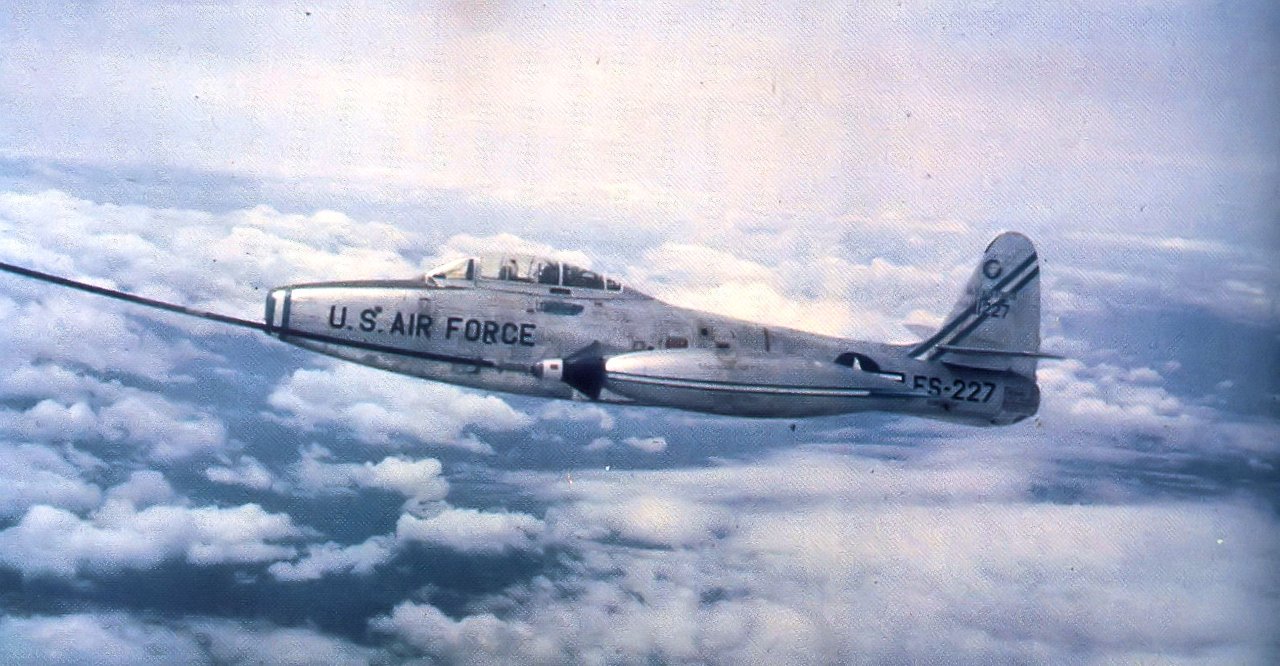
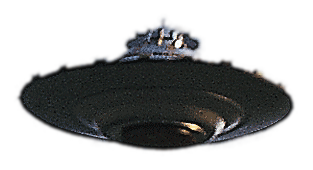
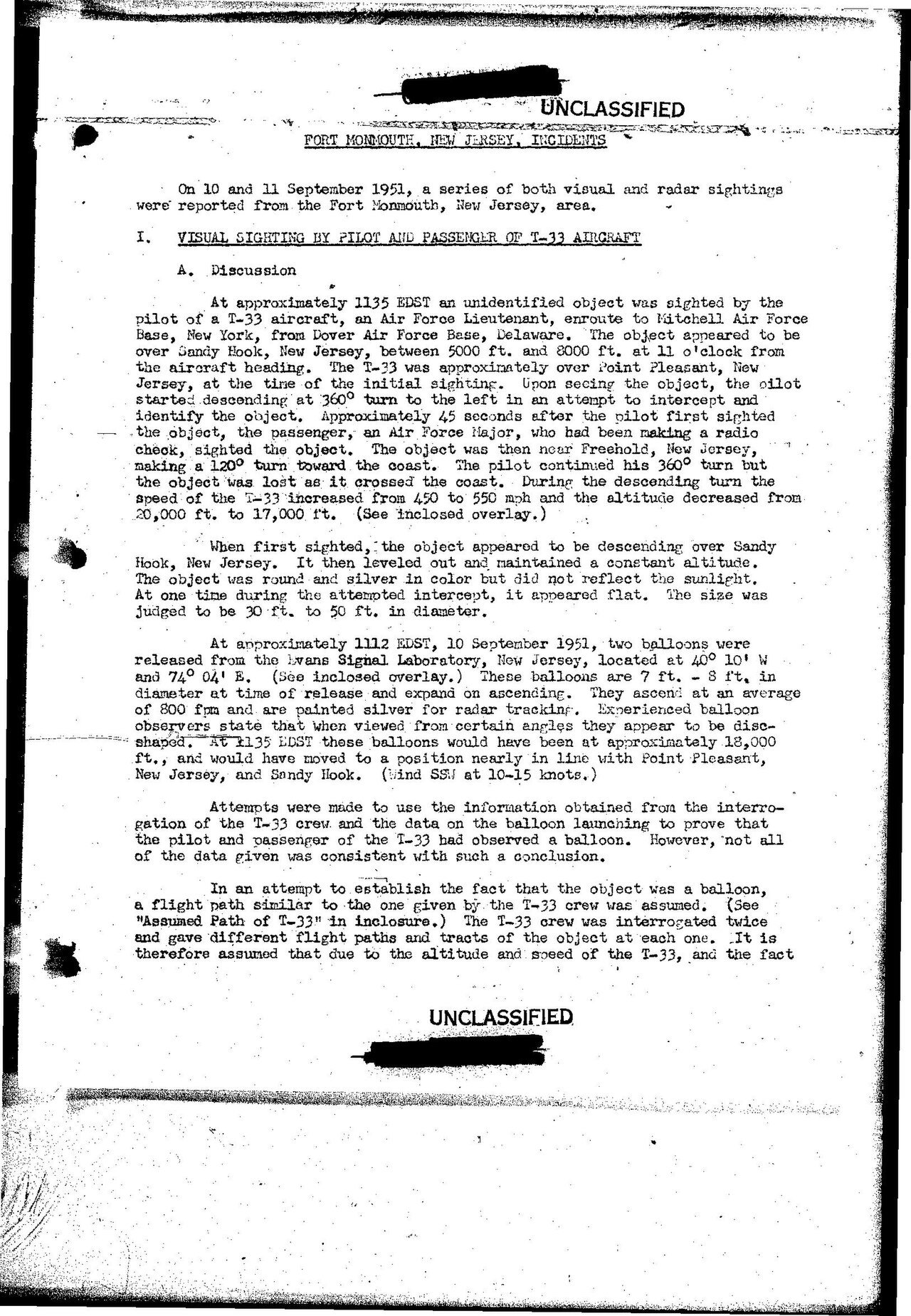
Roughly fifteen to twenty minutes later, near 11:35 in the morning, a T-33 jet trainer was in the air not far away. The pilot was Lieutenant Wilbert S. Rogers, a World War Two fighter veteran, and his passenger was Major Edward Ballard Junior. They were flying at around 20,000 feet near Point Pleasant, heading up toward Sandy Hook, when Rogers spotted a dull silver, disc-like or discus-shaped object well below them, between roughly 5,000 and 8,000 feet. He put the T-33 into a diving 360-degree spiral to close on it. The object was estimated at 30 to 50 feet in diameter. It appeared to level off near 5,000 feet and then accelerate out toward the open sea, covering a long stretch of coast in a couple of minutes at a speed the crew put at several hundred miles an hour and possibly as high as 700. Ballard confirmed the sighting seconds after Rogers called it.
The activity did not stop that morning. Around 3:15 in the afternoon on 10 September a radar at the post picked up a slow, very high target to the north, eventually plotted near 93,000 feet, that personnel could also see as a silver speck. That one was identified as a weather balloon. The next day, 11 September, two radar sets tracked further targets, one again clocked above 700 miles an hour and another, on an SCR-584 near Navesink, that climbed almost vertically, leveled, dove, and climbed again in a pattern the set could not follow automatically. So across two days the post logged a fast low coastal target, a daylight visual chase by two officers, a confirmed balloon, and several more radar tracks of varying speed and altitude.
What is the official explanation?
The case arrived at Air Technical Intelligence Center at Wright-Patterson Air Force Base by teletype on 12 September 1951 at 3:04 in the afternoon, carrying an operational priority. Major General Charles P. Cabell, Director of Intelligence at Air Force Headquarters in the Pentagon, reacted strongly. He had already ordered, earlier in 1951, a review of how the UFO problem was being handled, and the Fort Monmouth reports landed in the middle of that. Cabell phoned ATIC's chief, Colonel Frank Dunn, and demanded the case be run down at once. Two officers, Lieutenant Jerry Cummings and Lieutenant Colonel Nathan Rosengarten, flew to New Jersey within hours and worked nearly around the clock interrogating the radar operators, instructors, technicians, and the T-33 crew, and checking nearby radar stations, which had logged nothing unusual.
Cummings and Rosengarten then briefed Cabell at the Pentagon in a meeting Ruppelt says ran about two hours and was recorded on a wire recorder that was later destroyed. According to Ruppelt, who heard the recording several times, the room was furious at the state of Project Grudge. Cummings reported the project was effectively dead and that decent sightings were not being investigated. A general is quoted demanding to know who had been telling him every good saucer report was being looked into, and someone slammed a copy of the dismissive Grudge Report down on the table. The two officers were sent back to ATIC with orders to stand up a revitalized project and report when it was ready. Cummings was released to civilian life within days, and Rosengarten handed the project to Edward J. Ruppelt, who would formalize it into what became Project Blue Book.
As for the Fort Monmouth events themselves, the eventual official disposition was conventional. The Project Grudge status report of 30 November 1951 and the surviving Blue Book status reports attribute the morning radar contact to operator error, arguing the fast low target was really a conventional aircraft near 400 miles an hour that the flustered student could not auto-track. The 3:15 afternoon target and one of the 11 September tracks were called weather balloons, tied to balloons released from the Evans Signal Laboratory around 11:12 that morning. The erratic SCR-584 track of 11 September was put down to anomalous propagation, since the analyst judged the weather that day favorable for it. The T-33 visual sighting was explained as the same balloons. Ruppelt records in his 1956 book that Lieutenant Henry Metscher worked out a balloon reconstruction in which the relative motion between the climbing balloon and the diving jet could account for the apparent speed and behavior the crew described.
What did the witnesses think it was?
Lieutenant Wilbert Rogers and Major Edward Ballard did not accept that they had chased a balloon. When the balloon explanation was put to them during the interrogations, the two officers told the investigators they were, in the bluntest terms, wrong, and Rosengarten later told researchers the disagreement was heated enough that they nearly came to blows over it. Rogers was an experienced combat pilot who had been close enough to put his jet into a diving spiral after the object, and he described it leveling off and then outrunning him out to sea, behavior he did not think a balloon could produce. The radar men at the post likewise stood by what their scopes showed, including the operator who could not hold automatic lock on the morning target.
The corroboration here is unusually layered for a case this old. There is instrument data from more than one radar set, there is a same-area visual chase by two Air Force officers within roughly twenty minutes of the first radar contact, and there is the fact that the whole episode was taken seriously enough at the highest level of Air Force intelligence to scramble a two-man investigation team to New Jersey within hours and to trigger a Pentagon shake-up. Edward Ruppelt, who inherited and rebuilt the project as a direct result, treated Fort Monmouth as the hinge event in his own first-hand narrative. Brad Sparks and the physicist James E. McDonald both later reexamined the file and argued the balloon and operator-error reconstruction did not fit the geometry, pointing to the mismatch between the official balloon altitudes and the low altitude Rogers reported tracking his object through.
The dispute
The dispute is the Air Force's own conventional reconstruction of the events, advanced inside Project Grudge and Project Blue Book and repeated by Edward Ruppelt in his 1956 book. It has two parts. First, the morning radar contact at Fort Monmouth is attributed to operator error: the surviving Blue Book status report argues the student operator was, in the analyst's own spelling, highly flustrated in front of visiting officers, that he could not hold automatic lock, and that a ground-track calculation from 1115 to 1118 yielded a speed closer to 400 miles an hour than 700, consistent with an ordinary aircraft. Second, the T-33 visual sighting and several later radar tracks are attributed to weather balloons released from the Evans Signal Laboratory around 11:12 that morning, with Lieutenant Henry Metscher producing a reconstruction in which the relative motion between a rising balloon and the diving jet reproduces the apparent speed and descent. One of the 11 September radar tracks was instead put down to anomalous propagation in favorable weather.
This is a real, named, partly method-shown counter-explanation, which is why the case is disputed rather than verified unexplained. The afternoon high target of 10 September genuinely does look like a balloon, both on radar near 93,000 feet and as a visible silver speck, and that identification is solid. But it does not close the whole case. The two men who actually chased the object, Lieutenant Wilbert Rogers and Major Edward Ballard, rejected the balloon explanation to the investigators' faces, and Lieutenant Colonel Rosengarten said they nearly came to blows over it. The balloon-altitude figures cited in the file, with balloons placed near 18,000 feet and bursting far higher, sit awkwardly against Rogers reporting his object low, near 5,000 to 8,000 feet, and descending through that band. The status report itself concedes uncertainty, noting the T-33 crew gave different flight paths in two interrogations and that no definite conclusion could be drawn from the radar data, and even admits the apparent descent of the object when first sighted could not be explained.
Later independent review sharpened the doubt. The physicist James E. McDonald and the researcher Brad Sparks reexamined the file and argued the geometry does not support the balloon reconstruction for the T-33 encounter, with Sparks's analysis contending the jet was not chasing a balloon at all. None of this is a confession, recovered hoax props, or a positively identified specific aircraft or balloon track for the T-33 object itself. It is an official assertion plus a plausible-but-contested reconstruction on one side, and experienced eyewitness rejection plus a documented altitude mismatch on the other. That keeps the case in the barely disputed tier: the official story exists and is partly demonstrated for some of the radar tracks, but it has not been shown to close the core visual chase, and the case largely stands on its instrument-plus-eyewitness record.
Is the Fort Monmouth Radar Incident real? The two-pass assessment
Pass one, how this could be entirely ordinary. The Air Force's own files supply a coherent mundane reading, and parts of it are convincing. The afternoon target of 10 September really does behave like a high-altitude balloon, slow, very high, and visible as a silver speck, and it was identified as one. The Evans Signal Laboratory genuinely released balloons that morning, painted for radar tracking, so balloons were demonstrably in the air. A student operator running a demonstration in front of senior officers, unable to hold automatic radar lock and blurting that the target was faster than a jet, is a believable way to manufacture a 700-mile-an-hour scare out of a 400-mile-an-hour aircraft, and the recomputed ground track supports the slower figure. Some of the erratic radar behavior of 11 September is consistent with anomalous propagation in the right weather. A diving jet closing on a rising balloon can produce striking relative motion that an excited crew might read as a powered craft accelerating away.
Pass two, if real, what it was. What the ordinary reading does not cleanly dispose of is the T-33 chase. Two Air Force officers, one a combat-experienced pilot, saw a dull silver disc-shaped object low over the coast, dove after it in a spiral, watched it level off and then outrun them out to sea, and flatly refused the balloon explanation when it was offered, to the point of nearly coming to blows with the investigators. The altitudes do not line up neatly with the official balloons, and later independent analysts, McDonald and Sparks, concluded the balloon reconstruction does not fit. If the object was real and not a balloon, it was a small, fast, disc-shaped craft operating off the New Jersey coast that two trained observers could not match in a jet trainer. The deeper significance of Fort Monmouth is institutional rather than physical: it is the case that exposed how badly the Air Force was investigating sightings, forced General Cabell to act, and led directly to the reorganization that produced Project Blue Book under Edward Ruppelt. That an official-apparatus debunk had to be assembled at all is itself evidence the case was taken as real enough to need closing.
Tier: Barely Disputed. There is a named, partly demonstrated counter-explanation, balloons plus operator error, and it genuinely accounts for some of the radar tracks. But it is an official assertion plus a contested reconstruction, not a confession, recovered props, or a positive identification of the specific object the T-33 crew chased, and the two eyewitnesses and two later independent analysts reject it. The core radar-visual event largely stands, so the case sits in the barely disputed tier rather than strongly disputed or verified unexplained.
Sources
- en.wikisource.org/wiki/Page:Project_Blue_Book,_complete_status_reports.pdf/25
- en.wikisource.org/wiki/Page:Project_Blue_Book,_complete_status_reports.pdf/26
- en.wikisource.org/wiki/Page:Project_Blue_Book,_complete_status_reports.pdf/27
- en.wikisource.org/wiki/Page:Project_Blue_Book,_complete_status_reports.pdf/28
- en.wikisource.org/wiki/Page:Ruppelt_-_The_Report_on_Unidentified_Flying_Objects.djvu/133
- en.wikisource.org/wiki/Page:Ruppelt_-_The_Report_on_Unidentified_Flying_Objects.djvu/134
- en.wikisource.org/wiki/Page:Ruppelt_-_The_Report_on_Unidentified_Flying_Objects.djvu/135
- en.wikisource.org/wiki/Page:Ruppelt_-_The_Report_on_Unidentified_Flying_Objects.djvu/136
- www.army.mil/article/227612/history_mystery_from_the_archives
- www.nicap.org/reports/monmouth3.htm
- www.nicap.org/510910monmouth_dir.htm
- www.nicap.org/bluebook/51-69.htm
More cases from this region: UFO sightings in United States