The Ellsworth Air Force Base Incident
On the night of 5 August 1953, shortly after dark at about 8:05 p.m., a Ground Observer Corps volunteer at the small post near Black Hawk, South Dakota, roughly ten miles west of Ellsworth Air Force Base, telephoned the base to report a very bright light low on the horizon to the northeast. This case file covers what witnesses reported, the official narrative, and a two-pass assessment with its evidence tier.
What did witnesses see at Ellsworth Air Force Base?
On the night of 5 August 1953, shortly after dark at about 8:05 p.m., a Ground Observer Corps volunteer at the small post near Black Hawk, South Dakota, roughly ten miles west of Ellsworth Air Force Base, telephoned the base to report a very bright light low on the horizon to the northeast. The Air Force spotter is named in the NICAP case directory as Miss Phyllis Killian; Ruppelt, writing in 1956, renders the name as Mrs. Kellian. She described a red glowing light that hung in one spot, then moved.
The warrant officer who was the duty controller in the radar room at Ellsworth checked his scope and found a target sitting exactly where the spotter said the light was. He studied it for several minutes and judged it, in the language preserved in the file, well defined, solid, and bright. The height-finder radar put the target at about 16,000 feet. To rule out a trick of one set of eyes, three airmen were sent outside the radar building to look, and they too saw a bright light in that part of the sky.
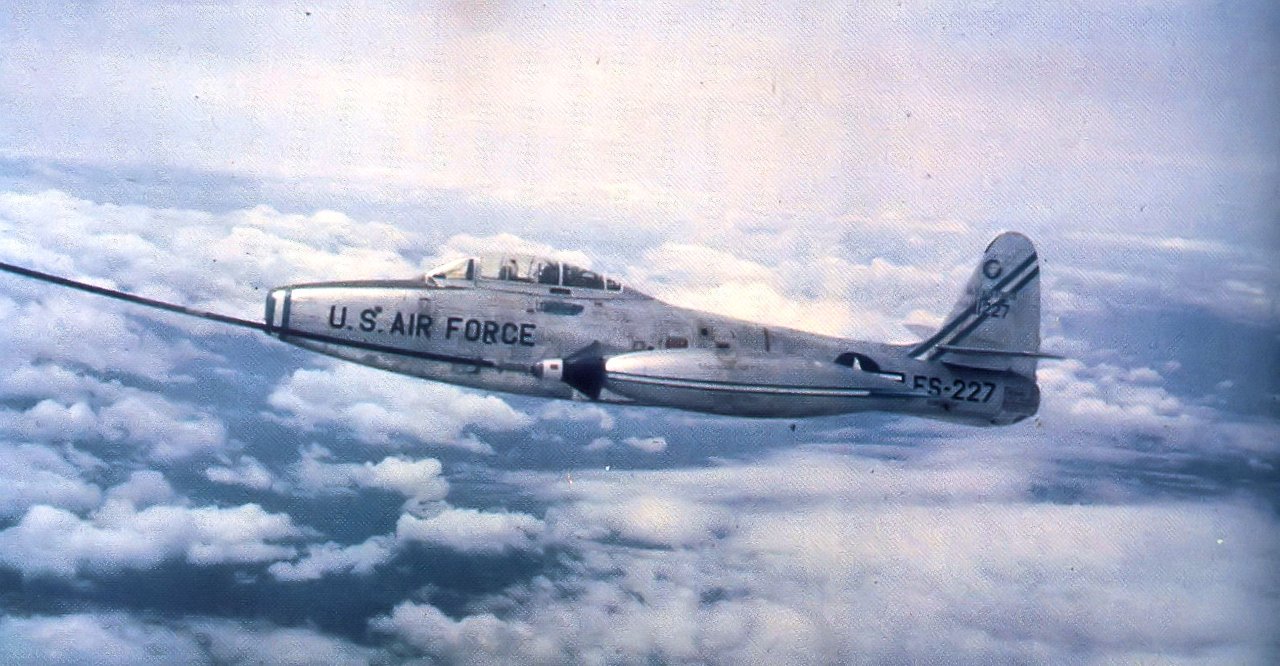
Then came the detail that made the case. According to Ruppelt's account, when the object started to move, three independent observers caught it at the same instant. In his words, the controller saw it begin to move, the spotter saw it begin to move and the pilot saw it begin to move, all at the same time. An F-84 from the base was vectored toward it. As the jet closed, the object pulled away and held a gap of about three miles, no matter what the pilot did. The pilot reported a silver-to-bluish light, brighter than the brightest star he had ever seen, that he watched move against the field of stars. The ground radar tracked both the jet and the target on a heading of about 320 degrees magnetic, running north, the object staying ahead. The first F-84 chased the light roughly 120 miles north into empty country before the pilot, low on fuel, had to break off and turn home.
A second F-84 was scrambled, this one flown by a combat veteran of two wars who, by Ruppelt's telling, was openly skeptical and went up expecting to debunk it. He climbed after the light, turned off his own cockpit and instrument lights and rolled the aircraft to kill any chance of a reflection, and still saw the light pacing him and apparently climbing as he climbed. He switched on his radar-ranging gun sight, and the lock-on lamp lit, meaning the gun sight radar was returning something solid out in front of the aircraft. As Ruppelt put it, in a few seconds the red light on his sight blinked on, something real and solid was in front of him, and then he was scared. The veteran pilot, who had walked into the briefing room a scoffer, readily admitted afterward that he had been frightened, and broke off the pursuit. Far to the north the same night, ground observers and radar around Bismarck, North Dakota, reported bright objects as well, which is why the case is sometimes filed as the Rapid City to Bismarck event.
What is the official explanation?
The Air Force carried the case in Project Blue Book as an Unknown. It appears in Blue Book Status Report 12 (pages cited in the NICAP directory as roughly 226 to 229, with the formal write-up also referenced at pages 20 to 23 of the published status material), logged as unsolved. The case is unusual in the Blue Book record because it combines four kinds of evidence at once: ground-visual from the spotter and the airmen, ground radar from the Ellsworth height-finder and search sets, air-visual from two interceptor pilots, and air radar from a gun-sight lock. Major Lawrence J. Tacker, the Air Force's public spokesman on UFOs, confirmed the case to a NICAP correspondent and stated that the Air Force held gun-camera photographs of the object and radarscope photographs, though the reports note the gun camera and scope cameras reportedly malfunctioned, so usable imagery never reached investigators.
Edward J. Ruppelt, the first director of Blue Book, devoted several pages to the case in his 1956 book, The Report on Unidentified Flying Objects, and treated it as one he could not dismiss. He recorded the controller's striking remark that as each interceptor closed, the object began to move, it was just as if the UFO had some kind of an automatic warning radar linked to its power supply. Ruppelt did not solve it, and his summary verdict in the book is blunt: this was an unknown, the best.
Fifteen years later the case was reopened by the University of Colorado UFO Project under Edward Condon. The radar-visual analysis was written by Gordon D. Thayer and published in 1969 in Scientific Study of Unidentified Flying Objects (the Condon Report), Section III, Chapter 5, where the event is handled as Case 2 and labeled internally as case 15-B. Thayer reconstructed the night as a stack of separate ordinary causes. His summary sentence reads: the Rapid City-Bismarck sightings appear to have been caused by a combination of stars seen through an inversion layer, at least one meteor, AP echoes on a GCI radar, and possible ghost echoes on the GCI radar and malfunction of an airborne radar gunsight. Thayer noted refractivity profiles showing temperature inversions at both Rapid City and Bismarck capable of forming a radio duct, which he argued could bend radar beams and create false returns, while the bright lights were stars and one meteor distorted by the same inversion. Even so, Thayer conceded the friction in his own explanation, writing that the descriptions of these objects by the various observers were consistent with the star hypothesis, although some apparent discrepancies caused early Air Force investigators to deduce by crude triangulations that the sighted objects must have been nearby. In other words, the men who worked the case at the time concluded the lights were close, not stars at infinity.
What did the witnesses think it was?
The witnesses on the ground and in the air believed they were watching a real, solid, controlled object, not a star or a glitch. The Ground Observer Corps spotter at Black Hawk did not just see a light; she watched it sit, then move, and stayed in radio contact with the radar room the whole time so that her account could be matched against the scope in real time. The duty controller, a warrant officer, was a radar professional who studied the return for several minutes before committing to it, and it was he who supplied the line about the object behaving as though it had an automatic warning radar tied to its power, a reading that only makes sense if you believe something was reacting to the approach of the jets.
The two pilots are the heart of the witness case because they were trained interceptor crews actively trying to catch the thing. The first pilot, who chased it 120 miles north, insisted the light was brighter than any star and that he could see it move against the star background, which is exactly the observation a star explanation has to defeat. The second pilot is the most telling witness of all. Ruppelt describes him as a veteran of the Second World War and Korea who came up to fly the intercept precisely because he did not believe in flying saucers, and who took deliberate steps in the cockpit to debunk himself by killing his lights and rolling the aircraft to chase off reflections. When his gun-sight radar locked and the lamp lit on something solid ahead of him, his skepticism collapsed. He admitted he had been scared and broke off. A career fighter pilot frightened into abandoning a pursuit by his own radar is not a witness who can be waved away as a nervous civilian.
Ruppelt himself, the investigator, is effectively a corroborating witness to the strength of the file. He had read, in his own words, every saucer report that came across his desk for years, and he singled this one out. His judgment was not that the case was probably real, but that it was the best report the Air Force held, an unknown he could not close. That assessment came from the man whose job was to explain these things away.
The dispute
The dispute is owned almost entirely by one document: Gordon D. Thayer's radar-visual analysis in the 1969 Condon Report, Scientific Study of Unidentified Flying Objects, Section III, Chapter 5, where the event is treated as Case 2 / 15-B. Thayer, a radio-propagation specialist, did not claim a single cause. He argued the night was a coincidence of several ordinary effects layered on top of each other. His exact summary is that the Rapid City-Bismarck sightings appear to have been caused by a combination of stars seen through an inversion layer, at least one meteor, AP echoes on a GCI radar, and possible ghost echoes on the GCI radar and malfunction of an airborne radar gunsight. The physical anchor of his case is real: radiosonde data showed temperature inversions over both Rapid City and Bismarck strong enough to form a radio duct, which can produce anomalous-propagation radar returns, and bright stars and a meteor seen through such an atmosphere can appear to shimmer, change color, and seem to shift position.
Where the dispute weakens is that every element is a plausible mechanism, not a matched identification. Thayer never named the specific star the pilots chased, never tied the meteor to a logged track, never recovered or tested the actual gun-sight set he calls faulty, and never explained how independent ground radar, airborne gun-sight radar, and multiple naked-eye observers all latched onto one object that several of them saw begin to move at the same moment. He also had to work around his own admission that the original Air Force investigators triangulated the lights and concluded they were nearby, which is incompatible with stars at infinity. An inversion-duct argument explains how a radar can lie; it does not explain why a luminous object held a constant three-mile lead on a climbing interceptor, opened that lead to ten or fifteen miles when the jet turned back, and returned a hard lock to a second jet's gun sight.
So the counter-explanation is real, published, named, and grounded in genuine meteorological data, which is why the case is disputed rather than cleanly unexplained. But it is a reconstruction built on a stack of assumed simultaneous failures, not a confession, a recantation, or a positive identification of one real object. It does not close the case; it competes with it. Set against Edward Ruppelt's verdict that this was the best unknown in the Air Force files, the Condon explanation lowers the case to Barely Disputed and no further.
Is the Ellsworth Air Force Base Incident real? The two-pass assessment
Pass one, the ordinary reading. The fullest skeptical case is Gordon Thayer's in the 1969 Condon Report, and it is a serious one. Thayer documented genuine temperature inversions over both Rapid City and Bismarck that night, the kind of layering that can duct radar beams and throw back anomalous-propagation returns and ghost echoes, and he argued the visual lights were bright stars, perhaps with one meteor, refracted and made to shimmer and seem to move by the same inversion. The gun-sight lock he wrote off as an equipment malfunction, consistent with the fact that the gun camera and scope cameras reportedly failed. Stack those together, a star, a meteor, two flavors of false radar return, and a glitchy gun sight, and you can in principle build the whole night out of mundane parts. This reconstruction is why the case cannot be filed as flatly Verified Unexplained.
But pass one has real seams, and they are seams Thayer himself half admits. The contemporary Air Force investigators triangulated the lights and concluded they were nearby objects, not stars at infinity, and Thayer had to argue around that rather than refute it. A star does not pace two climbing jets, hold a steady three-mile gap, and then open the gap to ten or fifteen miles when one jet turns for home, which is what the ground radar showed. An inversion can duct a beam, but it does not coordinate a ground radar track, a gun-sight lock, and the naked-eye reports of a spotter, three airmen, and two pilots into one moving object that several observers saw start to move at the same instant. And the gun-sight malfunction is an assertion, not a demonstration; the Condon team never examined that specific gun sight, they inferred a fault because the alternative was an unexplained solid return.
Pass two, if it was real. Then Ellsworth is close to the platonic radar-visual case: a luminous object, tracked by ground search and height-finder radar at a measured altitude, seen by independent ground and air observers, that reacted to interception by accelerating away while holding station, and that returned a hard lock on an airborne gun-sight radar. It outran or out-positioned two F-84 Thunderjets and frightened a two-war combat pilot into breaking off. Nothing in the file identifies what it was, and no specific aircraft, balloon, or known object has ever been named for it.
Weighing the two passes, this is Barely Disputed. There is a published, named, method-bearing counter-explanation in Thayer's Condon analysis, which is more than an empty official assertion, so the case is genuinely disputed and not simply Unknown. But that counter-explanation is a reconstruction, not a resolution. No one produced the specific star, the specific meteor track, or a tested faulty gun sight; no witness recanted; no hoax was shown. Thayer had to assume a chain of separate ordinary failures all firing on the same night and conceded his star hypothesis sat uneasily against the original triangulation. Against that stands the first director of Project Blue Book calling it the best unknown in the Air Force files. A weak, partial, assumption-heavy debunk against a strong multi-sensor case puts this squarely in the barely-disputed tier: the official explanation exists, but the case largely still stands.
Sources
- www.nicap.org/rufo/rufo-17.htm
- web.archive.org/web/20260714125341/https://www.gutenberg.org/ebooks/17346
- files.ncas.org/condon/text/s3chap05.htm
- www.nicap.org/Good_Cases/530805ellsworth_dir.htm
- realtvufos.blogspot.com/2016/06/ufo-case-directory-radcat-category-9_17.html
- ufologie.patrickgross.org/htm/ellsworth53.htm
- ufologie.patrickgross.org/htm/ellsworth53condon.htm
More cases from this region: UFO sightings in United States