The Conde Metal Sphere and the Dead Crewman, Bahia, Brazil, November 1963
A Rio radio bulletin said a large metal sphere had fallen in a small Bahian town with a dead crewman inside, and within eleven days the CIA's broadcast monitors, the White House space council and the US State Department had all put it in writing.
What did witnesses see at Conde?
On the night of 8 November 1963, Radio Tupi in Rio de Janeiro carried a bulletin about the small coastal town of Conde, in the north of the Brazilian state of Bahia, roughly a hundred kilometres up the Atlantic shoreline from Salvador. According to the broadcast, a large metallic sphere had come down in the centre of the town and driven a crater about four metres deep into the ground. The sphere was said to carry openings like windows, protected by thick glass. Inside, the bulletin said, was a human body dressed in heavy clothing marked with inscriptions that nobody could decipher. Brazilian outlets reporting on the declassified American files in August 2026 place the transmission at about 23:30 on 8 November and name Radio Tupi as the station.
That is the whole of the sighting claim, and it is a radio report about a town rather than testimony from anyone in it. No named resident of Conde has ever been produced who says they saw an object fall, heard an impact, stood at the edge of a crater or looked at a body, no photograph has surfaced, and no fragment was handed to any authority. The case has also left no footprint in the standing Brazilian ufology literature, which is unusual for a claimed crash with a body: no catalogue entry under Conde surfaces, no investigation by the Centro Brasileiro de Pesquisas de Discos Voadores, no Revista UFO write up, and every Brazilian article discussing it in 2026 treats it as a story recovered from American paperwork rather than a case from their own files.
The American paperwork describes the claim in two registers, and both are worth quoting because they show how fast the object mutated as it travelled up the chain. The Executive Office of the President record, EOP-UAP-D001, is described by the Department of War as tracking a Portuguese language radio broadcast from Rio about an alleged crash of a, quote, large metal sphere, unquote, containing a deceased occupant in Conde, Bahia. Six days later the same object appears in State Department traffic as something else. The Department's description of cable DOS-UAP-D001 says the Embassy cited descriptive language paraphrased from the press, namely a, quote, large metal manned balloon, unquote, and a, quote, dead crewman aboard wearing a uniform or spacesuit with strange markings, unquote. A sphere with glass portholes had become a manned balloon inside a week, which is what a story does when it is passed between newsrooms, monitors and embassies rather than examined on the ground.
One physical detail belongs here because it is the only measurable claim in the whole story. The crater was said to be four metres deep and in the centre of the town. A four metre crater in a populated town square cannot be missed by residents and cannot be quietly filled in, which makes it the easiest claim in the account to check, and checking it is exactly what the Brazilian press and then the American consulate did.
What is the official explanation?
Three separate arms of the United States government wrote this event down inside eleven days, and all three records were published together on 7 August 2026 in Release 05 of the Department of War's PURSUE programme, the Presidential Unsealing and Reporting System for UAP Encounters. They are cross paired to one another in the Department's own release manifest, in the column it uses to mark records belonging to a single event.
The first is EOP-UAP-D001, titled by the Department, quote, NASC Inquiry into Bahia, Brazil Incident, November 13, 1963, unquote, filed under the Executive Office of the President with an incident date of 13 November 1963 and an incident location given only as Bahia, Brazil. The Department describes it as a Central Intelligence Agency Foreign Broadcast Information Service wire report dated 9 November 1963, tracking the Rio radio broadcast about the alleged crash of a large metal sphere containing a deceased occupant in Conde. What makes this more than a press clipping is where it was found. The Department says the FBIS report is excerpted from the files of Edward C. Welsh, Executive Secretary of the National Aeronautics and Space Council, and explains what that body was: a cabinet level advisory body inside the Executive Office of the President responsible for coordinating United States space policy from 1958 to 1973. It adds that handwritten annotations dated 13 November 1963 document a communication between officials. The manifest text breaks off there, and this archive will not guess at the rest.
Welsh was the first Executive Secretary of the Space Council, appointed under President Kennedy, and the State Department's own Foreign Relations of the United States series prints him in exactly that role: National Security Action Memorandum No. 50 of 12 May 1961 is addressed to Dr Edward C. Welsh, Executive Secretary, National Aeronautics and Space Council, and a later FRUS volume carries a March 1965 memorandum from the Executive Secretary of the Council, Welsh, to Vice President Humphrey. A wire about a crashed sphere in rural Bahia sitting in that man's files is not a UFO report in a public affairs drawer. It is a UFO report in the working papers of the White House official whose job was national space policy.
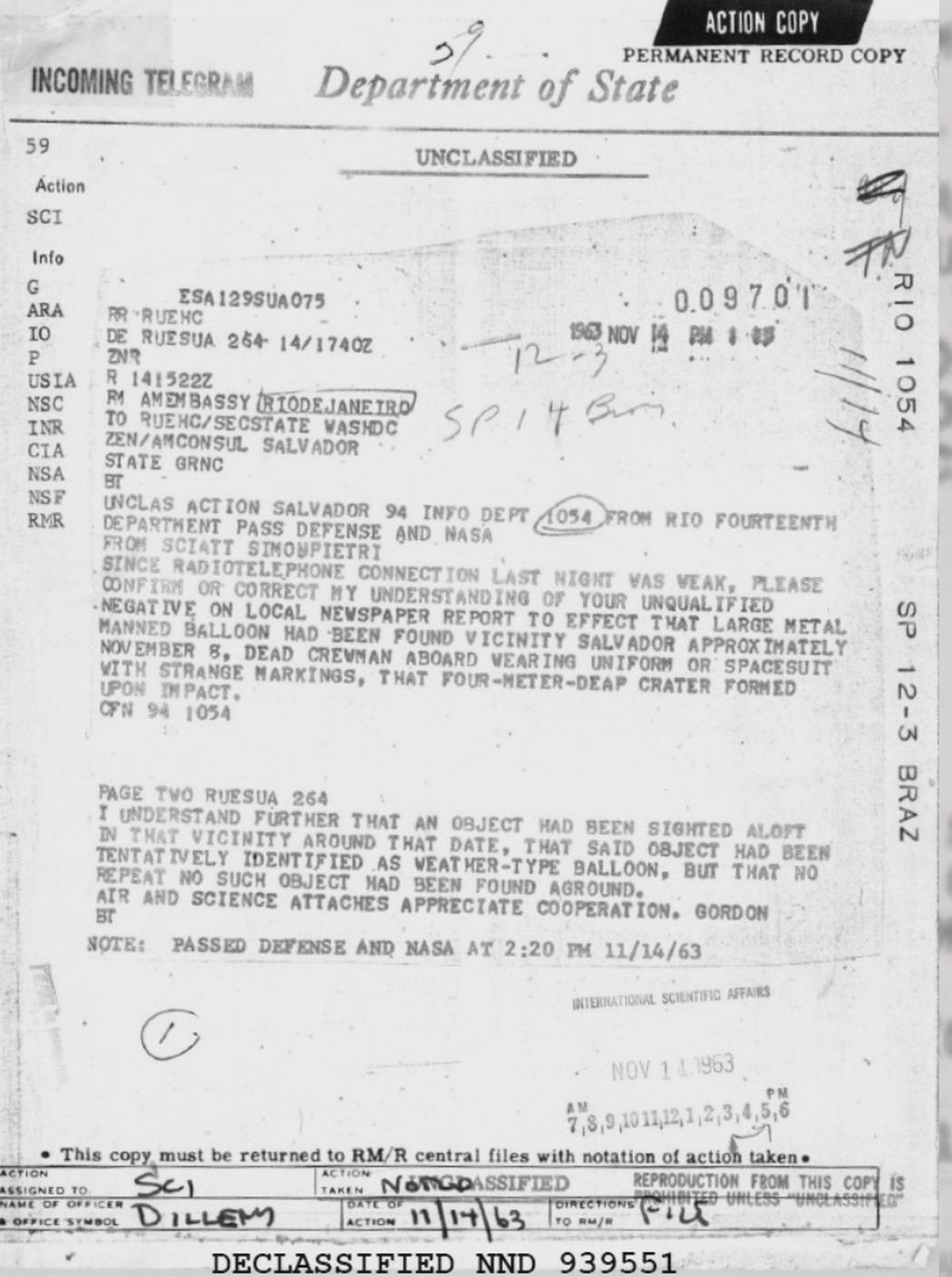
The second record is DOS-UAP-D001, a State Department cable of 14 November 1963 from the Embassy in Rio de Janeiro to the Office of the Secretary of State. The Department's description of it is careful and slightly strange. It says the cable documents an effort by the Embassy to verify that the Department had assessed certain content published in a local newspaper as inauthentic, following a discussion on a poor quality telephone connection the previous night, and that the Embassy quoted the press language so both offices could be certain they were describing the same reporting. Brazilian coverage adds that the Embassy asked Washington to pass copies onward to the Department of Defense, the Air Force and NASA. Within six days the material had reached a broadcast monitoring service, the White House space council, the State Department, the Pentagon and the American civil space agency.
The third record is DOS-UAP-D002, dated 20 November 1963, and it closes the case. The Department says the cable relays the findings of the scientific attache at the American Consulate in Salvador, Bahia, that a widely reported incident allegedly involving a crashed unidentified object was unsubstantiated, characterising the reports as a fabrication originating in Rio de Janeiro. It also states the method: a lack of contemporary local reporting about the alleged incident, and contradictory reporting from local newspapers after the fact. Brazilian outlets that read the released PDF give it a despatch number and title, A-628, headed as a negative report on a UFO supposedly sighted near Salvador, Bahia on 8 November, name the US Consul in Salvador as Harold Midkiff, and quote his conclusion that the story of a strange object descending in the region of Conde apparently was fabricated in Rio and that no such object was seen by anyone. They also report attached clippings from the Diario de Noticias of 9 November and the Jornal da Bahia of 11 November, the Brazilian Ministry of Aeronautics categorically denying any strange object at Conde, and the Secretary of Public Security for Bahia offering an unconfirmed weather balloon as a possible origin.
This archive has now read all three documents in full. The Brazilian outlet Poder360 published a full page reproduction of DOS-UAP-D001, the 14 November 1963 telegram, and UAP Globe recovered that reproduction at its original resolution and read the page directly. What follows in the next paragraph is taken from the document itself. The individual files are bot blocked at war.gov, but the Department published a bundle of the entire tranche and the Wayback Machine holds a working capture of it, so DOS-UAP-D002 and EOP-UAP-D001 were recovered and read as well. Their contents are given further down.
The telegram is worth setting out properly, because it carries several things the Department's summary leaves out. It is an INCOMING TELEGRAM on Department of State letterhead, stamped ACTION COPY and PERMANENT RECORD COPY, marked UNCLASSIFIED, filed as R 141522Z from AMEMBASSY RIO DE JANEIRO to SECSTATE WASHDC with AMCONSUL SALVADOR as an addressee, and it carries the instruction "DEPARTMENT PASS DEFENSE AND NASA". It is sent over the name of the scientific attache, SIMONPIETRI, and signed GORDON, which is Lincoln Gordon, then the United States Ambassador to Brazil. The body reads: "SINCE RADIOTELEPHONE CONNECTION LAST NIGHT WAS WEAK, PLEASE CONFIRM OR CORRECT MY UNDERSTANDING OF YOUR UNQUALIFIED NEGATIVE ON LOCAL NEWSPAPER REPORT TO EFFECT THAT LARGE METAL MANNED BALLOON HAD BEEN FOUND VICINITY SALVADOR APPROXIMATELY NOVEMBER 8, DEAD CREWMAN ABOARD WEARING UNIFORM OR SPACESUIT WITH STRANGE MARKINGS, THAT FOUR-METER-DEAP CRATER FORMED UPON IMPACT." The misspelling of "DEEP" is in the original. A second page adds the detail that matters most: "I UNDERSTAND FURTHER THAT AN OBJECT HAD BEEN SIGHTED ALOFT IN THAT VICINITY AROUND THAT DATE, THAT SAID OBJECT HAD BEEN TENTATIVELY IDENTIFIED AS WEATHER-TYPE BALLOON, BUT THAT NO REPEAT NO SUCH OBJECT HAD BEEN FOUND AGROUND." It closes "AIR AND SCIENCE ATTACHES APPRECIATE COOPERATION. GORDON", and a typed note records "PASSED DEFENSE AND NASA AT 2:20 PM 11/14/63". The routing stamp assigns it to SCI, the Bureau of International Scientific Affairs, to an officer recorded as Dillery, on 11/14/63, and the foot of the page carries the declassification number NND 939551.
Three points follow from reading the actual page rather than the summary. First, the Embassy's own cable places the alleged find in the vicinity of SALVADOR, while the FBIS wire that started the American paper trail names CONDE, about 180 kilometres to the north. The record is not internally consistent about where the thing was supposed to have come down, and no source resolves it. Second, the Department was asked to pass the report to both DEFENSE and NASA, and the note confirms it did so the same afternoon, which is the mechanism by which a Rio radio rumour reached the files of the National Aeronautics and Space Council. Third, and most usefully for anyone weighing the story, something WAS aloft: an object had been sighted in the area around that date and had been tentatively called a weather type balloon, but nothing was ever found on the ground. That is a far more specific and more prosaic picture than either the rumour or the flat denial. Everything attributed above to the documents comes from the Department's own published machine readable manifest, which carries the verbatim descriptions quoted here, or from the outlets that opened the PDFs from 7 August 2026 onward. Where those outlets add detail the manifest does not carry, such as the despatch number, the consul's name and the clippings, that is their reporting and not something read here.
EOP-UAP-D001 turns out to be the shortest and the most useful document in the set, because it is the thing that started everything: the Foreign Broadcast Information Service's verbatim transcription of the broadcast itself. It is a single page, marked FBIS 03 and declassified under authority NND968063, and it reads in full: "RIO DE JANEIRO RADIO TUPI IN PORTUGUESE 2330 8 NOV 63 W (TEXT) REPORTS FROM THE MUNICIPALITY OF CONDE, IN BAIA, SAY A LARGE METAL SPHERE FELL IN THE CENTER OF THE CITY, GOUGING A HOLE FOUR METERS DEEP. THE MYSTERIOUS SPHERE HAS WINDOW SHAPED OPENINGS COVERED WITH THICK GLASS. INSIDE IS A HUMAN BODY DRESSED IN HEAVY CLOTHING BEARING INSCRIPTIONS WHICH CANNOT BE DECIPHERED. THE POPULATION OF CONDE IS INTRIGUED, AND THE AUTHORITIES HAVE BEEN INFORMED." It is timed 2330 on 8 November 1963 and stamped 9 NOV 111A. That is the entire evidentiary basis of the story, and it is worth noticing how little it claims: it does not say a reporter went to Conde, it does not name a witness, and it attributes everything to unspecified "reports from the municipality".
DOS-UAP-D002 is the closing despatch, numbered A-628 and classified UNCLASSIFIED, from the Embassy in Rio to the Department, titled "Negative Report on UFO (Unidentified Flying Object) Reportedly Sighted Near Salvador, Bahia on November 8, 1964". The year in that subject line is wrong in the original, and the despatch itself is from November 1963. It confirms that the earlier telegram was passed on "to Defense (for the Air Force) and NASA", and it quotes the answer from Harold Midkiff, the United States Consul in Salvador, sent as his telegram No. 157 of 14 November, in full: "Story of strange object descending in region of Conde Bahia apparently fabricated in Rio no such objects seen by anyone in the area according to newspaper reporters and others who rushed there before investigation reports were received Secretary Public Security speculated object might be weather balloon but no such sighting verified." Midkiff also forwarded two clippings from Salvador papers, the Diario de Noticias of 9 November, in which the Ministry of Aeronautics categorically denies that there was any strange object at Conde, and the Jornal da Bahia of 11 November, headlined "The Airship that wasn't there". The despatch closes with the detail the Bahian reporter evidently thought was the only real story: that the sole remarkable by product of the whole affair was that he was able to file his telegram to his paper from the federal telegraph office in Conde on an old morse transmitter.
Read together the three documents make the sequence unusually clean. A Rio radio station broadcast an unsourced item at 2330 on 8 November. American broadcast monitors transcribed it the next morning. It reached the files of the White House space council within days. The Embassy asked Washington to confirm its negative and asked that the report be passed to the Pentagon, the Air Force and NASA. The Consul in Salvador, 180 kilometres from the alleged site, established through reporters who had physically gone there that nothing had been found, and the Brazilian air ministry denied it outright. The whole thing was opened and closed in twelve days.
What did the witnesses think it was?
There are no witnesses in this case, and the absence is the finding rather than a gap in the research. Every attempt to locate one, in 1963 and again in 2026, has come back empty. A crash claim with no witness is a very different object from a crash claim whose witnesses were suppressed.
The first people to look were Brazilian, and they looked immediately. Salvador newsrooms sent reporters up the coast to Conde within a day or two of the broadcast, and what they found, according to the reporting on despatch A-628 and its attachments, was nothing at all: no crater in the town centre, no debris, no body, nobody who would say they had seen an object come down. The Jornal da Bahia published its account on 11 November 1963 under a headline that says everything about how the Bahian press had already made up its mind, O dirigivel que nao estava la, the airship that was not there. Its reporter made a dry observation that has survived into the 2026 coverage: the only genuinely remarkable thing about the affair was the speed of the Morse link between Conde and Salvador, which returned an answer in about five minutes. In a story about a spacecraft, the fastest thing anyone could verify was the telegraph.
The Diario de Noticias of Salvador had run its piece two days earlier, on 9 November, carrying the Brazilian Ministry of Aeronautics denying categorically that any strange object existed at Conde. The Secretary of Public Security for Bahia floated the only competing physical explanation anyone offered, a meteorological balloon, and could not confirm it. Nobody in the Brazilian chain, civil or military, ever put a name to a witness.
If this case has protagonists, they are the American officials, and they are the reason the file exists at all. An unnamed FBIS monitor logged a late night Portuguese broadcast on 9 November. Somebody carried that wire into the office of Edward C. Welsh at the National Aeronautics and Space Council and, on 13 November, annotated it with a record of a conversation between officials. Somebody at the Embassy in Rio spent part of the night of 13 November on a bad telephone line to Washington and then cabled to make certain both ends were describing the same newspaper story before anyone acted. And the scientific attache at the Consulate in Salvador, working under Consul Harold Midkiff, did the ordinary and correct thing: he checked whether the local papers had reported an event on the day it supposedly happened, found they had not, found that what they printed afterwards contradicted itself, and said so.
One more thing about the people in this file. The last cable is dated 20 November 1963. Two days later the President who created the Space Council was shot in Dallas. Whatever attention the Executive Office of the President had been paying to a metal sphere in Bahia ended that week, and the paperwork sat unread in Welsh's files for sixty two years.
The dispute
The dispute is not really a dispute in the usual sense, because no serious party has ever argued the other side. What exists is an official American finding, published in the Department of War's own words in August 2026, that the whole thing was invented. The Department's description of record DOS-UAP-D002 states that the cable relays the findings of the scientific attache at the American Consulate in Salvador, Bahia, that a widely reported incident allegedly involving a crashed unidentified object was unsubstantiated, characterising the reports as a fabrication originating in Rio de Janeiro. Brazilian outlets that opened the released PDF report the despatch as A-628 of 20 November 1963, titled as a negative report on a UFO supposedly sighted near Salvador on 8 November, and quote the US Consul in Salvador, Harold Midkiff, concluding that the story of a strange object descending in the region of Conde apparently was fabricated in Rio and that no such object was seen by anyone in the area.
The method behind that finding is stated and it is a real one. According to the Department, the Consulate rested on the absence of contemporary local reporting about the alleged incident and on contradictory reporting from local newspapers after the fact. That is a falsifiable test rather than an official assertion, and it lines up with what the Bahian press had already done on its own. Reporters from Salvador drove to Conde and found no crater, no debris and nobody who claimed to have seen anything, and the Jornal da Bahia ran its account on 11 November 1963 under the headline O dirigivel que nao estava la, the airship that was not there. The Diario de Noticias of Salvador had carried the Brazilian Ministry of Aeronautics denying categorically on 9 November that any strange object existed at Conde. The only alternative physical object anybody named, a meteorological balloon suggested by the Secretary of Public Security for Bahia, was never confirmed and would not account for a body.
What keeps this at Barely Disputed rather than Strongly Disputed is what is still missing from the debunk. Nobody has ever identified the person who made the story up. There is no recovered Radio Tupi script, no named reporter or editor, no confession, no traced wire copy, and no demonstration of how the sphere, the portholes, the four metre crater and the inscribed clothing were assembled into a bulletin. The archive's bar for Strongly Disputed is a positive identification of the specific real world cause or a shown fabrication of this specific claim, and an official conclusion that a story was fabricated somewhere in a city of millions does not reach it. There is also an evidentiary limit on this page: DOS-UAP-D001 has been read here in full, from a full page reproduction published by Poder360, but DOS-UAP-D002 and EOP-UAP-D001 return HTTP 403 at war.gov to every non browser client and have no Wayback capture, so for those two the archive is relying on the Department's published manifest descriptions and on the reporting of outlets that opened the files.
None of which changes the shape of the case. On the physical claim, the sceptical side has the evidence and the believing side has a single late night radio bulletin. The part of this file worth keeping is not the sphere, it is the eleven day paper trail showing the CIA's broadcast monitors, the White House space council and the State Department all moving on an unverified foreign rumour about a dead crewman, and routing it to the Pentagon, the Air Force and NASA before a consulate in Salvador shut it down two days before the President was killed in Dallas.
Is the Conde Metal Sphere and the Dead Crewman, Bahia, Brazil, November 1963 real? The two-pass assessment
PASS ONE: how could this be entirely ordinary. The honest answer is that it very probably is, and the archive should say so without hedging.
The leading explanation is the one the United States government reached in 1963 and has now published: a press fabrication that started in Rio de Janeiro and was never true anywhere. The mechanism is easy to picture. A late night radio bulletin carries a sensational item, other newsrooms repeat it rather than check it, the item crosses into the wire monitoring system, and by the time anyone drives to the town the story has been told a dozen times. The test that settles it is the one the Salvador papers applied first and the American consulate applied second: if a four metre crater had opened in the middle of a town, the local press would have reported it on the day, and it did not. What they printed once they went and looked contradicted the Rio version.
The weather balloon offered by the Secretary of Public Security for Bahia is the only competing physical object anyone named. In 1963 radiosonde balloons were routinely released across Brazil and routinely came down in open country, and a recovered radiosonde with its metal housing and printed instruction labels is a good match for a metal object bearing writing nobody could read. But it was never confirmed, no balloon recovery was produced, and it does not explain a body. Treat it as a suggestion, not an identification.
Garbling is worth naming as a separate mechanism, because this file demonstrates it twice inside a fortnight. The object is a sphere with glass portholes on 9 November and a manned balloon by 14 November. The occupant is a body in heavy clothing with undecipherable inscriptions in the broadcast and a crewman in a uniform or spacesuit with strange markings in the Embassy cable. The drift is still happening in 2026: at least one English language write up of this release says the Embassy cabled and then five minutes later clarified that no craft had been recovered, which appears to be a misreading of the Jornal da Bahia detail about a five minute Morse exchange between Conde and Salvador. A story that mutates this reliably at every hop does not need a physical object at its origin.
PASS TWO: what resists an ordinary explanation. On the phenomenon itself, very little. There is no photograph, no fragment, no crater, no named witness, no Brazilian ufological investigation, and no corroborating report from any other source in November 1963. Anyone arguing that a spacecraft fell at Conde is arguing from a single radio bulletin against an on the ground check by two newspapers, a military ministry, a state security secretariat and an American consulate.
What does resist easy dismissal is the institutional half of the story, and it is the reason this page exists. Three arms of the United States government handled the claim inside eleven days: the CIA's Foreign Broadcast Information Service, which monitored and wired the broadcast; the National Aeronautics and Space Council, whose Executive Secretary's files held the wire and whose officials annotated it on 13 November; and the State Department, which cabled twice and asked that copies go to the Pentagon, the Air Force and NASA. The Department of War's own manifest pairs the three records as one event. That is a fast, senior, multi agency reflex to an unverified foreign radio story about a body in a fallen sphere, at the height of the Cold War, in the fortnight before the Kennedy assassination. Whatever it says about Bahia, it says something concrete about how the American government of 1963 routed a crash and body claim: not to a public affairs office, but into the working papers of the White House space adviser. One limit belongs on that record, and it is a limit on this archive rather than on the case. The three PDFs are still unreadable outside a browser session, so the single most interesting item in the file, the handwritten note of 13 November recording a communication between officials, is known only from a manifest description that breaks off mid sentence.
TIER. There is an official narrative, so this is not Unknown. The State Department's scientific attache in Salvador reached a finding and showed part of his working: no contemporary local reporting on the day of the alleged event, and contradictory local reporting afterwards. That is more than a bare assertion. But it stops short of what this archive requires for Strongly Disputed, which is a positive identification of the hoax and its author with the method shown. Nobody has named the Rio journalist, editor or prankster who invented the sphere, produced the original Radio Tupi script, or demonstrated how the item was manufactured, and the closing despatch that records the finding, DOS-UAP-D002, has not been read here, though the 14 November telegram that opened the inquiry has been. On those grounds the case is Barely Disputed. If the Radio Tupi broadcast text or a named originator ever surfaces, this page should move to Strongly Disputed the same day.
Sources
- www.war.gov/UFO
- www.metropoles.com/mundo/governo-trump-revela-documentos-de-investigacao-sobre-ovni-na-bahia
- www.poder360.com.br/poder-internacional/eua-liberam-arquivos-de-investigacao-sobre-ovni-no-brasil/
- oantagonista.com.br/mundo/eua-investigaram-suposta-queda-de-ovni-na-bahia-em-1963/
- jornalgrandebahia.com.br/2026/08/documentos-dos-eua-revelam-investigacao-sobre-suposto-ovni-em-conde-na-bahia-em-1963-apuracao-concluiu-que-relato-era-fabricacao/
- www.correiobraziliense.com.br/brasil/2026/08/7476251-eua-revelam-investigacao-de-suposto-ovni-no-brasil-em-1963.html
- www.correiobraziliense.com.br/brasil/2026/08/7476342-entenda-investigacao-dos-eua-por-suposto-ovni-na-bahia-em-1963.html
- ndmais.com.br/ciencia-e-espaco/ovni-bahia-arquivos-eua-relato-1963/
- olhardigital.com.br/2026/08/07/ciencia-e-espaco/ovni-na-bahia-documentos-dos-eua-relatam-investigacao-sobre-esfera-metalica-no-ceu-brasileiro/
- www.meionews.com/noticias/como-uma-transmissao-de-radio-no-rio-levou-a-cia-a-investigar-um-caso-de-ovni-na-bahia-571828
- www.aol.co.uk/articles/ufo-files-claim-dead-spaceman-220313000.html
- dailybeirut.com/en/miscellaneous/pentagon-releases-new-ufo-files-detailing-1963-brazilian-metal-sphere-containing/
- history.state.gov/historicaldocuments/frus1961-63v25/d364
- history.state.gov/historicaldocuments/frus1964-68v34/d30
- static.poder360.com.br/uploads/2026/08/documento-ovni-brasil-bahia.png
- web.archive.org/web/20260809162414/https://www.war.gov/medialink/ufo/release_05/Aug_07/release_05_Aug_07_documents.zip
More cases from this region: UFO sightings in Brazil