DOW-UAP-PR102/PR103: Unresolved UAP Report over the East China Sea (2024) (PURSUE Release 04)
Two 2024 infrared clips from a U.S. military sensor over the East China Sea, submitted by U.S. Indo-Pacific Command and marked "unresolved" by AARO, show an auto-tracked thermal "area of contrast" that was never identified.
What did witnesses see at East China Sea?
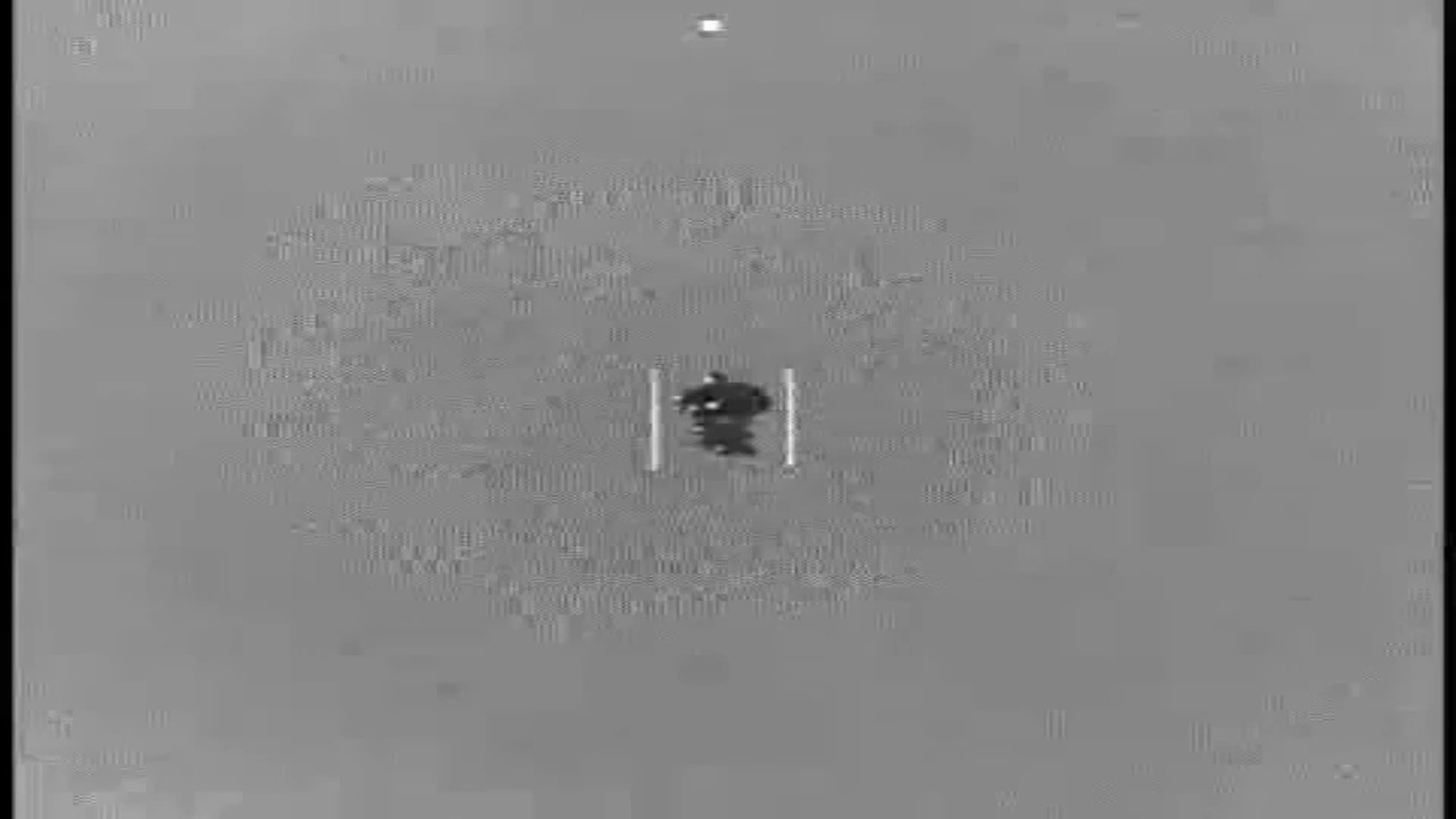
The event is documented by two short infrared clips released by the U.S. Department of War under the fourth PURSUE tranche and captioned by the All-domain Anomaly Resolution Office (AARO). Both clips come from "an infrared sensor aboard a U.S. military platform" operating over the East China Sea in 2024, and both track the same kind of target, which AARO describes only as an "area of contrast" rather than a solid object. The two clips are catalogued as DOW-UAP-PR102 (DVIDS video 1014098, 36 seconds) and DOW-UAP-PR103 (DVIDS video 1014099, 1 minute 16 seconds).
On the shorter PR102 clip, AARO's frame-by-frame caption states that from 00:01 to 00:20 "the sensor tracks an area of contrast, centered in frame." From 00:21 to 00:29 that contrast area "exits field-of-view at top of frame," and from 00:30 to 00:36 "the sensor zooms in and out multiple times with no content visible." In plain terms, the operator holds the target centred for about twenty seconds, loses it off the top of the frame, then repeatedly re-zooms on empty sky without reacquiring anything.
On the longer PR103 clip, AARO writes that from 00:01 to 01:16 "the sensor pans to track an area of contrast, keeping it generally within the center of the frame," and that from 00:12 to 01:16 "an auto-tracking reticle surrounds the area of contrast" while "the sensor tracks the area of contrast, keeping it generally within the center of the frame." The auto-track box engaging at the twelve-second mark and staying locked for the remaining minute is the most concrete technical detail in either caption: the platform's tracker was able to hold the return for over a minute.
What is verified is narrow and deliberately so. AARO's release states the footage exists, comes from a U.S. military infrared sensor, was captured in 2024 over the East China Sea, and shows a tracked thermal contrast. What is NOT stated is size, range, altitude, speed, shape, or identity. AARO attaches an explicit disclaimer to the descriptions: the video description "is provided for informational purposes only," and readers "should not interpret any part of this description as reflecting an analytical judgment, investigative conclusion, or factual determination regarding the described event's validity, nature, or significance." No claim of anomalous performance is made anywhere in the primary caption.
What is the official explanation?
The report was submitted by U.S. Indo-Pacific Command (USINDOPACOM) to the All-domain Anomaly Resolution Office (AARO). AARO catalogued it under two report identifiers, DOW-UAP-PR102 and DOW-UAP-PR103, and titled both "Unresolved UAP Report, East China Sea, 2024." "Unresolved" is AARO's own status label meaning the office has not attributed the observation to a known object or phenomenon; it is a statement about the limits of the analysis, not a positive finding that the object was novel or non-human. The two clips were published by the U.S. Department of War on war.gov/UFO on 10 July 2026 as part of the fourth release under the Presidential Unsealing and Reporting System for UAP Encounters (PURSUE), a tranche whose core was a block of roughly nineteen AARO-designated "unresolved" military infrared videos spanning 2015 to 2025. Secondary coverage of the release (The Debrief) notes that, across the whole tranche, none of the videos or documents released "provides clear examples of any objects attributable to unknown aircraft, or objects exhibiting unusual or advanced technologies."
What did the witnesses think it was?
This is a sensor case, so there are no named eyewitnesses in the primary record. The "observer" is an infrared targeting sensor aboard an unspecified U.S. military platform operating in the East China Sea, operated by U.S. Indo-Pacific Command personnel who are not identified in the release. AARO's captions describe operator actions (panning to keep the contrast centred, engaging an auto-track reticle, zooming in and out) but attach no crew testimony, no radar corroboration, and no analyst commentary beyond the neutral frame-by-frame description and the standard informational disclaimer. No pilot or operator quotes accompany the footage.
Is the DOW-UAP-PR102/PR103: Unresolved UAP Report over the East China Sea (2024) (PURSUE Release 04) real? The two-pass assessment
Honest tier: Unknown. AARO's "unresolved" marking reflects that the office did not attribute the target, not that the footage shows exotic technology, and the captions make no performance claims at all.
Pass one, how this could be mundane. The captions describe an "area of contrast," which is the language analysts use for a thermal blob whose true nature is undetermined, not a resolved craft. Several ordinary explanations fit the East China Sea, one of the busiest air and sea corridors on Earth: a distant aircraft or its engine exhaust, a high-altitude balloon or drifting payload (the same PURSUE release characterises another clip as "a large, somewhat deformed balloon"), a surface vessel or its wake seen against cooler water, birds, or a sensor and parallax artefact. The PR102 behaviour, where the target drifts off the top of the frame and the operator then zooms on empty sky with "no content visible," is consistent with the sensor losing a genuine but unremarkable object rather than tracking something that maneuvered. The auto-track lock in PR103 confirms only that a stable thermal return existed for a minute, which a balloon, aircraft, or ship would all satisfy. Nothing in the primary captions establishes speed, range, or acceleration, so no case for anomalous flight can be built from the released material.
Pass two, if it is real and genuinely unattributed. If the target is not a balloon, aircraft, ship, or artefact, the most it supports is that a U.S. military sensor in 2024 recorded a thermal contrast over the East China Sea that USINDOPACOM and AARO could not conclusively identify from the available data. That is an intelligence-gap statement about a contested maritime theatre, not evidence of a physical craft of unknown origin. Given the missing kinematic data and the ambiguity of a bare "area of contrast," the correct tier is Unknown, and any "it was a balloon" or "it was a drone" debunk is itself a claim that the released footage is too thin to prove.
A note on a neighbouring record. This archive also carries indopacom-radial-2024, built on DOW-UAP-PR46, a nine second clip released in the FIRST PURSUE tranche on 8 May 2026 and listed in the Department of War's own release manifest with an incident location of East China Sea and an incident date of N/A. That record is not the same as the two clips on this page, which are PR102 and PR103 from the fourth tranche and which run far longer and show a featureless area of contrast rather than a shaped body. The Department numbered them separately and released them months apart. It is nevertheless possible that both document the same underlying incident, because no dates, platforms or case identifiers are published that would either link them or separate them. The two pages are kept apart because the Department keeps the records apart, and readers should hold the question open.
Sources
- www.dvidshub.net/video/1014098/
- www.dvidshub.net/video/1014099/
- thedebrief.org/pentagon-releases-new-batch-of-uap-videos-and-historical-files-but-clarity-remains-elusive/
More cases from this region: UFO sightings in International waters, western Pacific (East China Sea)