European Commission UAP Monitoring: Brussels, the EASA Reporting Gap and the Airline Pilots Who Stayed Silent (17 August 2026)
The European Union has no UAP office, no UAP programme and, officially, no UAP position. What it turns out to have is a letter from its own defence department saying that Brussels is getting better at seeing them and needs to get better still.
What happened
On 17 August 2026 Euronews published an exclusive by Marta Pacheco reporting that the European Commission "seems to have been monitoring unidentified anomalous phenomena (UAP) under the radar since at least 2023," on the basis of a document from the Commission's defence department that the outlet had seen.
The line Euronews quoted from that document is the reason this case exists. "We are getting better at seeing it (UAPs) and better identifying it as our technological capacities improve, but we need to get even better," the letter read. That is not a denial, not a deflection to member states, and not the language of an institution that considers the subject closed.
The document was a reply. In October 2022 a Malaysian father and son, amateur astronomers whose lunar surface observations had been recognised internationally in 2020, wrote to the Commission under the title "UAP captures in the airspace and deep space using our UV infrared telescope." They sent 37 images of sky and space footage, asked President Ursula von der Leyen where the objects came from, and noted that the objects appeared to fly "very near to aircraft and important targets, such as military and nuclear facilities." They added that "we have also detected various signals from up above through the local networks Wi-Fi frequency." Their complaint about officialdom was blunt: "all governments simply have no opinions" when confronted about the objects.
The Commission answered that because the objects had been seen over Malaysia it had no authority to investigate. Then it went further than it needed to. It said it would propose to the 27 member states that the Union "increase its ability to detect objects in the space environment around the Earth", and explained why: "This is partly to help us better identify the UAPs that you have seen and the many pieces of space debris that endanger the many uses of space." It closed with a hedge that is more interesting than a refusal: "We do not claim that in the future this will solve all cases like those you have reported, but maybe some of them."
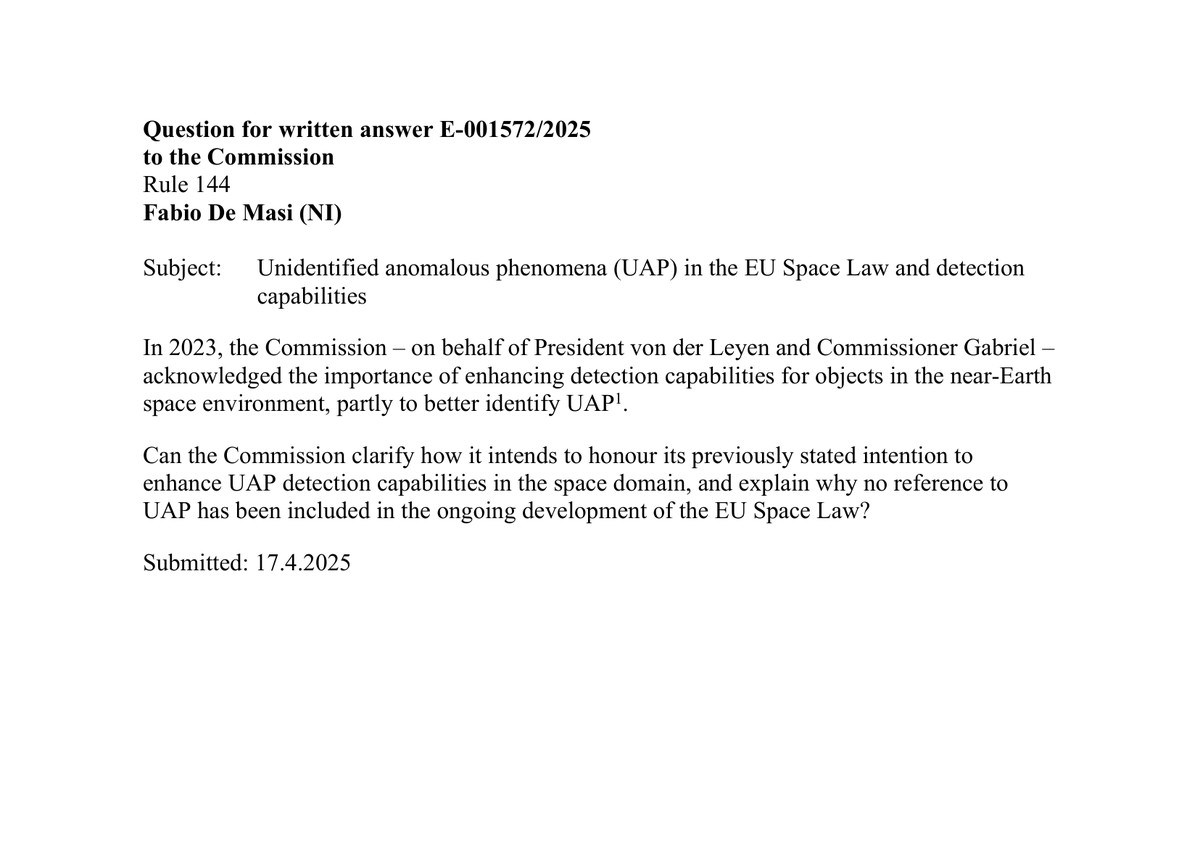
This archive can take the provenance one step past the Euronews report, because the trail is public. European Parliament written question E-001572/2025, tabled by MEP Fabio De Masi and submitted on 17 April 2025, asks the Commission to explain how it intends "to honour its previously stated intention to enhance UAP detection capabilities in the space domain, and explain why no reference to UAP has been included in the ongoing development of the EU Space Law". Its opening sentence states the fact directly: "In 2023, the Commission, on behalf of President von der Leyen and Commissioner Gabriel, acknowledged the importance of enhancing detection capabilities for objects in the near-Earth space environment, partly to better identify UAP."
That sentence carries a footnote, and the footnote is a link to a PDF hosted on AsktheEU.org, the freedom of information portal for EU institutions. The request it belongs to is titled "UFO/UAP/UCT/unknown unidentified craft/Congress UAP", was filed by Chris Gaffney against DG Defence Industry and Space on 8 August 2023 under Regulation 1049/2001, and is recorded on the portal as partially successful.
So the Commission's acknowledgement has been sitting in a public FOI response since 2023, was quoted on the floor of the European Parliament in April 2025, and reached a general audience in August 2026. That is worth stating plainly rather than treating the material as newly prised loose. What Euronews added in 2026 was not the document's existence but the reporting around it: the pilots, the agency responses, and the question of why a document like this had gone essentially unread for three years.
What is the official position?
The official European position, unusually for this archive, is available in full and on the record. It is a jurisdictional answer rather than a factual one.
Euronews asked the Commission whether it was considering any information sharing mechanism with the United States on UAP, or whether it intended to monitor and assess them itself in view of possible flight safety impacts. A Commission spokesperson answered: "UAP are the responsibility of EU member states, which handle them according to national security and defence priorities."
The European Union Aviation Safety Agency gave a parallel answer on the reporting question. EASA said its existing framework already covers "any occurrence that may have an impact on aviation safety", UAP included, and that "pilots and other aviation personnel are encouraged to report anything they consider to represent a potential safety risk, regardless of its nature". It declined to create a UAP specific reporting category, keeping such reports inside a miscellaneous incidents bucket, and stated its conclusion: "At present, EASA has not identified evidence indicating that reports of UAP represent a systemic aviation safety issue requiring additional measures."
Those two statements do not contradict the Commission letter, and it is important not to overstate the tension. Brussels can consistently hold that UAP are a national competence, that existing occurrence reporting is adequate, and that improving space domain awareness would incidentally help identify unidentified objects. What the statements do is leave the Union with no mechanism that would ever generate the evidence EASA says it lacks.
At member state level the picture is uneven. France is the only EU country with a dedicated, state funded UAP investigation body, the Groupe d'Etudes et d'Informations sur les Phenomenes Aerospatiaux Non identifies, known as GEIPAN, which has operated since 1977. Euronews reports that GEIPAN has analysed more than 3,300 cases, that exactly 106 remain classified as unexplained after full analysis, and that a further 1,014 are unresolved for want of sufficient data. On 29 June the French Parliament held a substantial debate on UAP covering GEIPAN's work, the French Air and Space Force, and possible liaison with the United States. French MP Arnaud Saint-Martin, whose background is in aerospace and astronautics, told Le Parisien: "We want to move beyond sensationalism and fantasies and instead address, in a serious and rational way, an issue that is generating significant interest."
Elsewhere the Dutch Safety Board has begun accepting UAP reports from flight crews under a general category, and Germany's Federal Aviation Office has engaged in scientific research on the subject. Without a standardised central database these remain fragmentary, which is precisely the loop the reporting gap creates.
What the people involved say
The witnesses in this case are commercial airline pilots, and what they describe is less remarkable than the reason they say they did not report it.
Rob Akkermans, a commercial pilot for a Dutch airline with 35 years of flying behind him, described a sighting in 2023 on a flight from the Middle East to the Netherlands. All six people aboard the flight deck and cabin crew saw it from the cockpit over more than two hours starting around 19:30 UTC.
"It began while we were south of Cyprus. Precisely on a heading of 300 degrees (Magnetic North), at an elevation of roughly 25 to 30 degrees and at a very high altitude, we saw a light flare up intensely and then slowly fade out. Subsequently, this occurred more frequently, often accompanied by one or two other lights that would also flare up and fade," Akkermans said.
"The most bizarre aspect was that one of the three lights would sometimes manoeuvre around the others. It resembled a chase, what air forces call dogfighting, after which two or all three of them would fade out again."
He and the crew initially assumed they were watching a military exercise over the Balkans, and then discarded that reading for a reason worth noting, because it is a geometry argument rather than an impression. "Upon reaching the Balkans, we witnessed the same spectacle, still on the same heading, at the same angle, and at a very high altitude." An object that holds the same bearing and elevation while the aircraft covers a large distance is very far away, which rules out anything local. After approximately 21:30 UTC the lights vanished at speed and did not return. A colleague of his reported seeing the same thing the following day from his back garden in the Netherlands.
What Akkermans said about the aftermath is the part that bears on policy. "Emotionally, the worrying part to deal with was frustration and concern over the stigma. You are forced to carry this experience in silence, worrying far more about the professional consequences of the taboo than the actual safety risk you just witnessed."
Christiaan van Heijst, aged 43, a Boeing 747 captain with more than twenty years of commercial flying, gave Euronews four sightings between 2005 and 2010, of which two matter here.
The first was in Greece in 2005, probably over Mykonos, late in the evening. "After landing at night, we made a 180 degree turn on the runway, and during the turn we saw a bright light appearing in the sky at extremely high altitude. It moved instantly, disappeared, appeared again, moved roughly the same distance, disappeared again, about three times," he said. "Before it appeared roughly two times that distance and instantly shot off at instant and unbelievable speed, without acceleration: just instant speed and it was gone from sight." Van Heijst himself supplies the context and then declines to draw the conclusion, which is the mark of a careful witness: United States Carrier Strike Group 2 with the USS Theodore Roosevelt was passing through the Mediterranean that night on its way to the Persian Gulf, and the associated airspace closures appeared in NOTAMs. "Unknown if these events are connected," he said.
His fourth sighting is the strongest single account in the piece, because it has independent verification from air traffic control at the time. On the late afternoon of 23 January 2010, flying a 737 from Amsterdam to Malaga at 41,000 feet, he and his colleague saw an object far ahead showing "a rounded rectangular shape as if we were looking in the rear side of a contrail", at an altitude where there is almost no traffic.
"While still flying in the north of Spain, we asked Madrid Air Traffic Control if there was any known traffic ahead and above us. They told us there was no traffic at all, and wondered why we asked. So, we told them we saw an object far ahead of us and rather large," van Heijst said. "He immediately asked us to contact the military air traffic control frequency and tell them what we saw. Military air traffic control was prompt, interested and took serious note of all we saw. Military air traffic control confirmed there was no other traffic at all, all the way down to Morocco, no military activity, no commercial traffic, no weather balloons, nothing. We saw the stationary object all the time for an hour at least, until we descended into the clouds over Malaga."
Van Heijst reports no emotional reaction to any of it and frames the issue narrowly: if something is in the airspace and the authorities cannot identify it, then "first and foremost it is a safety issue and not science fiction".
Joachim Dekkers, founder and chair of the UAP Coalition Netherlands, supplies the number that turns these accounts into a policy argument. He told Euronews that stigma is the greatest threat to European flight safety and that as a result 90 per cent of pilot sightings go unreported. "Without a dedicated UAP category in aviation safety systems, flight crews are forced to misclassify critical data. The EU cannot maintain global leadership in aviation safety while ignoring a reality other major powers measure."
MEP Fabio De Masi, who has pressed the Commission repeatedly across 2025 and 2026 to create a standardised UAP reporting category, put the institutional position in the form of a dilemma. Neither Commission nor Council claims to have specific evidence about the origin of these airspace incursions. "This is quite astonishing given surveillance of airspace and critical infrastructure. Either our airspace is vulnerable, and we have a major flight safety and security risk, or the EU is misleading public opinion," he said. "This is not about green little men but the safety of our airspace and the vested interests of the military-industrial complex and national intelligence services."
The pilot behind the Cyprus leg of the Euronews story has since been named in follow-up coverage around the eastern Mediterranean. He is Rob Ackermans, a Dutch commercial airline pilot, who describes watching unusual lights for more than two hours on a flight from the Middle East to the Netherlands in 2023, with the lights first appearing while the aircraft was south of Cyprus. In his account the crew watched three lights, one of which appeared to move around the others, and he describes seeing "a light suddenly become very bright and then slowly fade away". The Cyprus Mail carried it on 17 August 2026 and Greek City Times on 18 August 2026, both tying the sighting to the Commission's confirmation that such occurrences can be logged in ECCAIRS2, the European aviation safety reporting system. Neither outlet adds radar data, and no aviation authority has confirmed an ECCAIRS2 entry for this specific flight, so the sighting rests on the pilot's own testimony.
Is the European Commission UAP Monitoring: Brussels, the EASA Reporting Gap and the Airline Pilots Who Stayed Silent (17 August 2026) real? The two-pass assessment
Pass one, the mundane reading, and it accounts for most of this.
The Commission letter is a courtesy reply to unsolicited correspondence from members of the public. Read coldly, its central sentence is about space domain awareness, an established and entirely conventional EU priority driven by collision risk from orbital debris, and the reference to UAP is a polite acknowledgement of what the correspondents asked rather than a statement of programme. An institution that wanted to say nothing would have said less, but an institution running a UAP effort would not announce it in a letter to two amateur astronomers. The phrase "under the radar" belongs to the headline, not to the document.
EASA's position is defensible on its own terms. A miscellaneous category does capture UAP occurrences, and an agency should not build a new taxonomy for a hazard it cannot evidence. The pilots' accounts, taken individually, have prosaic candidates that the reports themselves cannot exclude: high altitude military exercises and flares for the Cyprus lights, given that flares that ignite and fade while another light manoeuvres nearby is a recognisable signature; and for the 2010 Malaga object, a very distant contrail lit at an oblique angle, or a high altitude balloon, neither of which would necessarily appear to civil or military radar as traffic. None of these witnesses claims to have identified anything. Each says the opposite.
There is also a circularity worth naming without endorsing either side of it. Dekkers's 90 per cent figure is an estimate from an advocacy organisation, not a measurement, and it cannot be verified from outside. But the structural point it makes does not depend on the number being exact. If reports are discouraged, the absence of reports is not evidence of absence, and EASA's finding of no systemic issue is then partly an artefact of its own collection method. That is a genuine methodological problem and it is not answered by either party asserting a number.
Pass two, taking the material seriously.
What is documented here is not a phenomenon, it is a governance vacuum, and that is the more defensible claim. The European Union is simultaneously telling its member states to spend more on defence and integrate their capabilities, and telling the public that unidentified objects in European airspace are somebody else's file. Both things can be true at once and the combination still leaves nobody accountable for the data.
The strongest single item in the record is van Heijst's January 2010 sighting, because it is the only one with contemporaneous third party verification. Two civil controllers and a military controller were asked in real time whether anything was there, and all said nothing was, for an object that two pilots watched for at least an hour from 41,000 feet. That does not establish what the object was. It does establish that the object was not identified by the people whose job it is to identify objects, which is precisely the category the acronym describes and precisely the case EASA says it has no evidence of.
Akkermans's account of the stigma is the load bearing testimony for policy, and it is self consistent in a way that is hard to fake: he describes worrying more about the professional consequences of speaking than about the safety risk he had just watched for two hours. A reporting system whose main filter is career risk will under-report by an unknown factor, and no agency can reason about a hazard from data shaped that way.
On the tier. There is no official narrative to weigh, because the Union's official narrative is that the question belongs to somebody else. There is no imagery in this case, no instrument record, and no single event to adjudicate. What there is instead is a documented institutional posture that is more open in private correspondence than in public statements, and a set of first hand accounts from named professional aircrew that no authority has explained or attempted to explain. The case is tiered Unknown, and the honest summary is narrow: the European Commission has said in writing that improving its detection capability would partly serve to identify UAP, it has said in public that UAP are not its responsibility, and it has not been asked to reconcile those two positions.
Sources
- www.euronews.com/my-europe/2026/08/17/exclusive-brussels-keen-to-monitor-ufos-under-the-radar
- www.europarl.europa.eu/doceo/document/E-10-2025-001572_EN.html
- www.asktheeu.org/request/ufouapuctunknown_unidentified_cr_3
- www.ibtimes.co.uk/eu-monitoring-unidentified-anomalous-phenomena-aviation-safety-1814671
- uapcoalitienederland.nl/en/consultation-with-mep-fabio-de-masi-uap/
- www.cnes-geipan.fr/
- www.easa.europa.eu/en
- www.euronews.com/next/2026/08/09/14000-ufo-sightings-in-germany-reporting-centre-in-hesse-investigates
- cyprus-mail.com/2026/08/17/pilots-report-unexplained-lights-over-cyprus-as-eu-monitors-ufo-reports
- greekcitytimes.com/2026/08/18/unexplained-lights-over-cyprus-pilots-uap
More cases from this region: UFO sightings in Belgium