Encounter at Gulfport, Mississippi
The only first-person account of this event comes from a single witness who allowed her story to be published under the pseudonym "Eve. This case file covers what witnesses reported, the official narrative, and a two-pass assessment with its evidence tier.
What did witnesses see at Gulfport?
The only first-person account of this event comes from a single witness who allowed her story to be published under the pseudonym "Eve." By her telling, in July 1966 she was 12 years old and staying with her aunt and cousins in Gulfport, on the Mississippi Gulf Coast. The byline on the published account reads "article by B J Booth, as told to him by Eve."
She describes being outdoors in the evening when she noticed a distant object in the sky carrying an array of colored, blinking lights. She found the lights unusually bright and clear, and she felt drawn to keep watching, as if something or someone was calling to her or watching her. In her words, "The more I looked, the more I wanted to keep looking." The published account states that she felt the object was reacting to her attention.
As the craft drew closer and lower, she says she could make out two beings inside it through a window. The account describes them plainly: "Both of the beings had long, slender arms, and the pilot of the object seemed to be focusing on Eve now." She reported that a white beam projected from the underside of the craft and moved across the ground as though searching, and that when the beam finished it was drawn back up into the craft in a single smooth motion rather than simply switching off. She says she hid in bushes near the house while the beam swept the area.
She further reported that this was not a single object. By her account four craft were present and moved in apparent coordination, each conducting beam searches before the group departed. When she finally reached the back door of the house and banged on it, her aunt answered and reportedly told her that everyone had been inside, in bed, for some time. Eve estimated that only about five minutes had passed from when her cousins went indoors to when she pounded on the door, a gap she could not reconcile with her aunt's account, which she presents as a missing-time discrepancy. The account indicates a cousin did not contradict the aunt.
There are no reported times to the minute, no measured sizes, no compass bearings, and no physical traces in the account. There is no photograph of the craft, no witness sketch reproduced with the article, and no named second witness who gave an independent statement. The narrative is a vivid but uncorroborated recollection set down more than thirty-five years after the night it describes.
What is the official explanation?
There is no official narrative for this case, because there is no record that any official body ever received a report of it. Project Blue Book, the United States Air Force program that logged civilian UFO reports, ran until December 1969 and would have been the natural destination for a 1966 sighting. Its complete case-file series was transferred to the National Archives as microfilm publication T-1206, arranged chronologically by date of sighting, and the National Archives finding aid (archives.gov/research/military/air-force/ufos) confirms the holdings are complete and indexed. That same series is reproduced in full on Fold3 (fold3.com/publication/461) and scanned on The Black Vault. No Blue Book case card or file is identifiable for Gulfport or Harrison County, Mississippi in 1966, and nothing in the July 1966 chronological run has been tied to a Mississippi Gulf Coast occupant report.
The 1966 wave that built the political pressure behind the University of Colorado (Condon) study centered on the March 1966 Michigan and Ohio sightings, as reflected in the period Department of Defense material and later Air Force summaries. Mississippi Gulf Coast events do not appear in that record. The civilian investigative bodies of the era and after, the National Investigations Committee on Aerial Phenomena (NICAP), the Aerial Phenomena Research Organization (APRO), the Mutual UFO Network (MUFON, founded 1969), and the National UFO Reporting Center (NUFORC), carry no publicly identifiable case matching this Gulfport account. By the witness's own statement she did try, years later, to bring the story to a UFO group and was told the case was not recent enough to pursue, so no investigation was opened.
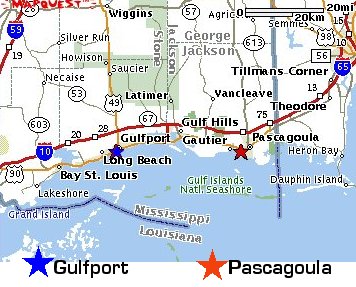
The only "official" document in any sense attached to the published article is geographic context, not investigation: a road map of the Mississippi Gulf Coast and a generic photograph of the moon over Gulfport. There is no investigating-body report to quote, no case number, and no closing finding. The official record here is an absence, and that absence is itself the most verifiable fact about the case.
What did the witnesses think it was?
The witness, "Eve," presents the experience as a genuine close encounter with a piloted craft and its occupants, not as lights misread at a distance. She is firm that she saw two beings through a window, that the pilot turned its attention toward her, that a searching beam quartered the ground and then retracted in one motion, and that four objects worked the area in concert before leaving. The detail she returns to most is the pull she felt to keep looking, and the fear that the beam was hunting for her specifically, which is why she says she hid in the bushes.
The element she treats as proof that something truly anomalous happened is the time discrepancy. By her reckoning only minutes had passed, while her aunt insisted the household had long been indoors and in bed. She frames this as missing time, the sense that more of the night had elapsed than she could account for. The published account presents the aunt and a cousin as the people whose recollections clashed with hers, but neither is quoted giving an independent statement, and no investigator interviewed them. So while the narrative gestures at corroboration through the family's differing sense of the hour, that corroboration was never documented. In evidentiary terms this remains a single-witness account.
It is worth weighing the conditions under which the memory was recorded. The witness was a child at the time, the telling came more than three decades later, and it was published in an era when "missing time," occupant encounters, and coordinated craft had long since become standard furniture of UFO and abduction culture. None of that proves the memory wrong, and a sincere witness is not discredited by the lateness of her report or by the absence of records. But it does mean her belief, however honestly held, stands on recollection alone, with no contemporaneous diary, letter, news item, or third-party statement behind it.
Is the Encounter at Gulfport, Mississippi real? The two-pass assessment
Pass one, the ordinary readings. The most economical explanation is that this is a sincere but heavily reconstructed childhood memory, set down some thirty-five years after the fact and shaped by decades of intervening UFO and abduction culture. A 12-year-old watching bright colored lights at night on the Gulf Coast could have been looking at aircraft on approach to or departure from local fields, a slow-moving light source, or planets and stars made strange by the hour and the mood. The "search beam" that retracts in one motion, the coordinated four craft, the beings with long slender arms seen through a window, and above all the missing-time discrepancy are all motifs that became culturally standard only after the late 1970s, well after 1966 but well before the 2002 telling. That does not make the witness dishonest. It means the narrative form is entangled with later templates, and autobiographical memory across that span is reconstructive and porous. A second, blunter ordinary reading is that the account is simply a story, with no way to test it because nothing about it was recorded at the time. There is no photograph, no sketch published with it, no physical trace, no named independent witness, and no contemporaneous report. None of these ordinary readings can be confirmed either, because there is nothing material to examine.
Pass two, if real. If a real external event occurred as described, it would be a high-strangeness close encounter of the third kind: a structured, piloted craft with visible occupants, a directed light beam used to search the ground, multiple objects operating together, and an apparent period of unaccounted time consistent with the missing-time reports that later became central to abduction literature. Taken at face value it would sit at the extraordinary end of the 1966 wave, more like the kind of occupant case that put Pascagoula, also on the Mississippi coast, into the national record seven years later. But Pascagoula is the instructive contrast. That 1973 case had adult witnesses, immediate reporting to law enforcement, contemporaneous investigation, and a durable documentary trail. This one has none of those things.
The tier is Unknown. There is no authenticated material and no official documentation that would lift it to Verified Unexplained, and there is no counter-explanation or official finding to argue against, which is what Disputed would require. What there is, is a single, vivid, late-reported witness account with zero independent corroboration, no Blue Book or civilian-organization file, and no contemporaneous trace of any kind. It is not discredited, because no analyst has shown a method that explains it away; you cannot debunk a story that left no evidence. It simply stands, unverifiable in either direction, on the testimony of one person and nothing else. That is precisely what Unknown is for: a case with no official narrative, resting entirely on the witness, where the honest verdict is that we cannot say what happened and the record gives us no way to find out.
Sources
- web.archive.org/web/20240303002938/https://www.ufocasebook.com/mississippiencounter.html
- web.archive.org/web/20030406202757/http://www.ufocasebook.com:80/mississippiencounter.html
- www.archives.gov/research/military/air-force/ufos
- www.fold3.com/publication/461/us-project-blue-book-ufo-investigations-1947-1969
- www.af.mil/About-Us/Fact-Sheets/Display/Article/104590/unidentified-flying-objects-and-air-force-project-blue-book/
More cases from this region: UFO sightings in United States