The Tyrone, Pennsylvania Beam Photograph
On Sunday evening, 20 October 2002, a man was hiking in the woods on Ice Mountain near the town of Tyrone, in Blair County, Pennsylvania. This case file covers what witnesses reported, the official narrative, and a two-pass assessment with its evidence tier.
What did witnesses see at Ice Mountain?
On Sunday evening, 20 October 2002, a man was hiking in the woods on Ice Mountain near the town of Tyrone, in Blair County, Pennsylvania. He had stayed out longer than he planned. He estimated it was about 7:30 PM local time, and it was getting dark, when he started walking back to his vehicle and noticed a bright light to the south, moving toward him in a northerly direction. His first impression was an airplane. As he put it, "the light appeared similar to the brightness of a normal aircraft light when first observed."
Then the light stopped. It began to pulsate, brightening and dimming. The witness noticed a faint orange-red haze encircling it. The pulsing sped up, the light started to flicker very rapidly, and it grew much brighter as it pulsed. Then, in his words, "suddenly a thin beam of very bright blue-white light was emitted from the bottom of the object to the ground."
He was emphatic that this was not an ordinary searchlight. "This was no searchlight," he told Stan Gordon. "Even a well focused searchlight tends to diffuse with distance, but this light was a tight, bright beam from top to bottom." He reached for an everyday comparison to convey how narrow it looked: "Imagine a piece of dental floss held at arms length, and you'll have a good idea of the beam's apparent width from my location."
The pulsing stopped, the beam went out. He was candid about the limits of what he could see in the dark: "As far as the form, I couldn't see any craft or object per se, just the bright light itself and the beam that came down from it, as it was pretty dark at the time." When the object was first moving it looked circular and orange-red. When it stopped and started pulsating it seemed more oval or egg shaped.
The object kept hovering. The witness ran to his vehicle, about 100 yards away, and grabbed his Olympus digital camera. He took one photograph while it hovered. He got a second shot just as the object began to move slowly in a tight circle. As he set up for a third frame, the object, he said, "suddenly shot straight up in the air at fantastic speed and was gone from sight."
The sky was partly cloudy. He detected no sound and no odd smells. He put the whole encounter at five minutes or less. He estimated he was about a quarter mile away or farther from where the beam met the ground, and put the object at roughly 1,000 feet in altitude. He added one detail that becomes central to any explanation of this case: "there is a large microwave relay tower at the top of the mountain," and "the beam appeared to be hitting the ground close to the tower." He could not see the exact spot where the beam struck. His closing words: "I don't know what this thing was, but I know I've never seen anything like it before," and "If anyone else saw this object, please let me know. If for no other reason, so I can stop questioning my sanity."
What is the official explanation?
There is no government file on this case. No Air Force, no FAA inquiry, no police report entered the public record. What exists instead is the civilian investigative trail, and it is worth being precise about what that trail does and does not contain.
The witness emailed his account and his two color photographs to two places: the National UFO Reporting Center (NUFORC), then run by Peter Davenport, and the Pennsylvania investigator Stan Gordon. Gordon has taken UFO and cryptid reports from the public in Pennsylvania since 1969 and ran field teams of scientists, engineers and former military specialists from 1970 onward; he is the same investigator long associated with the 1965 Kecksburg case. Gordon wrote up the report and released it on 23 October 2002. He noted, "Due to his concerns, my only communication with the witness has been via email," because the man was worried about ridicule and asked not to be identified.
On the photographs, Gordon was explicit at the time: "Due to computer problems, I am unable to post the photographs at this time. I have talked with Peter Davenport at the National UFO Reporting Center, who is expected to post the pictures as soon as he completes his sighting report updates." That is the crux of the documentary problem with this case. The two Olympus frames, the only physical evidence, were never published by Gordon and never appear in the NUFORC record. They did not surface through the established channels. No independent analyst has ever had the files to examine.
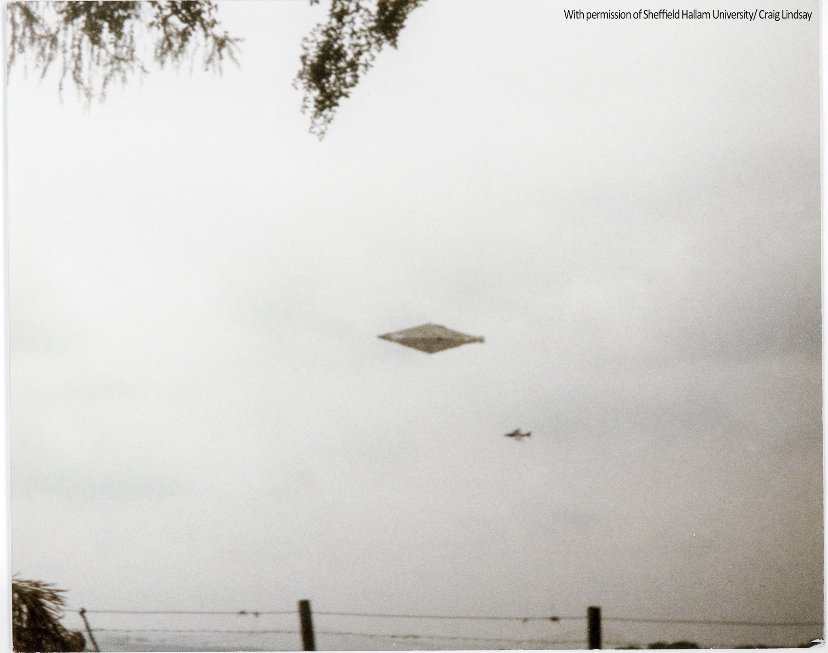
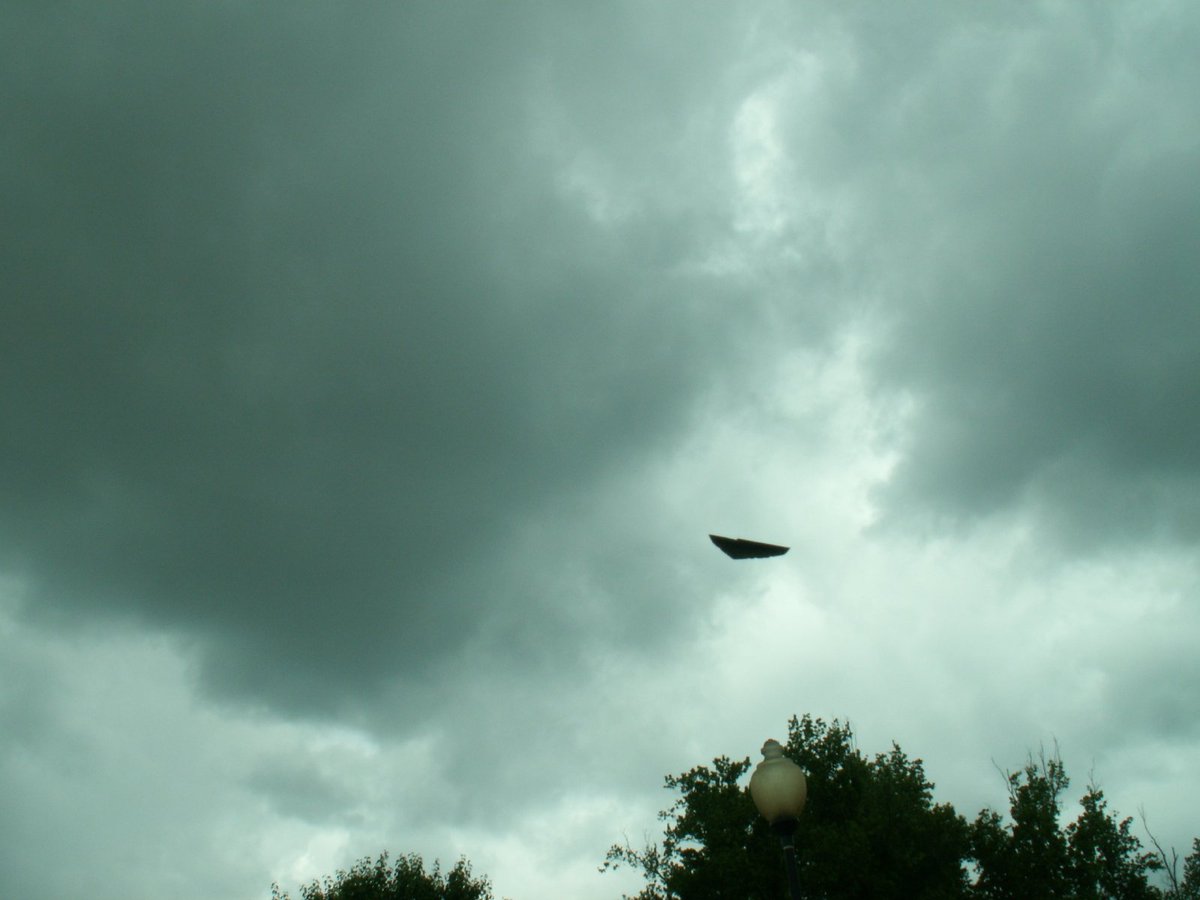
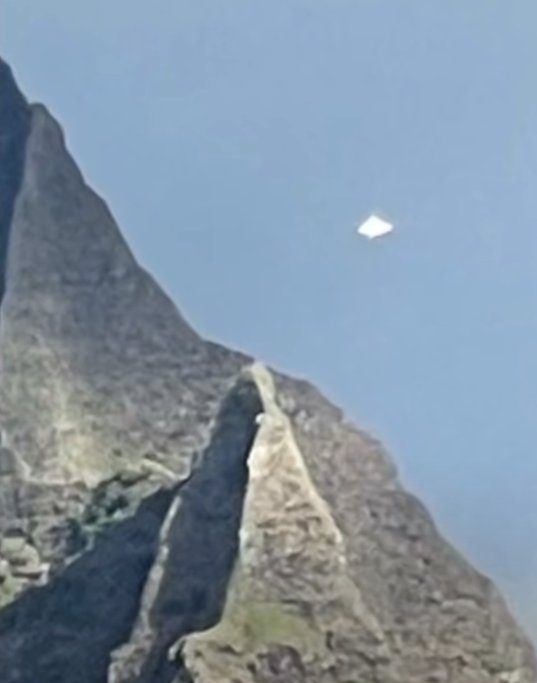
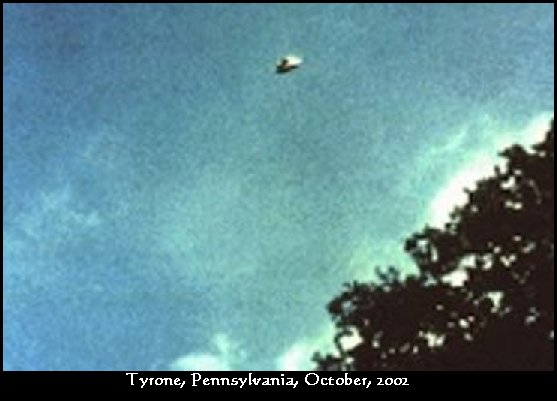
One image does circulate online attached to this case. The long-running site UFO Casebook reproduces Gordon's full report and hangs a photograph beside it, captioned "Tyrone, Pennsylvania, October, 2002," showing a small bright disc in a bright blue daytime sky above a tree line. That image cannot be the witness's photograph and should be treated as a miscaptioned stand-in. The witness's own account is unambiguous: the sighting happened around 7:30 PM, it was "pretty dark at the time," and he stressed that he "couldn't see any craft or object per se, just the bright light itself and the beam." A daylight photo of a crisply defined metallic saucer with no beam is the opposite of what he described. So the central piece of evidence in the official trail is missing, and the picture that fills the gap online is not it.
It is also worth correcting a claim that floats around aggregator write-ups: that this was a "weather balloon." The think-about-it documentation archive files the case under a "weather balloon" tag, but that archive states plainly it reproduces reports as a chronological record without analysis or opinion, and it offers no balloon evidence. The label is a taxonomy artifact, not a finding. No named investigator ever demonstrated a balloon, an aircraft, or any other cause.
What did the witnesses think it was?
The witness believed he had seen something genuinely anomalous and said so without embellishment. He never claimed it was extraterrestrial. He never claimed to see a structured craft. He was careful to report only the light, the haze, the egg-shaped pulsation, and the impossibly narrow blue-white beam, and he reached for a homely image, dental floss at arm's length, to keep the description honest rather than dramatic. His parting line, that he wanted to know if anyone else saw it "so I can stop questioning my sanity," is the language of a puzzled observer, not a man selling a story. He asked for anonymity specifically because he feared ridicule, which is a motive to stay quiet, not to invent.
The single most consequential thing the witness himself volunteered is the microwave relay tower at the top of the mountain, with the beam appearing to terminate close to it. He offered that detail freely, even though it hands a skeptic the obvious place to look. That structure is real and identifiable. Aviation navigation databases list the Tyrone VORTAC, identifier TON, a combined VOR and TACAN radio navigation facility, sitting at 40 degrees 44 minutes 06 seconds north, 78 degrees 19 minutes 53 seconds west, elevation 2,630 feet, on the ridge northeast of Tyrone borough. Its magnetic variation is logged as 1965, so the installation predates the sighting by decades, and it ran 24 hours for public use. This is almost certainly the "large microwave relay tower" the witness saw on the mountaintop. A hiker would not necessarily know a VORTAC from a microwave relay, but he correctly identified a tall lit aviation structure on the summit.
There is one striking corroborating thread, and it is independent. Four days after the Tyrone report went out, on 24 October 2002, a separate witness in Adelaide, South Australia filed report number 25760 with NUFORC describing an event from 12 September 2002. He reported an "oval shaped glowing ball of gas," bright red-orange, hanging maybe half a kilometer up, that after about a minute "emitted a very thin beam of light straight down from the middle of the object to the ground," lasted about five minutes, then dissipated. He had clearly read the Tyrone account, because he wrote, "as to the report of an eyewitness statement on the Rense.com site 'UFO Emits Light Beam Near Tyrone, PA', I have no clue as to what this was," and added that his own sighting was "very very similar sounding to the gentleman's experience in Tyrone, PA." This is not a second witness to the same event. It is a second, unconnected person on the other side of the world describing the same unusual phenomenology, an orange-red oval that fires a single pencil-thin beam straight down, which at minimum tells you the Tyrone description is not a one-off invention.
Is the Tyrone, Pennsylvania Beam Photograph real? The two-pass assessment
Pass one, the ordinary explanations. This case has a built-in candidate that the witness handed over himself: the lit aviation tower on the summit, the Tyrone VORTAC, with the beam seeming to land near it. The prosaic reading runs like this. A hiker at dusk, tired and heading back to his car, sees a bright point of light low over a mountaintop that carries a tall, lit navigation structure. Aircraft on approach, the tower's own obstruction lighting, atmospheric scintillation in the cooling October air, and the long line of sight up to the ridge can all conspire to make a fixed or slow light appear to pulse, flare, and change color. A VORTAC emits radio, not visible light, so the tower itself cannot throw a blue-white beam, which means the beam, if it was external at all, would have to be something else near the tower: a distant aircraft landing light pointed his way, a contractor's work light, or a misperceived reflection. It is also fair to flag that the one photograph circulating online for this case is a daylight disc that flatly contradicts the witness, which is the kind of detail that makes any aggregator account of this sighting unreliable and invites suspicion of the whole file. And the "shot straight up at fantastic speed" ending, while dramatic, is exactly what a light simply blinking out or being occluded by cloud can look like to a startled observer.
But the ordinary reading has real friction. The witness specifically pre-empted the searchlight idea, and he knew the difference: a searchlight diffuses with distance, and this beam stayed needle-thin "from top to bottom." A tower obstruction light does not pulse in an accelerating flicker and then fire a collimated downward beam. None of the mundane sources near a VORTAC naturally produce a tight vertical shaft of blue-white light that switches off cleanly. And the Adelaide report, filed independently within days, describes the same specific oddity, an orange-red oval emitting a single thin downward beam, which a generic aircraft-plus-tower misidentification does not predict.
Pass two, if it is real. Taken at face value, this is a low, hovering, pulsating light source that projected a coherent, tightly bounded beam toward the ground near a mountaintop installation, changed apparent shape from circular to egg-shaped as it stabilized, moved in a tight circle, and departed vertically at high speed. The downward-beam-near-infrastructure motif recurs across the Pennsylvania reporting Gordon collects and, as the Adelaide case shows, well beyond it. If genuine, it belongs to that recurring class of luminous objects that appear to interact with the ground or with fixed structures, and it remains unexplained.
The verdict. There is no official narrative to weigh, no Blue Book, no FAA finding, nothing to log in pass two as an apparatus debunk, because no agency ever touched this. The only physical evidence, the two Olympus frames, was never published by Gordon or NUFORC and has never been independently examined, so the case cannot be authenticated and cannot be discredited on its imagery. The lone circulating photo is a miscaptioned stand-in and proves nothing. No named analyst has ever shown a method-based prosaic solution. What stands is a careful, self-aware witness account, a real lit tower the witness himself volunteered, and an independent foreign report of the same rare phenomenology. That combination is too consistent to call discredited and too thin on hard evidence to call verified. It rests on its single witness and his missing photographs. Tier: Unknown.
Sources
- rense.com/general31/pa.htm
- ourairports.com/navaids/TON/Tyrone_VORTAC_US/
- www.pilotnav.com/navaid/faa-2058
- www.globalair.com/airport/apt.navaids.aspx?aptcode=aoo
- web.archive.org/web/20230925003437/https://www.ufocasebook.com/tyronepa2002.html
- thinkaboutitdocs.com/2002-ufo-emits-beam-of-light/
- www.stangordon.info/wp/stan-gordon/
More cases from this region: UFO sightings in United States