Hereford UFO Sighting, Herefordshire: The Light Trails of 15 September 2026
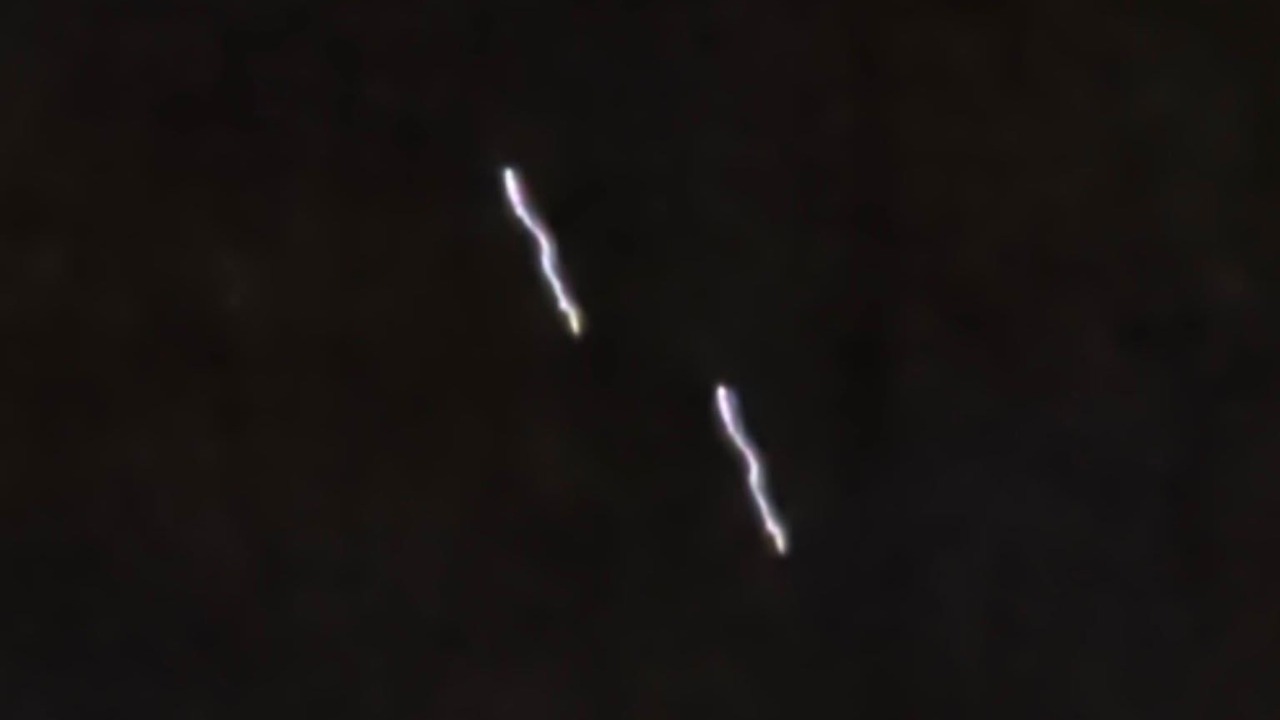
Two Hereford residents recorded streaks of light over the city on separate September evenings. Measurement of the published frames shows the wiggle in the trails is the camera, not the lights, and weather records show the two nights were not the same sky at all.
What did witnesses see at Hereford?
Two residents of Hereford, in the English county of Herefordshire, recorded streaks of light in the night sky on separate evenings in September 2026. The Hereford Times published their accounts and two still frames on 16 September 2026.
Karl Davis saw the lights on 15 September. Terri Michelle Edkins saw them on 12 September, three nights earlier, and her family can be heard reacting during a recording. Both witnesses described multiple streaks of light moving through the sky. The newspaper ran the two sightings together as a single phenomenon over the city, under a headline promising video.
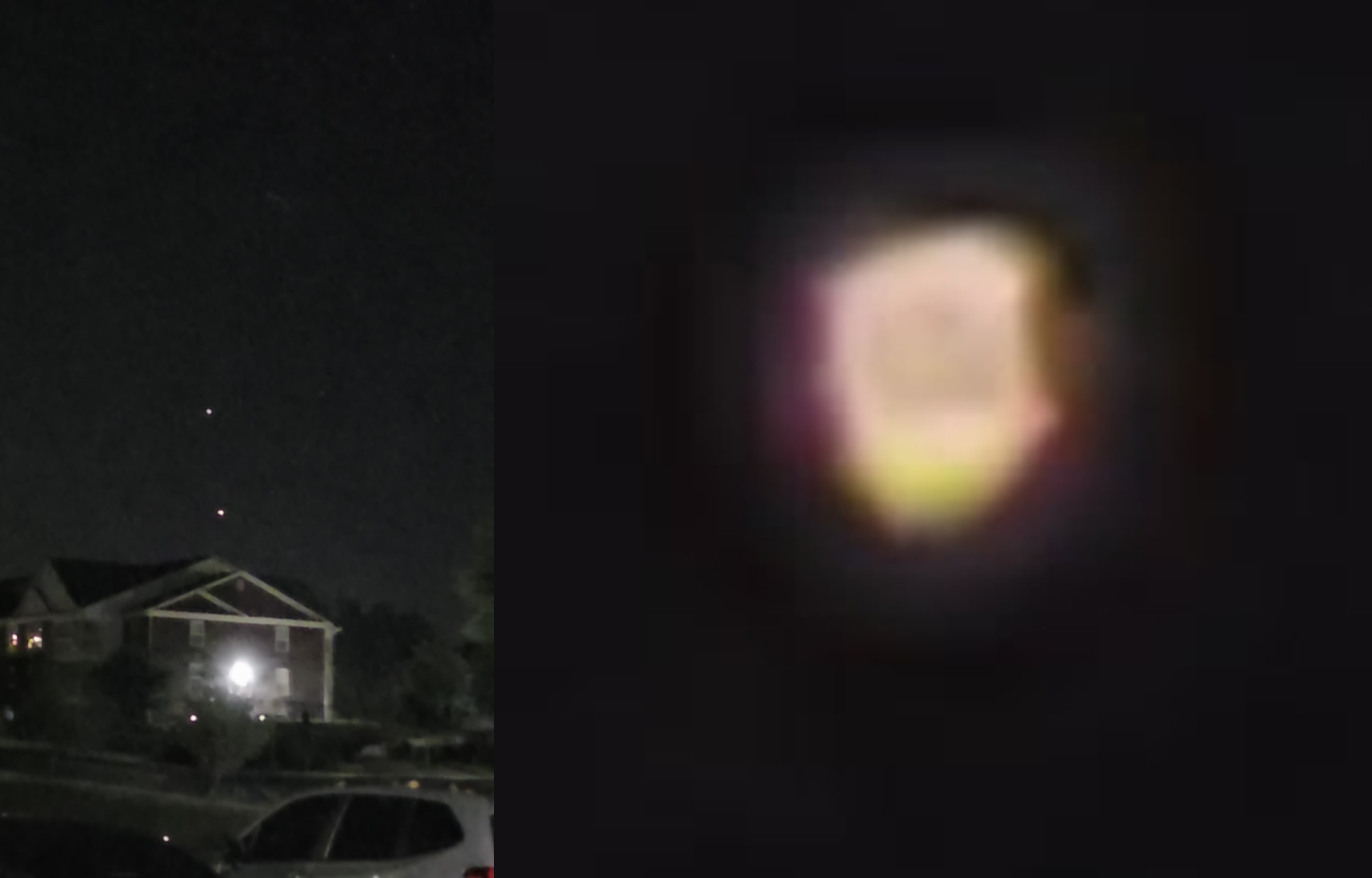
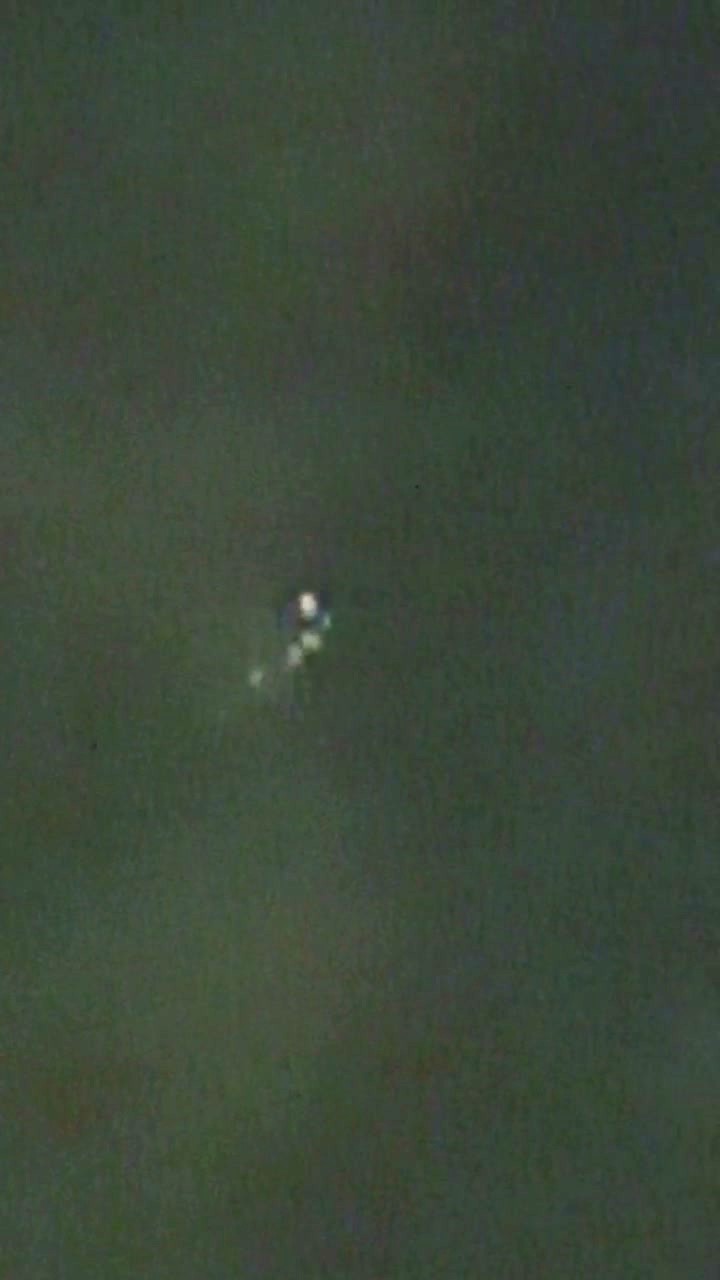
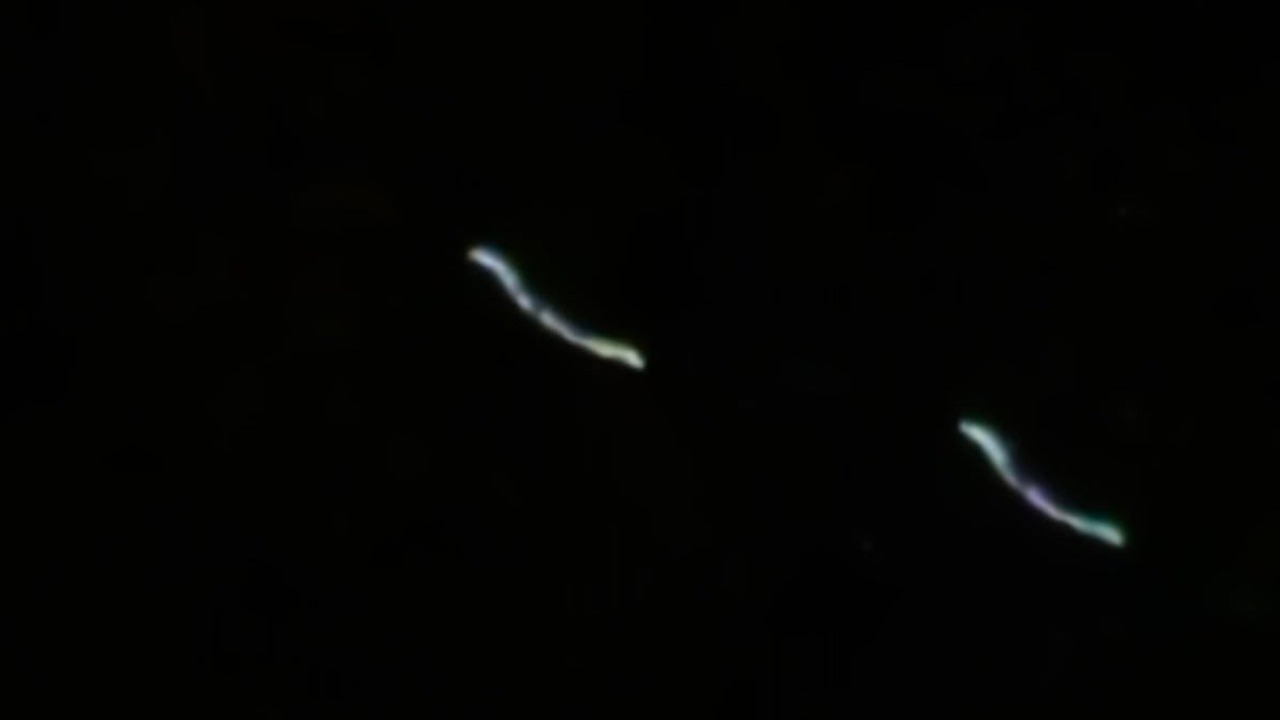
The two frames credited to Karl Davis are the only imagery the article carries. Each measures 1280 by 720 pixels, the standard dimensions of a video frame rather than of a phone photograph, and each shows exactly two luminous trails against a sky that is otherwise almost entirely black. The trails are not straight. They wander, doubling back on themselves in a shallow S, and they carry colour fringing along their length, which is the detail the witnesses fixed on.
No time of night is given for either sighting. No direction of view is given for either sighting. Those two omissions turn out to matter more than anything else in the article, because they are the two facts that would have allowed the lights to be identified outright.
More footage and images of this sighting
What is the official explanation?
There is no official statement on this event. No police force, aviation authority or government body has commented, and none appears to have been asked. The Ministry of Defence closed its UFO desk in 2009 and no longer collects or investigates public sighting reports, so there is no British government channel through which a Hereford sighting in 2026 would generate a file.
The only institutional account of the event is the Hereford Times report itself, written by reporter Joseph Whiteman and published at 10:24 UTC on 16 September 2026. That report carries an oddity worth recording, because it bears on how much weight the write-up can take. Inserted directly above the account of the sighting is a syndication disclaimer reading that the article "is brought to you by our exclusive subscriber partnership with our sister title USA Today, and has been written by our American colleagues. It does not necessarily reflect the view of The Herald." Neither USA Today nor The Herald has any evident connection to a sighting in Herefordshire, and The Herald is a different Newsquest title altogether. The disclaimer appears to have been pasted in from a template.
Roughly half the published article is generic background on unidentified flying objects that has nothing to do with Hereford, covering the post-war increase in reports, the Committee for Skeptical Inquiry, and the influence of the subject on folklore and fiction. The page also promises video in its headline and its own URL slug, and contains no video element, no embedded player and no VideoObject markup. What the reader is given is two stills.
None of that makes the witnesses wrong. It does mean the article is a thin vehicle for them, and that the evidence has to be read directly rather than through the write-up.
What did the witnesses think it was?
The Hereford Times quotes Terri Michelle Edkins' family reacting during her recording on 12 September:
"It's actually shining different colours. It's actually shining red and blue."
"It's like a rainbow."
"It's weird."
That is the entire body of direct witness speech in the article. Karl Davis is not quoted at all; he is credited only as the source of the two images and as having witnessed the phenomenon on 15 September. Neither witness is quoted on how long the lights lasted, how many there were, which way they were facing, how high the lights appeared, or whether the lights made any sound.
The colour description is the most useful thing either witness said, and it is consistent with what the published frames show. In both frames the trails are predominantly white to pale blue along their length with warmer tips, and the sampled colour along the two trails in the second frame runs from roughly red 113, green 137, blue 135 at one end to red 89, green 119, blue 114 at the other, a modest but real shift. A bright point source low in the sky, seen through a long path of turbulent air, disperses into exactly this kind of shifting colour. What a still frame cannot show, and what the family clearly saw, is how fast that colour changed.
Is the Hereford UFO Sighting, Herefordshire: The Light Trails of 15 September 2026 real? The two-pass assessment
PASS ONE: HOW COULD THIS BE MUNDANE
The single most testable claim in the article is that the lights were moving. The published frames settle that claim, and they settle it against the article.
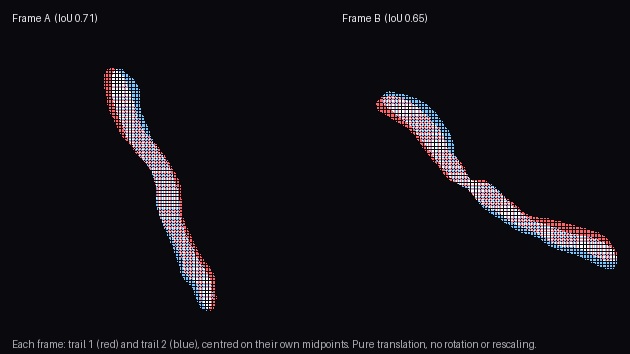
Each frame contains two separate luminous trails. In the first frame the two trails contain 2,628 and 2,573 bright pixels, a difference of two percent, and their bounding boxes are 77 by 167 and 70 by 168 pixels. In the second frame they contain 2,985 and 2,860 pixels and their bounding boxes are 174 by 119 and 162 by 123 pixels. In both frames, in other words, the two trails are the same size and the same shape as each other.
Testing that properly: take each trail, centre it on its own midpoint, and measure how well the two then overlap, applying nothing but translation. The first frame returns an intersection over union of 0.708, refining to 0.714 at an offset of one pixel. The second returns 0.653, refining to 0.719. For a control, rotate one trail against the other and repeat: at 30, 45 and 90 degrees the first frame returns 0.086, 0.059 and 0.046, and the second returns 0.050, 0.039 and 0.030. The match is roughly eight to twenty four times better than the rotated controls.
Two lights flying independently across the sky cannot produce that. Two point sources that are not moving at all, recorded on a handheld camera during a long exposure, produce it exactly: the shake of the photographer's hands is written identically onto every point source in the frame. The wander in the trails is a record of the camera's path, not of anything's flight. One honest caveat belongs here: the first frame's curve is close to point symmetric, so a 180 degree control still returns 0.532, noticeably higher than the other rotations. The 30, 45 and 90 degree results carry the argument, not the 180.
The two frames also differ from each other. The first is a tall narrow squiggle, 77 pixels wide and 167 tall; the second is a wide shallow one, 174 by 119. Different shake paths at different moments, which is what handheld recording produces and what objects holding a course would not.
So the streaks are time exposures of stationary points, and the question becomes what the points were. Here the two nights separate sharply, and the newspaper's decision to run them as one phenomenon is the second thing the evidence contradicts.
Cloud records settle 12 September. Hereford has no reporting station of its own, so three surrounding airfields were checked through the Iowa Environmental Mesonet archive of routine hourly observations. On the evening of 12 September, Cardiff reported overcast at 700, 600, 400 and 600 feet between 19:50 and 22:50 UTC, with visibility down to about three miles at 21:50; Brize Norton reported overcast at 1,500, 1,000, 900 and 1,000 feet across the same hours; Birmingham reported broken at 1,000 feet with a second overcast layer. Three stations bracketing the city, all reporting a solid deck between 400 and 1,500 feet. Nothing astronomical was visible from Hereford that evening. Whatever Mrs Edkins recorded on 12 September was underneath that deck, or was light thrown onto the underside of it.
The evening of 15 September was the opposite. Cardiff reported no cloud detected at 19:50, 20:50, 21:50 and 22:50; Brize Norton reported no cloud detected, then a few at 4,000 feet, then no cloud detected twice more; Birmingham reported scattered at 2,500 feet early and a few at 2,000 feet late. A clear sky, and the frames credited to Mr Davis are from this night.
What was up there on 15 September, computed for Hereford at 21:00 UTC: exactly one planet. Saturn stood at azimuth 108 degrees, altitude 17 degrees, magnitude plus 0.41, low in the east southeast. Venus, Jupiter, Mars and the Moon were all below the horizon, at minus 19, minus 21, minus 15 and minus 13 degrees respectively. Among the bright stars, three sat low enough to scintillate hard: Capella at azimuth 33, altitude 16, magnitude plus 0.08; Arcturus at azimuth 284, altitude 13, magnitude minus 0.05; and Fomalhaut at azimuth 148, altitude 2. Vega, Deneb and Altair were all high, at 67, 83 and 46 degrees, where the air is thin and colour flicker is mild.
At 13 to 17 degrees above the horizon an object's light crosses roughly four air masses, which is the band in which chromatic scintillation is most violent. That is the physical basis for "shining red and blue" and "like a rainbow", and it is a well established behaviour of bright low objects rather than an exotic one.
The satellite explanation was checked and does not fit. Only two Starlink launches occurred in the first half of September 2026, Group 15-23 on 2 September and Group 15-24 on 6 September, so the nearest launch preceded the 15 September frames by nine days and the 12 September sighting by six. A freshly deployed train is a tight string for a few days after launch, and in any case 12 September was under total overcast.
Where pass one stops: the identification cannot be closed. Naming which two points these were requires knowing which way each camera was pointed and at what hour, and the article supplies neither. Saturn, Capella and Arcturus are each separated from the others by seventy degrees or more of azimuth, so no two of them fall in one narrow frame, which means at least one of the two trails belongs to something not on that list. A pair of aircraft lights, a pair of fixed lamps on high ground, or one bright source together with an internal lens reflection would all reproduce a congruent pair, and nothing in the published material distinguishes between them.
PASS TWO: IF THE REPORT IS TAKEN AT FACE VALUE
Taking the witnesses at their word, the claim is that multiple lights were seen moving across the sky over one city on at least two nights in one week, changing colour as they went.
The colour change survives scrutiny; it is real, it is visible in the frames, and it has a straightforward physical cause. The movement does not survive, because the only evidence offered for it is the shape of the trails and that shape is demonstrably the camera.
What would move this case is cheap and specific, and none of it requires new technology. An unedited original file from either witness would carry an exposure time and, on most phones, a capture timestamp and a compass heading. A single stated direction of view for either night would allow the 15 September sources to be identified outright by the method that closed comparable cases in this archive. And the 12 September recording, which this archive has not seen, is the more interesting of the two, because a light source under a 400 to 1,500 foot overcast deck is by definition local, low and in principle traceable to something on the ground.
The honest position is that the article describes two different events on two different kinds of night, that the photographic claim of motion is contradicted by the photographs themselves, and that what the lights actually were remains open. The case is tiered Disputed rather than resolved: the central claim has been tested and fails, but nothing here has been positively identified, and the 12 September sighting under total cloud is genuinely unaccounted for on the material available.
Sources
- www.herefordtimes.com/news/26554445.video-multiple-ufos-spotted-across-herefords-night-sky/
- ssd.jpl.nasa.gov/horizons/app.html
- mesonet.agron.iastate.edu/request/download.phtml?network=GB__ASOS
- ll.thespacedevs.com/2.2.0/launch/?net__gte=2026-09-01T00:00:00Z&net__lte=2026-09-17T00:00:00Z&search=Starlink&limit=60&mode=list
- www.gov.uk/government/organisations/ministry-of-defence
More cases from this region: UFO sightings in United Kingdom