The Pentagon UAP NDA Waiver: The Department of War Opens a PURSUE Disclosure Channel (14 September 2026)
On 14 September 2026 the Department of War announced a legal waiver letting current and former personnel take UAP information to the PURSUE task force without breaching their nondisclosure agreements. Sixty-five outlets carried it as a breakthrough. The waiver reaches only civil and administrative enforcement, it routes to PURSUE alone where the ODNI memorandum it implements said "AARO or PURSUE", the underlying directive has not been published, and the statute Congress passed in December 2022 already granted more.
What happened
The Pentagon UAP NDA waiver of 14 September 2026 is a policy event, so the artifact is a document. The Department of War announced that current and former personnel may take UAP information to the PURSUE task force without breaching their nondisclosure agreements. Unusually, the document it announced has not been published, and the documents that settle what it means were already public.
At some point on 14 September 2026 the Department of War posted a release headed "Department of War Issues Legal Waiver to Authorize Unidentified Anomalous Phenomena (UAP) Disclosures to PURSUE", filed under Immediate Release as article 4600020 on war.gov. It runs to five short paragraphs. It names no signer, cites no directive number, attaches no memorandum, and gives no address, telephone number or portal through which a person covered by it would actually reach a PURSUE representative.
The opening paragraph states the action: "In direct alignment with President Trump's mandate for comprehensive transparency on Unidentified Anomalous Phenomena (UAP), the Department of War (DOW) today announced the issuance of a targeted legal waiver. This waiver establishes an authorized, legally protected disclosure mechanism for current and former personnel to provide UAP-related National Defense Information (NDI) to designated representatives of the PURSUE effort."
The second paragraph is the operative one, and every limit in this case lives inside it: "Under this directive, all current and former DOW service members, civilian personnel, and contractors holding or previously granted access to UAP-related National Defense Information (NDI) are authorized to disclose protected information directly to official PURSUE representatives. The waiver supersedes civil and administrative enforcement provisions contained within Non-Disclosure Agreements (NDAs) and Special Access Program Indoctrination Agreements (SAPIAs) previously executed within the United States, strictly for communications directed to the PURSUE team."
Three qualifications sit in that sentence and none of them were carried in the headlines. The waiver reaches "civil and administrative enforcement provisions" and stops there. It applies to agreements "previously executed within the United States". And it operates "strictly for communications directed to the PURSUE team".
The remaining paragraphs describe the purpose and the intended effect. Information entering the channel is said to undergo "systematic review, security evaluation, and potential declassification of historical and ongoing UAP data in furtherance of national mission objectives". The Department states that "Historically, individuals with direct knowledge of UAP-related programs cited concerns regarding potential legal liability, loss of clearances, or administrative prosecution stemming from standard NDAs and SAP indoctrination terms", and that the waiver "removes those barriers by explicitly authorizing covered disclosures to PURSUE representatives without triggering breach-of-agreement penalties or standard NDA violations".
The Department names nobody who raised those concerns, identifies no program, and offers no example of information previously withheld from PURSUE because of an agreement. The release does not assert that any undisclosed UAP program exists. It establishes a route by which claims about one could be delivered to the government.
One further point is worth recording because it is a fact about the site rather than about the coverage. The PURSUE portal at war.gov/UFO, read on 15 September 2026, carries no mention of the waiver. Its release list still ends at "RELEASE 05: CLEARED FOR RELEASE - AUG. 7, 2026", the fifth tranche, with the first dated 8 May 2026. The waiver lives only in the newsroom, not on the programme page a prospective discloser would be most likely to visit.
Documents and images
What is the official position?
The official position is the release itself. What makes this case unusual is that the government's own prior paperwork, already public, is the strongest test of the announcement, and it is available in full.
Congress created an authorized UAP disclosure mechanism in December 2022. Section 1673 of the James M. Inhofe National Defense Authorization Act for Fiscal Year 2023, Public Law 117-263, division A, title XVI, enacted 23 December 2022 at 136 Stat. 2959, is codified at 50 U.S.C. 3373b, "Unidentified anomalous phenomena reporting procedures". Subsection (a)(1) directs the Secretary of Defense to establish "a secure mechanism for authorized reporting" covering both UAP events and any federal or contractor "activity or program" relating to them, expressly including "material retrieval, material analysis, reverse engineering, research and development, detection and tracking, developmental or operational testing, and security protections and enforcement". Subsection (a)(2) requires that mechanism to account for "all categories and levels of special access and compartmented access programs".
The protections in subsection (b) are broader than the ones the Department of War announced on 14 September 2026, and the comparison is direct because both texts address the same problem.
Under 50 U.S.C. 3373b(b)(1), an authorized disclosure "shall not be subject to a nondisclosure agreement entered into by the individual who makes the disclosure"; "shall be deemed to comply with any regulation or order issued under the authority of Executive Order 13526 ... or chapter 18 of the Atomic Energy Act of 1954"; and "is not a violation of section 798 of title 18 or other provision of law relating to the disclosure of information". Subsection (b)(2)(A) separately forbids any official with personnel authority to take, fail to take, or threaten a personnel action, "including the revocation or suspension of security clearances, or termination of employment", as a reprisal for an authorized disclosure. Subsection (d)(5) defines a nondisclosure agreement expansively, as "any written or oral nondisclosure agreement, order, or other instrumentality or means" that could be read as a constraint on making an authorized disclosure.
Set the two instruments side by side and the statute is wider on three axes. It reaches criminal exposure under 18 U.S.C. 798 and "other provision of law"; the Department of War release reaches "civil and administrative enforcement provisions" and says nothing about criminal liability. It protects against reprisal and clearance revocation; the release names loss of clearances as a fear it intends to address but grants no protection against it. It covers oral obligations; the release covers executed NDAs and SAPIAs. The release is wider on one axis only, in that it names Special Access Program Indoctrination Agreements explicitly, a term the statute does not use.
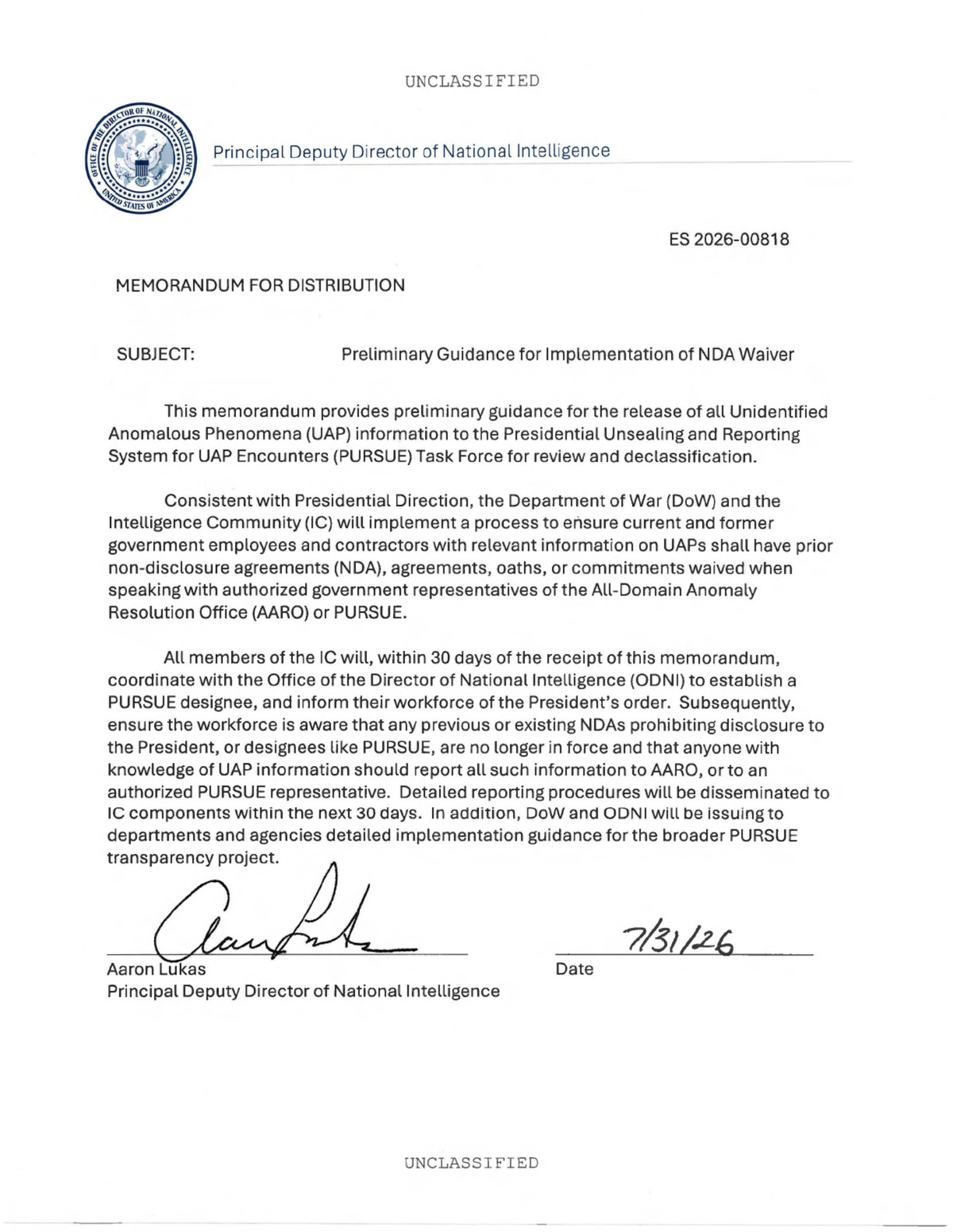
The same comparison applies to the directive the Department of War release implements. On 31 July 2026 Aaron Lukas, Principal Deputy Director of National Intelligence, signed a two page unclassified memorandum, serial ES 2026-00818, "Preliminary Guidance for Implementation of NDA Waiver", published on 1 August 2026 with the administration's permission by Congressman Eric Burlison. Its second paragraph reads: "Consistent with Presidential Direction, the Department of War (DoW) and the Intelligence Community (IC) will implement a process to ensure current and former government employees and contractors with relevant information on UAPs shall have prior non-disclosure agreements (NDA), agreements, oaths, or commitments waived when speaking with authorized government representatives of the All-Domain Anomaly Resolution Office (AARO) or PURSUE."
Two differences between that sentence and the 14 September release have gone unreported, and both narrow the September instrument.
The first is the destination. The ODNI memorandum waives obligations for disclosures to "the All-Domain Anomaly Resolution Office (AARO) or PURSUE", and its third paragraph repeats the pairing, instructing that "anyone with knowledge of UAP information should report all such information to AARO, or to an authorized PURSUE representative". The Department of War release names PURSUE five times and AARO not once. AARO is the office Congress created, the office the statutory protections attach to, and the office that holds the historical record mandate. In the Department's own implementing instrument it has disappeared from the sentence.
The second is the carve-down. The ODNI memorandum says obligations are "waived", without qualification, and it reaches "agreements, oaths, or commitments" as well as NDAs. The Department of War release supersedes only "civil and administrative enforcement provisions" of NDAs and SAPIAs. A department implementing a waiver has written a narrower waiver than the guidance directed it to implement, and has not explained the gap.
The third qualification, "previously executed within the United States", appears in neither the statute nor the ODNI memorandum. The Department has not said what it is for, and this archive will not guess. It is recorded here because it is in the operative sentence and because agreements signed at overseas postings are a foreseeable category it does not obviously cover.
What the people involved say
The counterweight to the announcement was published the same day by the researcher whose Freedom of Information Act work supplies the documents that make the comparison possible.
On 14 September 2026 John Greenewald of The Black Vault published "Department of War Issues New UAP Disclosure Waiver; But Similar Protections Already Existed". Greenewald credits what is new, writing that "The announcement is significant, particularly because the Department expressly references Special Access Program Indoctrination Agreements alongside conventional nondisclosure agreements", then states the finding: "the underlying concept, allowing government personnel to provide otherwise protected UAP information to specifically authorized government investigators without violating their NDAs, is not new."
He poses the question the release does not answer: "What does the PURSUE waiver provide that the government did not already provide through AARO?" His answer is that it cannot yet be determined, because "the Department has not publicly released, at least as of this writing, the underlying directive or complete waiver language accompanying its announcement. That makes a direct legal comparison impossible." Greenewald reports contacting the Department of War for the directive text, implementation instructions and legal advisements, and records that as of publication "the Department of War had not responded".
The documents he means were obtained through two FOIA cases and this archive has read both sets rather than relying on his description of them.
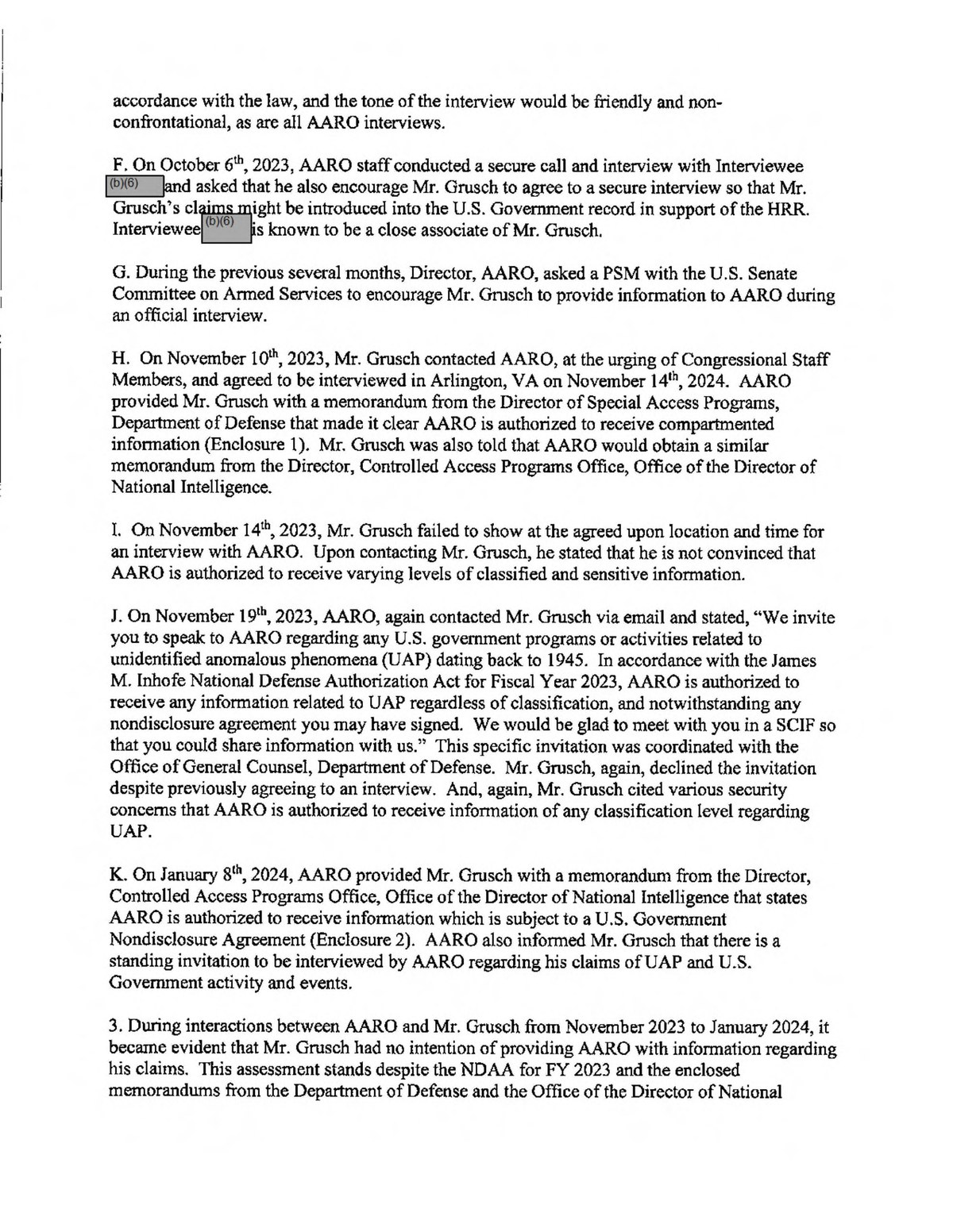
FOIA case 24-F-0266, filed November 2023 and released as 29 pages, covers AARO's attempts to interview the former intelligence officer David Grusch. Its chronology records that on 10 November 2023 Grusch agreed to an interview in Arlington, Virginia, and that AARO supplied him with a memorandum from the Director of Special Access Programs at the Department of Defense establishing that AARO was authorized to receive compartmented information. On 14 November 2023 he did not appear, and told AARO "that he is not convinced that AARO is authorized to receive varying levels of classified and sensitive information". On 19 November 2023 AARO wrote to him: "We invite you to speak to AARO regarding any U.S. government programs or activities related to unidentified anomalous phenomena (UAP) dating back to 1945. In accordance with the James M. Inhofe National Defense Authorization Act for Fiscal Year 2023, AARO is authorized to receive any information related to UAP regardless of classification, and notwithstanding any nondisclosure agreement you may have signed. We would be glad to meet with you in a SCIF so that you could share information with us." The chronology notes the invitation was coordinated with the Department of Defense Office of General Counsel. A small defect in the government's own document is worth recording: paragraph H dates the agreed interview to "November 14th, 2024" while paragraph I, describing the failure to appear at it, dates it to 14 November 2023. The 2024 is a typo in the original.
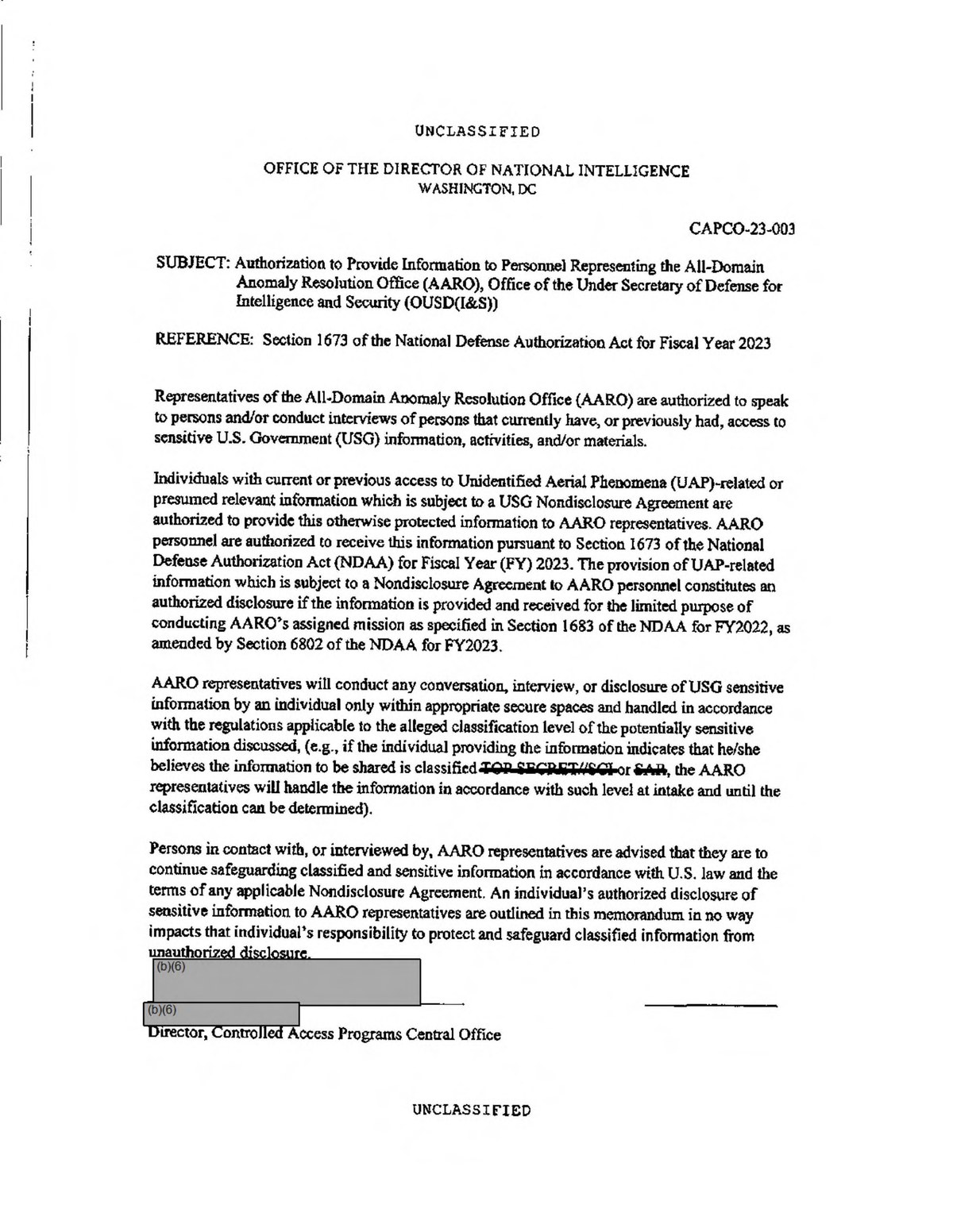
The second enclosure in that release is the document reproduced at the head of this case, and it carries an identifier none of the September coverage named. It is memorandum CAPCO-23-003 of the Office of the Director of National Intelligence, signed by the Director of the Controlled Access Programs Central Office, referencing Section 1673 of the National Defense Authorization Act for Fiscal Year 2023, and provided to Grusch on 8 January 2024. Its second paragraph states: "Individuals with current or previous access to Unidentified Aerial Phenomena (UAP)-related or presumed relevant information which is subject to a USG Nondisclosure Agreement are authorized to provide this otherwise protected information to AARO representatives", and that such provision "constitutes an authorized disclosure if the information is provided and received for the limited purpose of conducting AARO's assigned mission". It also instructs that where an individual believes the material to be classified at the levels struck from the released copy, AARO representatives are to handle it at the asserted level "at intake and until the classification can be determined". That is the pre-existing mechanism, in a signed government memorandum, two years and eight months before the September announcement.
FOIA case 24-F-1138, filed April 2024 and released in full in 2025, produced AARO's Verbal Legal Advisement, the script read to a witness before an interview. Greenewald quotes it: the witness is asked to confirm "that for the limited purpose of this oral history, and only during the course of our discussion in this Secure Compartmented Information Facility (SCIF), that the information you disclose is not subject to any Nondisclosure Agreement you have signed", and is told "Upon completion of this interview today all non-disclosure agreements remain in full force."
Grusch's own objection, recorded in a 13 November 2023 email in the FOIA release, is the one the new waiver still does not address. He wrote that "The key issue here is that many of these activities have conventional classified and compartmented Security Classification Guides that also cover non-UAP activities as well", and that "To discuss the UAP-related activities would also expose these conventional SAP mission areas." The protection on offer covered UAP information. His stated difficulty was that the UAP information could not be described without disclosing adjacent compartmented material that no UAP waiver touches. The September release authorizes disclosure of "UAP-related National Defense Information" and is silent on collateral classified material, which is the same silence he refused to act on in 2023. The FOIA record documents the disagreement between Grusch and AARO. It does not establish which reading of the authority would have prevailed had it ever been adjudicated.
One further gap was established independently the same day. DefenseScoop, which has covered the PURSUE programme since its announcement, published Brandi Vincent's report on 14 September 2026 and recorded that "Pentagon spokespersons did not identify PURSUE representatives or respond to questions from DefenseScoop about the new waiver on Monday." That matters more than it sounds. The waiver's entire operation depends on a person reaching a "designated representative of the PURSUE effort", and as of publication neither the release, nor the PURSUE portal at war.gov/UFO, nor the Department in response to press questions had named who those representatives are or how to contact them. Two outlets asked the Department for the underlying directive and for the mechanics on the day of the announcement, and neither received an answer.
Is the Pentagon UAP NDA Waiver: The Department of War Opens a PURSUE Disclosure Channel (14 September 2026) real? The two-pass assessment
Tier: Unknown. There is no phenomenon here to resolve, and the archive does not apply a sighting tier to a policy instrument. What can be assessed is the narrower question of what the 14 September 2026 waiver actually changes, and on the available documents that question has a defensible answer in both directions.
Pass one, the deflationary reading. The core permission is three years and nine months old. Congress enacted it in Section 1673 of the FY2023 NDAA on 23 December 2022, and 50 U.S.C. 3373b(b)(1) already provides more than the Department of War announced: it disapplies nondisclosure agreements including oral ones, it covers Executive Order 13526 and the Atomic Energy Act, it states that an authorized disclosure "is not a violation of section 798 of title 18 or other provision of law relating to the disclosure of information", and it separately prohibits reprisal including clearance revocation. ODNI reduced that to a signed operational memorandum in CAPCO-23-003 and handed it to the most prominent UAP witness in the country in January 2024. The Presidential direction of July 2026 and the ODNI implementing memorandum ES 2026-00818 of 31 July 2026 restated it again. On this reading the September release is the Department of War notifying the public that it has done what guidance told it to do six weeks earlier, written in the register of an announcement rather than of a compliance notice, and the 62 to 65 outlets that carried it as a breakthrough were reporting the restatement rather than the substance.
Pass two, what would make it matter. Three things in the release are not in the earlier instruments. Special Access Program Indoctrination Agreements are named explicitly, and a SAPIA is the specific paper a person inside a waived or unacknowledged programme signs; naming it removes an argument that the statutory language reached ordinary NDAs only. A Department-level instrument binds the Department's own security apparatus and its contractors in a way a statute addressed to the Secretary of Defense and a memorandum addressed to the intelligence community do not, and it is the Department's security officers, not Congress, who in practice decide whether a former employee is in trouble. And a separate, publicly announced channel has a signalling function that a statute buried in title 50 does not: the statutory mechanism has been on the books since 2022 and has not produced the disclosures its authors intended, which is itself evidence that the obstacle was never purely legal.
Weighing the two, the deflationary reading is better supported on the text, and the case for significance depends entirely on a document that has not been released. That is the finding this archive would put weight on. The waiver, as announced, is narrower than the statute it sits beside on criminal exposure and on reprisal, narrower than the ODNI memorandum it implements in routing to PURSUE alone while ODNI named "AARO or PURSUE", and narrower again in reaching only "civil and administrative enforcement provisions" where ODNI said obligations are "waived" without qualification. A person weighing whether to come forward is being offered, in the Department's own words, relief from civil and administrative enforcement of agreements executed in the United States, for statements made to one task force. The exposure that has always deterred this category of witness, criminal liability for disclosing national defense information, is not mentioned in the release at all. The statute does mention it, which is a reason to route a disclosure through the statutory mechanism rather than the announced one, and which makes the disappearance of AARO from the Department's sentence the single most consequential detail in the document.
Two questions remain open and both are answerable if the government chooses. What does the underlying directive say, and who signed it. And how is collateral compartmented material to be treated when UAP information cannot be described without it, which is the objection David Grusch put in writing in November 2023 and which no instrument issued since has addressed. Until the directive is published, the honest statement is the one Greenewald reached on the day: it cannot yet be determined whether this materially expands the protections already available, or primarily establishes a new authorized recipient operating under protections similar to those that already existed.
Sources
- www.war.gov/News/Releases/Release/Article/4600020/department-of-war-issues-legal-waiver-to-authorize-unidentified-anomalous-pheno/
- www.war.gov/UFO/
- www.theblackvault.com/documentarchive/department-of-war-issues-new-uap-disclosure-waiver-but-similar-protections-already-existed/
- documents2.theblackvault.com/documents/osd/24-F-0266.pdf
- uscode.house.gov/view.xhtml?req=granuleid%3AUSC-prelim-title50-section3373b&edition=prelim
- uscode.house.gov/view.xhtml?req=granuleid%3AUSC-prelim-title50-section3373&edition=prelim
- burlison.house.gov/sites/evo-subsites/burlison.house.gov/files/evo-media-document/memorandum_2026.pdf
- burlison.house.gov/media/press-releases/rep-burlison-releases-administration-memorandum-president-trumps-uap-nda
- mufon.com/2026/09/15/department-of-war-issues-legal-waiver-to-authorize-unidentified-anomalous-phenomena-uap-disclosures-to-pursue/
- www.abovethenormnews.com/2026/09/14/uap-secrecy-agreement-waiver/
- dallasexpress.com/national/pentagon-waives-uap-secrecy-pacts-so-insiders-can-talk-to-pursue/
- defensescoop.com/2026/09/14/pentagon-legal-relief-uap-whistleblowers-trump-project/
More cases from this region: UFO sightings in United States