The Kirtland Air Force Base Control Tower Sighting of 4 November 1957
Two Civil Aeronautics Administration controllers with twenty three years of experience between them watched an object the shape of an upended automobile descend into a restricted area at Kirtland, and the Air Force closed the file with a conclusion its own three reasons do not support.
What did witnesses see at Kirtland Air Force Base control tower?
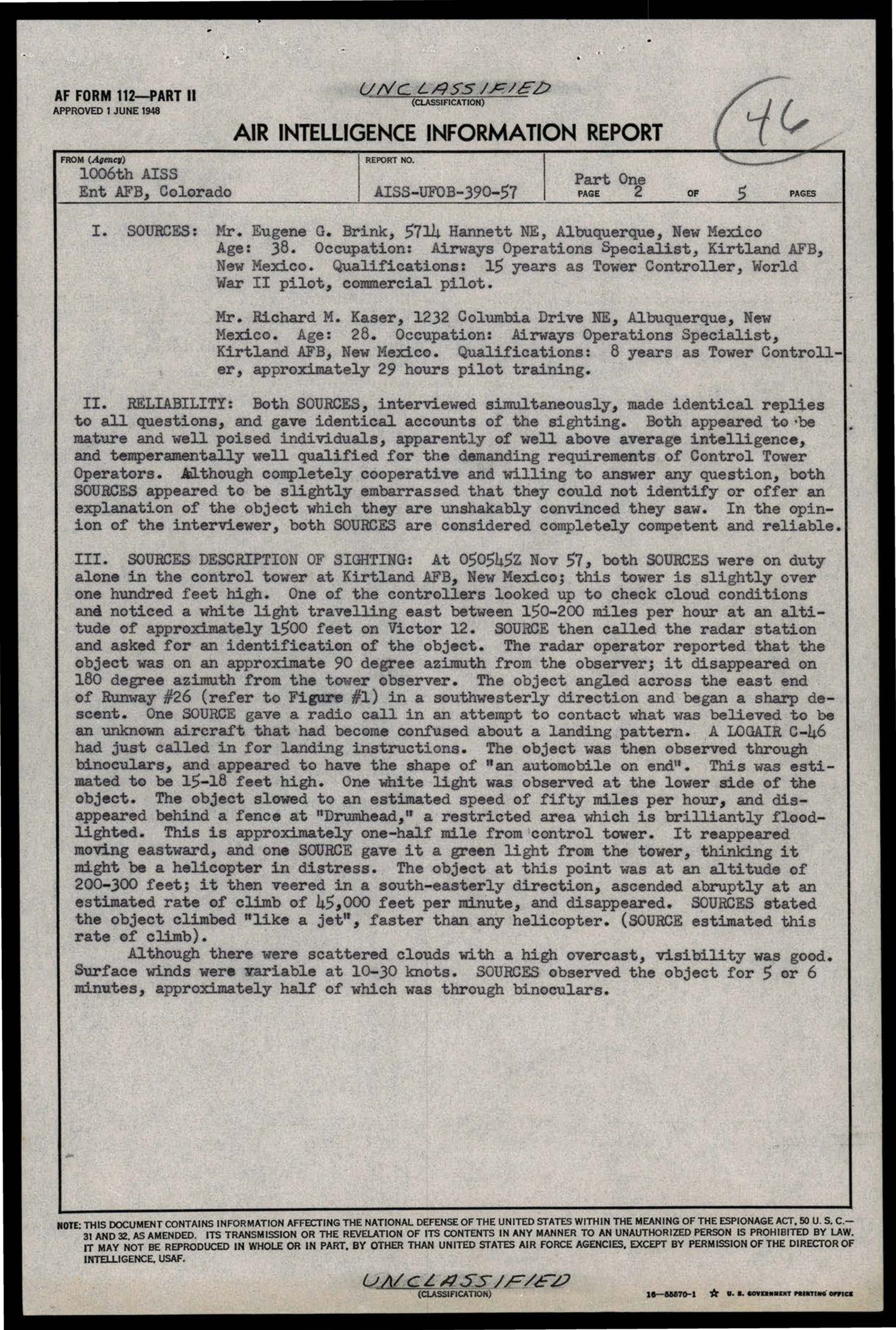
At 2245 Mountain Standard Time on 4 November 1957 two air traffic controllers were alone in the tower at Kirtland Air Force Base. The tower at Albuquerque stood slightly over a hundred feet high, and one of the two men looked up to check cloud conditions. He saw a white light travelling east along the airway Victor 12 at an estimated 150 to 200 miles per hour and about 1,500 feet.
The controller called the radar station and asked for an identification. The radar operator placed the object on an approximate 90 degree azimuth from the observer, and it later left on a 180 degree azimuth from the tower. The object then angled across the east end of Runway 26 in a southwesterly direction and began a sharp descent.
One of the controllers made a radio call, taking it for an unknown aircraft that had become confused about the landing pattern. A LOGAIR C-46 had just called in for landing instructions. They put binoculars on it. Through the glasses, in the words of the Air Force report, the object "appeared to have the shape of 'an automobile on end'", an estimated 15 to 18 feet high, with a single white light at its lower side.
It slowed to an estimated fifty miles per hour and dropped out of sight behind a fence at "Drumhead", a brilliantly floodlit restricted area about half a mile from the tower. Then it reappeared, moving east, at an altitude of 200 to 300 feet. One of the controllers, now thinking it might be a helicopter in difficulty, gave it a green light from the tower, which is the signal clearing an aircraft to land.
The object did not land. It veered southeast, ascended abruptly at an estimated rate of climb of 45,000 feet per minute and was gone. Both men said it climbed "like a jet", faster than any helicopter. The report notes in parentheses that the rate of climb was the witnesses' own estimate. They had the object in view for five or six minutes, roughly half of that through binoculars.
More footage and images of this sighting
What is the official explanation?
The case was investigated by the 1006th Air Intelligence Service Squadron at Ent Air Force Base, Colorado, under Air Force Regulation 200-2, and written up as Air Intelligence Information Report AISS-UFOB-390-57. The date of information is 4 November 1957, the date of collection 8 November and the date of report 13 November. The preparing individual was Lieutenant Colonel William P. Brunson, Operations Officer, and the investigator was Captain Patrick O. Shere. The report was approved by Colonel John W. Meador. The source evaluation is recorded as B-6.
The Air Force checked the obvious alternatives and recorded the results. A check with the Kirtland radar station "revealed that there had been an unidentified ordinary blip on the radar (N-16 Surface) scope", and the operator said it appeared like a conventional aircraft blip. Weather at 2255 MST was a 6,000 foot overcast with ten miles visibility and winds of 5 knots from the northeast; at 2230 MST the ceiling had been 2,500 feet overcast with seven miles visibility, rain squalls and winds of 5 knots from the west. A check with Dr Lincoln LaPaz, head of the Meteoritics Department at the University of New Mexico, "indicated that no unusual or distinctive astronomical phenomena occurred on the night of the sighting".
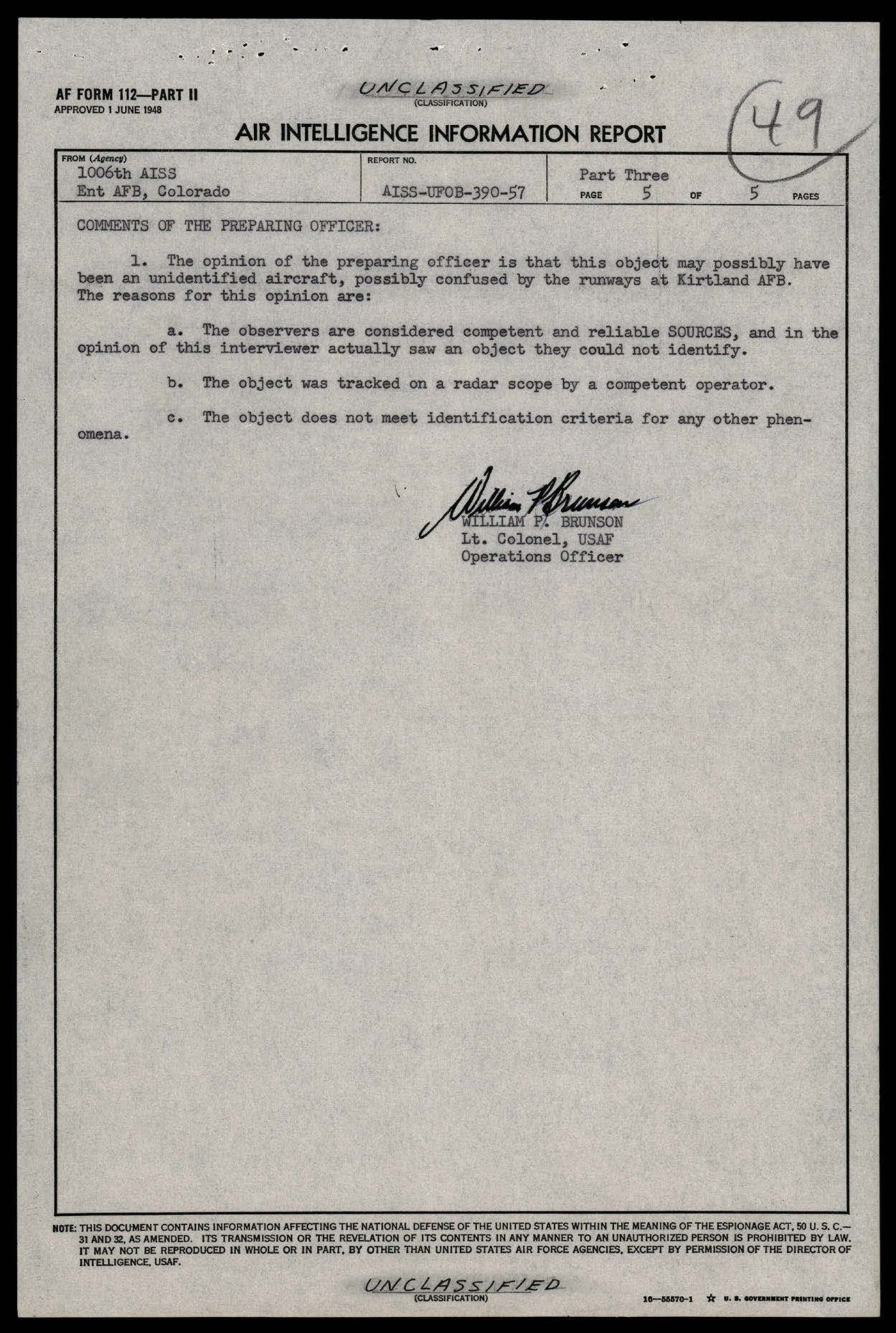
The conclusion sits in Part Three, over Brunson's signature: "The opinion of the preparing officer is that this object may possibly have been an unidentified aircraft, possibly confused by the runways at Kirtland AFB." He then gives three reasons for that opinion, and they are reproduced here in full because of what they say: "a. The observers are considered competent and reliable SOURCES, and in the opinion of this interviewer actually saw an object they could not identify. b. The object was tracked on a radar scope by a competent operator. c. The object does not meet identification criteria for any other phenomena."
Project Blue Book carried the case as aircraft.
What did the witnesses think it was?
The two men are named in the report with their addresses, ages and qualifications, which is unusual enough to be worth stating.
Eugene G. Brink, aged 38, of Albuquerque, was an Airways Operations Specialist at Kirtland with fifteen years as a tower controller. He had been a pilot in the Second World War and held a commercial licence. Richard M. Kaser, aged 28, also of Albuquerque, was an Airways Operations Specialist with eight years as a tower controller and about 29 hours of pilot training. Between them they had twenty three years of tower experience, and the report's summary says so.
The interviewer's assessment of them is the strongest language in the file. "Both SOURCES, interviewed simultaneously, made identical replies to all questions, and gave identical accounts of the sighting. Both appeared to be mature and well poised individuals, apparently of well above average intelligence, and temperamentally well qualified for the demanding requirements of Control Tower Operators. Although completely cooperative and willing to answer any question, both SOURCES appeared to be slightly embarrassed that they could not identify or offer an explanation of the object which they are unshakably convinced they saw. In the opinion of the interviewer, both SOURCES are considered completely competent and reliable."
One detail in their account conflicts with the Air Force's own weather data and is left unresolved on this page. Part One records that surface winds were variable at 10 to 30 knots. The official observations quoted in Part Two give 5 knots at both 2230 and 2255. Nothing in the file reconciles the two figures.
Is the Kirtland Air Force Base Control Tower Sighting of 4 November 1957 real? The two-pass assessment
Pass one, how could this be mundane. The prosaic candidate is the one the Air Force named, a light aircraft or helicopter lost in the pattern at night over an unfamiliar field. It has real support. The object first appeared at a plausible altitude and speed for an aircraft on an airway, it was descending toward an airfield, there was a radar return that the operator described as looking like a conventional aircraft, and the controllers themselves initially treated it as a confused pilot, which is why one of them transmitted to it and later gave it a green light. A 6,000 foot overcast with rain squalls half an hour earlier is weather in which a pilot could become disoriented.
Three things in the file weigh against that reading, and none of them requires an exotic alternative. The shape through binoculars at perhaps half a mile, an upended automobile fifteen to eighteen feet high carrying one white light low on the body, does not describe any aircraft in 1957 service. The object descended out of sight behind the fence of a floodlit restricted area and then came back out, which is not a landing pattern. And the departure, an abrupt climb the witnesses put at 45,000 feet per minute, is well outside what a light aircraft or helicopter of the period could do, though it is explicitly a witness estimate and the report flags it as such.
Pass two, what survives. What survives is not a claim about what the object was, but a documented defect in how the case was closed, and it is visible on the page.
The preparing officer's three stated reasons do not support his stated conclusion. That competent observers saw an object they could not identify, that a competent radar operator tracked it, and that it meets no identification criteria for any other phenomena are all reasons to record the object as real and unidentified. The third is explicitly a statement that identification failed. None of them is evidence that the object was an aircraft confused by the runways, and the conclusion is reached despite them rather than because of them.
This is not a novel observation and the archive does not claim it as one. Dr J. Allen Hynek, the Air Force's own astronomical consultant, made the same criticism in public in his paper "Twenty-one Years of UFO Reports", delivered at the 134th meeting of the American Association for the Advancement of Science on 27 December 1969. Hynek set out the structure of the reasoning, credible witnesses plus a competent radar operator plus an object that could not be identified leading to a verdict of aircraft, and argued that reasoning of that shape prevents genuinely new observations from ever being recognised. What the 2026 release adds is the complete field report behind the summary, so the three reasons can be read in the officer's own words and in their original order.
Two smaller points belong on the record. The astronomical explanation was tested and excluded at the time by Lincoln LaPaz, the leading meteoriticist of the era and a man based in the same city, which is a stronger exclusion than most cases of this period receive. And the released report gives the rate of climb as 45,000 feet per minute, where secondary accounts of this case commonly circulate a figure of 4,500 feet per minute. The archive reports the figure that appears in the document, read from a 200 dpi rendering of the released scan, and notes the discrepancy without resolving which is the error, since the document itself attributes the number to the witnesses rather than to an instrument.
The tier is Unknown. An official explanation exists, but it is hedged in its own wording as a possibility and is contradicted by the reasons given for it, and no prosaic identification was ever demonstrated.
Added 21 November 2026. The sighting at Kirtland fell on the evening after two United States Army military police patrols reported objects at the White Sands Proving Grounds, about one hundred and sixty miles to the south. The Air Force file on those White Sands reports was released on 20 November 2026 in the eighth PURSUE tranche and is covered at /cases/white-sands-stallion-1957. The two are separate events and nothing links them beyond the week and the state.
Sources
- www.war.gov/medialink/ufo/docs-112026-release-08/DOW-UAP-D195-Air_Intelligence_Information_Report_New_Mexico-1957.pdf
- www.war.gov/UFO/
- www.nicap.org/reports/kirtland57hyn.htm
More cases from this region: UFO sightings in United States