The CIA Office of Scientific Intelligence Files on Flying Saucers, August to October 1952
Six CIA documents released in November 2026 show the Agency concluding that fewer than 100 flying saucer reports were credible and unexplainable, that alien origin had not been excluded, and that no hint of its interest should reach the public.
What happened
On 20 November 2026 the Department of War published six Central Intelligence Agency documents written between July and October 1952. Together they form the paper trail of the months in which the CIA decided what to do about flying saucers, running from a working level evaluation to a draft directive written for the National Security Council.
The earliest item is a memorandum of 29 July 1952 from Ralph L. Clark, Acting Assistant Director for Scientific Intelligence, recording that a number of radar and visual sightings of unidentified aerial objects had been reported in recent weeks, that his office had kept the subject under continual review, and that a special study group had now been formed. The Office of Current Intelligence would take part alongside the Office of Scientific Intelligence, and a report was expected about 15 August.
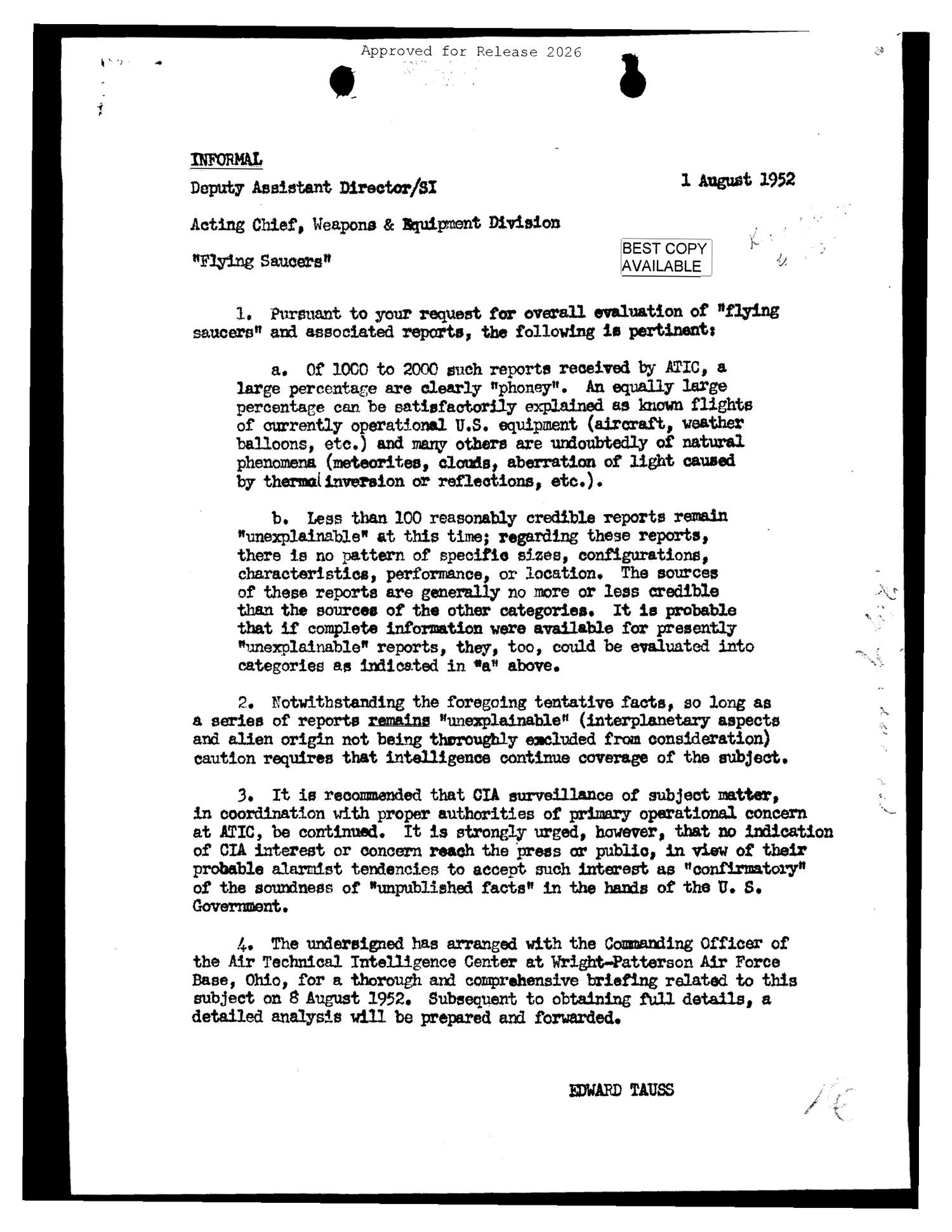
Three days later, on 1 August 1952, Edward Tauss, Acting Chief of the Weapons and Equipment Division, delivered that group's first evaluation under the subject line "Flying Saucers". Of the 1,000 to 2,000 reports received by the Air Technical Intelligence Center, he wrote, a large percentage were "clearly 'phoney'", an equally large percentage were explainable as known flights of US equipment, and many others were natural phenomena. Then the finding that mattered: "Less than 100 reasonably credible reports remain 'unexplainable' at this time; regarding these reports, there is no pattern of specific sizes, configurations, characteristics, performance, or location." He added that the sources of those reports were "generally no more or less credible than the sources of the other categories".
Tauss did not treat the residue as closed. "Notwithstanding the foregoing tentative facts, so long as a series of reports remains 'unexplainable' (interplanetary aspects and alien origin not being thoroughly excluded from consideration) caution requires that intelligence continue coverage of the subject." His third paragraph is the one that has been quoted for decades: he recommended continued CIA surveillance of the subject, but "strongly urged, however, that no indication of CIA interest or concern reach the press or public, in view of their probable alarmist tendencies to accept such interest as 'confirmatory' of the soundness of 'unpublished facts' in the hands of the U. S. Government." He closed by noting he had arranged a briefing at ATIC at Wright-Patterson Air Force Base for 8 August 1952.
The briefing that followed is in the release as an eleven page Office of Scientific Intelligence document of 14 August 1952. It puts numbers to the problem: since 1947 there had been about 1,500 official reports of sightings, and "this July alone, official reports totalled 250". Of the 1,500, ATIC carried 20 per cent as unexplained. The briefing walks through the history of the reports, the Center's analytical process, selected unexplained cases and the competing theories, including the proposal that the objects were a Russian development, which it records as an unsupported thesis.
A memorandum of 13 October 1952 from S. Q. Reber, Assistant Director for Intelligence Coordination, to the Deputy Director (Intelligence) states the security problem in two directions at once. Saucers had been the subject of Air Force analysis "because of the possibility that such objects might conceivably be an attack on the U.S.", and if they were not, "it is conceivable that the enemy might take advantage of the confusion created by the Flying Saucers to use at his convenience some air weapon against the United States". Reber recorded that an explanation had been provided for all but 20 per cent of the 1,500 reported sightings, and that the Office of Scientific Intelligence's review of existing information "does not lead to the conclusion that the saucers are USSR created or controlled". The memorandum's own list of major scientific intelligence problems ends with the question of what effect flying saucers have on the US warning system.
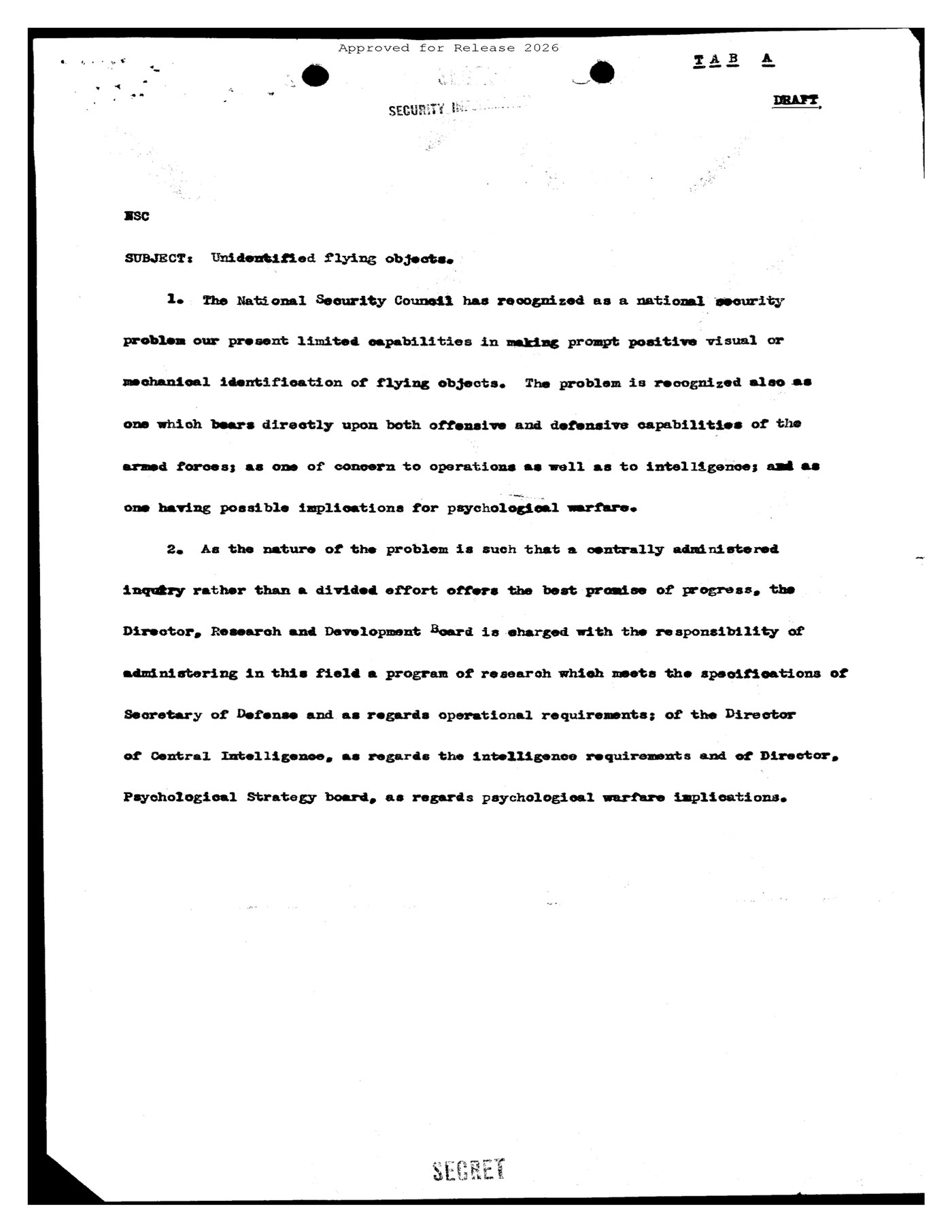
Two documents show what the Agency decided to do. One is a draft memorandum of about 2 October 1952 from Director of Central Intelligence Walter B. Smith to the Director of the Psychological Strategy Board, transmitting a proposal to the National Security Council. Its attached draft directive, marked TAB A and SECRET, reads: "The National Security Council has recognized as a national security problem our present limited capabilities in making prompt positive visual or mechanical identification of flying objects. The problem is recognized also as one which bears directly upon both offensive and defensive capabilities of the armed forces; as one of concern to operations as well as to intelligence; and as one having possible implications for psychological warfare." The draft then splits the work three ways, charging the Director of the Research and Development Board with administering the research programme, answering to the Secretary of Defense on operational requirements, to the Director of Central Intelligence on intelligence requirements, and to the Director of the Psychological Strategy Board "as regards psychological warfare implications".
The other is an action sheet and memorandum seeking approval in principle for an external research project: an ad hoc panel of leading scientists convened to analyse and evaluate the available evidence and to recommend any further government action. That panel met in January 1953 and is known as the Robertson Panel.
The last document in the batch is a page from a CIA official diary for Tuesday 28 October 1952, classified TOP SECRET. Among the day's items, Mr Clark "informed me that additional information had been obtained on flying saucers, particularly reports of sightings on the ground by relatively reliable observers. He noted that one of the primary theoretical difficulties with sightings thus far reported was the lack of noise and flare. Several scientists have recently delivered papers indicating a possible means of propulsion which would not involve noise and flare. He proposed to have a briefing on this general subject and to call the information to the attention of Air Force and R&DB." The diarist's response is recorded in three words: "I concurred,".
Documents and images
What is the official position?
These six items are the official record. They are internal CIA correspondence, and the position they set out is the Agency's own, stated to itself rather than to the public.
That position has three parts. The phenomenon was a legitimate intelligence problem, because a residue of credible reports had no explanation and because an adversary could exploit either the objects or the confusion around them. The Soviet hypothesis was examined and not supported, with the Office of Scientific Intelligence recording that its review did not lead to the conclusion that the saucers were created or controlled by the USSR. And the public was to be told nothing about the Agency's involvement.
What the release does not contain is any later CIA statement revising these documents, so the Agency's 1952 reasoning is presented here without an accompanying modern assessment. The Department of War published the files as part of the Presidential Unsealing and Reporting System for UAP Encounters and did not attach analysis of its own beyond a descriptive blurb for each record.
One point of official history is worth stating plainly because the current coverage obscures it. The substance of these documents has been publicly available for decades. Gerald K. Haines, writing in the CIA's own in-house journal Studies in Intelligence in 1997, described the Tauss memorandum and quoted its recommendation that the Agency conceal its interest from the media and the public "in view of their probable alarmist tendencies". Haines also records the formation of the OSI and OCI study group, Smith's interest in what use could be made of the phenomenon in psychological warfare, and the Robertson Panel's January 1953 recommendation that the National Security Council debunk UFO reports through mass media, advertising, business clubs, schools and the Disney corporation. The archive could not establish that any of the six documents is a first time disclosure.
What the people involved say
There are no witnesses in this file in the usual sense. The people in it are intelligence officers, and what they are reporting on is each other's assessments.
The names are worth keeping, because they are the people who set the US government's posture toward the subject for the following decade. Ralph L. Clark formed the study group. Edward Tauss wrote the evaluation that found a credible unexplained residue and recommended public silence about the Agency's interest. S. Q. Reber framed the problem for the Deputy Director. Walter Bedell Smith, the Director of Central Intelligence, signed the draft that routed psychological warfare implications to the Psychological Strategy Board. A fourth, named in the diary only as Mr Clark, proposed briefing the Air Force and the Research and Development Board about scientists' papers on silent propulsion.
The diary entry is the one that reads least like bureaucracy. It records, as a working difficulty rather than a wonder, that the objects being reported made no noise and showed no flare, and that this was a problem for interpretation because known propulsion produced both. It then records that several scientists had recently delivered papers describing a possible means of propulsion that would not involve noise and flare. The entry does not name those scientists or their papers, and the release contains nothing further about them.
Is the CIA Office of Scientific Intelligence Files on Flying Saucers, August to October 1952 real? The two-pass assessment
Pass one, how could this be mundane. Almost all of it is. These are ordinary staff documents produced by an intelligence agency doing its job during a summer of unusually heavy public reporting, and most of their content is deflationary. Tauss classed the large majority of reports as false, misidentified US equipment or natural phenomena. The August briefing recorded that ATIC had explained 80 per cent of some 1,500 reports. Reber's memorandum is principally about the Soviet Union, and the question driving it is whether an adversary could build such a thing or exploit the reporting. The proposal for a scientific panel is a normal response to an unresolved technical question, and the panel it produced concluded against the significance of the phenomenon. Nothing in the batch describes a recovered object, a body or a programme to conceal one, and anyone reading it for that will not find it.
The secrecy language also has a mundane reading that the documents themselves supply. Tauss did not write that the public should be deceived about the phenomenon. He wrote that public knowledge of CIA interest would itself be read as confirmation of facts the government did not have, which is a concern about a feedback loop rather than about the objects. That is a defensible worry and it is stated in the document in those terms.
Pass two, what survives. Three things, and they are quantitative and checkable rather than atmospheric.
The first is the residue. The Agency's own working figure was fewer than 100 reasonably credible reports that remained unexplainable, from sources it judged no less credible than the sources of the explained reports, and with no pattern in size, configuration, characteristics, performance or location. The 14 August briefing and the Reber memorandum independently put the unexplained fraction at 20 per cent of about 1,500. These are not the numbers of an agency that privately believed there was nothing there.
The second is the sentence about alien origin, which is remarkable mainly for how undramatically it is written. Tauss recommended continued coverage on the express ground that interplanetary aspects and alien origin were "not being thoroughly excluded from consideration". That is a parenthesis in a routing memorandum, not an assertion that the objects were alien, and it should not be inflated into one. What it does establish is that in August 1952 the hypothesis was live enough inside the Office of Scientific Intelligence to be written down as a reason to keep working.
The third is the institutional shape of what followed, and it is the part that bears on how this archive reads official debunking generally. Within ten weeks the file moves from an evaluation finding an unexplained residue, to a draft National Security Council directive naming psychological warfare as one of three lanes of responsibility, to approval in principle for a panel of scientists. That panel recommended a public education programme to reduce public interest. The documents do not show anyone concluding the phenomenon was unreal and then deciding to say so. They show an unresolved intelligence problem and, running alongside it, a separate decision about what the public should be allowed to see of the government's attention to it. Those are two different questions, and the file keeps them separate even where later retellings do not.
The tier here is Unknown because these are documents about sightings rather than a sighting, and because no official narrative resolves the residue they describe. The release's practical value is the quality of the scans rather than the novelty of the content: the substance has been in the public record since at least 1997, published by the CIA's own historian, and any account presenting these as newly surfaced revelations is overstating the case.
Sources
- www.war.gov/UFO/
- www.war.gov/medialink/ufo/docs-112026-release-08/CIA-UAP-D026-Summary_Assessment_of_Flying_Saucers-1952.pdf
- www.war.gov/medialink/ufo/docs-112026-release-08/CIA-UAP-D027-Office_of_Scientific_Intelligence_Briefing_on_Flying_Saucers-1952.pdf
- www.war.gov/medialink/ufo/docs-112026-release-08/CIA-UAP-D028-Assessment_of_National_Security_Issues_Relating_to_Flying_Saucers-1952.pdf
- www.war.gov/medialink/ufo/docs-112026-release-08/CIA-UAP-D025-Proposal_to_Consider_Psychological_Warfare_Implications_of_UFO_Related_Issues-1952.pdf
- www.war.gov/medialink/ufo/docs-112026-release-08/CIA-UAP-D024-Approval_in_Principle_Research_Concerned_with_UFOs-1952.pdf
- www.war.gov/medialink/ufo/docs-112026-release-08/CIA-UAP-D029-Official_Diary_Entry_on_Flying_Saucers-1952.pdf
- sgp.fas.org/library/ciaufo.html
More cases from this region: UFO sightings in United States