The Green Light Seen Across South Korea: UFO, Missile or Meteor on 7 September 2026
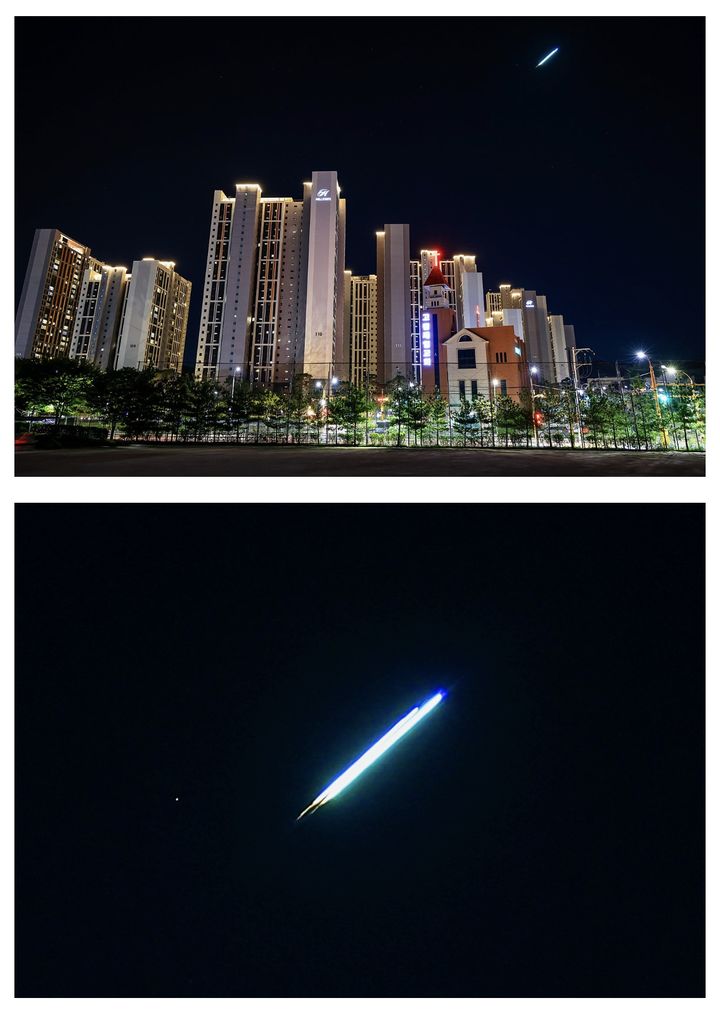
At about 20:49 on the evening of Monday 7 September 2026, a brilliant green light crossed the sky over South Korea and was reported from Seoul to Busan within minutes. Witnesses posted dashcam clips and photographs asking whether it was a UFO, a missile or a meteor. One photograph taken from Yongin answers the question more clearly than any of the coverage did.
What did witnesses see at Photographed at Yongin?
A brilliant green light crossed the sky over South Korea at about 20:49 on the evening of Monday 7 September 2026. Within minutes people the length of the country were posting the same question to social media and to the large online communities, and the question was always the same three options: UFO, missile or meteor.
The geographic spread is what made it a national story rather than a local one. Sighting reports named Seoul, Daejeon, Suncheon, Cheonan, Pohang, Gangneung, Daegu and Busan, which is effectively the whole peninsula from the capital to the southeast coast. The posts arrived with dashcam footage and phone photographs attached, and many of them carried the same timestamp to the minute. One early thread on a community board opened with the words UFO, missile, meteor, has anyone else seen this, and drew replies saying I saw it at 8:49 too.
The descriptions were consistent and short. Witnesses said they had been walking or running when they saw a strong green light. Several described a distinctive sequence, that it flared brightly three times and then vanished as a round light at the end. Others emphasised how fast it moved. One said the speed was such that for a moment they thought it was a missile and were frightened; another said it was the largest shooting star they had seen in their life; another said they wished for a lottery win the instant they saw it.
The single most useful account came from a member of the Naver amateur astronomy community Byeolhaneuljigi, who photographed the object from Yongin in Gyeonggi Province at about 20:50. He wrote that he had initially taken it for an aircraft, and had photographed it because the speed and the shape of the light were wrong for one. His description of the ending is specific: seen with the naked eye it separated into two pieces and then immediately went out.
That photograph is the hero image on this page, and it shows what he described. In the magnified panel the object is an elongated luminous trail with a bright blue white leading head and a green tinged body, and it is split into two distinct luminous segments running in line.
What is the official explanation?
No South Korean agency has issued any statement about the 7 September 2026 event, and that absence is worth stating precisely rather than glossing.
The Korea Astronomy and Space Science Institute is the body that would normally speak. It operates a meteoroid monitoring network built under the First Basic Plan for Space Hazard Preparedness, intended to reach 25 sites nationwide, with all sky cameras at its own headquarters and at a set of science high schools including Daejeon, Gyeonggi, Daegu, Busan and Gwangju. When that network catches something, the institute publishes a full analysis. As of this writing it has published nothing on 7 September 2026.
What such an analysis looks like is on the public record, and it is the right yardstick for this case. On 23 September 2020 a fireball was seen across almost the whole country except Jeju at 01:39 in the morning. The institute Center for Space Situational Awareness caught it on the monitoring network, then under test operation, and combined that with all sky camera footage from its Daejeon and Geochang observatories and with video sent in by the public. The published result gives the object a start of luminous flight at 70 kilometres altitude over the West Sea, a first explosion over Seocheon County at 36.07 degrees north, 126.73 degrees east and 44.5 kilometres altitude, a second explosion at the boundary of Seocheon and Iksan at 36.06 north, 126.86 east and 34.3 kilometres, an atmospheric entry speed of 13 kilometres per second and an entry angle of 40 degrees. The Korea Institute of Geoscience and Mineral Resources separately confirmed infrasound at its Gunsan and Daejeon stations and atmosphere to ground coupled seismic waves at Taean, Hongseong, Seosan and Daejeon. No meteorite was ever recovered.
So Korea has both the instruments and the institutional habit to resolve an event of this kind, and has done it before for a sighting of exactly this shape. Nothing comparable has been published for 7 September. Until it is, there is no official narrative on this event at all, and the reading offered below rests on the photograph and the witness accounts.
What did the witnesses think it was?
The witness body here is large, geographically distributed and almost entirely anonymous, which is the normal shape of a modern mass sighting and carries the normal caveats.
The strongest single witness is the Yongin photographer, and he is strong for reasons that have nothing to do with his name, which is not published. He is a member of an amateur astronomy club, so he is a practised observer of the night sky. He recorded a time, about 20:50, that matches the time other witnesses gave independently. He gave his own reason for photographing rather than dismissing, which was that the speed and the light did not match the aircraft he first assumed it to be. And critically, he produced an image, which means his description can be checked against something rather than believed or doubted.
The wider body of witnesses is the more interesting evidence in aggregate than in detail. The individual reports are thin, mostly a sentence on a community board. What they carry is convergence: independent people, hundreds of kilometres apart, giving the same minute and the same colour, with several of them reporting the same three flares and a round terminal light. The nationwide reach is corroborated by the weather record, because the sky really was clear everywhere that evening. The routine METAR observations at 20:00, 21:00 and 22:00 local read CAVOK at Seoul, at Daegu and at Busan simultaneously, which means no cloud below 5,000 feet and 10 kilometres or better visibility across the country. A single object high in the atmosphere would have been visible from all of those places at once, and this one evidently was.
The limitations are real. The clips and photographs circulated through community boards and social media rather than through any archive, so most of them cannot be origin traced, and this page cites only the one image whose provenance is documented by the outlet that published it. No witness here is named. And a nationwide flap is exactly the environment in which unrelated sightings from other evenings get swept into the same thread, so the count of witnesses should be treated as an impression rather than a figure.
Is the Green Light Seen Across South Korea: UFO, Missile or Meteor on 7 September 2026 real? The two-pass assessment
Pass one, how this could be entirely ordinary.
It almost certainly is, and the photograph is what makes that judgement possible rather than merely likely. The magnified panel shows an elongated luminous trail with a bright leading head and a green tinged body, terminating in two separate luminous segments running in line. That is the signature of a bolide, a meteor brighter than the planets, undergoing terminal fragmentation. It matches the photographer own account of the object separating into two pieces and going out, and it matches the wider witness reports of three bright flares followed by a round light, which is what a fragmenting meteoroid does as successive pieces flare and burn out. The green is consistent too, and unremarkable: it is the colour ablating meteoric material commonly produces, and Korea has seen it before. The Korea Astronomy and Space Science Institute account of the 2020 Seocheon fireball describes precisely this behaviour, an object that exploded twice during its fall, and notes that fragmentation of a fast entering meteoroid is a frequently observed phenomenon.
The alternatives that circulated on the night can be dealt with quickly.
A missile is excluded by the appearance and by the absence of any consequence. Nothing was announced, nothing was tracked publicly, and a ballistic event over the whole of South Korea at nine in the evening would not have ended as a curiosity thread.
A rocket launch is excluded by the schedule. A check of the launch record for 6 to 8 September 2026 returns exactly one orbital launch anywhere in the world, a Falcon 9 carrying Starlink Group 15-24 at 14:26 UTC on 6 September, more than 29 hours before the sighting. There was no launch plume to see.
Satellite debris, which several witnesses proposed, is the one prosaic candidate that cannot be dismissed on appearance, because a re-entering rocket body or satellite fragment glows by ablation just as a meteoroid does and can also break into trailing pieces. It is distinguished by speed and duration rather than by colour, a re-entry being markedly slower and longer lived than a meteor, and the witness reports here emphasise extreme speed and a very short event. That points to a natural meteoroid. It does not exclude debris on the available evidence, and no public re-entry prediction has been checked against this event.
The Moon is excluded outright. At Yongin on 7 September 2026 it was a 20 percent waning crescent and it had set at 16:33, more than four hours before the sighting, so there was no Moon above the horizon anywhere in the country at 20:49. The sky was fully dark: sunset was at 18:52 and civil twilight ended at 19:18.
Pass two, what this is if it is not ordinary.
There is very little to build on, and this page will not pretend otherwise. Nothing in the reported behaviour is anomalous for a meteor. There is no manoeuvre, no hovering, no change of direction, no duration inconsistent with an atmospheric entry, and no instrumented measurement that conflicts with one. The only element that resists a purely natural reading is the reported sequence of three distinct flares, which some witnesses described as deliberate pulsing, and that is much better explained by successive fragmentation events than by anything else.
The case is tiered Strongly Disputed rather than Unknown for that reason. No official body has spoken, which would normally place a case in Unknown, but the photograph is itself a method shown ordinary explanation and it comes close to settling the matter. It stops short of closing it because no analysis has been performed: nobody has triangulated the trajectory, computed an orbit, checked infrasound or seismic records, or recovered a fragment. If the Korea Astronomy and Space Science Institute publishes for this event what it published for Seocheon in 2020, this case moves to resolved. This page will be updated when it does.
Sources
- www.newsis.com/view/NISX20260908_0003781211
- n.news.naver.com/mnews/article/003/0014178097
- www.kasi.re.kr/kor/publication/post/newsMaterial/28640
- aa.usno.navy.mil/api/rstt/oneday?date=2026-09-07&coords=37.2411,127.1776&tz=9
- mesonet.agron.iastate.edu/cgi-bin/request/asos.py?station=RKSS&data=metar&year1=2026&month1=9&day1=7&year2=2026&month2=9&day2=8&tz=Asia%2FSeoul&format=onlycomma&report_type=3&report_type=4
- mesonet.agron.iastate.edu/cgi-bin/request/asos.py?station=RKPK&data=metar&year1=2026&month1=9&day1=7&year2=2026&month2=9&day2=8&tz=Asia%2FSeoul&format=onlycomma&report_type=3&report_type=4
- ll.thespacedevs.com/2.2.0/launch/?net__gte=2026-09-06T00:00:00Z&net__lte=2026-09-08T23:59:59Z&limit=40&mode=list
More cases from this region: UFO sightings in South Korea