The Metal Objects That Fell on a Kalimantan Palm Plantation, Kotawaringin Timur, 18 October 2026
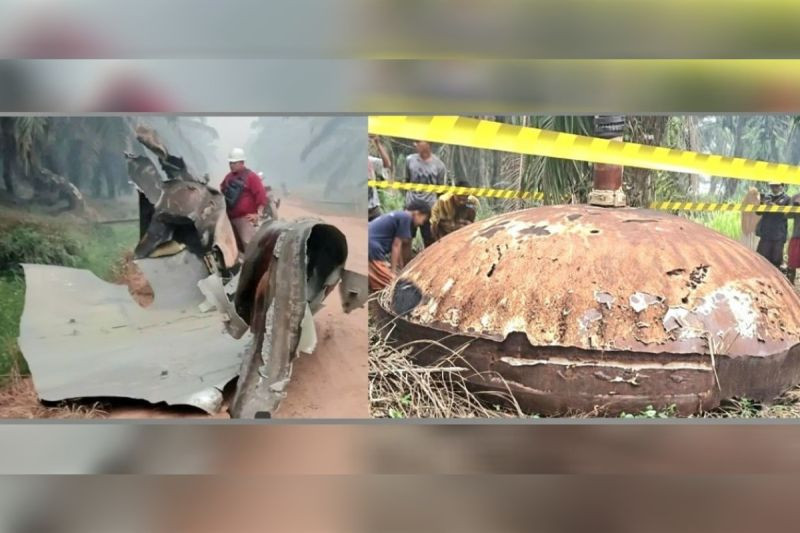
A four metre scorched dome sitting in an oil palm block is exactly what a flying saucer is supposed to look like. It is the end cap of a fuel tank.
What did witnesses see at PT Agro Bukit oil palm plantation?
Residents around Sampit heard a heavy boom roll across the sky on the evening of 18 October 2026. The next morning plantation workers found a torn sheet of metal about nine metres long lying in an oil palm block, and a day later a scorched metal dome roughly four metres across was found about ten kilometres away.
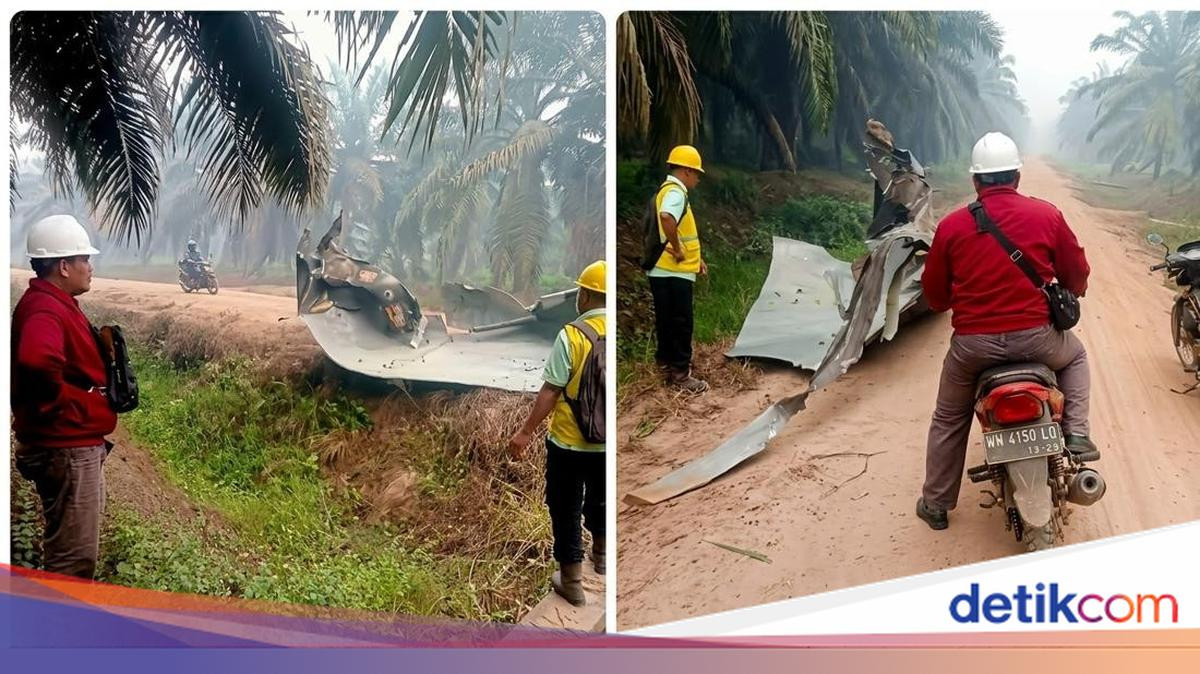
The first object was found on Monday 19 October in block G38 to G39 of the PT Agro Bukit plantation, on the boundary between Dusun Rongkang in the village of Natai Baru, Mentaya Hilir Utara district, and the village of Pasir Putih in Mentawa Baru Ketapang district, close to the Sampit to Pangkalan Bun road. The local police chief, I Kadek Dwi Yoga Sidhimantra, described it as a fairly large aluminium plate reaching nine metres in length, irregular in shape, with visible burn marks on the surface. Photographs show it crumpled and split, the way thin sheet metal tears rather than the way a solid body breaks.
The second object, found on the morning of Tuesday 20 October in the same company's plantation but at a different spot, is the one that drove the story. It is a dome, brown with scorching, with cabling and components still attached and a bolted flange running around its lower rim. CNN Indonesia reported that the find site was ringed with police tape to keep the scene sterile. Japanese coverage described it as disc shaped, and in a photograph taken from ground level among the palms that is a fair description of what it looks like.
A marking was legible on the debris. Indonesia's National Transportation Safety Committee, the KNKT, recorded the full code as 2ZQE31-20-15 240256KY, and noted that the 2ZQE31 element resembles the name of the Chinese satellite launch vehicle Zhuque-2E.
More footage and images of this sighting
What is the official explanation?
Indonesia treated this as a recovered object rather than a sighting, and several agencies went on the record within forty eight hours.
The National Research and Innovation Agency, BRIN, attributed the debris to the spent body of a Chinese Zhuque-2E rocket that re-entered the atmosphere on 18 October 2026. Thomas Djamaluddin, a principal researcher in astronomy and astrophysics at BRIN, said the identification rested on orbital track analysis: the spent stage ran from north to south across Kalimantan that day, and at about 17.36 local time its track lay near Sampit, which matched the time residents reported hearing the rumble. He said the data showed this was the stage's final orbital pass before re-entry. He described the recovered metal as fragments of the rocket body including a fuel tank, and he made the limitation explicit, saying that the fall point and timing of space debris cannot be precisely predicted even though the orbital track can be determined.
BRIN gave the rocket body the NORAD catalogue number 101070 and the international designator 2026-234L, and said the fragments carried no toxic material and posed no radiation risk. Zachrudien, the person in charge of the civil aviation publication team at H Asan Sampit airport, said the airport had coordinated with the KNKT and BRIN and had passed its field findings to them. The KNKT worked with BRIN's aviation and space research organisation, ORPA, and coordination also ran through the Region VII airport authority in Balikpapan. Military and police personnel surveyed the site, and the debris was moved to Iskandar Air Force Base at Pangkalan Bun in West Kotawaringin for further identification and for safety.
BRIN's own wording keeps a hedge that most coverage dropped. The attribution is stated as strongly suspected, and BRIN said physical examination is still needed to confirm it, matching the shape, the material and the markings against the rocket's technical data.
What did the witnesses think it was?
The reaction on the ground was caution rather than wonder. One resident at the second find site told ANTARA plainly why nobody went near it, saying they did not dare touch it because they were afraid there was still radiation.
That fear is the detail worth keeping, because it is the honest civilian response to a large scorched metal object appearing overnight in a working plantation. The objects did not land in empty country. The first came down in a block near worker housing, and the plantation road in the photographs carries ordinary traffic, with a motorcycle and workers in hard hats and high visibility vests standing beside a nine metre sheet of torn metal.
The UFO framing came from the shape and the sequence rather than from anyone claiming to have seen a craft. Nobody reported seeing a structured object in flight. What people reported was a loud boom from the sky at dusk, and then, on two consecutive mornings, metal in the plantation. Indonesian outlets led with benda misterius, mysterious object, and Japanese television led with the phrase UFO commotion over a photograph of the dome.
Is the Metal Objects That Fell on a Kalimantan Palm Plantation, Kotawaringin Timur, 18 October 2026 real? The two-pass assessment
Pass one, how could this be mundane. It is mundane, and unusually for this archive the prosaic answer can be checked rather than merely asserted.
The archive confirmed the official account against an independent catalogue. CelesTrak's satellite catalogue record for NORAD 101070 lists the object as ZHUQUE-2E R/B, a rocket body, international designator 2026-234L, owner PRC, launched on 14 October 2026 from the Jiuquan launch site, with a decay date of 18 October 2026. That decay date is the evening of the boom, and it comes from a source with no connection to BRIN. The same record gives the stage's final orbit as a period of 87.4 minutes at an inclination of 98.03 degrees, with an apogee of 186 kilometres and a perigee of 105 kilometres. Two things follow that were not in any of the coverage. An inclination of 98 degrees is a retrograde, near polar, sun synchronous orbit, which independently predicts the north to south ground track across Kalimantan that BRIN described, rather than taking BRIN's word for it. A perigee of 105 kilometres is already inside the decaying regime, so a re-entry within days of launch is expected rather than surprising. The catalogue also lists ten separate payload objects under the same designator, 2026-234A through 2026-234K, which matches the reported ten satellites. The Launch Library record independently puts a Zhuque-2E Block 2 launch at 11:40 UTC on 14 October 2026 carrying ten satellites.
So four independent legs support the identification: the serial marking physically present on the debris, the catalogued decay date matching the night of the boom, the orbital inclination matching the described track, and the payload count matching the launch. The physical appearance agrees as well. What survives an uncontrolled re-entry is the thick, domed end of a pressure vessel, while thin cylindrical tank walls shred, and that is precisely the pair of objects recovered here: one torn sheet and one intact dome with a bolted flange. BRIN described the find as rocket body fragments including a fuel tank, and the dome is consistent with that description.
Pass two, if it were something else, what would it be. It is not something else, and the case is tiered accordingly. The point of keeping it is not that the identification is in doubt. It is that this is what a genuine unidentified object report looks like from the inside before it is resolved, and the resolution took two days, several agencies and a legible part number.
Two honest limits remain on the record. BRIN's own attribution is formally provisional, because the physical match against the manufacturer's technical data had not been completed when the agency spoke, and this archive has not seen that match confirmed. And the precise re-entry time of 17.36 local is BRIN's figure from its own orbital analysis; the independent catalogue gives a decay date but not a decay time, so the timing match is corroborated to the day rather than to the minute. What is genuinely open here is not what the object was. It is that an uncontrolled upper stage shed two large pieces of metal onto an inhabited working plantation, and that the people who found them were left guessing about radiation for a day.
Sources
- kalteng.antaranews.com/berita/846513/dua-benda-jatuh-di-kotim-diduga-bekas-roket-asal-china
- news.detik.com/berita/d-8714700/logam-besar-di-kebun-sawit-kotim-kalteng-ternyata-puing-roket-milik-china
- news.detik.com/berita/d-8716615/brin-ungkap-asal-logam-misterius-di-kebun-sawit-kalteng-sampah-roket-china
- www.cnnindonesia.com/nasional/20261020131807-20-1417465/benda-logam-misterius-di-kebun-sawit-kotim-ternyata-roket-china
- internasional.kompas.com/read/2026/10/21/085658370/obyek-asing-9-meter-jatuh-di-kebun-sawit-kalteng-diduga-serpihan-roket
- mediaindonesia.com/nusantara/946906/brin-benda-misterius-yang-jatuh-di-kebun-sawit-kalteng-adalah-roket-bekas-tiongkok
- celestrak.org/satcat/records.php?CATNR=101070&FORMAT=json
- www.cnbcindonesia.com/news/20261020220000-4-692119/geger-serpihan-roket-china-sebesar-mobil-jatuh-di-kebun-sawit-ri
More cases from this region: UFO sightings in Indonesia