Unidentified Flying Object Fragments on the Beach at Karwia, Poland
The defence minister stated as settled fact what his own Military Police, the same afternoon, called most probable and still awaiting laboratory tests.
What did witnesses see at Karwia?
A passerby walking the beach at Karwia on the Polish Baltic coast found a partly buried object on 13 October 2026. The emergency call reached the duty officer at the Puck County police headquarters at about 18:20 local time, and the response that followed was out of all proportion to a piece of beach debris. Sappers, soldiers, officers of the Internal Security Agency and the Military Counterintelligence Service, police counter terrorist officers and firefighters were sent to the dunes, a safety cordon of about 300 metres was established, and the Military Police opened the case under the supervision of a prosecutor from the Military Affairs Division of the District Prosecutor's Office in Gdańsk. No evacuation of residents was ordered.
The object was reported as roughly two metres long. The phrase the Polish state used for it, in the Military Police's own communiqué rather than in any headline, was "fragmenty niezidentyfikowanego obiektu latającego", fragments of an unidentified flying object. That is the reason this event belongs in this archive at all. A NATO member's military police placed the words unidentified flying object into the official record of a coastal find, and then closed the question in about nineteen hours.
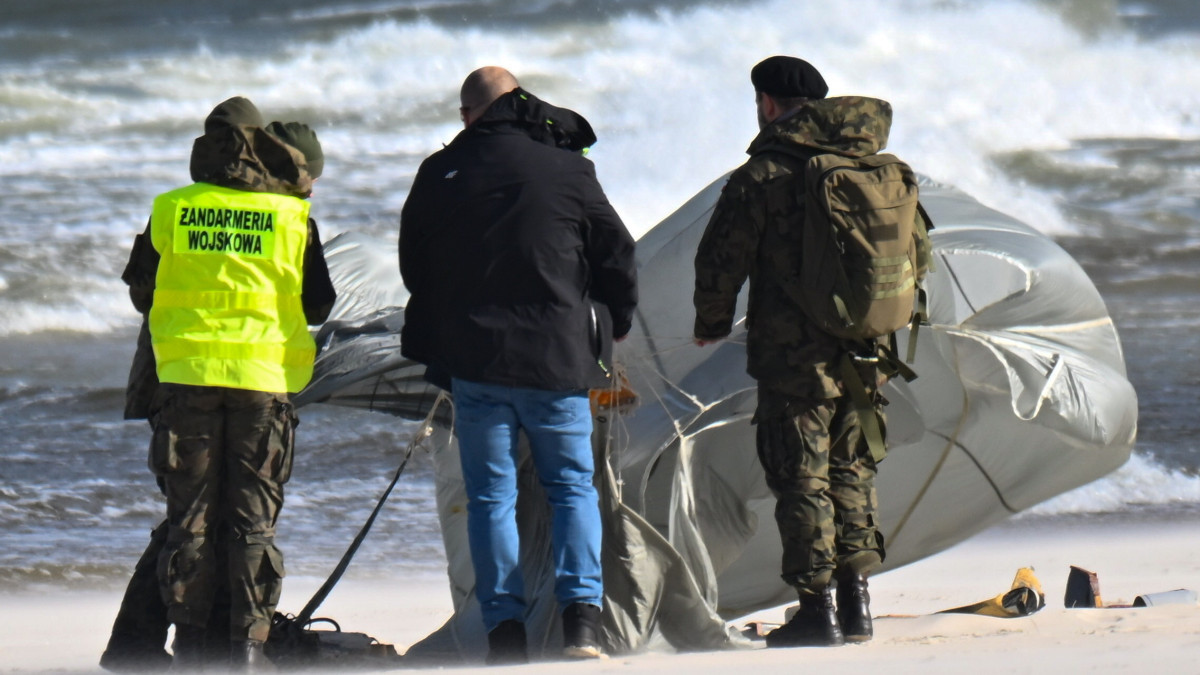
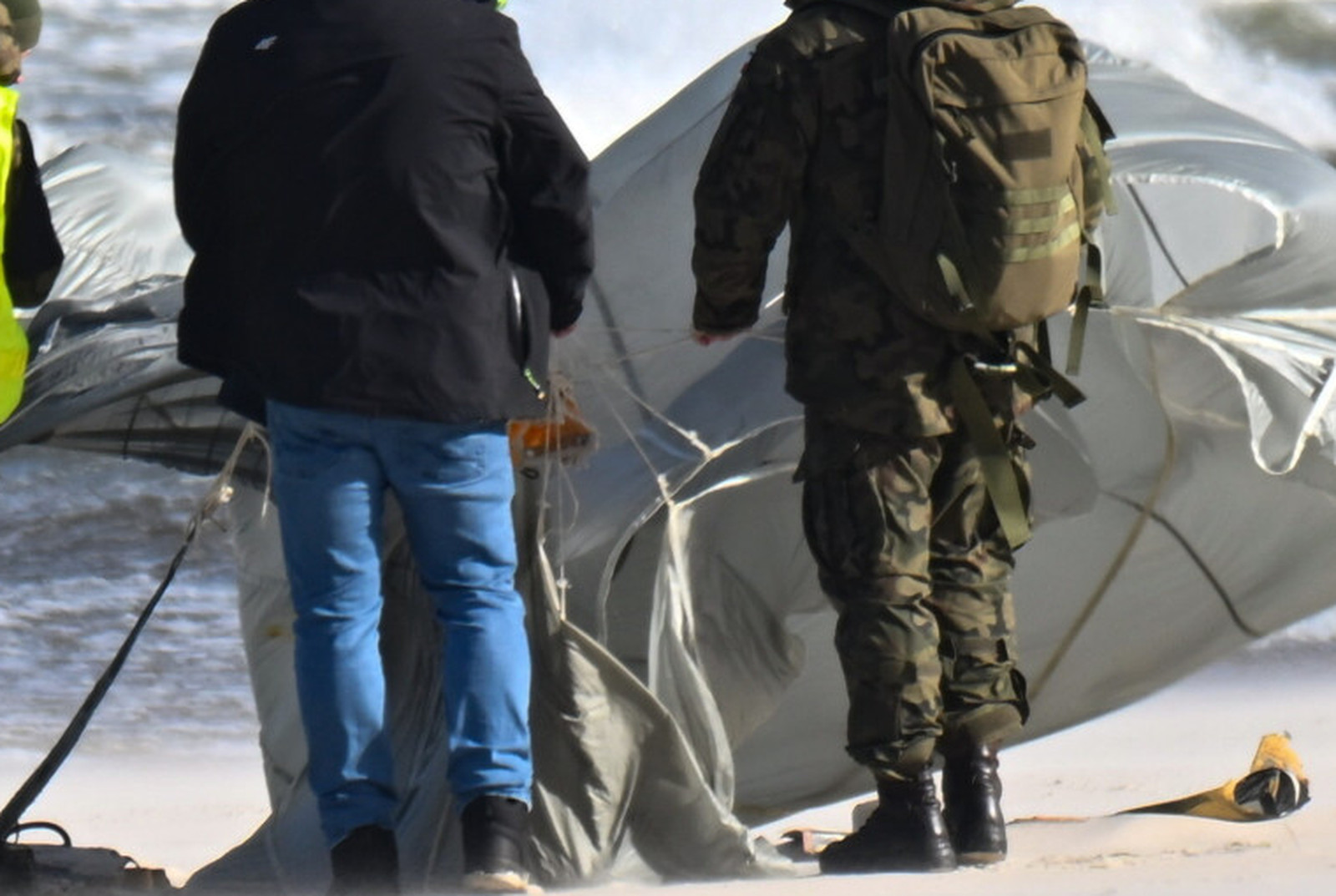
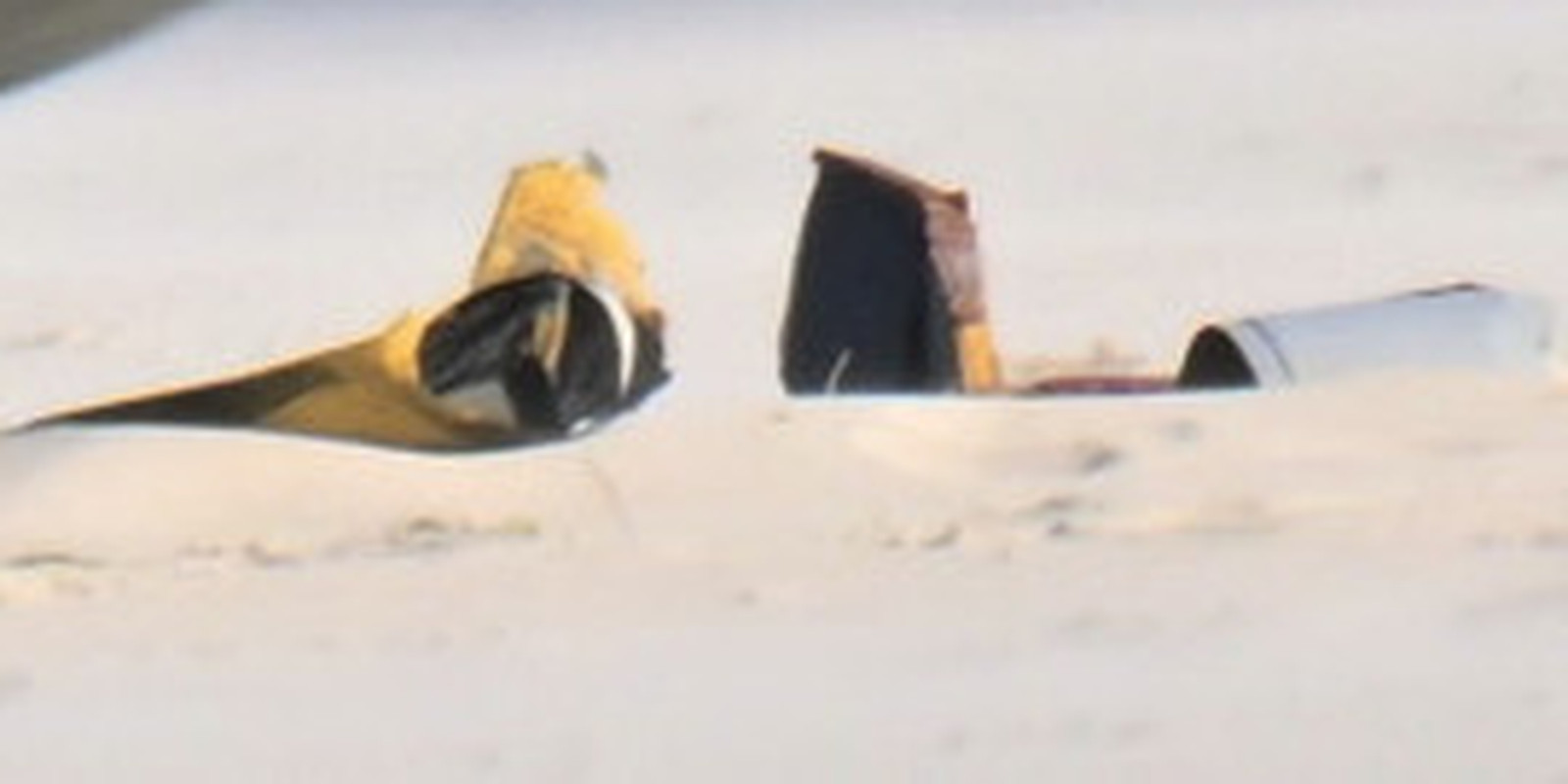
No photograph or video of the object in flight exists, and none is claimed. What exists is press photography of the recovery, and the most useful frame was taken by Andrzej Jackowski for the Polish Press Agency. It shows a Military Police officer, a soldier and a civilian standing at the surf line over a large pale fabric canopy collapsed across the wet sand. Enlarged to roughly two and a half times, that canopy resolves into panelled construction with visible shroud lines running from it, an orange component near its centre, and a line bundle held in the civilian's hand. Separately on the dry sand, partly buried, lie hollow thin walled light coloured structural fragments: a tapered yellow and tan piece with a dark hollow interior, a dark angular fragment whose break edge shows a layered sandwich construction, and a pale broken cylindrical tube. Heavy surf and whitecaps fill the background.
That description is offered as a reading of a published photograph and nothing more. This archive has not handled the material, and the laboratory examination the Military Police said would follow had not been reported when this page was written.
More footage and images of this sighting
What is the official explanation?
Poland produced two official statements on 14 October 2026, within about two hours of each other, and they do not carry the same degree of confidence.
The first came from Lieutenant Colonel Dariusz Rozkosz, spokesman for the Commander in Chief of the Military Police. He recorded that the actions carried out at the site of the find by the 43rd Sapper Battalion at Rozewie, the counter terrorist unit of the provincial police headquarters in Gdańsk, the Military Centre for Preventive Medicine in Gdynia and the State Fire Service in Gdynia had eliminated biological, chemical and radiological hazards and ruled out the presence of explosive materials. On identity, his wording was careful: preliminary examination indicated that it was most probably a military training drone of Polish manufacture, used for exercises over the Baltic Sea. He added that the site would be examined further and that the object would be recovered and secured for detailed laboratory testing.
The second came from Deputy Prime Minister and Minister of National Defence Władysław Kosiniak-Kamysz, speaking at a military unit at Nowy Glinnik. He stated without qualification that the find was the wreckage of a Polish drone shot down during exercises with Polish drones and anti drone systems at the coastal training ground at Ustka some weeks earlier, and that the sea had thrown the wreckage ashore afterwards. He attributed the work to the Air Force Institute of Technology, which develops drone and counter drone systems. His reassurance was the quotable line and it ran everywhere: it was not any kind of Russian provocation, but the result of exercises at the Ustka range.
The mayor of Władysławowo, Roman Kużel, released a video statement at about 09:15 that morning telling residents the area was safe, that services were still working at the site, that initial testing had found no hazard, and that the school in Karwia was operating normally. He asked people to rely only on official channels.
No laboratory confirmation of the identification had been published at the time of writing, and no serial number, airframe type or exercise date was released.
What did the witnesses think it was?
There is no witness to an event in the sky here, and that is worth stating plainly because the case circulated internationally under the word UFO. Nobody reported seeing anything fly. A member of the public walking a beach out of season found wreckage in the sand and did the correct thing with it, which was to call the emergency number rather than pick it up.
What gave the find its charge was not the object but the coastline it washed up on. Karwia sits on the open Baltic shore in Puck County, a short distance west of the root of the Hel Peninsula, and it came after a long run of drone incidents across NATO's eastern and northern flank. The question every Polish outlet asked in the first hours was not whether this was extraterrestrial but whether it was Russian, and that is the question the defence minister answered.
The local reaction recorded in the regional press was correspondingly practical. Residents wanted to know whether the beach and the school were safe. The reporting that proved most accurate was not the national coverage but the work of Krzysztof Zasada of RMF FM, who reported that the fragments came from a Polish test drone belonging to the Air Force Institute of Technology before the minister said so publicly.
Is the Unidentified Flying Object Fragments on the Beach at Karwia, Poland real? The two-pass assessment
Pass one, how could this be mundane. It is mundane, and unusually well evidenced as such. The identification does not rest on a single official assertion, because two independent routes arrive at it: the Military Police's own preliminary examination of the material, and a named reporter's sourcing to the Air Force Institute of Technology published ahead of the ministerial statement.
The physical evidence in the press photography points the same way. A large panelled canopy with shroud lines and an orange component is a recovery parachute, and a recovery parachute is standard equipment on a target or test drone, which is precisely the class of object the Military Police named. The structural fragments are hollow, thin walled and light coloured, with a layered break edge consistent with composite or foam cored construction, which is small unmanned airframe construction and is not consistent with a large aircraft or a munition.
The drift is also checkable and it checks out. The minister's account requires material from the Ustka range to reach Karwia by sea. Those two points are 91.0 kilometres apart on a bearing of about 72 degrees, so the required transport is eastward along the shore, which is the direction of the dominant surface drift on the Polish Baltic coast under prevailing westerly winds. Karwia additionally sits at the western approach to the Hel Peninsula, a natural strand point for debris carried east along that coast. The geography supports the explanation rather than straining it.
Pass two, what survives. One thing does, and it is a matter of record rather than of interpretation. The Military Police said most probably, said preliminary, and said the object would be secured for detailed laboratory testing. The defence minister, the same afternoon, said it was a Polish drone from Ustka and that it was not a Russian provocation, with no qualification at all. Both men were speaking honestly to what they had, but one was describing an opinion pending tests and the other was announcing a conclusion. No outlet reported the gap, and the laboratory results that would close it have not been published.
This is the ordinary shape of how an unknown gets resolved, which is why it is worth keeping. The archive is mostly full of cases where no official narrative ever arrives. Here one arrived in about nineteen hours, with named officers, a named institute, a named range and a physical object in hand, and it is almost certainly correct. The honest qualification is simply that the state's own investigators had not finished when its most senior political officer announced the answer, and that the page should say so rather than inherit the certainty of the headline.
The case is tiered Strongly Disputed because the prosaic identification is strong, specific, officially attributed and physically corroborated. It is not tiered Discredited. Nobody hoaxed anything. A member of the public found real military debris on a public beach and reported it correctly, and the state responded as if it might matter, which on that coastline in 2026 was a reasonable thing to do.
Sources
- www.rmf24.pl/regiony/trojmiasto/news-obiekt-znaleziony-na-plazy-w-karwi-szef-mon-ma-najnowszy-kom,nIdn,1021852
- dziennikbaltycki.pl/obiekt-przypominajacy-drona-znaleziony-na-plazy-w-karwi-zandarmeria-wskazuje-co-to-jest/ar/c1p2-29436953
- nadmorski24.pl/aktualnosci/82618-na-plazy-w-karwi-znaleziono-quot-fragmenty-niezidentyfikowanego-obiektu-latajacego-quot-minister-obrony-narodowej-wyjasnia
- tvn24.pl/trojmiasto/karwia-dzialania-sluzb-na-plazy-fragmenty-bezzalogowego-statku-powietrznego-st9285312
- defence24.pl/polityka-obronna/szczatki-obiektu-latajacego-na-plazy-w-karwi-sprawe-bada-zandarmeria
- www.tvp.info/95924557/dron-na-plazy-w-karwi-mon-potwierdza-to-polski-dron-zestrzelony-na-poligonie-w-czasie-cwiczen
- tvpworld.com/95920438/karwia-mystery-ufo-wreckage-on-baltic-beach-identified-as-polish-military-drone
- www.polsatnews.pl/wiadomosc/2026-10-14/nieznany-obiekt-na-plazy-w-karwi-nowe-informacje-sluzb/
More cases from this region: UFO sightings in Poland