The Loch Raven Dam Incident
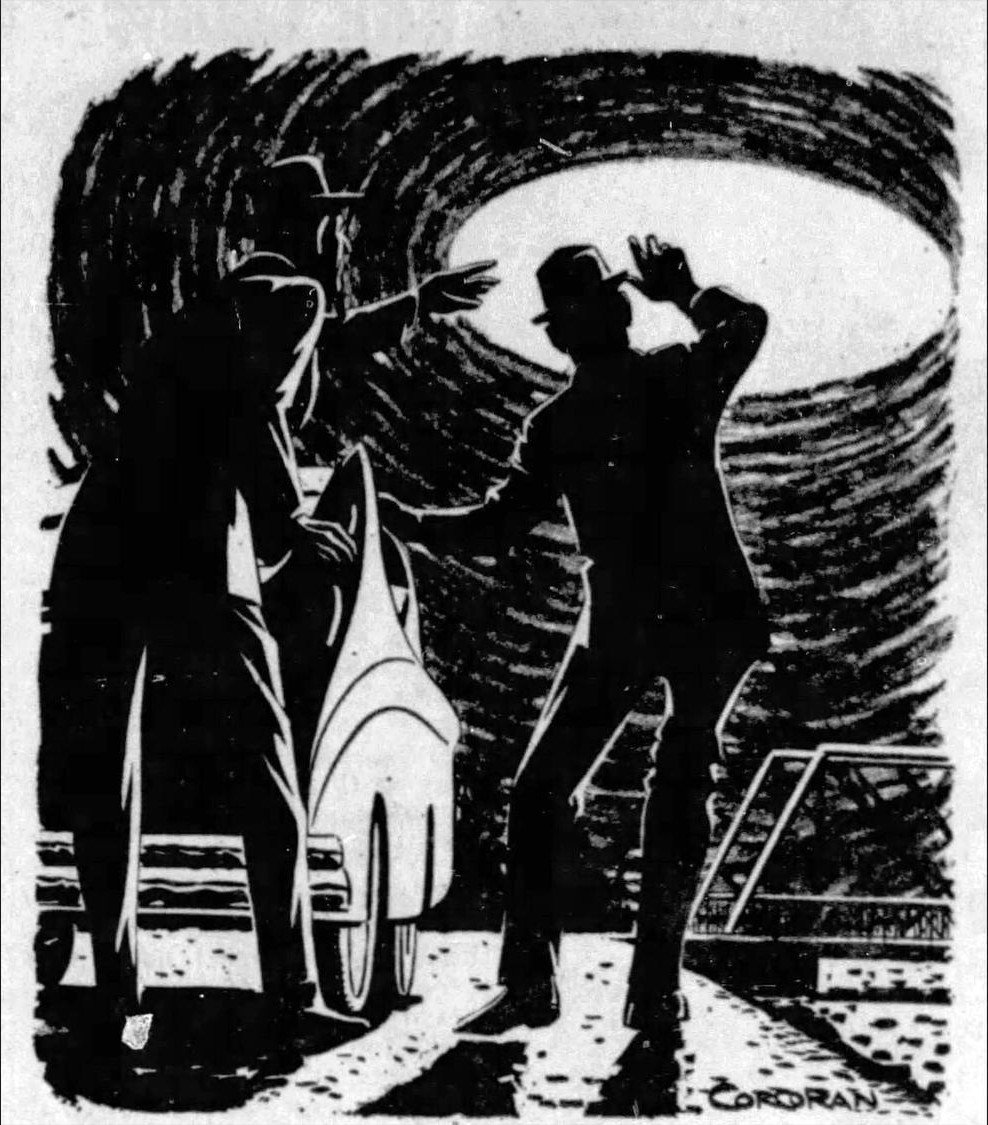
Late on the night of 26 October 1958, around 10:30 pm, two young Baltimore men were driving north of the city along the winding road that skirts Loch Raven Reservoir in Towson. This case file covers what witnesses reported, the official narrative, and a two-pass assessment with its evidence tier.
What did witnesses see at Loch Raven Reservoir?
Late on the night of 26 October 1958, around 10:30 pm, two young Baltimore men were driving north of the city along the winding road that skirts Loch Raven Reservoir in Towson. Alvin Cohen, 24, and Phillip Small, 27, said that as they neared the steel bridge that carried the road over an arm of the reservoir, a large glowing object came into view hanging in the air directly above the span. In the statement they submitted to an Air Force investigator within about two weeks, they described the approach plainly: "Shortly after you pass the dam the bridge looms up in front of you at 200 to 250 yards away. We slowed and decided to go closer and investigate the object." They put the thing at roughly 100 feet long, hovering about 100 to 125 feet over the top of the bridge, flattened and egg-shaped, and glowing a dim, even white.
What happened next is the heart of the case. "When we got to within 80 feet of the bridge," they told investigators, "the car went completely dead on us." It was not a stalled engine alone. The dashboard lights, the headlights, the ignition, the whole electrical system died at once, and the driver could not restart it. The two men got out and took cover behind the car, watching the object hang motionless over the bridge for what they estimated as another 30 to 45 seconds.
Then it discharged. "It seemed to flash a brilliant flash of white light," they said, and at the same instant they felt a wave of heat on their faces and heard a loud noise like a clap of thunder or an explosion. The object brightened so intensely that its outline blurred, then it rose straight up and was gone from sight in five to ten seconds. As soon as it left, the car's electrical system came back to life and the engine started normally. The men drove to a phone booth at Loch Raven Boulevard and Joppa Road, reaching it in roughly 15 minutes, and began trying to report what they had seen.
What is the official explanation?
The United States Air Force logged the sighting under Project Blue Book as case 6148 and assigned the field investigation to 2nd Lieutenant Bert R. Staples. The first call the witnesses made was to the Ground Observer Corps, the Cold War volunteer aircraft-spotting network, and according to the men they were brushed off. Cohen later recounted that the person who answered said, "Aww, come on now," and hung up on them. They then drove to St. Joseph Hospital, at that time on East Caroline Street in Baltimore, specifically to be checked for possible radiation burns, because the side of the face each man had turned toward the object had reddened. Baltimore County Police out of the Towson precinct responded to the scene and filed a report.
Staples interviewed the witnesses and assessed them carefully. His report described both men as appearing well educated, speaking in an intelligent manner, and seeming sincere. He also collected accounts from additional witnesses in the area that night, including a 16-year-old boy and two employees of a lakefront restaurant, who reported seeing similar glowing objects and hearing the same loud boom or explosion-like sound around the same time and place. After all of this, the Air Force evaluation field on the case was filled in with a single word: unidentified. Staples' own written summary closed with the line that has followed the case ever since, "As far as this investigation has gone, this UFO remains unidentified." The Air Force separately concluded the event represented no threat to national security.
The case did not stay buried in the files. J. Allen Hynek, the astronomer who served as Blue Book's scientific consultant, used Loch Raven as one of his worked examples of a Close Encounter of the Second Kind, the category he defined for an object seen at close range that leaves a physical effect such as heat, burns, or electrical interference. He referenced it in his 1972 book "The UFO Experience" as one of his close-encounter cases. Decades later, NICAP-affiliated researchers Brad Sparks, Fran Ridge, and Dan Wilson catalogued it as an electromagnetic-effect case with a high preliminary rating, and Wilson flagged that the sighting occurred only a few miles from a Nike missile site that at the time fielded nuclear-tipped Hercules interceptors. The witnesses' statements, the police involvement, and the unidentified evaluation are all documented in the Blue Book record now held by the National Archives.
What did the witnesses think it was?
Cohen and Small did not present themselves as flying-saucer enthusiasts, and they were careful about what they would and would not claim. Cohen drew the line explicitly: "I am not saying that it was a flying saucer. I do know there are at least such things now as UFOs." Both men were openly frightened by the encounter rather than thrilled by it. Small told the Air Force investigator, in a line that became the case's signature, "There was no place to run. We probably would've if we could've but we were terrified at what we saw." Cohen put their fear the same way, recalling simply, "We were very frightened."
What weighed on them most was the physical aftermath. They went to a hospital that night not to make a story but because their skin had reddened on the side that had faced the object and they genuinely feared they had absorbed a dose of something. Small reported that the change in his complexion was obvious enough that his wife and his colleagues noticed it afterward. That combination, a measurable bodily effect they took seriously enough to seek medical attention, plus the total and temporary death of the car's electrical system, is what separates Loch Raven from an ordinary light-in-the-sky report.
The two men were not the only witnesses. The teenage boy and the two restaurant workers interviewed by Staples independently described glowing objects and the same loud report in the same window of time, which means the central claim, that something luminous and loud was over the reservoir that night, does not rest on Cohen and Small alone. Investigators on every side, from Staples in 1958 to Hynek to the later NICAP cataloguers, treated the two principal witnesses as credible and consistent, and none of the original parties is on record recanting any part of the account.
The dispute
The dispute over Loch Raven is a natural-explanation reconstruction, not a debunk in the strong sense. The Air Force itself never offered a counter-explanation; Blue Book evaluated the case as unidentified. The substantive skeptical case comes from Alan W. Sharp, writing in the British skeptical UFO journal Magonia in 2009, who argued that the sighting could in principle be assembled from conventional elements rather than requiring an unknown craft, including candidate explanations along the lines of a misidentified airship or balloon, ordinary atmospheric or electrical phenomena, and the unreliability of human perception and memory under fright at night. The aim of the argument is to show the report is not good evidence of anything extraordinary.
The weakness is that the reconstruction never identifies the actual object or demonstrates the mechanism. It does not name a specific blimp or aircraft that was over the reservoir that night, it does not show that any known natural phenomenon produces a roughly 100-foot luminous body capable of killing a car's entire electrical system from tens of feet away and then delivering a heat flash to two men's faces before climbing out of sight in seconds, and it does not account in one coherent picture for the simultaneous electromagnetic, thermal, and acoustic effects reported by several independent witnesses. Sharp's reasoning was contested even within skeptical circles, with critics noting that non-rigid Navy airships were a common sight along the Eastern seaboard into the 1960s and that Baltimore-area residents would not have been fooled by one in the way the reconstruction requires.
Because the dispute consists of a plausible-but-unproven natural-explanation reconstruction with no positive identification of the real object, no confession, no recovered prop, and no demonstrated fabrication of this specific event, it does not rise to the level of a strong dispute under the tiering rules. There is also no witness recantation; Cohen and Small never walked back their account, and the supporting witnesses were independent. The case therefore largely stands on its Blue Book unidentified evaluation and its documented physical effects, with one contested skeptical reconstruction weighing against it. That places it in the Barely Disputed tier rather than Strongly Disputed.
Is the Loch Raven Dam Incident real? The two-pass assessment
Pass one, the ordinary readings. A glowing egg shape hanging over water at night invites several mundane candidates: a misperceived aircraft or blimp, ball lightning or some electrical atmospheric discharge, a reflection or temperature-inversion mirage, or simple exaggeration of a bright light. The most developed natural-explanation attempt is by Alan W. Sharp in the skeptical journal Magonia in 2009, who argued the report could be reconstructed from conventional ingredients rather than an unknown craft. The car failure has its own non-exotic possibilities, an old 1950s electrical system that genuinely failed by coincidence, or panic compressing a sequence of normal events. The facial reddening can be read as ordinary, since the men did not have it formally diagnosed as radiation injury and the hospital did not confirm a dose. None of these requires anything new in physics, and an honest file has to put them first.
The problem is that none of them has ever been pinned to the specific object. There is no recovered prop, no confession, no identified aircraft on a flight log, no named blimp on patrol that night, no traced launch, and no demonstration that ball lightning produces a 100-foot luminous body that kills a car's entire electrical system and then heat-flashes two men from a distance before rising vertically out of sight in seconds. Sharp's reconstruction is a plausibility argument, and it was criticised at the time as stretching credibility, for instance on the point that Navy blimps were familiar sights on the Eastern seaboard and would not have been mistaken this way by local witnesses. A contested natural-phenomena reconstruction with no positive identification is exactly the kind of counter-claim that disputes a case without closing it.
Pass two, if the core report is accurate. Then this is a low-altitude, self-luminous object that produced three correlated physical effects at once, a complete temporary failure of a vehicle's electrical system, a radiant heat pulse felt on the witnesses' faces, and skin reddening, accompanied by an explosive acoustic signature, witnessed by at least five people and recovering its environment the instant it departed. That cluster is precisely why Hynek used it as a textbook Close Encounter of the Second Kind and why the Air Force, after interviewing sincere and consistent witnesses, wrote unidentified in the box rather than forcing a fit. The official apparatus tried and failed to explain it, which under our rules is evidence the event was solid enough to need closing, not a strike against it.
Weighing both passes: the event is officially documented and evaluated as unidentified in the Project Blue Book file, the physiological and electromagnetic effects are on the contemporaneous record, and multiple independent witnesses corroborate the core sighting. The only counter-explanation on offer is a single skeptical reconstruction that is plausible in outline but identifies no specific object, shows no mechanism for the combined effects, and was itself contested. That is a real but weak dispute, so the case largely stands. Tier: Barely Disputed.
Sources
- ufologie.patrickgross.org/htm/lochravendam.htm
- ufologie.patrickgross.org/htm/bluebooku58.htm
- www.nicap.org/581026lochravendam_dir.htm
- www.thinkaboutitdocs.com/1958-the-loch-raven-dam-incident/
- exonews.org/loch-raven-reservoirs-forgotten-ufo-60-years-later/
- www.baltimoresun.com/2018/10/22/no-place-to-run-loch-raven-reservoirs-forgotten-ufo-60-years-later/
- www.baltimoremagazine.com/section/community/ufo-sightings-in-maryland/
- kirkmcd.princeton.edu/JEMcDonald/mcdonald_hcsa_68.pdf
More cases from this region: UFO sightings in United States