The Michigan Swamp Gas Case
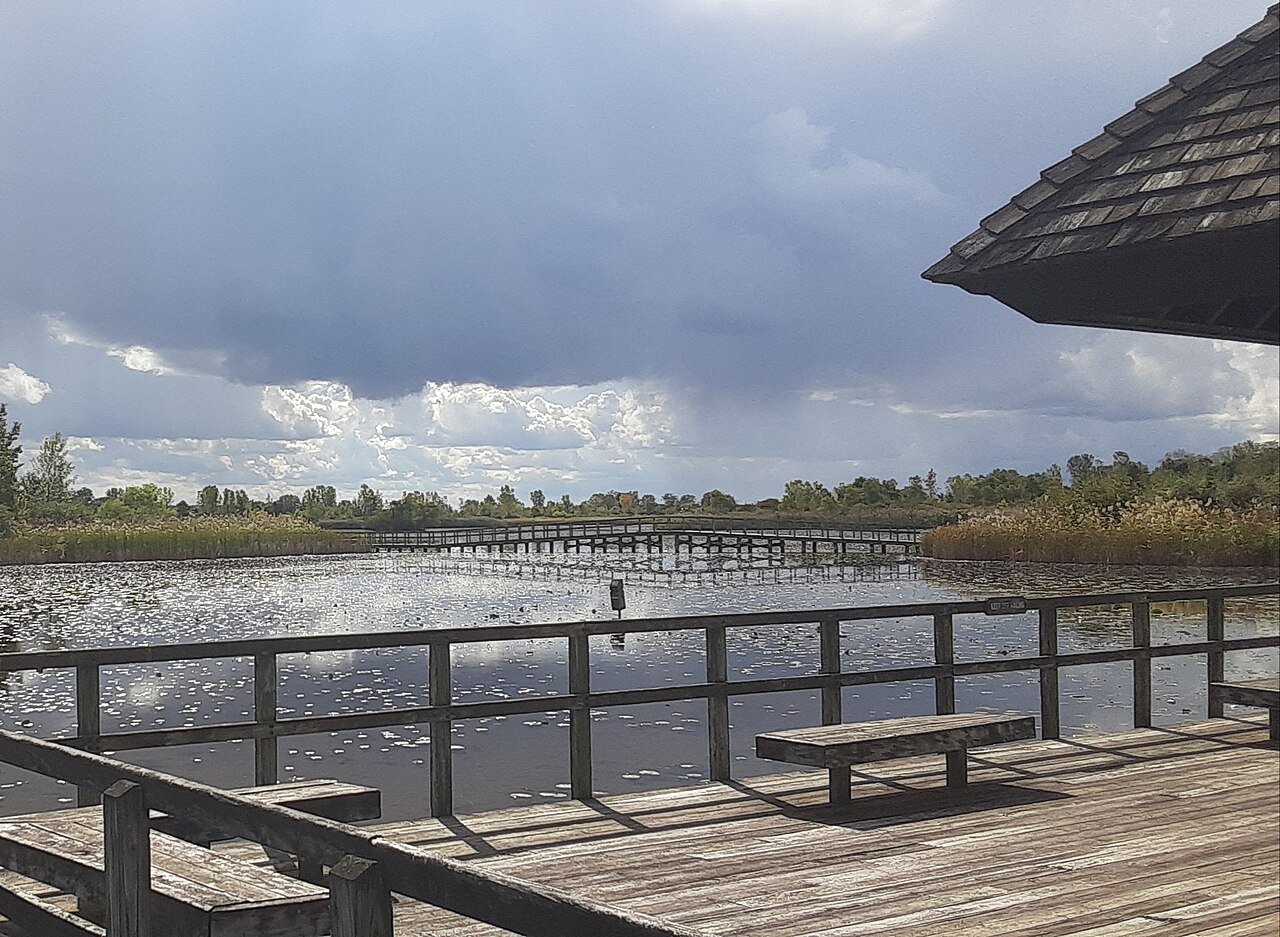
For about a week in March 1966 the farm country of southern Michigan filled with lights that police, civil-defense officers, college students and farmers could not name. This case file covers what witnesses reported, the official narrative, and a two-pass assessment with its evidence tier.
What did witnesses see at Dexter and Hillsdale?
For about a week in March 1966 the farm country of southern Michigan filled with lights that police, civil-defense officers, college students and farmers could not name. The two nights that made the case famous were 20 and 21 March 1966.
On the night of 20 March, the Washtenaw County sheriff's office took a call about an object down in the swamp on the edge of Frank Mannor's farm in Dexter Township, west of Ann Arbor. Mannor, a truck driver, walked toward it across his land with his son Ronald. He told reporters afterward, in words the Detroit and Ann Arbor papers carried that week, "We got to about 500 yards of the thing. It was sort of shaped like a pyramid, with a blue-green light on the right-hand side and on the left, a white light. I didn't see no antenna or porthole. The body was like a yellowish coral rock and looked like it had holes in it." He said it was wrapped in heat shimmer "like you see on the desert," and that the white light turned "blood red" as they got closer before the thing shot off. Dexter patrolman Robert Huniwell had already chased a low object that flashed red and green, hovered, then climbed away at speed. Carloads of deputies converged on the swamp; by some accounts dozens of police and civilians watched lights move over the marsh that night.
The next night, 21 March 1966, the lights moved about fifty miles west to Hillsdale College. Women in McIntyre Hall, the women's dormitory, watched a glowing object over the swampy arboretum between their dorm and the airport for the better part of two hours, from roughly 10:30 p.m. on. They phoned the county civil-defense director, William "Bud" Van Horn, who came out and watched it himself. Student Gidget Kohn described it for the campus paper: "There was a glow around it and the lights appeared to be pulsating. The glow was gone and there were three lights which were yellow-white, then the middle light turned red and then the one on the left." Another student, Josephine Evans, said "it moved like nothing earthly and Mr. Van Horn was seeing it too." Hillsdale police officers Harold Hess and Jerry Wise saw it near the arboretum; Hess said, "Then, over by the college, we saw a real brilliant light in the sky at a low altitude. You couldn't look at it, it was so bright." Hess added that when the light split and moved off, their patrol car radio died: "We got into our patrol car and we couldn't transmit. We just got static." Civil-defense director Van Horn estimated the object rose to between 100 and 150 feet and watched it dim and brighten as it moved. Reported counts of the Hillsdale witnesses run from the dozens in the dorm to as many as 87 students that night.
What is the official explanation?
The Air Force ran these sightings through Project Blue Book, its standing UFO office, and sent its scientific consultant, the Northwestern University astronomer Dr. J. Allen Hynek, to Michigan. Hynek arrived on 23 March 1966, toured the Dexter swamp and the Hillsdale arboretum, and talked to police and witnesses. Sheriff Douglas Harvey of Washtenaw County, who drove Hynek around, said years later that in private Hynek told him he had no idea what the people had seen and thought it worth further study, then took a phone call and changed his tone. Harvey's recollection, given to the Ann Arbor press decades on, was blunt: "He said, 'It's swamp gas.' He tells me one minute he has no idea what it is. And then he makes one phone call to Washington and comes out and gives a statement that it's swamp gas."
On 25 March 1966 the Air Force put Hynek in front of about sixty reporters at the Detroit Press Club. Hynek's own first-person account of that day, published in the Saturday Evening Post on 17 December 1966 under the title "Are Flying Saucers Real?", is the best primary record of what happened and how reluctant he was. He wrote that he received word from the Air Force that there would be a press conference at which he would give the cause of the sightings, and that he protested he had no real idea what had caused them. A University of Michigan botanist had phoned him about "swamp gas," the slow release and occasional ignition of methane from rotting vegetation in marshland, a glow long known in folklore as will-o'-the-wisp, jack-o'-lantern and fox fire. After checking with other Michigan scientists Hynek decided to offer it as a "possible" explanation. He described the press conference as a scrum: "The TV cameramen wanted me in one spot, the newspaper men wanted me in another, and for a while both groups were actually tugging at me." He watched the word he had hedged get stripped of its hedge in real time: "One reporter scanned the page, found the phrase 'swamp gas,' underlined it, and rushed for a telephone." His prepared statement stressed that the explanation was confined to the localized swamp sightings and not to UFO reports generally, and it carried the line that became the headline, that a dismal swamp is a most unlikely place for a visit from outer space. Hynek later called the affair the low point of his association with UFOs.
The official explanation did not hold politically. Michigan's congressman and House Minority Leader Gerald R. Ford pushed for a formal congressional inquiry, the first time a congressional leader had done so over UFOs. In his own press column for the 5th District weeklies, held in the Gerald R. Ford Presidential Library (Box D6, Ford Press Releases), Ford wrote: "At week's end, the Air Force explained away the UFO's as a product of college-student pranks, swamp gas, the rising crescent moon, and the planet Venus. But the Air Force has been explaining away UFO's for years, and I don't believe the American people generally are satisfied with its statements. For that reason, I have proposed that there be a congressional investigation of UFO's. Let's try to get to the bottom of this thing." Ford pressed the House Armed Services Committee and its chairman, and the committee held an open hearing on 5 April 1966 at which Air Force Secretary Harold Brown and Blue Book personnel testified. The episode fed directly into the Air Force commissioning the University of Colorado UFO study, the Condon Committee, the following year.
What did the witnesses think it was?
The witnesses did not accept the swamp gas verdict, and several were people whose job was to assess what they saw. Frank Mannor maintained that what he and his son walked up on in his own swamp was a solid, lit, heat-shrouded object, not a glow over the marsh. Sheriff Douglas Harvey backed his deputies and witnesses for the rest of his life: "They did see something. I'll believe this to the day I die. Somebody has kept something quiet, and nothing more ever materialized."
At Hillsdale the pushback was sharpest from the man with the most relevant training. Civil-defense director William "Bud" Van Horn had watched the object himself and afterward drew up a point-by-point rebuttal of Hynek's investigation, reported as a 15-point refutation. He objected that the inquiry was steered toward a predetermined answer: "I also observed that his main line of questioning was relative only to that which would fit the Marsh Gas Theory." Witnesses said the investigators barely engaged, that they talked to only a handful of people and ignored statements that did not fit. The student witnesses were just as unmoved. Josephine Evans said, "Dr. Hynek came to Hillsdale and I think he just wanted to get rid of us. Hynek was pressured to play it down." Officer Harold Hess put the physics objection plainly: "Swamp gas would never be bright. It was like looking into 20 spotlights. They'll never convince me it was swamp gas." The brightness, the structured movement, the duration of up to two hours, the patrol-car radio static and the fact that the Hillsdale arboretum lights and the Dexter swamp lights were fifty miles and a day apart were all things the witnesses said marsh gas could not cover. None of the principal witnesses is on record recanting.
The dispute
The dispute is the swamp gas explanation itself, and who advanced it and how. On 25 March 1966 at the Detroit Press Club, Project Blue Book's scientific consultant Dr. J. Allen Hynek told reporters that the Dexter and Hillsdale sightings were probably caused by marsh gas, methane released by rotting vegetation in the swampy ground at both sites, which can glow or briefly ignite. The Air Force adopted this as the working explanation. It is a real natural phenomenon, and both anchor sites were genuinely wetland, so on its face the explanation has a plausible mechanism.
What weakens it is the manner and the man. By his own published account in the Saturday Evening Post of 17 December 1966, Hynek did not arrive at swamp gas through investigation; he was told there would be a press conference at which he would give a cause, he protested that he had no real idea what the witnesses saw, and he reached for marsh gas as a "possible" explanation after a University of Michigan botanist phoned him about it. He stressed it applied only to the localized swamp lights, not to UFO reports in general, and he watched a reporter underline "swamp gas" and run for a phone while the qualifier evaporated. Sheriff Douglas Harvey, who drove Hynek around, said Hynek admitted uncertainty in private and announced swamp gas only after a phone call to Washington. So the counter-explanation is an official assertion without a shown method, hedged by its own author, not an independent reconstruction.
The explanation also does not match the strongest sighting. At Hillsdale on 21 March, dozens of witnesses including civil-defense director William Van Horn and police watched a bright, structured, color-changing object for up to two hours, saw it rise to over 100 feet, and reported their patrol-car radio failing while it was overhead. Marsh gas is a faint, low, flickering glow that does not persist coherently for two hours, climb, or knock out a radio. Van Horn issued a 15-point rebuttal and said Hynek's questioning was steered only toward what would fit the marsh-gas theory; officer Harold Hess said it was like looking into twenty spotlights and that swamp gas would never be that bright.
Why it does not close the case: no independent civilian analyst has ever positively identified the specific cause of the 20 to 21 March events, located the vents, traced an aircraft, balloon or rocket, recovered a hoax prop, or obtained a recantation from the principal witnesses. The one photograph linked to the case was never published or authenticated. Under UAP Globe's rules an official, method-free, self-hedged explanation that the eyewitnesses rejected is a barely-disputing counter-claim, not a discredit. The case largely stands as an unexplained mass sighting that was officially, and unconvincingly, labeled.
Is the Michigan Swamp Gas Case real? The two-pass assessment
Pass one, how this could be ordinary. The official explanation is itself an ordinary-cause claim, and parts of the flap genuinely do look prosaic. Spring thaw over Michigan marshland really can release methane that glows or briefly ignites, and the two famous sites, the Dexter swamp and the Hillsdale arboretum wetland, were exactly the boggy ground where that happens. Hynek also publicly attributed some of the wider sightings and the police time-exposure photographs to the rising crescent moon and the planet Venus low on the horizon, classic misidentifications during a flap when everyone is watching the sky and expecting saucers. March 1966 was a peak UFO-flap period nationally, with heavy press amplification and copycat reports, and a number of the hundreds of secondary reports across Macomb, Oakland, Washtenaw and beyond are consistent with stars, aircraft lights, and excited misreporting. A single staged or natural light source plus contagion can manufacture a "wave."
Pass two, if the core events were real. The trouble is that swamp gas does not fit the two anchor sightings it was invoked to explain. The Hillsdale object was watched for up to two hours by dozens of people from a fixed vantage, brightened and dimmed, showed structured red and white and yellow lights in sequence, and appeared to move with intent; will-o'-the-wisp is a faint, flickering, near-ground glow that does not rise to 100-plus feet, does not stay coherent for two hours, and does not coincide with patrol-car radio failure. The Dexter object was a close-range, heat-shrouded, structured shape per a sober farmer on his own land. And the same explanation was stretched to cover two events fifty miles and a day apart. So if these were real stimuli, "swamp gas" is the wrong label, and what remains is an unidentified structured-light object observed at low altitude by trained and multiple witnesses.
Weighing the dispute itself. The counter-explanation here is an official Air Force assertion delivered under explicit time pressure by a consultant who said in print that he had no real idea what the witnesses saw and offered marsh gas only as "possible." Under UAP Globe's rules an official-apparatus debunk is evidence the case was real enough to need closing, not a verdict, and it counts against the case only when an independent, civilian, method-shown analysis identifies the specific cause of these specific events. No one has done that. No named investigator has positively identified a single methane vent, traced a specific aircraft or balloon, recovered a hoax prop, or produced a witness recantation for the 20 to 21 March anchor sightings. The one photograph tied to the case, the so-called Mannor photo held by a Detroit News reporter, was never published and remains unauthenticated, so it can neither support nor sink the case. What we have is a weak official explanation, advanced by the official body, contested at the time by the civil-defense director who saw the object and by the police and students who saw it, and never closed by method-shown civilian work. That is the definition of Barely Disputed: a counter-explanation exists and is official, but it is partial, hedged by its own author, and widely rejected, while the core sightings stand. Tier: Barely Disputed.
Sources
- ufologie.patrickgross.org/htm/hynekeveningpost.htm
- www.theblackvault.com/documentarchive/gerald-ford-pushes-congressional-ufo-hearings-1966/
- hillsdalecollegian.com/2015/03/ufo-in-1966-hillsdale-had-its-own-close-encounter/
- www.hillsdalehistoricalsociety.org/alien-invasion
- www.clickondetroit.com/features/2024/03/13/ill-believe-this-to-the-day-i-die-the-michigan-ufo-craze-of-1966/
- ufoconjectures.blogspot.com/2023/02/that-alleged-1966-photo-of-frank.html
More cases from this region: UFO sightings in United States