The Tully Saucer Nest
At about 9 a.m. on Wednesday 19 January 1966, George Alfred Pedley, a 28 year old banana farmer from Euramo near Tully in tropical Far North Queensland, was driving a tractor across the cane and swamp country of his neighbour Albert Pennisi, close to a body of water called Horseshoe Lagoon. This case file covers what witnesses reported, the official narrative, and a two-pass assessment with its evidence tier.
What did witnesses see at Horseshoe Lagoon?
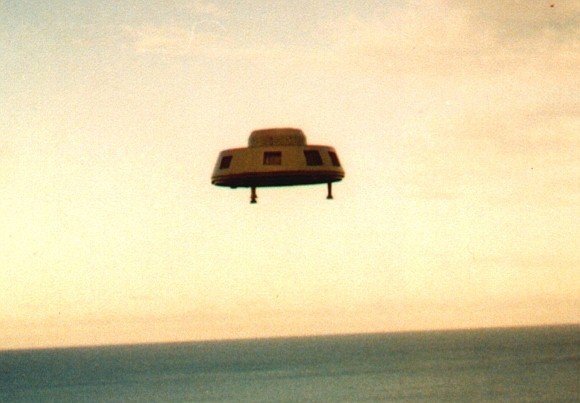
At about 9 a.m. on Wednesday 19 January 1966, George Alfred Pedley, a 28 year old banana farmer from Euramo near Tully in tropical Far North Queensland, was driving a tractor across the cane and swamp country of his neighbour Albert Pennisi, close to a body of water called Horseshoe Lagoon. Above the noise of the tractor engine he heard what he described as a loud hissing sound, "like air escaping from a tyre". Roughly 25 yards ahead of him, at about the level of the surrounding tree tops, he saw a large grey object already in the air.
Pedley described it as a saucer shape, convex on the top and bottom, roughly 25 feet across and about 9 feet high at the centre, silver grey to blue grey in colour, with no portholes, antennas or any sign of life. He likened it to "something similar to like two saucers, you know, face to face". He watched it rise a little, tilt slightly to one side, spin, and then depart toward the south west at a steep angle of about 45 degrees in a tremendous burst of speed, the whole sighting lasting only a few seconds. Years later, in a 1981 interview with researcher Bill Chalker, Pedley was careful to correct the popular version: he did not see the thing climb out of the water. "I didn't see it in the lagoon as they say. That's wrong." He saw it already airborne above the marsh.
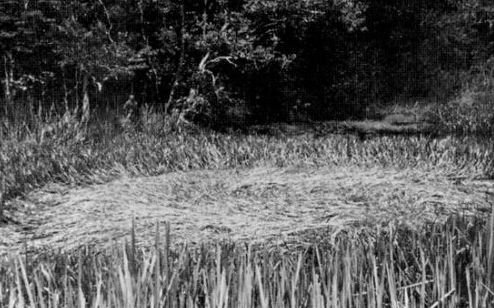
When he rounded the bend and reached the spot the object had come from, Pedley found something in the lagoon that had not been there before. A roughly circular area of the dense swamp reeds, about 30 to 32 feet across, had been cleared and the water inside it was slowly rotating. Within hours a great floating mat of reeds rose to the surface, the stems uprooted from the lagoon bed rather than merely bent over, and laid down in a radial pattern that swirled in a clockwise direction. That afternoon Pedley returned with Albert Pennisi, who waded out to the floating mass and found he could swim right under it, the water beneath being clear and free of obstruction. Observers noted a sharply down thrusting outer rim, as if pressed by a huge inverted saucer, and a roughly circular central mound about 6 to 8 feet across and perhaps 18 inches deep. The reeds turned brown at the top within about 8 hours, far faster than hand pulled swamp reeds normally brown, while their undersides stayed green.
Over the following days and weeks more marks were found around Horseshoe Lagoon. A neat rectangular patch of swamp couch grass about 5 by 6 feet had been pulled out and removed entirely. Teardrop shaped impressions were found in adjacent ploughed soil, spaced about 12 inches apart. Smaller circular nests were located nearby, at least one swirled anticlockwise and at least one reported with a scorched looking centre. Albert Pennisi said his dog had become highly agitated around 5:30 that morning, racing toward the lagoon, and that for about a week beforehand he had been having recurring dreams of a giant dish landing on his property.
What is the official explanation?
The case was investigated by the Royal Australian Air Force through the Department of Air, the body then responsible for Australian UFO reports, and the surviving file was later examined in detail by Australian researcher Bill Chalker, who was given official access to the national UFO records. The first formal document was a report by Sergeant A.V. Moylan of the Tully Police, dated 26 January 1966. Moylan described "a clearly defined near-circular depression in swamp grass at point from which object seen rising, about 32 feet long and 25 feet wide", with the grass "flattened to surface of 4 feet of water lying in clockwise curves". His own first guess was prosaic: "I formed the opinion that the depressed area in the swamp grass had been caused by a small helicopter." That guess was undercut by the RAAF itself.
The RAAF checked the air traffic. Flight Lieutenant Wallace at the Townsville RAAF base confirmed there were no service or civil aircraft operating in the area at the time of the sighting. The Department of Air then addressed the helicopter idea head on. As reported in The Courier-Mail, Brisbane, on 25 January 1966, "RAAF officials discounted the theory that 'nests' have been made by helicopters. The RAAF said that in depressions left by helicopters the grass usually ran in an anti-clockwise direction, the main nest found at Tully ran in a clockwise direction." Grass and water samples were collected and forwarded to the University of Queensland for analysis on 24 January 1966.
On 11 February 1966 the Secretary of the Department of Air, A.B. McFarlane, set out the official conclusion in a letter. The investigation, he wrote, had failed to reveal anything of significance, and "there is no explanation for the visible phenomena reported but it could have been associated with or the result of 'down draughts', 'willy willies' or 'water spouts'." A "willy willy" is the Australian term for a small whirlwind or dust devil. This vortex idea hardened over time. In December 1973 G.J. Odgers, Director of Public Relations for the Department of Defence, told inquirers that the most probable explanation was a "willy willy" or circular wind phenomenon that flattened the reeds and sucked up debris to a height of about 30 feet.
The scientific testing was inconclusive and, in one respect, self contradictory. The University of Queensland physics department found only trace radioactivity, a slight beta reading at the centre of the nest that was described as much less than the activity from a luminous wristwatch dial and dismissed as insignificant background. The botany department reported that the grass had "apparently died from submersion in swamp water", with no sign of parasites or burning. Yet that submersion explanation sat awkwardly against the field observation that the Tully reeds browned in roughly 8 hours, whereas reeds simply pulled up and left in swamp water normally take about three days to brown. The official file, in short, closed the case as a probable wind effect while never actually accounting for the speed of the browning, the uprooting of the reeds, or Pedley's sighting of a structured airborne object.
What did the witnesses think it was?
George Pedley never wavered. He was, by every contemporary account, an ordinary working farmer with no prior interest in flying saucers, and he was reportedly reluctant to talk about it at first for fear of ridicule. He rejected the whirlwind verdict flatly: "I've seen wet whirlwinds and dust whirlwinds. If the police believe this, let them. I know what I saw. It wasn't a whirlwind." He told reporters his body was "frigid with fright" as the object left. In his 1981 interview with Bill Chalker he was still consistent on the key facts more than fifteen years later, and was at pains to strip the legend back to what he actually saw, an already airborne grey disc, not a craft rising dripping from the lagoon.
Albert Pennisi, who owned the lagoon and the land, became the long term custodian of the story. He photographed the floating nest, kept watch over the site for decades, and reported that further nests appeared at Horseshoe Lagoon in later years, in 1969, 1972, 1975, 1981 and 1987, with the running tally reaching around twenty two formations by 1990. Pennisi's account of his recurring premonitory dreams and his dog's agitation that morning was carried in The Sun, Sydney, on 24 January 1966 by journalist Ben Davie, where Pennisi described the dream: "This thing like a giant dish would come out of nowhere and land nearby." He set up a homemade UFO detector and camera at his home, which he said triggered before dawn on 8 February 1969 when a second nest was found measuring 29 feet 6 inches across, although the film he posted to Kodak in Melbourne came back marked as containing no film on arrival.
Several Queensland investigators worked the case on the ground, including Stan Seers of the Queensland Flying Saucer Research Bureau, whose group examined the nest and samples soon after the event. Bill Chalker, the most rigorous Australian documentarian of the file, interviewed Pedley directly, read the RAAF and Department of Air paperwork, and weighed both the physical evidence and the official explanations. He treats later nests at the lagoon with appropriate caution, allowing that some could be hoaxes or natural, but he holds that neither hoaxing nor simple misidentification accounts for Pedley's original encounter. His own published verdict on the 1966 event is that it remains "a remarkable example of a UFO physical trace case" in which "an unidentified phenomenon was apparently involved" and "a definitive explanation currently eludes us".
The dispute
The standing counter-explanation is the one the Royal Australian Air Force and the Department of Air put on the file: a "willy willy", a small whirlwind or atmospheric vortex of the kind common in tropical North Queensland, possibly a waterspout or downdraught, that flattened and swirled the reeds and gave Pedley the impression of a departing craft. Secretary A.B. McFarlane named it in his 11 February 1966 letter, and Department of Defence public relations director G.J. Odgers restated it more confidently in December 1973, claiming a circular wind had flattened the reeds and lifted debris to about 30 feet. Skeptical writers have leaned on this ever since, and the broader cultural verdict shifted further in 1991 when English hoaxers Doug Bower and Dave Chorley confessed to inventing the modern crop circle craze, citing the Tully "saucer nests" among their inspirations.
The trouble is that the willy willy explanation is an official assertion with no demonstrated mechanism, not a reconstruction that has ever been shown to reproduce the Tully nest. By the witnesses' account, and consistent with reports of the day, the morning of 19 January 1966 was fine, sunny and calm, the wrong conditions for a vigorous vortex. The reeds were not merely flattened, they were torn out by the roots and laid in a clean radial swirl, and they browned in about a third of the normal time, neither of which a wind theory addresses. The RAAF's own observation cuts against a simple wind or rotor explanation too: it noted the main nest ran clockwise, which it used to rule out a helicopter, but a tidy single direction sits poorly with the chaotic, debris strewn damage a real whirlwind leaves. The University of Queensland botany finding, death by submersion, does not explain the eight hour browning, and the physics testing turned up nothing meaningful either way.
The 1991 Bower and Chorley confession is frequently cited as if it discredits Tully, but it does not touch this event. The two men admitted to fabricating English crop circles from 1978 onward with planks and rope; they made no claim to have been at a Queensland lagoon in 1966, twelve years earlier and on the other side of the world. That they were inspired by reading about Tully is a fact about them, not evidence that the original nest was faked. Likewise the later nests at Horseshoe Lagoon, some of which may well be hoaxes or natural, do not retroactively explain Pedley's sighting of a structured object or the first nest's physical state.
This stays at Barely Disputed rather than anything stronger because nothing discredit grade has ever been produced for the 1966 event. There is no confession from Pedley or Pennisi, no recanted testimony, no recovered hoaxing apparatus tied to that morning, and no positive identification of a specific real world object or weather event that has been shown to make this exact trace. The willy willy remains a plausible label that was never demonstrated, contradicted by the calm weather, the uprooting, and the browning. On the evidence that exists, the object and the original nest are still unexplained.
Is the Tully Saucer Nest real? The two-pass assessment
Pass one, the ordinary readings. The official line is a whirlwind, a willy willy or waterspout, flattening reeds into a circle. It has real surface appeal because North Queensland does get such vortices in the wet season, and a rotating wind would naturally produce a roughly circular swirl. But the specifics fight it. Witnesses describe a calm, fine, sunny morning, the reeds were uprooted rather than bent and then laid in a single clean clockwise spiral, and the upper reeds browned in about eight hours when normal submerged reeds take around three days. A whirlwind also leaves a messy debris trail, which was not the picture here. A second ordinary reading is a hoax, someone pulling reeds into a pattern. This is the standard charge against later nests at the lagoon and against crop circles generally, and the 1991 Bower and Chorley confession showed exactly how cheaply such patterns can be faked with planks and rope. But that method was shown for English crop fields in the late 1970s and after, not for a floating reed mat in a Queensland lagoon in January 1966, and there is no confession, no caught hoaxer, and no recovered apparatus for the original event. A third reading is helicopter or aircraft downwash, which the RAAF itself raised and then discarded after confirming no aircraft were operating in the area and noting the rotation direction was wrong for a helicopter. None of the three ordinary explanations has ever been demonstrated to reproduce this specific trace.
Pass two, if it is real. George Pedley, an ordinary farmer with no UFO background and a clear motive to stay quiet, reported a structured grey object roughly 25 feet across and 9 feet thick, convex top and bottom like two saucers face to face, that hovered at treetop height, spun, tilted and left at high speed, all in seconds, accompanied by a loud hissing. Below the spot he found a freshly uprooted reed mass swirled in a clockwise radial pattern with a central mound, water rotating beneath it, that browned anomalously fast, plus a removed rectangle of couch grass and regularly spaced teardrop impressions in the adjacent soil. If genuine, that is a classic physical trace case: an unidentified airborne object leaving measurable, photographed ground effects that the responsible air force investigated and could not explain, falling back on an undemonstrated weather label.
The case is well anchored in primary material. It rests on the witness's own consistent testimony across fifteen years, on contemporary press within days, on the Tully Police report of 26 January 1966, on the Department of Air's own correspondence under Secretary A.B. McFarlane and later G.J. Odgers, on University of Queensland botany and physics testing, and on Bill Chalker's direct examination of the official file and interview with Pedley. The only counter-explanation on offer is an official assertion of a willy willy that was never shown to make this trace and is contradicted by the calm weather, the uprooting and the rapid browning. That is enough to mark the case Disputed, but only barely. There is no confession, no recantation, no recovered props and no positive identification of a specific natural cause, so it does not rise to a strong dispute. Tier: Barely Disputed. The object and the original 1966 nest remain unexplained, with a weak and undemonstrated official counter-claim attached.
Sources
- www.project1947.com/forum/bctully.htm
- theozfiles.blogspot.com/2017/07/the-1966-tully-flying-saucer-nest.html
- uforq.org/the-tully-saucer-nest/
- www.thinkaboutitdocs.com/the-1966-tully-saucer-nest/
- ausufo.wordpress.com/2017/05/22/the-tully-saucer-nests/
- www.australiangeographic.com.au/blogs/tim-the-yowie-man/2020/09/saucer-hysteria-the-case-of-the-tully-crop-circle/
- oldcropcircles.weebly.com/australia-1966-tully.html
More cases from this region: UFO sightings in Australia