The Portage County UFO Chase
In the predawn dark of 17 April 1966, around 5:00 a.m., Portage County deputy sheriff Dale Spaur and mounted deputy Wilbur "Barney" Neff stopped on State Route 224 east of Randolph, Ohio, to check an apparently abandoned car. This case file covers what witnesses reported, the official narrative, and a two-pass assessment with its evidence tier.
What did witnesses see at Ravenna?
In the predawn dark of 17 April 1966, around 5:00 a.m., Portage County deputy sheriff Dale Spaur and mounted deputy Wilbur "Barney" Neff stopped on State Route 224 east of Randolph, Ohio, to check an apparently abandoned car. Spaur later said he turned to look behind him, a habit, and saw a light rise out of the wooded area. In his own words, "I always look behind me so no one can come up behind me. And when I looked in this wooded area behind us, I saw this thing." The object lifted to roughly tree-top height, swung toward the deputies, and lit up the road. Spaur described it as very bright, bright enough to "make your eyes water," with a cone of light beneath it that lit the ground like daylight, and a low hum he likened to an overloaded transformer.
Spaur and Neff estimated the object at roughly 30 to 45 feet across. The Akron Beacon Journal of 18 April 1966 reported it as "between thirty-five and fifty feet wide and fifteen to twenty-five feet high," shaped, in the officers' words, like the head of a flashlight. Ordered by their sergeant to keep it in sight, the two deputies gave chase eastward. The object held station ahead of them and seemed to react to them, slowing when they slowed, holding position when they stopped. Spaur said the lines of it were distinct and that "somebody had control over it. It wasn't just floating around. It [could] maneuver," and at one underpass, "when I came out from under the bridge, it came down and waited for us. Just as though it knew these two cars were following it."
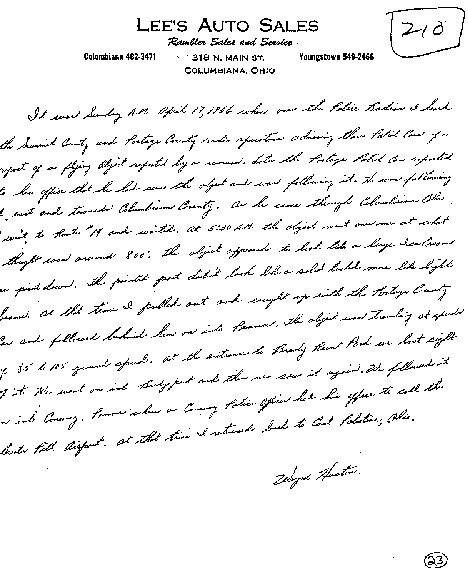
The pursuit ran east out of Ohio and across the Pennsylvania line, covering roughly 85 miles at speeds the officers clocked past 100 mph, old Route 14 and then Pennsylvania routes carrying them toward the Ohio River towns. Near the Ohio-Pennsylvania border, East Palestine patrolman H. Wayne Huston, who had been listening to the radio traffic, was parked waiting and saw the object pass overhead with the sheriff's cruiser behind it. In his signed statement he described "a large ice cream cone with point down" moving at "85 to 105 ground speed," and he pulled out and joined the chase. The cars ran low on fuel near Conway, Pennsylvania, where they found patrolman Frank Panzanella already watching the object. Panzanella, a Korean War veteran familiar with aircraft, described it as the shape of half a football, around 25 to 35 feet across, hanging at about a thousand feet. As the sky brightened the deputies saw it in silhouette with a vertical projection at the rear, taking on a metallic look. When radio chatter mentioned scrambling jets, the object climbed. Spaur said, "When they started talking about fighter planes, it was just as if that thing heard every word that was said; it went PSSSSSHHEW, straight up," and Panzanella watched it rise until it shrank to the size of a ballpoint pen and was gone. The whole observation ran roughly an hour and a quarter, ending around 6:15 a.m.
What is the official explanation?
The case went into Project Blue Book, the Air Force's UFO investigation at Wright-Patterson. The file holds signed statements from the principal witnesses, Spaur and Neff jointly, Huston, Panzanella, and a separate witness who gave the half-football description. It also contains a statement from radar officer William L. Akers covering the relevant area, who wrote plainly, "I observed nothing on the radar presentation that coincided with the reported object." Mantua police chief Gerald Buchert had tried to photograph the object from in front of his house roughly twenty miles off; his picture came out as a fuzzy white smear on black and was published in the Akron Beacon Journal on 19 April 1966, and Buchert later said the Air Force told him not to talk about it.
Blue Book's chief, Major Hector Quintanilla, handled the evaluation. The initial Air Force contact amounted to two short telephone calls to Spaur alone, totaling around four minutes, opening, by Spaur's account, with the line "tell me about this mirage you saw," and pressing Spaur to agree the sighting had lasted only a few minutes rather than over an hour across two states. The conclusion Blue Book put on the case was that the officers first saw an orbiting satellite and then chased the planet Venus. Quintanilla held to the satellite-and-Venus identification under pressure from Ohio officials and in an acrimonious meeting refused to change it, even when it was pointed out that the officers had seen the object at the same time as Venus and the moon at the end of the sighting. Quintanilla also denied that any jets had ever been scrambled.
The official explanation collided with Blue Book's own scientific consultant. Astronomer J. Allen Hynek, Blue Book's astronomical adviser, and his assistant William Powers regarded the satellite-and-Venus answer as untenable, and Hynek counted this among the cases where he openly broke with the Air Force conclusion. Separately, NICAP investigator William B. Weitzel built an exhaustive dossier on the case, taped interviews, signed statements, sketches, and a route reconstruction, and when the Air Force funded the University of Colorado UFO study under Dr. Edward U. Condon, a copy of Weitzel's report was hand-delivered to Condon. The Condon Report, the formal Scientific Study of Unidentified Flying Objects published in 1968, does not mention the case at all.
What did the witnesses think it was?
The witnesses never accepted the Venus answer. Portage County sheriff Ross Dustman put the core objection bluntly: "I've seen Venus many times, but I never saw Venus 50 feet above a road and moving from side to side like this was." The officers had watched the object stop, reverse, hold position at an underpass, and climb vertically out of sight, behavior no planet performs, and they had Venus and the moon in the sky at the same time to compare it against.
The four principal witnesses were trained observers with nothing to gain. Spaur and Neff were on-duty deputies, Huston a city patrolman, Panzanella a small-town officer and combat veteran, and they reported the same low, structured, maneuvering object independently from positions tens of miles apart along the route. Their consistency is part of why Hynek and Powers, working inside Blue Book, found the official answer impossible to defend.
The aftermath cuts against any motive of glory-seeking. The men were ridiculed. Buchert told a reporter the whole thing "should just be forgotten about." Neff stopped talking about it. Panzanella had his phone removed because of the constant calls. Huston quit the force and moved away, later saying, "Sure I quit because of that thing. People laughed at me. And there was pressure." Spaur was hit hardest. The Cleveland Plain Dealer found him by October 1966 living in a motel on peanut butter sandwiches, twenty pounds lighter, his job gone and his marriage ended. He told the paper, "Thirty-four years old and what do I have? Nothing. Who knows me? To everyone, I'm Dale Spaur, the nut who chased a flying saucer," and years later, "If I could change all that I have done in my life, I would change just one thing. And that would be the night we chased that damn thing. That saucer." People do not pay that price to defend a hoax.
Is the Portage County UFO Chase real? The two-pass assessment
Pass one, the ordinary case. The Air Force's own answer is the ordinary case: a satellite first, then the planet Venus, low on the horizon in the predawn sky and chased by tired men who misjudged its distance and motion. Venus was indeed in that part of the sky, and an unfamiliar bright point near the horizon can fool a moving observer into thinking it pacing or following the car. A blurry photograph from twenty miles away proves nothing. That is the whole of the conventional explanation, and it has real surface appeal because there genuinely was a bright planet out that morning.
The problem is that the explanation does not fit what was documented. Four trained police observers, spread across roughly 85 miles of road in two states, independently reported a low object, tens of feet across, at tree-top to low-altitude height, throwing a cone of light bright enough to hurt the eyes and lighting the ground, with a transformer-like hum, a silhouette with a rear projection, and a metallic look at dawn. It stopped, reversed, waited at an underpass, and shot straight up. Venus does none of that and is not 30 to 45 feet wide at a few hundred feet. The witnesses had Venus and the moon in view at the same time as the object, the radar officer's signed statement records nothing on radar that matched, and Blue Book's own consultant, Hynek, with his assistant Powers, judged the satellite-and-Venus identification untenable. Under Graham's rule six, the Quintanilla finding is an official-apparatus debunk, a four-minute phone call and a refusal to revise, and it counts as evidence the case was real enough to need closing, not as a mark against it. There is no independent, civilian, method-shown analysis that identifies a specific ordinary object, no confession, no recovered props, no traced launch.
Pass two, if real. If the object was what the officers described, it was a structured, controlled craft of unknown origin that held station against and reacted to pursuing cars, illuminated the ground, hummed, and departed by vertical ascent. It remains, in the strict sense, unidentified.
The material here is authenticated official documentation: signed Blue Book witness statements from four officers, a radar negative on the record, contemporary newspaper coverage with measured dimensions, a NICAP dossier delivered to the Condon study, and the documented dissent of Blue Book's own astronomer. The object is officially recorded and the only counter-explanation is a contested official assertion that the witnesses observed simultaneously with the object itself. That places the case at Verified Unexplained.
Sources
- ufologie.patrickgross.org/htm/portage66.htm
- ufologie.patrickgross.org/htm/portage66hall.htm
- www.nicap.org/reports2/660417portage.htm
- www.theblackvault.com/casefiles/project-blue-book-ravenna-mantua-ohio-april-17-1966/
- alien-ufo-research.com/portagecountyufopolicechase/
- www.clevescene.com/news/50-years-ago-a-small-town-ohio-policeman-chased-a-flying-saucer-into-pennsylvania-and-it-ruined-his-life-4877356/
- thepennsylvaniarambler.wordpress.com/2022/02/20/the-great-ufo-chase-part-one/
- thepennsylvaniarambler.wordpress.com/2022/02/23/the-great-ufo-chase-part-two/
- kevinrandle.blogspot.com/2014/05/portage-county-close-encounters-chase.html
More cases from this region: UFO sightings in United States