The Monon Railroad Encounter (1958)
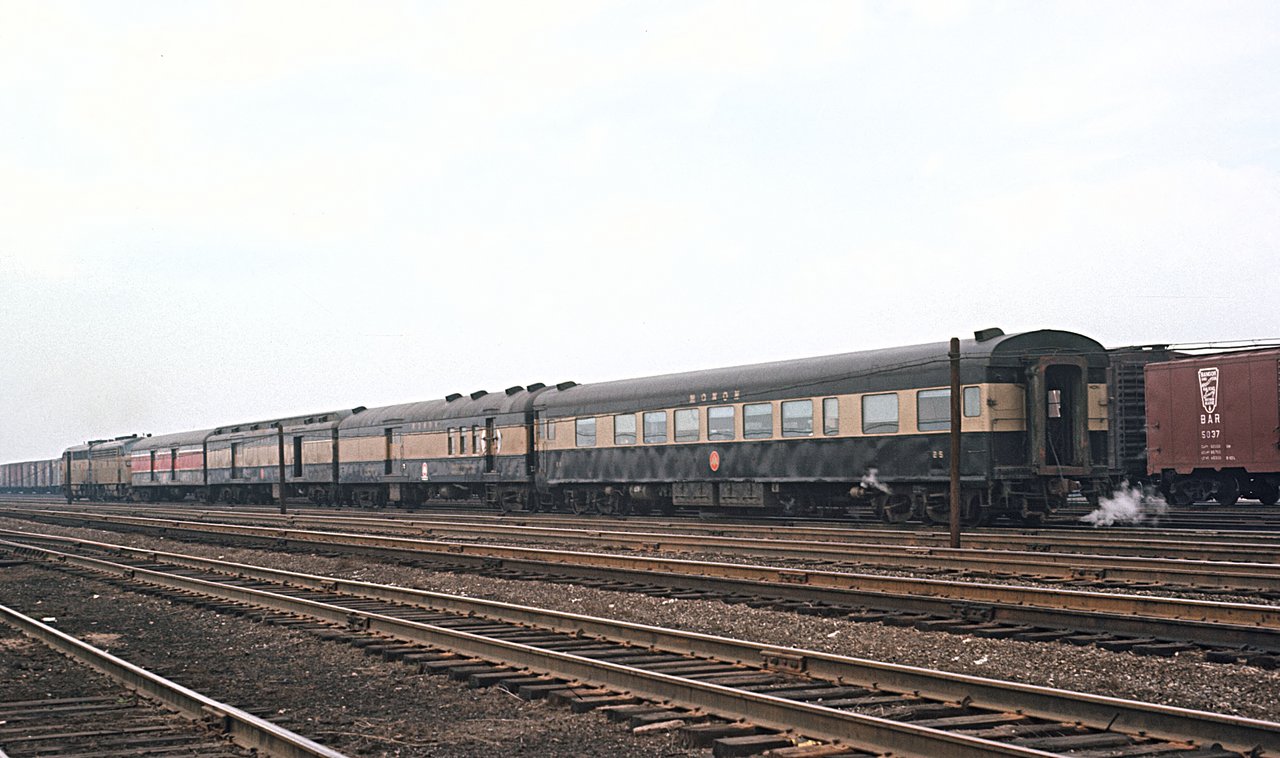
In the small hours of Friday 3 October 1958, Monon Railroad freight train No. 91 was running southbound from Monon to Indianapolis, a string of 56 cars stretching roughly half a mile down the line through Clinton County in north-central Indiana. This case file covers what witnesses reported, the official narrative, and a two-pass assessment with its evidence tier.
What did witnesses see at Between Wasco and Kirklin?
In the small hours of Friday 3 October 1958, Monon Railroad freight train No. 91 was running southbound from Monon to Indianapolis, a string of 56 cars stretching roughly half a mile down the line through Clinton County in north-central Indiana. Five railroad men crewed it. In the cab of the diesel locomotive were engineer Harry Eckman, fireman Cecil Bridge, and head brakeman Morris Ott. Back in the caboose rode conductor Ed Robinson and flagman Paul Sosbey. The time was about 3:10 a.m. and the train was somewhere near a spot the crew called Wasco when fireman Cecil Bridge, looking up the track, first noticed four lights in the sky ahead of the locomotive.
Bridge, a former Air Force man with 450 hours of heavy bomber time, described them as four big, white, soft lights moving in a sort of open V formation, two lights to a wing set at an angle, with no point out front. They looked, in the crew's words, like the color of fluorescent lights, round and kind of fuzzy around the edges. The objects crossed the tracks ahead of the train, perhaps half a mile out, then turned and ran the full length of the train from front to back, the whole half mile of it, in plain view of every man aboard. After they reached the rear they swung east, came back, and began to follow.
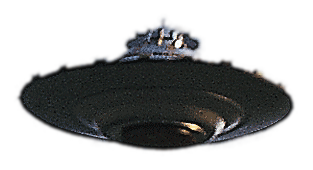
The lights changed color as they changed speed, going from bright white to yellow and then to a dirty orange when they slowed, and brightening again when they accelerated. They shifted formation repeatedly. At one point they dropped low and came in obliquely, passing directly over the train at an estimated hundred feet or so. From his cupola in the caboose, conductor Ed Robinson was looking straight up the line of cars as the four disc-shaped things swept over. He put their diameter at about forty feet and their thickness at roughly ten feet, round things, circular on the bottom. He watched them fly on edge: two in the middle were tilted up on edge while the two outside leaned at the same angle. They lit up in sequence, the front one first, then two, three and four.
Robinson grabbed a five-cell sealed-beam flashlight and shone it on them. As soon as the beam touched the objects they jumped sideways out of it. When they drifted back over the tracks he did it again and they scattered. They acted, he said, like they did not care for that light at all, and after that they would not come in close again. Up in the cab the engine crew also waved and blinked their flashlights at the things, asking them to come nearer, but the objects flashed nothing back. The entire encounter ran from Wasco to Kirklin, roughly 38 miles northwest of Indianapolis, and lasted about an hour and ten minutes. Through it all the crew talked steadily on the train radio. The dispatcher down in Lafayette could hear every word but never cut in.
What is the official explanation?
There is no Air Force record closing this case, and that absence is itself part of the story. When physicist James E. McDonald re-interviewed three of the five crewmen years later, all of them emphatically denied having been ordered to keep quiet, and all confirmed that no Air Force personnel had ever interrogated them about what they saw. McDonald also noted that, as far as he could establish, no wire-service story on the encounter was ever filed, which is why a multiple-witness, hour-long sighting by trained railroad professionals never became a national headline the way Project Blue Book era cases sometimes did. In Blue Book's surviving files the Monon encounter does not appear as a formally investigated, resolved entry.
The serious documentation that does exist came from civilians, not the government. The first full account was assembled by broadcaster and investigator Frank Edwards, who interviewed the train crew directly and published the case in his 1966 book Flying Saucers - Serious Business (Bantam Books, New York). A NICAP report was also generated. The most authoritative scientific scrutiny came from Dr. James E. McDonald, senior physicist at the Institute of Atmospheric Physics and professor in the Department of Meteorology at the University of Arizona, one of the most credentialed scientists ever to study UFO reports. McDonald personally tracked down and re-interviewed engineer Harry Eckman, fireman Cecil Bridge, and conductor Ed Robinson.
McDonald called it a very involved sighting and found nothing in the men's accounts to fault. He logged Robinson's detail of the discs passing overhead at about a hundred feet, their estimated thirty-to-forty-foot diameters, and a striking secondary observation: during a ten to fifteen minute car-switching operation the train made at Frankfort, Indiana, Robinson said the objects appeared to have landed a mile or so back up the line, where he could make out sparks or glowing lights, before they rose again and resumed the chase when the train pulled out. The official posture, then, amounts to silence: no debunking report, no identified balloon or aircraft, no stated conclusion of any kind. The record that survives is the civilian one, and it treats the men as credible.
What did the witnesses think it was?
The five witnesses were not casual observers. They were a professional train crew working a scheduled run, men whose jobs depended on reading lights, signals and moving hardware accurately in the dark. Fireman Cecil Bridge carried 450 hours as an Air Force heavy-bomber crewman, so he knew what conventional aircraft and their running lights look like at night, and he was the first to call the objects out on the radio. Engineer Harry Eckman, head brakeman Morris Ott, conductor Ed Robinson and flagman Paul Sosbey all watched the same four objects independently from two separated vantage points, the locomotive cab and the caboose half a mile back, which gave the sighting an internal cross-check most single-observer reports lack.
To a man, the crew believed they had watched four real, solid, controlled craft, not stars, not a reflection, and not any aircraft they could name. They were struck above all by the way the objects reacted to Robinson's sealed-beam flashlight, jumping clear of the beam as if the light bothered them, which read to the crew as deliberate, responsive behavior rather than anything passive in the sky. The objects' silence, their formation changes, the on-edge tilting, the dirty-orange color shift when they slowed, and the apparent brief landing near Frankfort all reinforced the men's conviction that they were dealing with something structured and intelligently handled.
Their credibility held up under later scrutiny. When McDonald re-interviewed Eckman, Bridge and Robinson, their independent accounts matched the original record and matched each other, and the physicist came away unable to find a problem with their testimony. Local corroboration of the men's character has surfaced too. A retired Monon employee, Ron Marquardt, who said he personally knew and worked with these men, stated flatly that he believed their story, calling them good, decent railroad men. The witnesses never recanted, never embellished into something more sensational over the years, and never sought publicity from it. The account they gave in 1958 is the account that stood when a research scientist came back to test it.
Is the Monon Railroad Encounter (1958) real? The two-pass assessment
Pass one, the ordinary explanations. The case has the classic profile of a nocturnal-lights report: no photographs, no radar, no physical traces recovered, just human testimony to glowing objects in the dark. That naturally invites prosaic candidates. Could the four lights have been an aircraft formation with running lights, a string of bright planets or stars, refueling or training aircraft, ground lights, or the planet Venus low on the horizon misjudged for motion against a moving train. Each runs into the specific testimony. Astronomical bodies do not cross a train's path at half a mile, run the length of 56 cars front to back, reverse, descend to pass overhead, tilt on edge, change color with speed, and break formation to dodge a flashlight beam over an hour and ten minutes. Conventional aircraft of 1958 do not silently hover, drop to a hundred feet over a freight train and then apparently settle near the tracks at Frankfort. A hoax is hard to sustain too, because five separate men in two locations told a consistent story at the time, repeated it years later to a hostile-minded scientist, and never profited from it or walked it back. No prankster method, prop, balloon launch, or specific real object has ever been identified for this event.
Pass two, if the report is accurate. What the crew described is a formation of four disc-shaped objects, roughly forty feet across and ten feet thick, self-luminous, capable of silent low-speed flight, formation flying, station-keeping with a moving train, and what looked like responsive evasion of a directed light. Those are the reported characteristics of a structured craft under control, behavior that maps onto the broader unexplained disc reports of the late 1950s rather than onto any documented aircraft, drone, or natural phenomenon of the period.
The deciding factor for tiering is the strength and independence of the testimony set against the complete absence of any shown counter-explanation. This is a five-witness, two-vantage-point, seventy-minute encounter, documented first-hand by Frank Edwards and then independently verified by a credentialed atmospheric physicist, James McDonald, who re-interviewed the crew and could find no fault. No official body produced an identification, no balloon, aircraft, rocket, or natural cause has ever been positively matched to it, and no civilian analyst has demonstrated a method by which it was faked or misperceived. With credible authenticated testimony on one side and an unidentified object on the other, the case sits as Verified Unexplained.
Sources
- www.nicap.org/reports/581003wasco_mcdonald.htm
- ufologie.patrickgross.org/htm/monon58.htm
- archive.org/details/flyingsaucersser00edwa
- monroehistory.org/2018/10/01/the-1958-monon-ufo-incident/
More cases from this region: UFO sightings in United States