The Mt. Vernon Train Stoppage
In the early morning of 20 October 1973, at about 6:50 a.m., a Louisville and Nashville (L&N) freight train was working its way east out of Mt. Vernon, Indiana toward Evansville, hauling a heavy coal load behind a set of diesel units. This case file covers what witnesses reported, the official narrative, and a two-pass assessment with its evidence tier.
What did witnesses see at L&N Railroad line east of Mt. Vernon?
In the early morning of 20 October 1973, at about 6:50 a.m., a Louisville and Nashville (L&N) freight train was working its way east out of Mt. Vernon, Indiana toward Evansville, hauling a heavy coal load behind a set of diesel units. The crew had a problem before anything strange happened: one of the rear diesel units was overheating, and a maintenance man at Upton, a veteran with around 30 years on the job, had already looked at it and effectively written it off, saying there was no use messing with it. The train was overloaded and that dead unit mattered, because Belknap Hill, a steep grade near the Peerless Crossing, was ahead.
The two men in the front engine, the lead conductor and an engineer, spotted a very bright but distant light in the sky coming out of the north. At first they took it for an aircraft, then decided it could not be one. The light pulsated from real bright to dim and back to bright, and between pulses it seemed to jump forward, the conductor estimating roughly 50 to 60 feet of travel between pulsations. It tracked north to south, then turned east toward Evansville, in the same direction the train was heading, and faded out.
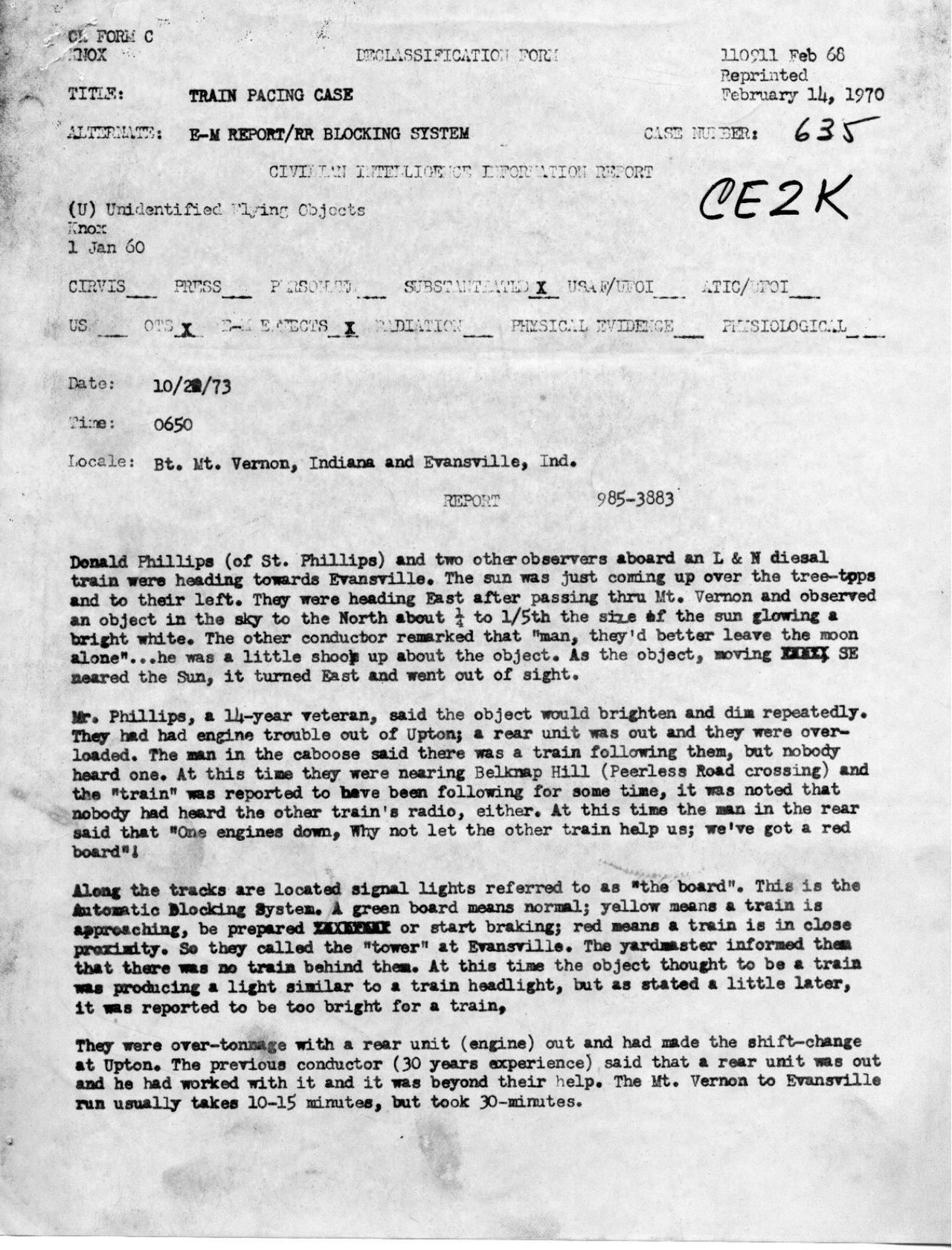
The strange part came as the train approached Caborn and the Lamont Crossing, six to seven miles east of Mt. Vernon. The rear crew reported a bright headlight behind them on the same track, and one of the rear conductors said over the radio words to the effect of, there is a headlight behind us, I can see it, it is real bright. The train's automatic blocking system, the trackside signal logic that protects against a following train, lit a red board behind them, the danger indication meaning something was occupying the block to their rear. The crew radioed the yardmaster at the Howell roundhouse, who confirmed there was no actual train back there. As the bright object moved in relation to the train the signal board cycled, the conductor describing it going red as the thing approached and then clearing to green as the light backed away down the tracks, in his words the board went green, that light cleared up the board.
The train stalled on Belknap Hill with the dead rear unit unable to help pull the tonnage up the grade. After the object had withdrawn, the conductor hit the restart button on the rear diesel that the maintenance man had declared dead, and it kicked right off and ran real good. With that unit suddenly alive again the train climbed the hill under full load and made it into Howell without further trouble.
What is the official explanation?
There is no military or government investigation of this case, and that absence is itself part of the record. Project Blue Book, the U.S. Air Force's public UFO program, had been shut down in December 1969, almost four years before this happened, so by October 1973 there was no official Air Force channel logging or adjudicating civilian sightings. The October 1973 wave, which produced the Coyne helicopter encounter over Mansfield, Ohio on 18 October and the Charles Hickson and Calvin Parker abduction claim at Pascagoula, Mississippi on 11 October, swamped local police and newspapers across the country with no federal body collecting the reports.
What stands in for an official file here is the investigation by Francis L. Ridge, who happened to live in Mt. Vernon and ran the UFO Filter Center from his home. Ridge was not a casual hobbyist. He had led NICAP's Indiana Unit No. 1 from 1960, became a MUFON State Section Director in 1972 and later Indiana's MUFON State Director, and worked as a CUFOS field investigator producing a UFO Intelligence Summary mailed to local police. His wife took the urgent call from the conductor on the Filter Center hotline around 11:00 a.m. on 20 October, only hours after the train reached Howell, and Ridge recorded the witness interview on a reel-to-reel recorder wired to the hotline phone. That recording survives and is archived by NICAP as the official interrogation, phase one, dated 20 October 1973. Ridge also filed a contemporaneous CR Form C preliminary report through the Filter Center, which NICAP archives as a scanned document, and later wrote a detailed case report.
Ridge recorded one further claim from the crew side that he could not independently verify: that the crew was reprimanded for filing a report, and that an informant told him the troublesome rear engine unit had been pulled and taken down south to be studied, with alleged U.S. Air Force involvement. Ridge logged this as an unconfirmed informant claim, not as established fact, and no document trail supports the engine-removal story.
What did the witnesses think it was?
The witnesses were the working crew of the L&N freight, and their belief was straightforward: something they could not identify paced their train, registered as a phantom following train on the trackside signal system, and was tied in time to their engine failing and then recovering. The lead conductor was the primary witness and the one who phoned Ridge. He was careful and specific on the recording, explaining how the automatic blocking system worked and why a red board with no real train behind them was so unsettling, then describing the dead rear unit firing up the moment the object had gone. Ridge characterized him as very serious about the incident, not a man chasing attention, which fits the detail that the crew were reportedly reprimanded rather than rewarded for reporting it.
The rear conductors corroborated the second phase independently from their position at the back of the train, calling out the bright headlight behind them on the same track, the sighting that the front crew could not have staged or imagined for them. The Howell yardmaster provided a useful cross-check by confirming over the radio that no train occupied the block to their rear, which is what turned a routine signal reading into an anomaly.
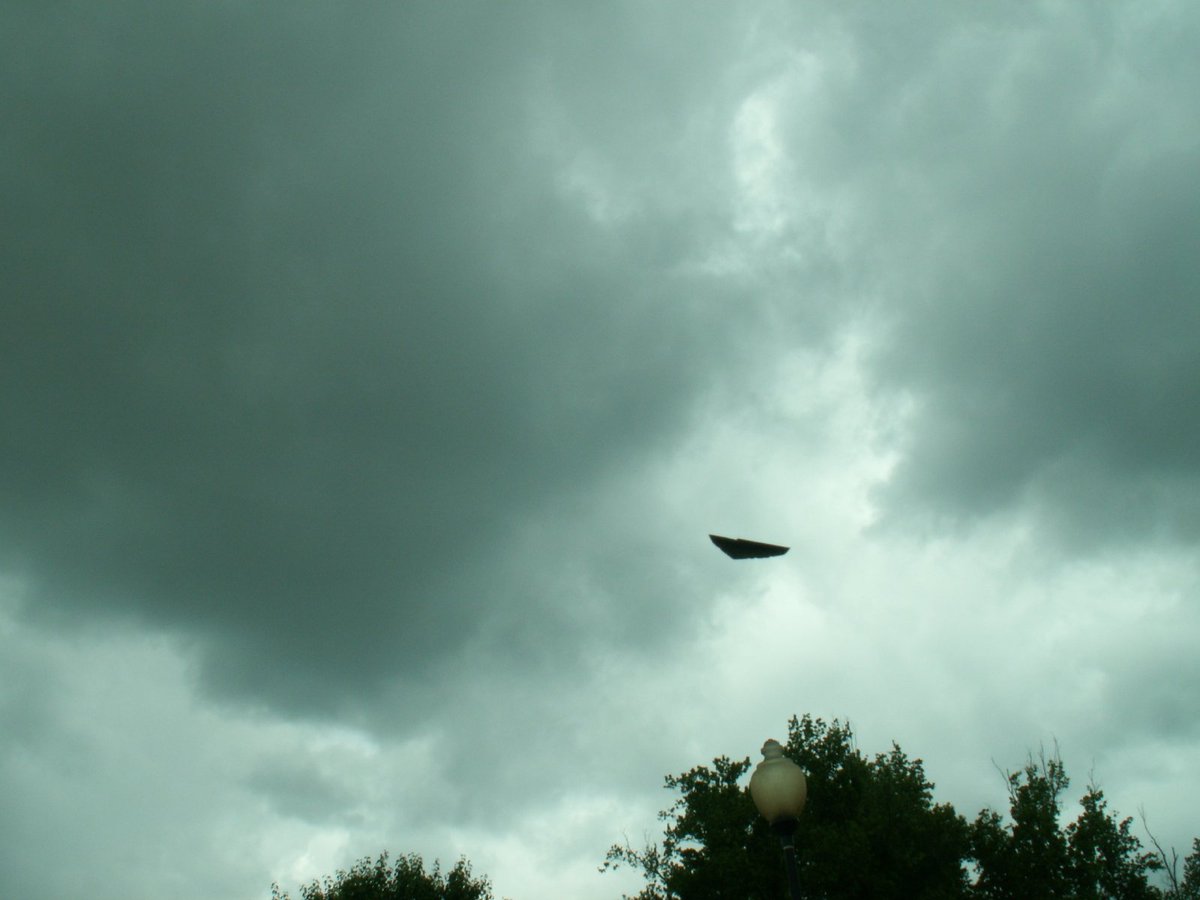
The sighting did not stand alone in the immediate area. Ridge logged a related report two days later, on 22 October 1973, in which a farmer near Upton and his daughter watched a dark, roughly triangular object carrying red, white and green lights hover near the L&N tracks around dusk before moving off toward Mt. Vernon. A separate report from Maunie, Illinois described an object flying over an L&N train engine, relayed to police and to the Evansville dispatcher. Ridge framed the cluster as a possible stalking phase, a series of close approaches to trains on the same rail line within days of each other. The corroboration is real but limited: it is several independent witnesses describing similar objects near the same tracks in the same week, not a second instrument record of the electromagnetic effects.
Is the Mt. Vernon Train Stoppage real? The two-pass assessment
Pass one, the ordinary explanation. Take the two phases separately, because they may have nothing to do with each other. The first light, the bright pulsating object coming out of the north before dawn, was initially taken by the crew themselves for an aircraft, and a brightening and dimming light moving across the pre-dawn sky is consistent with an aircraft's landing lights or a bright planet or star seen through turbulent air, with the apparent jumps between pulses being a known visual effect of a flashing or scintillating point source against a dark sky. The second phase has a mundane reading too. Old automatic block signal systems were electromechanical and could throw a false occupancy, a red board with no train present, from a track circuit fault, moisture, or a broken bond, which is exactly the kind of glitch railroads dealt with routinely. A diesel unit that overheats, is shut down or throttled back, cools while the train is stopped on the grade, and then restarts and runs is ordinary thermal behavior, not proof of an external cause. A skeptic can assemble the whole night from a misidentified light plus an unrelated signal fault plus a sick engine that cooled off, with the human tendency to bind coincident events into one story doing the rest. Nothing in this case was photographed or recorded on an instrument that survived, so there is no physical trace to test.
Pass two, if it is real. What the crew described is a textbook close-range electromagnetic effect case, the category that includes stalled car engines and dimmed headlights in the presence of a low UFO, here scaled up to a diesel-electric locomotive and a trackside signal network. The striking element is the timing and the coupling: a bright unidentified light pacing the train, a phantom following-train indication that cycled red to green in step with the object's approach and retreat, and a written-off diesel unit that came back to life the instant the object left, letting an overloaded train climb a grade it had stalled on. That synchrony, reported independently by front and rear crew and cross-checked by a yardmaster who confirmed no real train, is harder to wave away than any single piece of it. If genuine, it points to a structured object capable of inducing electrical effects in heavy equipment at close range, consistent with the wider October 1973 wave in which the Coyne helicopter crew over Ohio reported their own instrument and electrical anomalies during a close approach.
The honest verdict is Unknown rather than Verified Unexplained or Disputed. It is Unknown, not Disputed, because no named analyst has ever advanced a method-shown counter-explanation, no confession or recovered prop exists, and no specific real-world cause has been positively identified, so there is nothing to dispute on the record. It is Unknown, not Verified Unexplained, because the entire evidentiary base is testimonial: a credible same-day recorded interview and a filed report by a serious investigator, but no preserved instrument log, no photograph, and no engineering record of the signal fault or the engine, only the crew's account of them. The case rests on the witnesses and Francis Ridge's investigation, which is precisely the definition of the Unknown tier. The object remains unidentified, the documentation is contemporaneous and traceable, and the strength of the report is the multi-witness, multi-position consistency rather than any surviving physical evidence.
Sources
- www.nicap.org/731020mtvernon_dir.htm
- www.nicap.org/reports/731020mtvernon_report.htm
- www.nicap.org/reports/CRFormC.Mt.Vernon.train.case.pdf
- www.nicap.org/audio/731120_mt.vernon_train-ec_01.mp3
- nicap.org/bios/detailed/Ridge_F_detailed%20_bio.htm
- www.nicap.org/trains/
- www.ufoinsight.com/ufos/close-encounters/multiple-ufos-monon-railroad
- www.thinkaboutitdocs.com/1973-october-ufo-alien-sighting/
More cases from this region: UFO sightings in United States