The Yacanto Photographic Case
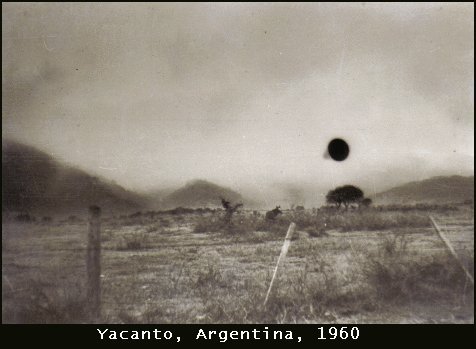
On the afternoon of 3 July 1960, at about 4:30 PM, Captain Hugo F. Niotti of the Argentine Air Force (Fuerza Aerea Argentina, AAF) was driving from Yacanto toward the city of Cordoba. This case file covers what witnesses reported, the official narrative, and a two-pass assessment with its evidence tier.
What did witnesses see at Villa General Belgrano?
On the afternoon of 3 July 1960, at about 4:30 PM, Captain Hugo F. Niotti of the Argentine Air Force (Fuerza Aerea Argentina, AAF) was driving from Yacanto toward the city of Cordoba. He was an officer assigned to the Air Force School for Sub-officers in Cordoba. It was the middle of the Argentine winter, the weather was inclement with on-and-off drizzle, the road was slippery, and a low cloud deck hung at perhaps 100 to 150 meters. Niotti was concentrating hard on his driving when, near the village of Villa General Belgrano about 70 km from Cordoba, he came out of a wide S-curve and suddenly noticed an unusual object hovering close to the ground on the right side of the road.
Startled, he stopped the car, grabbed the camera that happened to be on the seat beside him, stepped a few paces away, and took a single photograph. While he was winding the film to take a second shot, the object began to accelerate and vanished into the low clouds.
In Niotti's own description, recorded by investigator G. Roncoroni when he interviewed the officer in 1977, the object was conical, roughly 7 to 8 meters in height with a base diameter of 3 to 4 meters, its axis nearly parallel to the ground and its base facing him. He judged it to be 80 to 100 meters away, drifting slowly toward the south at perhaps 10 km/h while rotating slowly on its axis. It then accelerated very rapidly, reaching perhaps 200 km/h in 3 or 4 seconds, and disappeared into the cloud bank. The color was a uniform dark gray, and the surface was perfectly smooth, without joints or rivets, with a definite metallic look. The entire encounter lasted about 40 seconds and unfolded in complete silence, which, given his proximity to the object, Niotti found inexplicable. The abruptness, the bad weather, and the eerie quiet left him with a sense of unreality, and he jumped back into his car and continued to Cordoba, where he had the film processed.
When the print came back, it showed two details Niotti had not registered during the sighting. The base of the cone, which he had perceived as the same uniform gray as the rest, appeared in the photograph as a dull, flat black with no gradation of tone, despite being oriented toward the (cloud-hidden) sun, while the rest of the cone read much lighter. The edges of that black base, on the original negative, were sharper and more sharply defined than other elements in the frame, as if the base were absorbing rather than reflecting light. The second detail was a horse standing in the pasture between the object and the road, its head turned around and apparently looking directly at the object. Niotti had not noticed the animal at all during the event.
What is the official explanation?
This is one of the very few cases on record in which a national armed force publicly endorsed a UFO photograph. As a serving officer, Niotti was initially reluctant to talk and told only a few fellow officers, who persuaded him to send the negatives and copies to the Revista Nacional de Aeronautica (RNA), the official aeronautics magazine. The RNA editors passed the photo to the Servicio de Informaciones de Aeronautica (SIA), the Air Force's technical information service, for examination.
The SIA's finding, quoted in the published accounts, was that the negative's developing process had been normal and that, in the service's words, "it can thus be asserted without any doubt that there exists a register of an object that could very well be linked to what the officer stated." On the anomalous black base, the analysts ventured that it "could be attributed to the sensibilization of the photographic film to the influence of radiations not within the light spectrum and of unknown nature." The RNA published the case in its issue of November 1960. As Dr. Willy Smith later observed in his UNICAT review, it is remarkable that the Argentine armed forces never before or after made public the results of a UFO investigation, which makes this official sign-off unusual.
The photograph then passed through a chain of further examinations across the following decades, none of which found fault with it. Argentine investigators G. Roncoroni and Gustavo Alvarez performed photogrammetry on the original negative. Using the horse as a scale reference, they placed the animal about 80 meters from the road, which put the object no more than 50 meters from Niotti, and derived dimensions of about 7 meters in height, 6 meters in diameter, and an altitude of about 17 meters, in good agreement with Niotti's own estimates.
Roncoroni sent a first-generation print to Ground Saucer Watch (GSW) in Arizona, the group run by William Spaulding that specialized in computer image enhancement of UFO photographs. According to the GSW analysis, "the UFO is definitely not a small model thrown in the air or suspended by a wire," and "there is no evidence of photomontage or other photographic trick." The TopFoto / Fortean Picture Library archive, which holds a print of the image, summarizes the GSW result plainly: computer analysis found the object to be a genuine unknown. The case reached English-speaking researchers chiefly through Oscar Galindez, who wrote it up as part of "Unusual Photographs from Argentina" in Flying Saucer Review vol. 13 no. 1 (Jan/Feb 1967), and later through Roncoroni's "Foto de OVNI avalada por la Fuerza Aerea Argentina" in UFO Press #3 (April 1977).
What did the witnesses think it was?
Niotti was a single witness, but an unusually credentialed one. He was a captain in the Argentine Air Force at the time, trained by profession to observe and record detail, and his account stayed consistent from 1960 through his 1977 interview with Roncoroni. Crucially, his involvement in the case did not damage his career. By the time Roncoroni interviewed him, seventeen years after the event, Niotti had risen to the rank of vice-commodore and held a responsible position with the AAF. Dr. Willy Smith, who incorporated the case into the UNICAT database, argued that a single-witness case would normally not even be considered, but that two circumstances made this an exception: a competent, level-headed witness who kept his presence of mind and grabbed his camera, and a photograph that on its own lends the case enough credibility to deserve serious consideration. Smith added that it is "inconceivable that the Air Force officer would compromise his career with a fabrication that would bring him nothing but problems and discredit," and that for those who knew Niotti, such an option was "unthinkable."
Niotti himself believed he had photographed a real, structured, metallic object behaving in a way no aircraft of 1960 could match: hovering silently near the ground, rotating, then accelerating to roughly 200 km/h in three or four seconds without a sound. He was genuinely surprised by the photograph's two anomalies, the radiation-absorbing black base and the staring horse, neither of which he had noticed in the moment, which argues against a staged composition he would have arranged in advance. The horse provides a measure of independent corroboration of a sort: an animal that, as anyone familiar with roadside pastures knows, would normally ignore passing traffic, but which appears to be fixated on the object placed halfway between it and the road. The Argentine researchers Roncoroni and Alvarez concluded that the photograph was "a unique case in Argentina" precisely because of its official Air Force endorsement.
Is the Yacanto Photographic Case real? The two-pass assessment
Pass one, the ordinary explanations. A single-witness daylight photograph always invites the question of whether the object is small and near rather than large and far. The classic suspects are a thrown or suspended model, a double exposure or photomontage, a lens artifact, or a mundane object misjudged for scale. Each of these was specifically tested here and failed. The SIA confirmed the negative's development was normal and that a real object was registered on the film. Ground Saucer Watch's computer enhancement explicitly ruled out a small model thrown in the air or hung on a wire and found no evidence of photomontage or any photographic trick. The photogrammetry using the horse as a scale reference is internally consistent with Niotti's distance and size estimates, which works against the "small object close to the lens" hypothesis. A balloon, aircraft, or helicopter is hard to reconcile with the silent near-ground hover followed by a 200 km/h acceleration in a few seconds, and nothing in the smooth, jointless, rivetless conical form matches a known 1960 aircraft. Notably, no skeptic or debunker has ever published a named, method-shown counter-explanation for this image; even Willy Smith pointed out that the case largely escaped the debunkers, partly because it was published only in Spanish and partly because the usual dismissals would not fit it.
Pass two, if it is what it appears to be. Then Niotti captured a structured, metallic, conical craft, roughly 7 meters tall, hovering silently a few tens of meters from a public road in winter, capable of rotating in place and then accelerating away faster than any contemporary aircraft, in total silence. The single most striking physical detail is the base that reads as a flat, sharp-edged black on the negative, sharper than surrounding features and oriented toward the light yet reflecting none of it, which the SIA analysts could only describe as a possible sensitization of the film to radiation outside the visible spectrum and of unknown nature. That detail, an apparent sink of radiation rather than a reflective surface, is not something a hoaxer of 1960 would think to fake and is not how a thrown model would render.
The verdict. The photograph is officially documented and was authenticated by the witness's own air force, then survived independent civilian photogrammetry and computer analysis, and to this day no investigator has produced a method-shown identification of the object or any demonstration that the image was faked. The material is real, the chain of custody runs through an official military magazine, and the object remains unexplained. That places the Yacanto case squarely in Verified Unexplained.
Sources
- www.ufoevidence.org/cases/case873.htm
- www.theblackvault.com/casefiles/yacanto-cordoba-argentina-july-3-1960/
- www.openminds.tv/argentinas-x-files-pt-1/4164
- www.topfoto.co.uk/asset/345323/
- web.archive.org/web/20260615073144/https://www.ufocasebook.com/yacantophotograph1960.html
More cases from this region: UFO sightings in Argentina