Dr. Botta Enters a Flying Saucer
An Italian engineer in Venezuela claimed that in May 1950 he walked into a landed disc in remote Argentina and found three small crewmen dead at the controls. The story never existed until 1955, fails every geographic check, and the craft he photographed matches an Adamski image from 1952.
What did witnesses see at Near General Acha?
The witness was an Italian architect and aeronautical engineer who had relocated to Venezuela, named in the early literature as Enrico Carotenuto Bossa and later mangled into "Enrique Caretenuto Botta" by Leonard Stringfield. He said that around 15 May 1950 he was driving alone through a remote stretch of Argentina, by his account some 280 kilometres from Bahia Blanca and roughly 200 kilometres from General Acha in what he called La Pampa, when he saw a metallic disc-shaped craft sitting on the ground just off the road. He put its diameter at about 10 metres and its interior height at around 2.10 metres.
By his telling the door stood open. In his own words, recorded in the Spanish accounts, "No dude en aproximarme y entrar al interior del objeto, cuya puerta estaba abierta", I did not hesitate to approach and enter the interior of the object, whose door was open. Inside he described a curved divan or bench fitted with four seats arranged before a control panel studded with lights and gauges. Three of the seats were occupied by small humanoid figures, about 1.2 metres tall, dressed in tight lead-grey one-piece suits. They sat motionless, facing the controls.
He said he could not resist touching one of them. "Toque un brazo que estaba rigido y la figura estaba fria", I touched an arm that was rigid and the figure was cold. The three occupants were dead, their bodies hard and as if charred. He described a domed ceiling with a blinking red light, a transparent rotating sphere above the panel, and vents in the floor. Overcome, he fled the craft. He reported coming down afterward with fever and blistered skin that doctors could not explain and that lingered for weeks, and a smell like ozone or garlic.
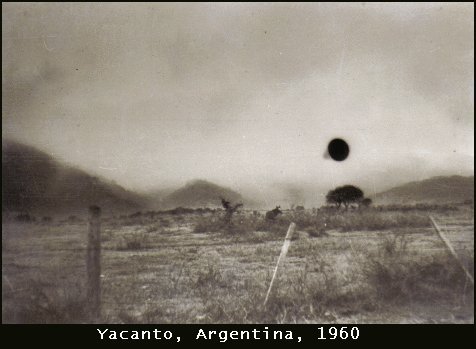
The next morning, he said, he returned to the spot with two companions and found only a pile of silvery-red ashes where the craft had stood. One man who touched the ashes had his hand turn purple for several days. While they were there, three objects appeared overhead, one cigar-shaped and two discs. Bossa said he photographed them; of five or six exposures only two were ever shown, both grainy and indistinct, one showing a small dark disc against a mottled background.
What is the official explanation?
There was no official investigation of this case in any conventional sense, because no authority ever received a contemporaneous report. No Argentine police file, air force record, or newspaper from 1950 records a landed craft, a dead-occupant retrieval, or a missing Italian engineer near General Acha. The entire documentary trail begins in 1955 in Venezuela, not in 1950 in Argentina.
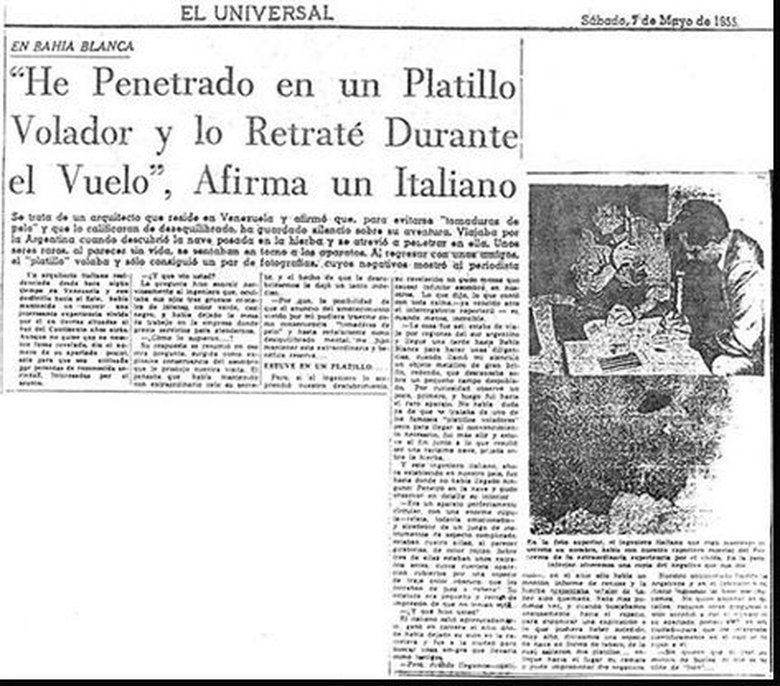
The case first reached print through the Venezuelan ufologist Horacio Gonzalez Ganteaume, author of "Platillos Voladores Sobre Venezuela", who interviewed the witness and placed the account in the Caracas daily El Universal on 7 May 1955, identifying him only as "un arquitecto italiano". From there it spread through the early saucer press. The APRO Bulletin carried it in August 1955 under the cover name "Dr. B." In April 1956 the French-language Le Courrier Interplanetaire, edited by Alfred Nahon, published a letter from the witness himself and gave his full name for the first time. Coral Lorenzen of the Aerial Phenomena Research Organization wrote in the magazine Flying Saucers in December 1958 that she had been in contact with the man and could name him as Enrique Carotenuto Bossa. Two decades later Leonard Stringfield folded a garbled version into his crash-retrieval book "Situation Red: The UFO Siege!" (1977), where he altered the surname to "Botta", said he was protecting the witness, and seeded the spelling that most English-language websites still copy.
So the "official" layer here is really a chain of UFO-organisation case files, each working from the one before, with no independent state, military, or contemporary press confirmation behind any of them. The most rigorous documentary work on the case was done not by officials but by the Argentine investigator Roberto Banchs, whose study "General Acha, La Pampa: Un Accidentado Aterrizaje (15 May 1950)" reconstructs the publication history and tests the geography against the record, and is treated in the assessment below.
What did the witnesses think it was?
There is exactly one witness to the central event, Bossa himself, and the only corroboration on offer is also routed through him. The two unnamed companions who supposedly saw the ashes and the overhead objects the next morning were never identified, never interviewed by anyone, and never came forward; they exist only inside Bossa's own narrative. The photographs that would have been the hard evidence were, by Bossa's account, reduced from five or six exposures to two faint images, and even APRO's own director Jim Lorenzen, in a 1983 interview with researcher Richard Heiden, said the surviving photo did not look like a good photograph because it had "una textura de fondo", a background texture, the kind of thing you get from a backdrop or a degraded copy.
Bossa presented himself as a credible man, a forty-year-old former military pilot and trained engineer working on a large construction project, which is part of why APRO and later Stringfield took him at his word. He gave the account consistency and technical colour, and he stuck to it across his 1955 letter and his interviews with Gonzalez Ganteaume. He plainly believed, or wanted others to believe, that he had walked into a downed extraterrestrial machine with its crew dead at the controls.
But the witness himself could never be pinned down. The ufologist Christian Vogt said he met Bossa in Caracas in the 1960s at a Swiss diplomatic building, then went back and found him gone, "con posterioridad, nada se supo de el", afterward nothing more was known of him. When Banchs and his team later went looking for any independent trace of the man in Argentina, in municipal records, local newspapers, construction registries, and the professional councils of architects and engineers in both Buenos Aires and La Pampa provinces, they found nothing. No resident, historian, or old-timer remembered an Italian architect or his building project. The sole human anchor of the case left no footprint anywhere except in the saucer literature he himself fed.
The dispute
The dispute is not a vague debunk, it is a documented near-demolition by the Argentine researcher Roberto Banchs in his study "General Acha, La Pampa: Un Accidentado Aterrizaje (15 May 1950)". Banchs shows that the witness's own geography is impossible. Bossa described being at "Bahia Blanca, capital de la provincia de La Pampa", which Banchs calls doubly wrong, since Bahia Blanca belongs to Buenos Aires province and the capital of La Pampa is Santa Rosa, and notes that La Pampa was a Gobernacion in 1950 and did not become a province until 1951. Bossa placed himself among granite stones and mountains a thousand metres high in a region that is essentially flat, with basaltic outcrops barely over 500 metres and no granite. The coordinates he supplied do not match the distances he supplied, and a records search of municipalities, local newspapers, building registries, and the professional architects' and engineers' councils of Buenos Aires and La Pampa turned up no trace that the man ever lived or worked there.
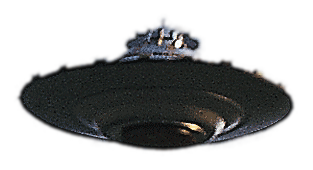
The strongest single point is the photograph. Banchs reports that the craft in Bossa's account and image is "sorprendentemente identica" to George Adamski's famous Venusian scout ship, photographed at Palomar Gardens on 13 December 1952. That craft type did not exist in the public imagination until late 1952, more than two years after Bossa's claimed May 1950 encounter, and Adamski's photos were widely reprinted in South American papers, including El Nacional in Caracas, by 1953, just as Bossa moved to Venezuela. The dead occupants, metre-tall and at their stations, echo Frank Scully's 1950 bestseller "Behind the Flying Saucers" and its crashed discs with small humanoid corpses. Bossa's account, which he did not make public until 1955, fuses two narratives that became famous only after his claimed date.
The supporting weaknesses pile up. The story has no 1950 existence at all; its oldest appearance is El Universal on 7 May 1955. The two corroborating companions were never named or found. The photographs were cut from five or six exposures to two faint ones, and APRO's own Jim Lorenzen thought the survivor looked like it had a background texture, suggesting a backdrop or a bad copy. No ash sample was ever submitted despite the witnesses being technically trained. The witness himself vanished, last reportedly seen by Christian Vogt in Caracas in the 1960s before disappearing for good.
Where the counter-explanation falls short of closing the core claim. For all its weight, this case stays Disputed rather than discredited because not one of the three closures that would settle it is in hand. There is no signed confession and no recantation: Bossa never walked the story back, he held it across his 1955 letter and his interviews and then disappeared still telling it. There is no recovered prop: no model, no backdrop, no doctored negative tied to this event, only Lorenzen's 1983 impression of a "textura de fondo" on a degraded copy. And the Adamski match, powerful as it is, is a resemblance and a timeline, evidence that Bossa likely drew on a 1952 photograph, not a positive identification of the actual physical disc he claimed to enter and touch. Banchs, who did the hardest work on the case, deliberately stops short himself: his closing line is that "Puede que la verdad ultima del caso jamas sea escrita", the ultimate truth of the case may never be written. That is independent, civilian, method-shown work strong enough to all but sink the account, which is why proposedDiscredit is set and the discredit dossier is filled. But it leaves the core claim demolished by inference, not formally closed, so the case is carried as Disputed pending the separate human gate.
Is the Dr. Botta Enters a Flying Saucer real? The two-pass assessment
Pass one, how this could be entirely ordinary. The simplest reading is that there was never any craft, only a story. The account surfaces five years after the supposed event, in another country, with no contemporary Argentine record of any kind, no body, no wreckage, no ash sample submitted despite the witness and his companions all being technically trained, and no clear photographs. That is the classic signature of a tale, not an incident. And the independent investigation here is unusually strong. The Argentine researcher Roberto Banchs tested the geography against the record and found it impossible. Bossa called Bahia Blanca "capital de la provincia de La Pampa", which Banchs flags as "doblemente incorrecto": Bahia Blanca is in Buenos Aires province, the capital of La Pampa is Santa Rosa, and in 1950 La Pampa was not even a province but a Gobernacion, only becoming a province in 1951. Bossa described "piedras graniticas" and "muchas montanas de unos 1.000 m de altura", granite stones and mountains around a thousand metres, in a region Banchs notes is basically flat with only basaltic outcrops barely topping 500 metres and no granite at all. The coordinates he gave cannot be reconciled with the distances he gave. Banchs and his team then searched municipal records, local papers, construction registries, and the architects' and engineers' professional councils, and found no evidence the man was ever in the region.
The decisive piece is the image and the chronology. Banchs reports that the craft Bossa described and photographed is "sorprendentemente identica" to the Venusian "scout ship" George Adamski photographed at Palomar Gardens on 13 December 1952, an image that did not exist anywhere until two and a half years after Bossa's claimed 1950 encounter, and which was splashed across South American newspapers, including El Nacional in Caracas, by 1953, the very year Bossa moved to Venezuela. On top of that, the dead-little-men motif matches Frank Scully's bestselling "Behind the Flying Saucers" (1950), with its crashed discs and metre-tall corpses. Bossa's 1950 story conveniently fuses two famous narratives that only became famous after his claimed date, while he did not go public until 1955. Banchs concludes it is reasonable to think "Enrico Carotenuto Bossa pudo haberse inspirado en la novelesca literatura platillista", that Bossa drew on the popular saucer literature and recreated its images and fantastic scenes. The British journalist David Wightman, writing in Uranus, had already noted in the 1950s that "el caso flaquea", the case is shaky. Taken honestly, this is a case that almost certainly cannot survive its own evidence.
Pass two, what the debunk does not close. For all its force, the counter-case stops at inference and absence, and it never lays a hand on the one thing the Strongly Disputed tier requires, a positive close on the core claim. There is no signed confession from Bossa and no recantation; he stuck to the account across his 1955 letter, his interviews with Gonzalez Ganteaume, and the years after, and then he vanished still telling it. There is no recovered prop, no backdrop, no model saucer, no doctored negative tied to this event, only Jim Lorenzen's impression in 1983 that a faded survivor photo had "una textura de fondo". And there is no positive identification of the actual object. The Adamski match is the strongest single strand, but it identifies a likely source of inspiration, a resemblance plus a chronology, not the specific physical disc Bossa said he walked into and touched. Banchs himself does not claim to have closed it. His own last word is that "Puede que la verdad ultima del caso jamas sea escrita", the ultimate truth of the case may never be written, that it belongs among events with more of the marvellous in them than the historical or real. That is the verdict of a careful investigator who knows he has built an overwhelming circumstantial case and has not produced the document that ends it.
Taken at face value the claim would be one of the earliest and most spectacular occupant-and-retrieval cases on record, a landed disc with its crew dead at the controls, predating Roswell's popular fame and the entire contactee wave, with physical aftereffects, ash residue, and photographs. None of that survived contact with evidence: no craft, no body, no ash, no clear photo, no trace of the man, and an image that copies a craft type from 1952. What still stands is narrower and more stubborn, the bare testimony of a single witness who was never caught out, never confessed, and was never identified with the thing he photographed.
So the tier is Barely Disputed, not Strongly Disputed. The counter-explanation here is real, independent, civilian, and method-shown, an empty records search plus a chronology that makes an honest 1950 dating impossible, and it is strong enough that the case very likely does not survive. But none of the three closures that the top dispute tier demands is present: no confession or recantation, no recovered prop, no positive identification of the real object behind the sighting. The debunk converges hard on Bossa and leaves nothing standing around him, yet it has not crossed the positive-close line, and the project's own discredit gate keeps the case logged as Disputed until that human review happens. The core claim is largely demolished but not formally closed, and the file says so honestly.
Sources
- www.visionovni.com.ar/archivos/923
- ufodisclosurecountdownclock.blogspot.com/2014/06/those-ufo-tales-from-1950s-and-omissions.html
- archive.org/details/flyingsauceroccu00lore
- openlibrary.org/works/OL7366501W/Platillos_voladores_sobre_Venezuela
- www.visionovni.com.ar/wp-content/uploads/images/img50a03e03b9954.jpg
- www.visionovni.com.ar/wp-content/uploads/images/img50a03ffb65af2.jpg
More cases from this region: UFO sightings in Argentina