The RB-47 Electronic Surveillance Incident
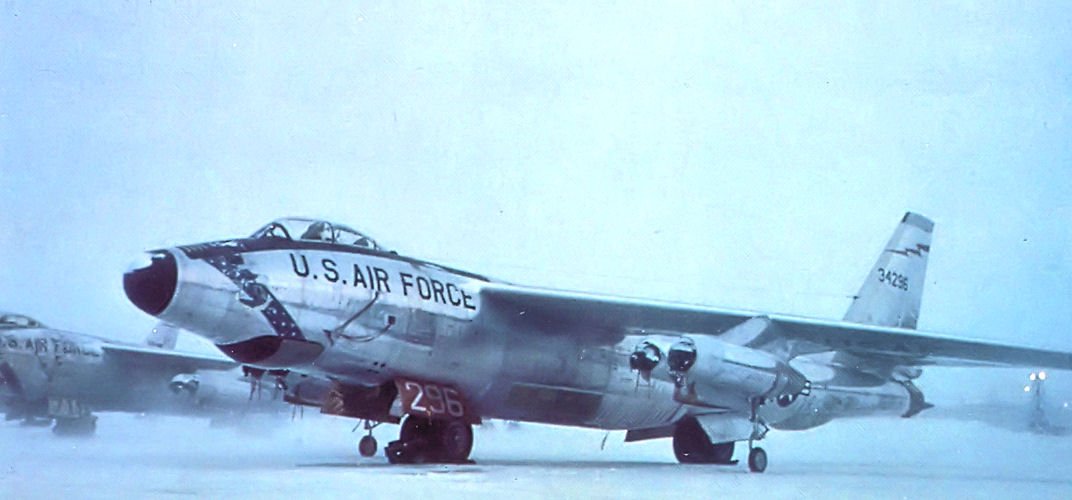
In the early hours of 17 July 1957 a Boeing RB-47H electronic reconnaissance jet of the 55th Strategic Reconnaissance Wing took off from Forbes Air Force Base near Topeka, Kansas on a composite training mission that took it down to the Gulf Coast for gunnery and electronic countermeasures exercises. This case file covers what witnesses reported, the official narrative, and a two-pass assessment with its evidence tier.
What did witnesses see at Gulf Coast?
In the early hours of 17 July 1957 a Boeing RB-47H electronic reconnaissance jet of the 55th Strategic Reconnaissance Wing took off from Forbes Air Force Base near Topeka, Kansas on a composite training mission that took it down to the Gulf Coast for gunnery and electronic countermeasures exercises. It carried a crew of six. Major Lewis D. Chase was the pilot, Captain James H. McCoid the copilot, and Major Thomas H. Hanley the navigator. Crammed into a pressurized capsule in what had been the bomb bay were three electronic warfare officers, the men the Air Force called Ravens: Captain John J. Provenzano on the No. 1 monitor, Captain Frank B. McClure on the No. 2 monitor, and First Lieutenant Walter A. Tuchscherer on the No. 3 monitor.
The strange part began near Gulfport, Mississippi. McClure, working his No. 2 monitor, an ALA-6 direction finder feeding an APR-9 receiver and an ALA-5 pulse analyzer, picked up a signal that behaved wrong. The documented characteristics were a frequency of 2995 to 3000 megacycles, a pulse width of 2.0 microseconds, a pulse repetition frequency of 600 cycles per second, and a scan rate of 4 rpm. That looked like an ordinary S-band ground search radar. The problem was the bearing. Instead of sitting still where a ground station should sit, the signal's direction-finding lobe swung up the scope and tracked along with the aircraft, moving from one bearing to another as if the source were keeping pace. McClure initially assumed his gear was malfunctioning and said nothing.
Then, near Winnsboro in northeastern Louisiana at about 10:10 Zulu, the cockpit crew got a visual. Chase saw a very intense blue-white light at his 11 o'clock position, dead ahead and slightly high, closing fast. He thought for an instant it was going to hit the aircraft. It crossed the RB-47's flight path from left to right at an angular velocity Chase said he had never seen in twenty years of flying, then it was gone off to the right. McCoid saw it too.
As the aircraft pressed on toward Texas, the encounter became a three-channel event. McClure's monitor held the moving signal. Ground radar at the 745th Aircraft Control and Warning Squadron station near Duncanville, Texas, identified in the documents as Site Utah, picked up a target near the RB-47 by direct skin-paint reflection, not just a transponder return. And the crew saw a large luminous object dead ahead. Chase and McCoid described a bright red glow that Chase said was bigger than a house, holding station ahead of them near the Dallas-Fort Worth area. Chase asked the ground site for permission to chase it and was cleared. He pushed the throttles up, but the object held its lead, then dropped back and let him close. At one point near Mineral Wells, the object appeared to descend rapidly. As it did, in the same instant, the light blinked out visually, McClure announced over the interphone that he had lost the signal on the No. 2 monitor, and the ground site reported the target had vanished from its scope. Three independent detection systems lost it together. Moments later the signal, the ground radar paint, and the visual all came back at once. The pursuit ran more than 600 miles and lasted over an hour before the RB-47, low on fuel, broke off near Oklahoma City and headed home.
What is the official explanation?
The case was reported up the chain at the time. A three-page TWX from the 745th ACWRON at Duncanville went out on 17 July 1957, a four-page case summary was prepared by the 55th Reconnaissance Wing intelligence officer E.T. Piwetz, and Major Chase later filed a twelve-page Airborne Observer's Data Sheet. The material was forwarded from Air Defense Command to Project Blue Book that November. Blue Book's stated resolution was that the crew had tracked American Airlines Flight 655, a near-collision involving DC-6 airliners. That event was real, but it happened near the Salt Flats area west of El Paso, Texas, far from the RB-47's track over east Texas and Louisiana, at a different time and altitude. Researcher Brad Sparks interviewed American Airlines operations and confirmed the airliner near-miss took place hundreds of miles away, leaving the airliner identification geographically impossible.
By the time the University of Colorado UFO Project (the Condon Committee) examined the incident in 1967 and 1968, Project Blue Book had no usable record of it. Major, by then Lieutenant Colonel, Chase recounted the event to the project's investigators, and the committee's radar and propagation specialist Gordon David Thayer took the case as Case 5 of the final report. Thayer treated the Air Force airliner explanation with open contempt. He called it, by the account that came down from the investigation, literally ridiculous, given the distances and timing involved. Working the case from a propagation standpoint, Thayer wrote that the available descriptions were not adequate to allow positive identification of the phenomenon, and he reached the conclusion that the report quotes directly: "From a propagation standpoint, this sighting must be tentatively classified as an unknown." That is significant because the Condon Report was widely read as a debunking document, the report whose summary recommended that further UFO study was unlikely to be productive. Even inside that frame, Case 5 stayed in the unexplained column.
The strongest contemporary scientific advocate for the case was atmospheric physicist James E. McDonald of the University of Arizona, who interviewed all six crew members and dug out the documents the Condon team did not have. McDonald laid the case out in his 1969 AAAS paper "Science in Default" and in a dedicated technical write-up. He found the simultaneity across the three channels decisive, writing that "such simultaneous loss of signal on what we can term three separate channels is most provocative, most puzzling," and that this was "a case in which the reported phenomena appear to defy explanation in terms of either natural or technological phenomena." He recorded the key moment plainly: "At that same moment McClure announced on the interphone that he'd lost the 2800 mcs signal, and GCI said it had disappeared from their scope." McDonald noted with frustration that even after Chase walked the project through all of this in person, project director Edward Condon could, in his words, "shrug his shoulders and walk out."
What did the witnesses think it was?
The witnesses were six experienced Strategic Air Command officers, not casual observers, and the men who mattered most carried the right specialties to read what they saw. McClure was a trained electronic warfare officer whose whole job was identifying and direction-finding hostile radar emitters; his immediate instinct was that his equipment was faulty, which is the opposite of a man eager to call something a UFO. Chase was a senior pilot with roughly two decades in the air who insisted he had never seen an object move with the angular velocity of the blue-white light that crossed his nose near Winnsboro.
Chase never recanted. When the Condon investigators interviewed him a decade later, by then a Lieutenant Colonel serving, with some irony, as a base UFO officer at Malmstrom AFB, he reaffirmed the account in detail, telling them the object went by so fast that he had no time to react at all before it flashed from his 11 o'clock out to about the 2 o'clock position. He went on to a full Air Force career and command responsibility. There is no record in the primary material of any crew member walking the story back, and there were no estranged or hostile witnesses attacking it from the inside. McClure's own initial skepticism, his assumption that his gear was broken, is itself a kind of corroboration: the men were not primed to see something extraordinary, the data forced it on them. What the crew believed, and what McDonald reported after interviewing them, was that they had been paced for over 600 miles by an object that registered at the same time and place on their eyes, on a search-radar emitter that should not have been moving with them, and on a ground radar's skin-paint return, and that the same object could make all three of those signatures vanish and reappear together in an instant.
The dispute
The dispute is narrow and specific. The skeptical case, advanced principally by aviation writer Philip J. Klass and later refined by analyst Tim Printy in his SUNlite publication, is that the RB-47 crew did not pace a real flying object at all. They argue that the electronic signal Captain Frank McClure tracked, documented at 2995 to 3000 megacycles, was simply a ground search radar. Printy identifies a strong candidate: the AN/CPS-6B radar at Keesler AFB in Biloxi, Mississippi, whose transmitters spanned roughly 2700 to 3019 megacycles, a band that contains the detected frequency. On this view the moving direction-finding lobe was an artifact of a fast jet flying through the radar's coverage, the dramatic blue-white light that crossed Chase's nose near Winnsboro was a bright meteor, and the later returns were ordinary aircraft and radar clutter that the crew, under the pressure of a long mission, combined into the impression of one coordinated chase.
This counter-explanation is taken seriously, and it is why the case is disputed rather than verified outright. But it does not close the case, for three reasons. First, the two formal, official debunks both collapsed. Project Blue Book's resolution, that the crew tracked American Airlines Flight 655, places that airliner near El Paso, hundreds of miles from the RB-47's track, at a different time and altitude; Brad Sparks confirmed this with American Airlines, and Condon Committee analyst Gordon Thayer reportedly called the airliner explanation literally ridiculous. Klass's original mechanical theory, a stuck solenoid relay producing a phantom signal, was abandoned after Printy himself conceded McClure had logged over a thousand hours on the gear without such a failure.
Second, and most important, the skeptical reconstruction does not account for the three-channel simultaneity. A fixed ground radar at Keesler can supply a signal at the right frequency, but it cannot by itself explain a signal whose bearing tracked the aircraft, and it cannot explain that signal vanishing and reappearing in the same instant as a visual object dead ahead and a separate ground radar's skin-paint return at Site Utah near Duncanville. James McDonald, who interviewed all six crewmen, treated this correlation as the decisive feature and found it defied both natural and technological explanation.
Third, and decisively for the tier, the skeptics do not claim a positive identification. Printy is explicit that he is offering a plausible reconstruction of how conventional sources could fit the available data, not a demonstration that a specific named radar, aircraft, or natural event was this object. There is no confession, no recovered prop, and no traced single cause shown to be the object. A plausible-but-unproven natural-explanation reconstruction, with the case's own investigating physicist classifying it as an unknown, is the definition of a barely disputed case, not a strongly disputed one.
Is the RB-47 Electronic Surveillance Incident real? The two-pass assessment
Pass one, the ordinary case. The skeptical reconstruction is real and has named authors and a concrete mechanism. The signal McClure tracked, 2995 to 3000 megacycles with a 2.0 microsecond pulse and a 600 cps repetition rate, is an unremarkable S-band search radar profile. Aviation writer Philip Klass first argued the crew had simply been receiving ground radar, and analyst Tim Printy refined this in his SUNlite work by pointing at the AN/CPS-6B radar at Keesler AFB in Biloxi, Mississippi, whose five transmitters covered roughly 2700 to 3019 megacycles, bracketing the detected frequency exactly. The skeptical claim is that a moving aircraft passing through the lobes of one or more fixed ground radars, plus a bright meteor or bolide for the first dramatic visual near Winnsboro, plus ordinary aircraft and radar clutter for the later phase, can be stitched into something that feels like a single coordinated chase. Printy also addressed a counter from Brad Sparks that the Keesler radar was idle that summer, arguing that the training school ran year round and the set was in use in July 1957. On this reading nothing exotic happened; experienced men over a long, tense mission knitted several mundane returns into one phantom.
Pass two, if real. The feature that resists the ordinary reading is the three-channel simultaneity, and it is the feature McDonald hammered. A fixed ground radar at Keesler explains a signal at the right frequency, but it does not explain a direction-finding lobe that tracks the aircraft's motion up the scope rather than sweeping past it, and it does not explain that signal vanishing and returning in lockstep with both a visual object dead ahead and a skin-paint return on a different radar at Site Utah near Duncanville. Three physically independent channels, the crew's eyes, an airborne passive ELINT receiver, and a ground search radar, losing and regaining the same object at the same instant is the hard core of the case, and no one has shown a single mundane source that produces all three correlated signatures at once.
Now the dispute and the tier. The official apparatus produced two debunks, and both failed on their own terms. Blue Book's American Airlines Flight 655 identification put the supposed object hundreds of miles away near El Paso at the wrong time and altitude, which is why Thayer dismissed it. Klass's original mechanism, that a stuck solenoid relay in McClure's gear created a phantom, was undercut when Printy himself conceded McClure logged over a thousand hours on the equipment with no such failure. What survives on the skeptical side is Printy's careful reconstruction, and Printy is explicit that he is offering a plausible account of how conventional sources could fit the data, not a positive identification of the specific object. That distinction decides the tier. There is no confession, no recovered hardware, no traced single emitter or airliner or rocket that has been shown to be this object, and the two formal debunks are refuted. There is a contested natural-explanation reconstruction that the case's own investigating physicist, Thayer, classified as an unknown, and that McDonald argued exceeded both natural and technological explanation. That is the textbook shape of Barely Disputed: a counter-explanation exists and is taken seriously, but it is partial and unproven and the case substantially stands.
Sources
- files.ncas.org/condon/text/case05.htm
- ufologie.patrickgross.org/htm/aiaa1971.htm
- www.academia.edu/165502543/The_RB_47_Radar_Electronic_Intelligence_ECM_UFO_Incident_1957_by_James_McDonald
- kirkmcd.princeton.edu/JEMcDonald/mcdonald_aaas_69.pdf
- www.globalsecurity.org/intell/systems/rb-47h.htm
- kevinrandle.blogspot.com/2014/02/the-rb-47-case-american-airlines-and.html
- kevinrandle.blogspot.com/2021/01/lewis-chase-and-rb-47.html
- badufos.blogspot.com/2012/01/rb-47-encounter-of-1957-ufologys-best.html
More cases from this region: UFO sightings in United States