The Trindade Island Photographs
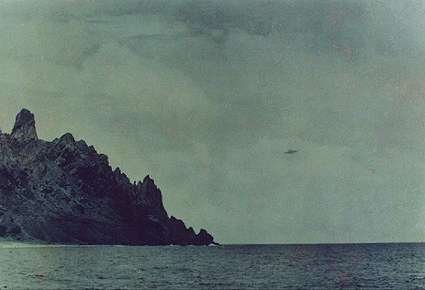
A few minutes after noon on 16 January 1958, the Brazilian Navy training and survey ship NE Almirante Saldanha lay at anchor off Trindade Island, a remote volcanic rock about 1,200 km off the coast of Espirito Santo, finishing a station for the International Geophysical Year. This case file covers what witnesses reported, the official narrative, and a two-pass assessment with its evidence tier.
What did witnesses see at Trindade Island?
A few minutes after noon on 16 January 1958, the Brazilian Navy training and survey ship NE Almirante Saldanha lay at anchor off Trindade Island, a remote volcanic rock about 1,200 km off the coast of Espirito Santo, finishing a station for the International Geophysical Year. On deck were dozens of crew and a civilian party. Captain Jose Teobaldo Viegas, a retired Brazilian Air Force officer, and Amilar Vieira Filho, leader of a group of submarine explorers aboard, saw a dark object approaching the island from the direction of the sea. Viegas later described it as a flattened sphere encircled at its equator by a large ring or platform, the shape that quickly got tagged "Saturn-shaped."
Their shouts drew the ship's dentist, Captain-Lieutenant Homero Ribeiro, who came running from the bow pointing at the sky, and they pulled in the one man on deck with a camera already in hand, the professional underwater photographer Almiro Barauna. Barauna had a Rolleiflex 2.8 Model E loaded, set to 1/125 of a second at f/8, settings that he said left the frames slightly overexposed. Jostled by people crowding to look, he managed to fire a burst of exposures as the object crossed the sky. By his own account to O Cruzeiro magazine he got off two shots before the object slid behind the island's highest point, Desejado Peak, then a third as it reappeared larger and tracking the opposite way, with the last frames missing it entirely in the chaos on deck. Of six exposures on the roll, four caught the object and two showed only sea and coastline.
Witnesses agreed on a metallic, ash-grey body with a solid look, glittering at moments as if catching the sun or changing its own light, ringed or wrapped by a greenish haze or phosphorescent mist. It moved with an undulating, almost batlike motion, tilted as it passed the island, hovered briefly, then accelerated away over the horizon at very high speed. Estimates of the number of people on deck who saw something run to 47 or 48. The object's closest approach and size were never pinned down precisely from the deck, with later estimates placing the disc on the order of tens of meters across at a distance of several kilometers.
What is the official explanation?
Brazilian Navy commission report by Captain of Corvette Carlos Alberto Ferreira Bacellar concluded there were "indications of the existence of the UFO"; Cruzeiro do Sul Aerophotogrammetric Service found "no sign of montage"; Navy Minister Admiral Antonio Alves Camara publicly affirmed the images; US Project Blue Book / ATIC filed it "probably a hoax" while conceding it never obtained copies of the photos
What did the witnesses think it was?
Almiro Barauna (photographer); Captain Jose Teobaldo Viegas (reserve Brazilian Air Force officer); Amilar Vieira Filho (civilian submarine-exploration leader); Captain-Lieutenant Homero Ribeiro (ship's dentist); plus roughly 47 to 48 Navy crew and passengers on deck
The dispute
Two separate counter-explanations sit on this case and both are taken seriously here, yet neither has been demonstrated against the actual negatives. The first is technical. Independent analyst Martin J. Powell, in a published study of photographs 1 and 2, used photographic geometry to put the object's angular width at about 1.5 degrees and argued the frames are consistent with a small twin-engined aircraft, something like a Beechcraft Twin Bonanza or Piper Apache at a few hundred meters, that was superimposed onto the Trindade background rather than captured there. He cited the way the dark "dome" of the disc migrates and mutates from frame to frame and the loss of internal detail as evidence the images were worked up from a single source photograph. This is a real and specific reconstruction, but it remains a model, not a proof. It does not produce the alleged original aircraft photo, and it has to assume Barauna built montages convincing enough that both the Brazilian Navy's hydrographic laboratory and the civilian Cruzeiro do Sul Aerophotogrammetric Service examined the negatives microscopically and reported no sign of montage.
The second is the hoax allegation broadcast by the Brazilian television program Fantastico in August 2010. A friend of the photographer, Emilia Bittencourt, said Barauna had told her personally that he faked the pictures, joining two kitchen spoons into a craft and photographing them against his refrigerator door with carefully calculated lighting, and that he laughed about it afterward. A relative of Barauna was reported to hold files said to confirm a trick but declined to be interviewed, and a 2024-era nephew account in Revista UFO likewise asserts the photos were faked. Skeptics also lean on Barauna's documented past as a maker of staged trick photographs, including a 1953 piece in which he demonstrated how an earlier UFO photo could have been faked, which is precisely the history the US naval attache and Project Blue Book invoked when they filed the case as "probably a hoax."
Against all of that stand facts the hoax scenario has to explain away. The negatives were developed within roughly an hour of the sighting in an improvised darkroom aboard the Almirante Saldanha, with Commander Bacellar waiting just outside and Captain Viegas present, then passed around the deck while crew compared them to what they had just watched. Between 47 and 48 people, most of them Navy crew and officers plus a reserve Air Force captain and a civilian dive leader, reported seeing the object, and none recanted. Barauna himself never publicly confessed; he died on 29 July 2000 still maintaining the account, and a 1997 television segment headlined as him revealing "the trick" was found on review to contain no actual admission about the Trindade photographs. The Fantastico material is therefore hearsay at one remove, a private boast relayed by a friend and a relative, with no spoons produced, no original montage recovered and no method shown on these negatives. A friend's recollection and a plausible aircraft reconstruction are enough to keep the case disputed, but they fall well short of the confession, recovered props or positive identification of the real object that a strong dispute would require. The case largely stands, which places it in the Barely Disputed tier.
Is the Trindade Island Photographs real? The two-pass assessment
Authenticated by two technical bodies and officially documented by the Brazilian Navy as unexplained, with about 48 corroborating witnesses and supervised on-board film development. Disputed by Martin Powell's superimposed-aircraft reconstruction and the 2010 Fantastico spoons-and-refrigerator hoax hearsay, but neither shows a fabrication of the actual negatives, no props were recovered, and Barauna never recanted before his death in 2000. The counter-case is weak and contested and the case largely stands, so the tier is Barely Disputed.
Sources
- ufologie.patrickgross.org/htm/trindade58.htm
- ufologie.patrickgross.org/htm/brazil58.htm
- www.nicap.org/trindade/cufos_pages/baraunaIUR.htm
- www.aenigmatis.com/trindade-island-ufo-1958/trindade.htm
- www.bibliotecapleyades.net/ciencia/ufo_briefingdocument/1958.htm
- kevinrandle.blogspot.com/2010/08/trindade-island-ufo-revisited.html
- www.ghosttheory.com/2010/08/24/trindade-island-ufo-most-revered-photograph-a-hoax
- uapbrazil.com/trindade-island/
More cases from this region: UFO sightings in Brazil