The Nash-Fortenberry Sighting
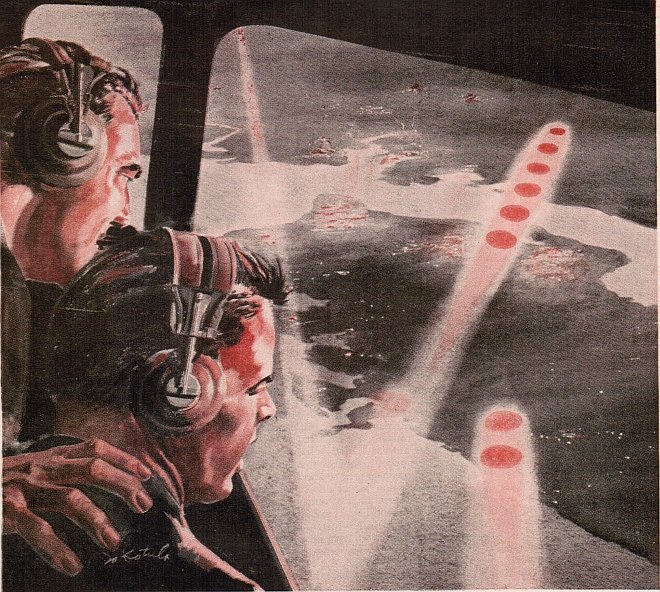
On the clear, moonless evening of 14 July 1952, a Pan American World Airways DC-4 was being ferried empty of paying schedule from New York to Miami, carrying a crew of three and ten non-revenue passengers. This case file covers what witnesses reported, the official narrative, and a two-pass assessment with its evidence tier.
What did witnesses see at Chesapeake Bay near Newport News and Langley Field?
On the clear, moonless evening of 14 July 1952, a Pan American World Airways DC-4 was being ferried empty of paying schedule from New York to Miami, carrying a crew of three and ten non-revenue passengers. The aircraft was on autopilot at 8,000 feet over Chesapeake Bay, a few minutes from the radio range station at Norfolk and roughly over the area between Newport News and Langley Field, Virginia. Captain Fred Koepke was in the cabin checking the passengers. First Officer William B. Nash was flying and Second Officer William H. Fortenberry was in the right seat.
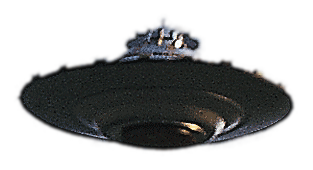
At 8:12 Eastern Standard Time both men saw what Nash described as "a red brilliance in the sky, beyond and somewhat below the plane." It resolved into six bright objects "streaking toward us at terrific speed," holding what Nash called "a narrow echelon formation, a stepped-up line tilted slightly to our right." The objects had, in his words, "the fiery aspect of hot coals, but of much greater glow," a glowing red-orange, and were "clearly outlined and evidently circular." He compared their size to "a little larger than a DC-3 wingspread would appear to be" at that distance, which he and Fortenberry put at about 100 feet across, with exposed edges "about 15 feet thick" when the objects turned, the top surfaces flat, "in shape and proportion they were much like coins." They estimated the objects were "slightly more than a mile below us, or about 2,000 feet above ground level."
Then came the maneuver that made the case famous. As the formation reached a point apparently almost beneath the airliner, the lead object's glow "blinked out" for an instant, the others dimming behind it in sequence, and the whole formation executed a sharp reversal. In Nash's account, "all together, they flipped on edge, the sides to the left going up and the glowing surface facing right." While they were edgewise the last five slid over and past the leader so that the line was now reversed, tail-foremost, after which "without any arc or swerve at all, they all flipped back" to the flat position and darted off to the west. Two more identical objects then "darted out" from somewhere behind and below the plane and joined the formation, bringing the count to eight, before all eight made a final climbing turn, brightened, and shot up and away to the northwest until they blinked out one by one. The entire encounter lasted only about twelve seconds.
Both pilots, trained in aircraft recognition from naval service, immediately recognized they had measured a benchmark. Using the known ground distance the objects had covered against the elapsed time, they calculated a conservative speed of about 12,000 miles per hour, and noted that a less cautious reading of the geometry gave figures far higher. Within minutes they radioed Norfolk and asked that a message be relayed to the military: "Two pilots of this flight observed eight unidentified objects vicinity Langley Field; estimate speed in excess of 1,000 mph; altitude estimated 2,000 feet." They deliberately understated the speed in the cable so as not to sound unbelievable.
What is the official explanation?
The report went into the Air Force's UFO program, then run as Project Blue Book. At 7 a.m. the next morning, 15 July 1952, the two pilots were met at Miami International Airport by USAF Wing Intelligence officer Major John H. Sharpe and four officers from the 7th District Office of Special Investigations. The interrogation was unusually thorough for the period. The pilots were questioned separately for one hour and forty-five minutes, then brought together for another thirty minutes, using prepared questionnaires, map overlays, and the complete weather reports for the route and time.
Blue Book moved quickly to test the obvious mundane answer. Five jet aircraft had been operating out of Langley Field that evening, and investigators checked whether the pilots could have seen those. The conclusion in the file was that the five Langley jets could not account for what was reported, given the geometry, the speed, the formation behavior, and the simultaneous reversal. With no conventional explanation surviving, the case was filed in the official record as "Unknown," the small category Blue Book reserved for reports that resisted identification even after investigation.
The weather data gathered during that investigation matters because it later became the pivot of the debate. The official report for the night recorded roughly 3/8 cirrus cloud at about 20,000 feet, no temperature inversion, and a sharply clear sky. The investigators noted these conditions matched the previous evening's flight plan. Major Sharpe characterized the reported motion of the objects, when the pilots' distance and time measurements were taken at face value, as involving a speed he called "fantastic to contemplate."
Inside the Pentagon the case did not vanish into a filing cabinet. Major Dewey J. Fournet, the officer who served as the Pentagon's monitor for the UFO project during 1952, was strongly impressed by the report. He carried it forward as one of his selected cases, listing the Nash-Fortenberry sighting as Case 6 on the handout he prepared for the CIA-convened Robertson Panel in January 1953, valuing it for the quality of the witnesses and the precision of their measurements. Project Blue Book chief Captain Edward Ruppelt, by his own later account, was so buried under the flood of mid-1952 reports, the Air Force was logging on the order of twenty a day by then, that he gave this one little attention and set it aside after being told there had been aircraft up that night. The official record therefore holds two things at once: a formal "Unknown" classification, and an internal split between an analyst who rated it among the best cases on file and an overworked project chief who barely engaged with it.
What did the witnesses think it was?
William Nash and William Fortenberry were not casual observers. Both had served as U.S. Navy pilots and both had received intensive instruction in aircraft identification during the war. Nash had flown patrol bombers for the Naval Air Transport Service on the long ocean crossings between the African and South American coasts. Fortenberry had spent two years with a Navy air experimental wing. By 1952 they were professional airline officers flying for Pan American. They understood that emotional excitement degrades an observation, and Nash put the point bluntly in his later correspondence, noting that "pilots do not excite earlier, or they would not be airline pilots."
Neither man wavered on what he had seen. In their True Magazine account and in years of follow-up, both insisted the objects were solid, controlled craft of a performance no aircraft of the era could approach. Nash stated flatly that he believed "to this day, that it was nothing from this planet." They emphasized that they had a rare measuring opportunity, with the objects passing below a known altitude over recognizable ground features in clear air, which let them bracket size, distance, and speed instead of guessing.
The case is unusual for the number of independent ground witnesses gathered up by the same investigation. Residents around Stockley Gardens in Norfolk reported seeing "seven or eight" objects overhead, described by one witness as "the first three white and the others were yellow and red," circling and then moving off to the north. A naval officer aboard the cruiser Roanoke reported eight red lights moving in a straight line near Old Point Comfort at about 8:55 p.m., not far in time and place from the airliner encounter. Other Tidewater residents reported similar red objects that evening. The clustering of multiple separate observers describing red discs in formation over the same stretch of coast on the same night is part of why later researchers rated the case so highly.
Two days later, on 16 July 1952, the encounter gained a witness of exceptional technical standing. Paul R. Hill, an aeronautical engineer at NASA's Langley Research Center, watched four amber objects maneuvering near the same area with his future wife. Hill, a serious propulsion and dynamics researcher, was struck by the tight, rapid circling and estimated the centripetal acceleration involved at around 100 g. Blue Book wrote his sighting off as airplanes, an identification Hill rejected outright, and the experience launched a quarter-century of private analysis that he eventually distilled into his book "Unconventional Flying Objects: A Scientific Analysis," published after his death. Hill treated the Nash-Fortenberry maneuvers as a real engineering problem rather than a misperception.
The dispute
The single substantive counter-explanation comes from the Harvard astronomer Donald H. Menzel, the era's most prominent UFO skeptic, in his 1963 book with Lyle G. Boyd, "The World of Flying Saucers," in a section he titled as a possible explanation of the Nash-Fortenberry disks. Menzel argued the objects were not solid at all but "immaterial images made of light." His model was a temperature inversion: he proposed that a thin atmospheric layer of concentrated haze, ice crystals, or smoke could act as a reflecting and refracting surface, so that a searchlight or ground lights beamed up into it would show as a row of glowing discs, and that movement of the beam or the airliner would make the discs appear to dart, flip, and reverse. At other times Menzel suggested the men might have seen ground lights distorted by haze, or even reflections, and in one widely cited remark he floated the idea of fireflies caught between the cockpit window panes.
The problem with Menzel's reconstruction is that the physical conditions it requires were specifically recorded as absent on the night in question. The official weather report compiled during the Air Force investigation listed about 3/8 cirrus at roughly 20,000 feet, no inversion, and a sharply clear sky. An inversion-layer searchlight reflection cannot occur without the inversion layer, and the contemporaneous meteorological data say there was none. Menzel did not have access to evidence that an inversion was present; he posited one as a hypothetical to fit the case, which inverts the normal burden of proof.
The explanation also struggles with the geometry the witnesses actually reported. Trained observers described eight discrete, equally sized objects holding and then reversing a stepped echelon, flipping onto edge to show an unlit underside, and two additional objects joining from a different bearing. Nash specifically rebutted the reflection idea by pointing out that the objects appeared in sequence through three different cockpit windows as they crossed the sky, which a fixed reflection in the glass or a single beam on a haze layer cannot reproduce. The independent ground witnesses around Norfolk and the naval officer aboard the Roanoke, who saw red objects in formation from completely different vantage points, further undercut a cockpit-window or single-searchlight artifact, since those observers had no airliner windscreen and no shared optical path.
For these reasons the Menzel explanation is treated here as a weak, contested debunk rather than a resolution. It is an assertion of a mechanism without the supporting conditions, advanced years after the fact and contradicted by the official weather record, which is exactly the profile of a counter-explanation that does not close a case. It is logged honestly as the dispute, but it does not move the case beyond the "barely disputed" line.
Is the Nash-Fortenberry Sighting real? The two-pass assessment
Pass one, the ordinary readings. The most serious mundane candidate is conventional aircraft, specifically the five jets known to be flying out of Langley Field that evening, and this is precisely the explanation the Air Force tested first. Blue Book concluded the Langley jets could not produce the reported geometry: eight equally sized glowing discs in a stepped echelon, an instantaneous formation reversal with the objects flipping onto edge, a near-zero-radius course change, and a measured speed that even on the pilots' deliberately conservative figure ran to roughly 12,000 miles per hour, far beyond any 1952 jet. The other ordinary candidate is Menzel's optical mirage, searchlights or ground lights on a temperature-inversion layer, or reflections in the cockpit glass. That model fails on its own terms because the official weather report for the night records no inversion and a sharply clear sky, removing the reflecting layer the theory depends on, and because multiple independent ground witnesses with no shared optical path saw red objects in formation over the same coast at nearly the same time. A balloon train is ruled out by the speed and the abrupt directional reversals. A genuine misidentification by two recognition-trained naval-veteran airline pilots, watching for twelve seconds in clear air against known ground features, with corroboration from strangers below, is possible in principle but is not supported by any positive identification of a real object.
Pass two, if the report is taken at face value. Then two professional pilots measured eight solid, self-luminous craft about 100 feet across performing controlled maneuvers, an edge-flip reversal and a near-instant turn at thousands of miles per hour, that no human aircraft of the period could remotely match. That is the reading Nash and Fortenberry themselves held, that Major Dewey Fournet rated highly enough to carry to the Robertson Panel as one of his best cases, and that NASA engineer Paul Hill, who saw similar objects two days later and rejected the Air Force's airplane label, spent twenty-five years analyzing as a real aerodynamic and propulsion problem.
The official apparatus did not discredit this case; it classified it "Unknown" after a thorough same-day interrogation, which under our standard is evidence the report was substantial enough to survive investigation, not a mark against it. The only method-bearing skeptical claim, Menzel's inversion-reflection model, is contradicted by the very weather data the investigation collected and is therefore a weak, contested debunk rather than a resolution. Because a named counter-explanation exists but is partial, unsupported by the conditions it requires, and widely rejected, while the case itself stands on credible trained witnesses, independent ground corroboration, and a formal "Unknown" in the government record, the correct tier is Barely Disputed.
Sources
- www.project1947.com/fig/true_10_52.htm
- www.project1947.com/shg/articles/tulien_nashfort.htm
- www.nicap.org/reports/nash-tulien.htm
- web.archive.org/web/20251028215839/https://www.gutenberg.org/cache/epub/66639/pg66639-images.html
- cufos.org/peeking-into-corners-part-four/
- ufologie.patrickgross.org/htm/newport.htm
- www.ufoinsight.com/the-nash-fortenberry-ufo-sighting-a-case-study/
More cases from this region: UFO sightings in United States