The Tremonton, Utah Film
On the morning of 2 July 1952, Delbert C. Newhouse, a chief photographer and commissioned warrant officer in the United States Navy with twenty-one years of service and roughly 2,000 hours of aerial-photography flying time, was driving west on U.S. Highway 30S with his wife Norma and their two children. This case file covers what witnesses reported, the official narrative, and a two-pass assessment with its evidence tier.
What did witnesses see at U.S. Highway 30S?
On the morning of 2 July 1952, Delbert C. Newhouse, a chief photographer and commissioned warrant officer in the United States Navy with twenty-one years of service and roughly 2,000 hours of aerial-photography flying time, was driving west on U.S. Highway 30S with his wife Norma and their two children. They had passed through Tremonton, in northern Utah, and had gone about seven miles when, as Newhouse put it in his 1956 filmed interview, "Norma, my wife, noticed a group of objects in the sky, which she could not identify." He pulled the car off the road and got out to look.
In his account there were "about twelve of them, milling about in a round formation" and drifting in a generally westerly direction. He said they had "the shape of two saucers, one inverted over the other," that "they were a bright silvery color," and that "they had a metallic appearance. They seemed to be made of some kind of polished metal." He heard no sound, saw no exhaust, trail, or wings, and at first had nothing in the sky to give him a scale.
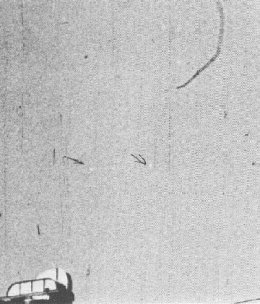
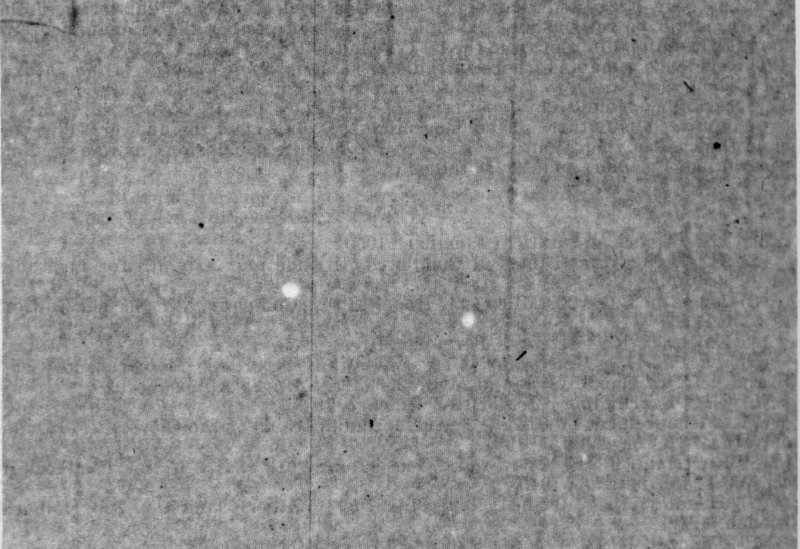
Newhouse carried his photographic gear in the car. His camera was a Bell and Howell Automaster 16mm, and he swung the turret around to a 3-inch telephoto lens and loaded Daylight Kodachrome color film running at 16 frames per second. By his own telling, the assembly cost him time he never got back: the objects had already moved off before he could shoot, so the footage shows them at a distance rather than overhead. He exposed roughly thirty feet of film, about 1,200 frames, opening at one aperture and then stopping the lens down as he worked. Late in the sequence a single object broke away from the cluster and tracked off in the opposite direction, and Newhouse swung the camera to follow that one as it left the group. What the developed film shows is a loose swarm of bright white dots moving and circling against a clear sky, brightening and dimming as they go.
What is the official explanation?
Newhouse turned the film over to the Navy, which passed it to the Air Force's Air Technical Intelligence Center at Wright-Patterson for Project Blue Book. The Air Force Photo Reconnaissance Laboratory studied it for roughly three months and reported the objects were not balloons or aircraft and were most unlikely to be birds, but reached no firm identification. The film was then examined independently at the U.S. Navy Photographic Interpretation Laboratory at Anacostia in Washington, where Lt. R. S. Neasham and Mr. Harry Woo carried out a frame-by-frame study. The 1953 panel record states the laboratory expended "approximately 1000 man hours of professional and sub-professional time" on the Tremonton analysis.
The Navy laboratory's headline finding was that the images were "not reflections because there was no blinking while passing through 60 degrees of arc" and were therefore "self-luminous." Neasham and Woo ruled out aircraft, balloons, and birds, and on that basis the analysis was read inside the Air Force and the Pentagon as evidence the objects were intelligently controlled vehicles. Edward J. Ruppelt, who ran Blue Book at the time, later wrote that "the Navy lab spent about two months studying the films" and concluded "the UFO's were intelligently controlled vehicles and that they weren't airplanes or birds." Ruppelt added that after he left the Air Force he met Newhouse and that "few impressed me as much as Newhouse."
In January 1953 the CIA convened the Robertson Panel, a group of physical scientists chaired by H. P. Robertson, to review Blue Book's best evidence. Neasham and Woo presented the Tremonton and Great Falls films in person. The panel, none of whom was trained in motion-picture or photographic analysis, rejected the laboratory's conclusion. On the self-luminous point the panel asserted that "a semi-spherical object can readily produce a reflection of sunlight without 'blinking' through 60 degrees of arc travel," and after watching a separate short film of seagulls flaring in bright sunlight it found "the apparent motions, sizes and brightnesses of the objects were considered strongly to suggest birds." The panel's wider mandate showed in its recommendations: it called for an educational program with the dual aims of "training and 'debunking'," explicitly aimed at a "reduction in public interest in 'flying saucers'." In 1969 the Air Force-funded Condon study revisited the film as Case 49, written by astronomer William K. Hartmann, who measured angular sizes and transverse velocities, then went to Utah and watched gulls. His conclusion was hedged: "Although I cannot offer an expert ornithological opinion, it appears to me that the Tremonton objects constitute a flock of white birds," while conceding "the data are not conclusive."
The 2026 release adds the analysts' own paperwork to a case that has always been argued through secondhand descriptions of it.
On 7 August 2026 the Department of War published, in its fifth PURSUE release, a record catalogued as DOW-UAP-D098, "Film Analysis of Unidentified Objects, 1953". The Department's own release manifest lists its incident location as "Montana, Utah" and its incident dates as "1950, 1952", which means this single memorandum concerns both this film and the other one. The manifest describes it as a memorandum on the U.S. Naval Photographic Interpretation Center's assessment of the two films, documenting "the Center's analytic process, assumptions that constrained its confidence level, tentative conclusions, and recommendations for future research". According to that description the Center "assessed, generally, that the objects depicted in the film demonstrated characteristics that were inconsistent with those of natural phenomena or commonly known aerospace technologies", and recommended a better resourced investigation to corroborate what it called its presumptive findings, citing a lack of funding and personnel. The manifest adds that the file carries charts comparing the film's luminosity against the apparent angular size of the phenomena, using photogrammetric analysis and the mathematical modelling of the period.
The memorandum has since been read here in full. The individual file is bot blocked at war.gov, but the Department also published a bundle of the whole tranche and the Wayback Machine holds a working capture of it, so the document was recovered from there.
It is a progress report dated 4 May 1953 from the Officer in Charge of the U.S. Naval Photographic Interpretation Center at the U.S. Naval Receiving Station in Washington, to the Director of Naval Intelligence under the office symbol OP-322H4D, headed "Interpretation of Movies of Unidentified Objects". Its own references establish the sequence: the Air Force asked for interpretation of the Utah film of 2 July 1952 by a confidential letter of 27 October 1952, sending about 30 feet of 16mm colour film and a list of questions, and then asked for the Montana 1950 film to be added by a memorandum of 24 November 1952 from the Chief of the Topical Division, USAF. The Center is careful about its own standing, noting that the work was done by the Photogrammetry Division of its Evaluation Department and does "not necessarily represent the official attitude of the Department of the Navy or this Center".
The method is set out in detail. Density readings were taken with a Densichron Model 2150 made by the Welch Scientific Company, each frame projected at about 22 times magnification onto a fine ground glass screen with the sky background set to a density of 3.0. The Utah film was split into three parts by aperture and camera handling, and the Montana film was read in its entirety. The analysts are candid about their own limits: the object images varied so much in size that the probe sometimes measured the whole object and sometimes only part of it, and the film they worked from was "a duplicate of a copy", which raised the question of whether the centres of the objects had been burnt out in duplication.
The reasoning is what has been argued over ever since. The analysts found that luminosity and apparent size rose together, which would fit a reflecting surface, but rejected reflection as improbable because the objects were visible continuously for about 90 seconds across roughly 60 degrees of arc without blinking, and because the sun angle and reported atmospheric conditions did not fit. They wrote that "it is the majority opinion of the group conducting this analysis that these images are light sources", which explains the absence of blinking and the variation in luminosity but not the velocity or acceleration. Their summary sentence is the one that has been quoted secondhand for decades, and it reads: "In either case, light source or reflective surface, it appears as if the objects are of a nature which we are not able to identify in terms of natural phenomena or commonly known man-made objects."
The next paragraph is the one that bears hardest on the later argument: "There is no indication of what kind of objects could have caused the images except that they must be of a construction, design, and material not commonly known. This is indicated by the computed acceleration rate and velocity. For the same reasons, birds, aircraft and balloons are ruled out." The report describes the objects as oblate or disc shaped, blue white in colour, and between 16 and 98 feet in size, while stating openly that the size figure rests on an assumed range of five miles. The velocity work rests on three stated assumptions, one of which the analysts themselves call a fallacy while noting it yields a minimum rather than a maximum, and it produces a figure of 3,780 miles per hour for a shift of one millimetre per frame at that assumed range.
So the document is at once stronger and more qualified than either camp has usually made it. It does rule out birds, and it says so in those words. It also rests its size and speed numbers on an arbitrary assumed distance, says so, and was working from a copy of a copy.
For Tremonton this matters more than for most cases, because the entire dispute here turns on what the photographic analysts actually concluded and how confident they were. The bird explanation rests on Hartmann's 1969 Condon review, and the counterweight has always been the Navy laboratory's earlier frame by frame study of light intensity. A released memorandum that documents the Center's method, its stated confidence limits and its request for a properly resourced follow up is directly on that question. It does not by itself settle the case, and it does not change the tier here, both because the memorandum is described as tentative in the Department's own words and because the archive has not yet read it.
What did the witnesses think it was?
Newhouse never moved off his account. In the 1956 filmed interview he repeated that he had seen about a dozen metallic, silvery, saucer-paired objects and that they bore no resemblance to anything he knew. He was not a casual observer: he had spent twenty-one years in the Navy as an aerial photographer with around 2,000 hours in the air, which is the very job of telling aircraft, birds, and optical artifacts apart from a moving platform. He maintained that the objects were high and large, reasoning that if they had been the size of a B-29 they would have had to be at around 10,000 feet, and he flatly rejected the idea that a career aerial photographer had filmed seagulls and not noticed.
His wife Norma was the first to see the objects and pointed them out to him, and their two children were in the car, so the visual sighting had more than one witness even though only Newhouse worked the camera. The strongest corroboration, though, came from the analysts who actually measured the film rather than the panel that watched it projected on a wall. Robert M. L. Baker Jr., an astronomer at Douglas Aircraft, ran an independent photogrammetric analysis of the "Utah" film in 1955 and 1956 and was openly skeptical of the bird explanation, noting that "the motion of the objects is not exactly what one would expect from a flock of soaring birds (not the slightest indication of a decrease in brightness due to periodic turning with the wind or flapping)." Baker's written conclusion, dated 16 May 1956, was that "the evidence remains rather contradictory and no single hypothesis of a natural phenomenon yet suggested seems to completely account for the UFO involved." Newhouse himself, the Navy laboratory team, and Baker therefore all landed in the same place: whatever the film showed, the soaring-gull answer did not fit what they had measured.
The dispute
The standard skeptical verdict on Tremonton is that the bright dots are seagulls soaring and flaring in sunlight over the Great Salt Lake basin. That explanation has weight because it is the official one and because it has been restated by serious people: the Robertson Panel in 1953 declared the objects birds, and the 1969 Condon Report's William Hartmann independently concluded they were "a flock of white birds." Newhouse filmed at a distance after the objects had already moved off, so the film alone cannot establish absolute size, and at small angular size bright birds in sun can mimic featureless luminous points. Hartmann's measured angular diameters of roughly 1.5 to 5.5 minutes of arc and transverse speeds of tens of miles per hour are, on their face, consistent with birds at a couple of thousand feet.
What keeps this in the "barely disputed" tier rather than anything stronger is that the bird verdict was an official assertion rather than a shown method, and the people who actually analyzed the film frame by frame reached the opposite result. The Robertson Panel contained no one trained in motion-picture or photographic analysis; it overruled the Navy Photographic Interpretation Laboratory's roughly 1,000-hour study not by re-measuring the film but by watching a separate, unrelated reel of seagulls and judging that the dots "looked like" birds. The panel's own charter to "debunk" and reduce public interest in flying saucers means its conclusion arrived with a thumb on the scale. The two analysts who did measure the Tremonton film, Lt. R. S. Neasham and Harry Woo at Anacostia, found the objects self-luminous and not birds, and the only fully independent civilian photogrammetric study, Robert M. L. Baker Jr.'s for Douglas Aircraft, explicitly found the motion inconsistent with soaring birds and concluded no natural explanation accounted for the objects.
So there is a concrete counter-explanation (gulls) and an official finding behind it, but there is no confession, no recovered prop, and no positive identification of a specific flock, ship, balloon, or aircraft. Hartmann's own bird conclusion is hedged with "the data are not conclusive," and his identification followed a trip to Utah to watch live gulls rather than flowing from the film measurements themselves, which is the reverse of the order a clean identification would take. The seagull hypothesis is plausible and widely repeated, but it remains a contested reconstruction that the contemporary frame-by-frame analysts rejected. That is the textbook shape of a weak or partial counter-explanation, so the case largely stands and sits at "Barely Disputed."
Is the Tremonton, Utah Film real? The two-pass assessment
Pass one, the ordinary readings. The single most-cited mundane explanation is birds, specifically white gulls soaring and banking in bright sun so that their bodies flare and fade into featureless points of light. Newhouse filmed at a distance with no fixed reference in the frame, which removes the scale that would otherwise separate large distant objects from small near ones, and the brightening and dimming of the dots is exactly what flaring birds do. The Robertson Panel and the Condon study both reached the bird conclusion, and at the measured angular sizes the geometry does not forbid it. Other ordinary candidates fare worse: aircraft were ruled out by both the Air Force and Navy laboratories because of the absence of wings, exhaust, and engine form; spherical or pilot balloons were excluded by the laboratory's motion analysis; and there is no hoax case to make, because Newhouse was a serving Navy photographer who handed the film straight to the government and never sought money or fame from it. So the realistic mundane field narrows to one thing, birds, and that explanation is asserted more confidently than it was ever demonstrated.
Pass two, if it is not birds. If the film shows real objects, then it shows roughly a dozen self-luminous, metallic-looking craft in loose formation, with one peeling off on a reversed course, photographed by a trained aerial cameraman with a calibrated telephoto setup. The Navy Photographic Interpretation Laboratory's frame-by-frame measurement found them self-luminous rather than reflective, which is hard to square with birds, and Robert Baker's independent photogrammetry found the object motion wrong for soaring birds and concluded no natural phenomenon then proposed accounted for them. That is a strong primary-document chain: the witness, the contemporary government analysts, and the one independent civilian analyst who actually measured the film all rejected the bird answer.
Weighing the two passes, the case is authentic film, officially documented, and analyzed at length by qualified people, and the only mundane explanation on offer is a contested bird hypothesis that the measuring analysts disowned. There is no confession, no recovered prop, and no positive identification of a specific real-world cause, so this is not a strongly disputed case. But a named official counter-explanation does exist and is widely held, so it is not unexplained-and-clean either. The honest placement is "Barely Disputed": the seagull verdict is a weak, method-light official assertion, the contemporary frame-by-frame analyses point the other way, and the case largely stands.
Sources
- cufos.org/peeking-into-corners-part-five/
- files.ncas.org/condon/text/case49.htm
- files.ncas.org/condon/text/appndx-u.htm
- ufologie.patrickgross.org/htm/tremontonruppelt.htm
- ufologie.patrickgross.org/htm/tremontonnewhouse.htm
- ufologie.patrickgross.org/htm/tremontoncondon.htm
- kevinrandle.blogspot.com/2013/12/newhouses-tremonton-utah-movie-revisited.html
- www.theblackvault.com/casefiles/desks-project-blue-book-tremonton-utah-navy-warrant-officer-delbert-newhouse-1952/
- www.nicap.org/docs/utah520702docs2.htm
- web.archive.org/web/20260808030643id_/https://www.war.gov/Portals/1/Interactive/2026/UFO/uap-data.csv?release=5
- web.archive.org/web/20260809162414/https://www.war.gov/medialink/ufo/release_05/Aug_07/release_05_Aug_07_documents.zip
More cases from this region: UFO sightings in United States