The Washington, D.C. Sightings
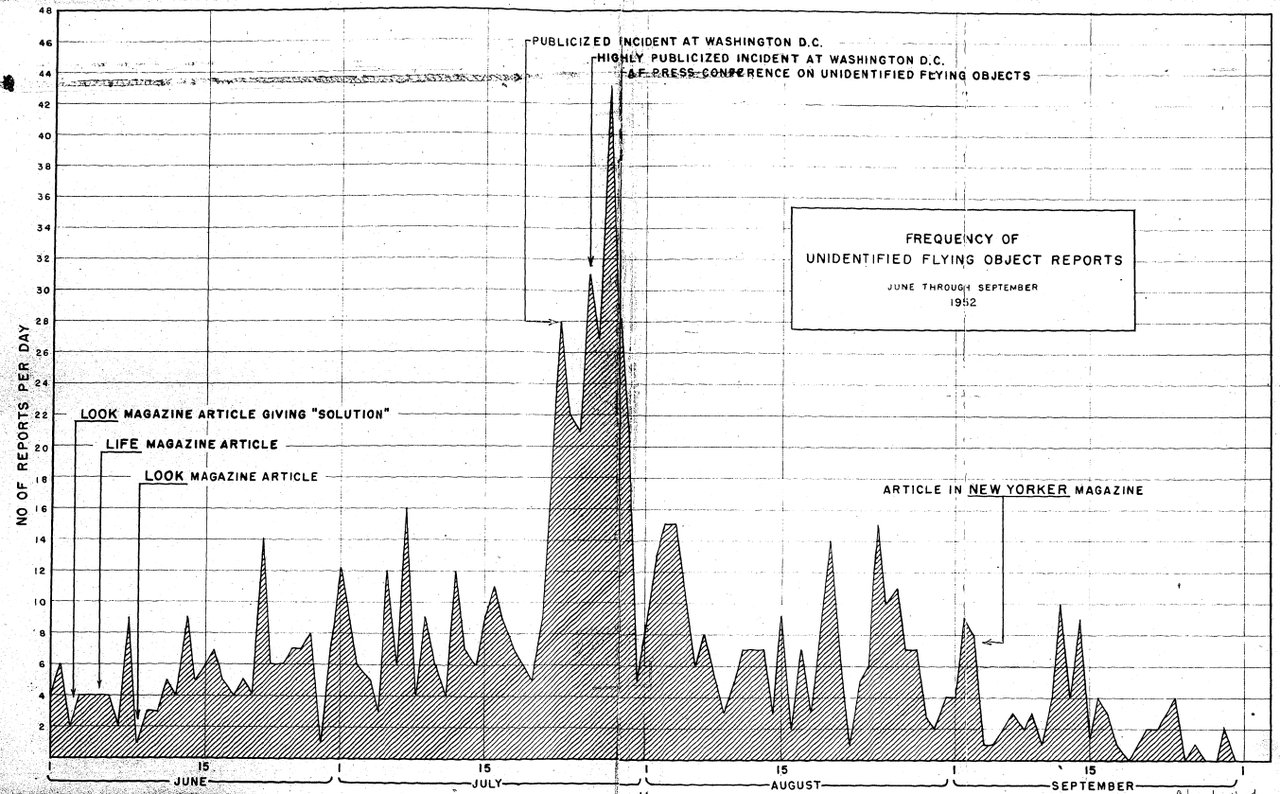
On Saturday 19 July 1952, at 11:40 p.m., air traffic controller Edward Nugent was watching the long-range radar at the Air Route Traffic Control center at Washington National Airport when seven slow targets appeared on his scope about 15 miles south-southwest of the city, in airspace where no aircraft were scheduled. This case file covers what witnesses reported, the official narrative, and a two-pass assessment with its evidence tier.
What did witnesses see at Washington National Airport?
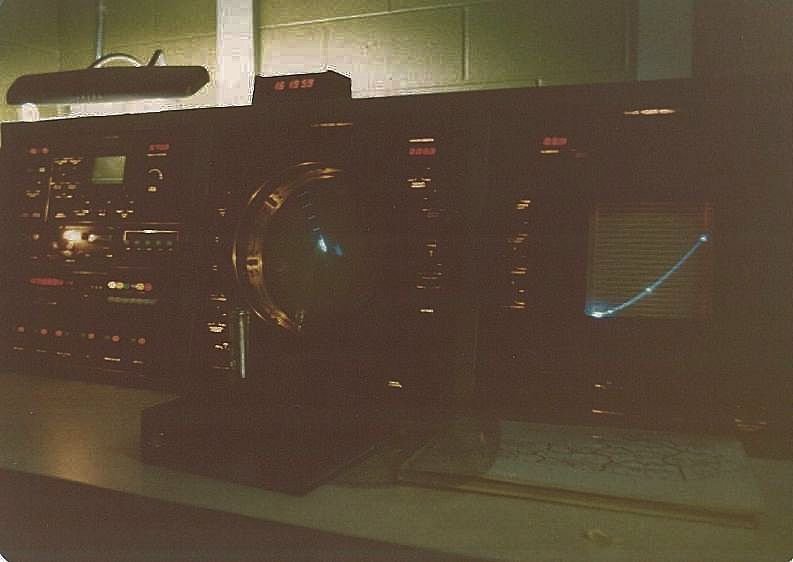
On Saturday 19 July 1952, at 11:40 p.m., air traffic controller Edward Nugent was watching the long-range radar at the Air Route Traffic Control center at Washington National Airport when seven slow targets appeared on his scope about 15 miles south-southwest of the city, in airspace where no aircraft were scheduled. Senior controller Harry Barnes walked over, looked, and as he later wrote for a news syndicate, "We knew immediately that a very strange situation existed. Their movements were completely radical compared to those of ordinary aircraft." Barnes had two other controllers verify Nugent's set was working normally, then telephoned the airport's separate tower radar, where controller Howard Cocklin and Joe Zacko confirmed they had the same targets. Cocklin said he could even see one of them visually, "a bright orange light. I can't tell what's behind it."
The targets loafed along at 100 to 130 miles an hour, then without warning accelerated to what Ruppelt's account called "fantastically high speeds," one of them clocked at about 7,000 miles an hour. Over the night they ranged across every sector of the scope and flew through the prohibited airspace over the White House and the Capitol. A Capital Airlines DC-4 captain, S.C. "Casey" Pierman, was holding for takeoff and was asked by the tower to watch for objects. Over roughly 14 minutes he saw six white, tailless, fast-moving lights. Barnes, who was in radio contact with him, stated: "Each sighting coincided with a pip we could see near his plane. When he reported that the light streaked off at a high speed, it disappeared on our scope." At Andrews Air Force Base across the river, airman William Brady and others in the tower saw an object "which appeared to be like an orange ball of fire, trailing a tail," and civilian engineer E.W. Chambers reported "five huge disks circling in a loose formation." The targets faded around dawn near 5:30 a.m.
The objects returned the following Saturday, 26 July, again around 10:30 p.m., picked up by the same controllers on the same scopes. Two F-94 Starfire jet interceptors were vectored in from New Castle in Delaware. One pilot, Lieutenant William Patterson, found himself surrounded by four white glows and radioed the tower to ask what he should do; he later said the controllers gave him no answer. The targets repeatedly vanished from the radar when the jets arrived and returned once they left for fuel, a behavior the radar men found pointed and deliberate. Present in the radar room that night were Major Dewey Fournet, the Pentagon's monitor for the UFO project, and a Navy radar specialist, both of whom concluded the returns looked like solid objects.
What is the official explanation?
The Air Force response culminated in the largest Pentagon press conference since the Second World War, held at 4:00 p.m. on 29 July 1952 in Room 3E-869 and led by Major General John A. Samford, Director of Air Force Intelligence. Samford's central claim was meteorological: temperature inversion. As he put it, a "temperature inversion in the atmosphere can cause an image from somewhere else to be reflected in positions where it is not," and Air Force radar man Captain Roy James backed him on "the temperature inversion effect on radar waves that is fairly well established."
Samford was, however, careful not to oversell it. He conceded that the leading inversion theory was contested, saying, "I don't think that we are quite sure that the Menzel theory of temperature inversion is a good theory. It's supported by some people. Other people who have equal competence discredit it." He made the admission that became the case's most quoted line, that within the total body of reports "there have remained a percentage of this total, in the order of twenty per cent of the reports, that have come from credible observers of relatively incredible things." He framed the affair as no military threat: "there has been no pattern that reveals anything remotely like purpose or remotely like consistency that we can in any way associate with any menace to the United States," and "in my own view the thing is excluded as being a material evidence."
Project Blue Book, the Air Force's own UFO office, did not in fact resolve the case. Its director Edward Ruppelt wrote in 1956 that on each night a sighting occurred there was indeed a temperature inversion present, "but it was never strong enough to affect the radar," and that across June, July and August 1952 hardly a night passed without an inversion over Washington, yet the slow solid targets appeared on only a handful of them. He recorded that when he interviewed the radar and tower personnel afterward, not one of them agreed with the inversion explanation, and he closed: "So the Washington National Airport Sightings are still unknowns," adding that "the complete story has never fully been told."
The flap also drove the intelligence response. The CIA's own internal history (Gerald Haines, "CIA's Role in the Study of UFOs, 1947-90") records that the Washington radar incidents and the press frenzy alarmed the Agency. H. Marshall Chadwell, Assistant Director of the Office of Scientific Intelligence, warned of "sightings of unexplained objects at great altitudes and traveling at high speeds in the vicinity of major US defense installations" that were "not attributable to natural phenomena or known types of aerial vehicles," and pushed for a scientific review. That recommendation produced the CIA-convened Robertson Panel of January 1953, whose mandate leaned toward debunking and public reassurance rather than open-ended investigation.
What did the witnesses think it was?
The witnesses were not casual members of the public. Edward Nugent, Harry Barnes, Howard Cocklin and Joe Zacko were professional air traffic controllers reading calibrated radar; Barnes had two other controllers independently check that the equipment was functioning before he accepted the targets as real. Their conviction was that something solid was in the air. Barnes, in his syndicated account, insisted the movements were "completely radical compared to those of ordinary aircraft," and the radar-visual coincidence with Captain Pierman's six lights persuaded him the pips were physical objects, not phantoms in the set.
The judgment of the men in the room carried weight. Major Dewey Fournet, the Pentagon officer assigned to the UFO project, and the Navy radar specialist present (identified in later accounts as John Holcomb) both came away believing the targets were most likely solid metallic objects, and Holcomb judged the inversion present that night nowhere near strong enough to produce the "good and solid" returns they were watching. The pilots added independent visual data: Lieutenant William Patterson described being ringed by white glows in his F-94, and ground and tower observers at Andrews, including William Brady, and Capital Airlines captain Pierman, all reported lights whose appearance and disappearance tracked the radar. Ruppelt, who as Blue Book's director had every institutional reason to want the case closed, instead documented that the people who actually watched the scopes rejected the official explanation and that he himself could not square the inversion theory with the facts.
The dispute
The dispute is entirely about the Air Force's meteorological explanation, advanced publicly by Major General John Samford and his radar specialist Captain Roy James at the 29 July 1952 Pentagon press conference: that the radar targets were "mirage effects" produced by a temperature inversion bending the radar beam and painting ground objects as false airborne returns, with the visual sightings dismissed as stars, meteors and observer excitement. A Civil Aeronautics Administration follow-up supported the general point that inversions can cause such radar artifacts, and later skeptics have built on anomalous-propagation arguments to suggest the whole flap was weather plus nerves.
That explanation is genuine and cannot be ignored, but it has never been shown to actually account for these particular events, and it was disputed at the time by the technical people closest to the data. Project Blue Book's own director, Edward Ruppelt, wrote that on each sighting night an inversion was present "but it was never strong enough to affect the radar," and that inversions occurred over Washington nearly every night that summer while the solid slow-moving targets appeared on only a few. The Navy radar specialist in the room (John Holcomb) judged the inversion far too weak to produce the "good and solid" returns on the scopes, and Major Dewey Fournet, the Pentagon's UFO monitor, agreed the targets behaved like solid metallic objects. The inversion theory also struggles to explain matching targets appearing simultaneously on three independent radar sets together with coincident visual sightings, including Capital Airlines captain S.C. Pierman's lights tracking his radar pips and Lieutenant Patterson's F-94 encounter.
It is important to separate two things. The famous "lights under the Capitol" photograph is a proven fake, shown by Curt Collins and Colman von Keviczky to be a lens-flare reflection of the building's own lamps, taken years later and first published in a 1973 magazine. That fakery discredits one recycled image, not the case, which rests on radar logs and professional witnesses, not on that photo.
Because the counter-explanation is an official assertion contested by the firsthand experts and never validated against the specific multi-scope, radar-visual data, and because no confession, recovered prop, or positive identification of a real object or traced cause exists, this is a barely disputed case rather than a strongly disputed one. The Air Force's own Project Blue Book left it logged as "unknown."
Is the Washington, D.C. Sightings real? The two-pass assessment
Pass one, the entirely ordinary reading. The Air Force's own answer is the prosaic candidate: anomalous radar propagation from a temperature inversion bending the beam and painting ground returns as false targets, with the visual elements written off as stars, meteors and the normal excitement of keyed-up observers on a hot summer night. Inversions were genuinely present on the sighting nights, and a Civil Aeronautics Administration follow-up agreed that inversions commonly produce such radar artifacts. Some later researchers extend this to argue the slow targets were ground traffic and the fast jumps were the scope re-acquiring scattered echoes. Separately, the single most famous "photograph" of this case, the streak of lights beneath the Capitol dome, is a demonstrated fake: independent researcher Curt Collins and analyst Colman von Keviczky showed by mapping the Capitol's own lamps to the light positions that it is a lens-flare reflection shot years after 1952 and first surfaced in a 1973 saucer magazine, never a 1952 news photo. That image must be discarded, but it was never part of the actual evidentiary record.
Pass two, if the radar and the witnesses are read straight. The inversion explanation runs into the problem Blue Book's own director put on the record: inversions occurred over Washington almost nightly that summer, yet the solid, slow, controllable targets showed up on only a few nights, and Ruppelt judged the inversions present were "never strong enough to affect the radar." The radar professionals who were actually watching, including a Navy radar specialist and the Pentagon's own UFO monitor Major Fournet, concluded the returns behaved like solid metallic objects, and the simultaneous appearance of matching targets on three separate radar sets plus the coincident visual sightings (Pierman's lights tracking his radar pips, Patterson's glows, the Andrews observers) are hard to reduce to a propagation artifact, which would not normally coordinate across independent systems and a pilot's eyes at once. The targets also vanished when jets arrived and returned when they left.
Weighing it: the official counter-explanation is real and was advanced by named people (Samford, Captain Roy James), but it is an assertion without a demonstrated mechanism for these specific multi-scope, radar-visual events, it was contested on the night by the very experts present, and Project Blue Book itself never reclassified the case, logging it as "unknown." No confession, no recovered prop, no positive identification of a specific real object or traced cause has ever been produced. That is the signature of a contested-but-standing case, not a resolved one. Tier: Barely Disputed. The official inversion finding exists and must be stated, but it is weak and disputed by the firsthand technical witnesses, and the case largely stands as an unexplained radar-visual event.
2026 development, the AF-ATIC-FILM recording. In the spring of 2026 the 1952 Washington sightings returned to the news through a congressional records fight rather than a new sighting. In a letter dated 7 May 2026, publicized by his office the next day, Representative Eric Burlison of Missouri asked MIT Lincoln Laboratory to locate, preserve and review a reel to reel recording catalogued as AF-ATIC-FILM, 03/52 and labelled flying saucer talk, which lists Edward J. Ruppelt, the officer who headed Project Blue Book through the Air Technical Intelligence Center, as the briefer. The item is tied in the letter to the Beacon Hill Study, an early 1950s MIT air defense project, and its 03/52 marker places the briefing in March 1952, a few months before the summer radar visual events over the capital. The recording was discussed again at the Disclosure Forum 2026, a UAP transparency gathering held on Capitol Hill on 25 June 2026. Burlison's request invokes the UAP records preservation provisions of the 2024 defense authorization act and sets a thirty day deadline for the laboratory to say whether the recording exists, whether it has been digitized, and whether it has been referred to the National Archives. As of early July 2026 none of that is confirmed: MIT Lincoln Laboratory has published no response, no digitized copy or transcript has appeared, and the recording's contents are unknown. The strongest reporting, in The Hill and NewsNation, frames the matter as a claim by transparency advocates that a tape may surface, not as a released recording. It changes nothing about the assessment for now, but a contemporaneous 1952 briefing tape would be a primary source of real value if it is genuinely located and made public. UAP Globe is tracking that request on its case file for the 2026 UAP Disclosure Forum.
Sources
- en.wikisource.org/wiki/The_Report_on_Unidentified_Flying_Objects/Chapter_12
- www.saturdaynightuforia.com/html/articles/articlehtml/samfordpctanscript.html
- sgp.fas.org/library/ciaufo.html
- www.wanttoknow.info/ufos/19520728_washington_post_ufos
- www.blueblurrylines.com/2014/12/photo-fakery-washington-dc-flying.html
- mufon.com/2021/05/14/ufos-over-washington-dc-1952/
- www.cnn.com/2025/12/28/us/fighter-jets-ufos-1952-dc
- www.ibtimes.co.uk/1952-invasion-washington-ufo-recording-1805248
- www.prnewswire.com/news-releases/disclosure-foundation-to-convene-senators-members-of-congress-and-leading-experts-across-disciplines-for-landmark-public-forum-on-june-25-302807931.html
- burlison.house.gov/media/press-releases/burlison-requests-review-identified-1952-uap-recording
- burlison.house.gov/sites/evo-subsites/burlison.house.gov/files/evo-media-document/mit-lincoln-lab_uap-tape-letter.pdf
- thehill.com/homenews/5944717-ufo-washington-invasion-evidence/
- www.newsnationnow.com/space/1952-dc-ufo-encounter-missing-tape/
More cases from this region: UFO sightings in United States