The Lubbock Lights
On the evening of 25 August 1951, four professors from Texas Technological College were sitting in the back yard of geologist Dr. W. I. Robinson, drinking tea and discussing micrometeorites. This case file covers what witnesses reported, the official narrative, and a two-pass assessment with its evidence tier.
What did witnesses see at Lubbock?
On the evening of 25 August 1951, four professors from Texas Technological College were sitting in the back yard of geologist Dr. W. I. Robinson, drinking tea and discussing micrometeorites. With Robinson were Dr. A. G. Oberg, professor of chemical engineering, Professor W. L. Ducker, head of the petroleum engineering department, and Dr. George, professor of physics (who had studied the night sky during years at the University of Alaska). At about 9:20pm a formation of lights streaked directly over their heads. It happened so fast that none of them got a good look, and they could recall only a few details: the lights were a weird bluish-green color, in a semicircular formation, numbering somewhere between fifteen and thirty, moving north to south. About an hour later the lights passed over again. This time the men were ready, and the details from the first flight checked out, except the lights were now in a loose group rather than an orderly formation.
The professors then did something almost no UFO witnesses do: they turned themselves into an observing team. Over the next few weeks they made twelve more observations, adding two more people to the group. They measured the angle the objects swept and timed them. The flights they clocked crossed 90 degrees of sky in about three seconds, a rate of roughly 30 degrees per second. The lights usually appeared suddenly about 45 degrees above the northern horizon and winked out about 45 degrees above the southern horizon, always traveling north to south. Two or three flights were often seen in a single night. They tried to triangulate altitude with two teams on a measured baseline linked by two-way radio, but on the nights the teams were set up the lights never appeared on the course, though the watchers' wives reported seeing them from their homes in the city.
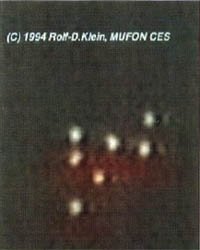
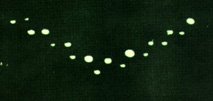
For two weeks hundreds of other people for miles around Lubbock reported the same dull bluish-green lights moving north to south, and the professors found many of these reports lined up in time with their own logged flights. On the night of 31 August 1951, 18-year-old Texas Tech freshman Carl Hart Jr. was lying in bed by an open upstairs window when he saw a formation of the lights cross an open patch of sky and pass over his house. He grabbed his loaded Kodak 35, set it to f3.5 and one tenth of a second, and went into the back yard. He got two photographs of a second pass and three more of a third pass, five negatives in all, showing an inverted-V or V formation of luminous dots. The same night a retired Lubbock rancher's wife reported a large object "like an airplane without a body" with pairs of glowing bluish lights along the back of a swept wing gliding silently over their house, matching a near-simultaneous report from an Atomic Energy Commission employee and his wife outside Albuquerque, New Mexico, of a huge "flying wing" with six to eight pairs of bluish lights. On 31 August two women near Matador, Texas, 70 miles northeast of Lubbock, reported a "pear-shaped," aluminum-colored object the size of a B-29 fuselage drifting low beside the road with a visible porthole before it spiraled up and out of sight.
What is the official explanation?
The Lubbock Lights became one of the marquee files of Project Blue Book, and the man who ran the project investigated them in person. Captain Edward J. Ruppelt, the first director of Blue Book, flew to Lubbock in late September 1951, met the four professors, interviewed Carl Hart Jr., re-enacted the photo session in Hart's back yard, and built what he called a "voluminous report." His unabridged chapter on the case, published in his 1956 book "The Report on Unidentified Flying Objects," remains the fullest primary account and states plainly: "Officially all of the sightings, except the UFO that was picked up on radar, are unknowns." A near-simultaneous radar return at an Air Defense Command station in Washington State, two scopes showing a target at about 900 miles per hour, was later written off by ATIC electronics specialists as a borderline weather echo, a verdict the radar captain on duty rejected, telling Ruppelt the target looked identical on both scopes, which is not how weather usually behaves.
Hart's five negatives went to the Air Force's Photo Reconnaissance Laboratory at Wright Field for the analysis catalogued as Test Report No. WCEFP-2-4 (Physics Branch). By the time the Air Force asked to borrow them only four of the five survived. The lab found the images were genuine photographic sources, circular near-pinpoint lights "like a bright star, or a distant light bulb," badly blurred by camera motion, shifting position frame to frame in a definite pattern. One detail stood out: although the night was clear, no stars showed in the background, meaning the lights were far brighter to the film than the stars, or registered on the emulsion more strongly. Ruppelt's official conclusion, later given to the press, was that "The photos were never proven to be a hoax but neither were they proven to be genuine."
Ruppelt then chased the prosaic answer and described it honestly. An 80-year-old man in Lamesa identified the lights as plover, a water bird, and the federal game warden in Lubbock confirmed plover have an oily white breast that reflects light but said they almost never travel in flocks of fifteen to thirty, more usually pairs. Ruppelt noticed Lubbock had just installed bluish mercury-vapor street lights, and the professors' vantage point sat near one of the lit boulevards, which fit the bird-reflection idea, except that people miles from any lit boulevard had also reported the lights, which he admitted he could not reconcile. Harvard astronomer Dr. Donald Menzel, the era's leading debunker, published his own explanation in LOOK magazine (17 June 1952): a temperature-inversion mirage refracting distant city lights into the sky. Menzel wrote that in his laboratory, "when I replaced the single pinhole with a row that simulated distant street lights, the resulting images behaved and looked like the Lubbock Lights." The professors themselves rejected the official prosaic readings. In a letter to LIFE magazine (28 April 1952) they wrote that "the groups of objects shown in the Hart photographs are, in these respects, essentially different from any of the 12 or more groups that we sighted," noting their lights were soft and glowing, mostly formless or in smooth arcs, not the bright sharp V of Hart's frames.
Then comes the twist that keeps the case from ever closing cleanly. Ruppelt wrote that he had personally believed the professors saw birds reflecting the street lights, "but I was wrong. They weren't birds, they weren't refracted light, but they weren't spaceships." He claimed the professors' lights "have been positively identified as a very commonplace and easily explainable natural phenomenon," the work of an unnamed scientist who built instrumentation and tested theory after theory for months. But Ruppelt never said what the phenomenon was. He had promised the scientist anonymity, and revealing the answer, he said, would reveal the man's identity. So the single most cited "solution" in the entire case is an official assertion with the method and the result both withheld.
What did the witnesses think it was?
The witnesses were not credulous saucer chasers. They were four senior faculty members at a Texas engineering college, a geologist, a chemical engineer, the head of the petroleum engineering department, and a physicist who had spent years studying the night sky in Alaska. Ruppelt himself wrote, "If a group had been hand-picked to observe a UFO, we couldn't have picked a more technically qualified group of people." They considered natural phenomena seriously and decided that if the lights were natural, they were "something altogether new," because Dr. George, with his Alaskan sky experience, had never seen or heard of anything like it. Crucially, the professors never recanted. When the Hart photographs went national and were taken as proof, the professors wrote to LIFE to correct the record, insisting the photographed formation differed from what they had personally watched, the act of careful observers protecting their data rather than people inflating a story.
Carl Hart Jr. also never wavered. Decades later, UFO researcher Kevin Randle interviewed Hart on 1 February 1993. Randle, a careful and often skeptical investigator, noted the telling point that hoaxers almost always confess eventually, "sometimes decades later," yet "with Hart, although no one would really care at this late date if he had faked them, he maintained he didn't know what he had photographed." Asked directly whether he had faked the pictures, Hart answered simply, "No." A professional re-enactment failed to reproduce his results: when Ruppelt's team tried to photograph a light moving at the same speed with an identical camera, they got only two poor, badly blurred shots in four seconds, far worse than Hart's. Professional photographers, including one from LIFE, told Ruppelt that an experienced sports photographer panning the camera (which Hart was, having shot sporting events for the Lubbock newspaper) would produce exactly the sharper images Hart had. William Hams, chief photographer of the Lubbock Avalanche-Journal, separately tried to photograph birds over the city's street lights and could not match Hart's pictures.
Corroboration ran wide. Hundreds of residents over two weeks, airport tower operators in nearby towns, the retired rancher whose wife independently described the same swept-wing object with bluish lights that the Albuquerque AEC couple reported (two parties who, Ruppelt stressed, could not have heard each other's stories since only a few Air Force people knew of the New Mexico sighting), and the two Matador women whom Air Force investigators found to be "solid citizens" with no motive to invent. In 2001, independent researcher Donald Burleson published "New Findings on the Lubbock Lights" in International UFO Reporter, applying digital image enhancement to the Hart frames over roughly two years and arguing the photographed objects were structured, fast, and not ducks, concluding the speeds involved made the bird explanation implausible. His more dramatic claims (apparent hexagonal cell structure) are contested, but his core point, that the photographic objects are hard to square with low birds, aligns with the Air Force lab's own finding that the lights were intense pinpoint sources brighter than stars.
The dispute
The Lubbock Lights are disputed, but the dispute is shallow rather than decisive, which places the case in the "Barely Disputed" tier. Three counter-explanations exist, and none of them is a confession, a recovered prop, or a positive identification of the specific real-world object. The first is the bird-and-streetlight theory: migrating plover reflecting Lubbock's newly installed mercury-vapor boulevard lights. This was advanced by Ruppelt himself during the investigation, but Ruppelt then explicitly threw it out in his own book, writing "I was wrong. They weren't birds, they weren't refracted light." The federal game warden told him plover do not flock in groups of fifteen to thirty, and people miles from any lit boulevard reported the lights too, which the theory cannot cover. A debunk that the chief investigator personally examined and discarded cannot be treated as closing the case.
The second is Harvard astronomer Donald Menzel's refraction-mirage theory, published in LOOK magazine in June 1952: a temperature inversion bending distant city lights into apparent flying formations. Menzel claimed a laboratory demonstration, writing that a row of pinholes simulating street lights produced images that "behaved and looked like the Lubbock Lights." This is the strongest prosaic candidate, but it is a general analogue, not a demonstration against the actual Lubbock data. Menzel never had access to the full Blue Book report (Ruppelt noted that none of the public commentators did), never reconciled the measured 30-degrees-per-second angular velocity sustained across a dozen logged flights, and never explained why the witnessing physicist with decades of sky experience rejected an atmospheric optical cause. A plausible but unverified natural-explanation reconstruction is, by definition, a "Barely Disputed" counter-claim, not a strong one.
The third is the most cited and the weakest as evidence: Ruppelt's statement that an anonymous scientist "positively identified" the professors' lights as "a very commonplace and easily explainable natural phenomenon." Ruppelt withheld both the method and the answer, citing a promise of anonymity. An official assertion of a solution with no shown method, no named analyst, and no disclosed phenomenon is the textbook example of a debunk that cannot be evaluated, and under UAP Globe's rules an unverifiable official assertion does not push a case toward discredited. On the other side, the photographer never confessed and maintained the images were genuine in a 1993 interview, the witnessing professors corrected but never retracted their sighting, the Air Force photo lab found the images authentic and the lights brighter than stars, professional re-enactments could not reproduce Hart's results, and independent analysis by Burleson in 2001 argued against the bird reading. Officially the sightings remain unknowns in the Blue Book file. The case stands largely intact with weak, partial, or unverifiable counter-explanations, which is exactly the "Barely Disputed" profile.
Is the Lubbock Lights real? The two-pass assessment
Pass one, how could this be entirely ordinary. The strongest mundane reading is birds reflecting Lubbock's brand-new mercury-vapor street lights. Plover and ducks were unusually numerous in west Texas that autumn, the professors' vantage point sat near a lit boulevard, the lights were silent and made no sound a fast solid object should make, and the wives could see the lights from home while teams sent out to triangulate them on a baseline never caught them, consistent with low local objects rather than high distant craft. Donald Menzel's inversion-mirage theory offers a second ordinary route, refracted city lights smeared into apparent formations. The Hart photographs can be questioned on their own: only four of five negatives survived, they were heavily handled, the formation in the photos (a sharp V) did not match what the professors described (soft, mostly formless or arc-shaped groups), and a teenager who shot sports for the local paper had the panning skill to produce sharper streak photos than the Air Force could replicate, which some read as a sign of staging. None of these, though, is method-shown for the actual event: the game warden rejected plover flocking, witnesses far from any boulevard saw the lights, Menzel never tested his model against the real Lubbock data or the measured angular speed, and Hart never confessed and failed no test that proved fakery.
Pass two, if real, what is it. Take the data at face value and you have a tightly correlated cluster: four technically expert observers logging fourteen passes of bluish-green lights at a steady 30 degrees per second along a fixed north-south track, hundreds of corroborating townspeople, airport tower operators, photographs the Air Force lab judged authentic and brighter than stars, a near-simultaneous two-radar return at roughly 900 miles per hour, and two independent parties (the Albuquerque AEC couple and the Lubbock rancher's wife) separately describing the same silent swept "flying wing" studded with paired bluish lights, two reports that could not have contaminated each other because only a handful of Air Force people knew of both. If genuine, the lights and the wing are plausibly the same structured craft seen in different attitudes, exactly the swept-wing, edge-jet configuration the scientist study group Ruppelt described inferred from the file. The honest verdict sits between the passes. Officially these sightings are unknowns in the Project Blue Book record; the only claimed solution, Ruppelt's anonymous scientist, is an assertion with its method and its answer both hidden, and the civilian counter-explanations are plausible but never demonstrated against this event. There is no confession, no recovered prop, no positive identification of the specific object. The case largely stands on its witnesses, its measurements, and an authenticated photographic record, with weak and unverifiable counter-claims attached. That is "Barely Disputed."
Sources
- www.nicap.org/510825lubbock_dir.htm
- www.project1947.com/fig/look61752.htm
- www.nicap.org/docs/lubbock/510825burleson.htm
- kevinrandle.blogspot.com/2006/08/carl-hart-and-lubbock-lights.html
- kevinrandle.blogspot.com/2019/01/historys-project-blue-book-lubbock.html
- www.gutenberg.org/cache/epub/17346/pg17346.txt
- ufologie.patrickgross.org/htm/lubbock5102.htm
- www.nicap.org/docs/lubbock/fig1_LLs.jpg
More cases from this region: UFO sightings in United States