The Great Falls Film (Mariana, 1950)
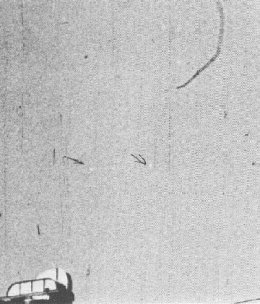
Around 11:30 in the morning on a clear day in August 1950, Nick Mariana, the general manager of the Great Falls Electrics minor-league baseball club, walked out to the empty Legion Park stadium with his nineteen-year-old secretary, Virginia Raunig, to check the wind before a game. This case file covers what witnesses reported, the official narrative, and a two-pass assessment with its evidence tier.
What did witnesses see at Legion Park baseball stadium?
Around 11:30 in the morning on a clear day in August 1950, Nick Mariana, the general manager of the Great Falls Electrics minor-league baseball club, walked out to the empty Legion Park stadium with his nineteen-year-old secretary, Virginia Raunig, to check the wind before a game. Mariana said a bright flash caught his eye and he looked up to see two silvery objects in the northwestern sky, near the city's water tower and roughly over the Anaconda Copper Mining smelter stack. He described them as bright and metallic, like "two new dimes in the sky," each one he estimated at about 50 feet across and 3 feet thick, holding station for a moment and then crossing the sky in formation roughly 150 feet apart. He believed they were rotating and seemed to vibrate, and he put their speed in the low hundreds of miles per hour.
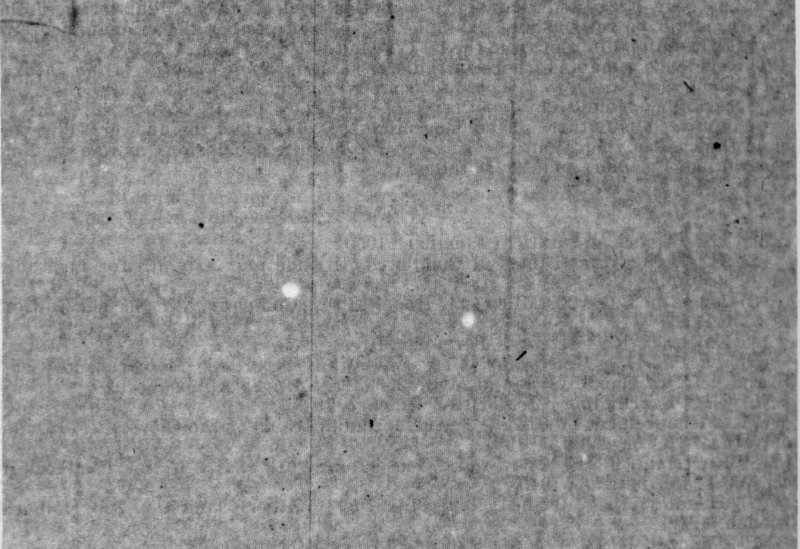
Mariana ran to his car, grabbed his 16mm movie camera, and filmed the objects for about sixteen seconds on color Kodachrome film as they moved across the sky and behind the water tower. The camera recorded picture but no sound. Raunig watched the same two objects and confirmed the sighting. Mariana said that a minute or two after the objects had gone, two F-94 jet fighters appeared and came in to land at the nearby air base, well after and well away from where the two silvery objects had been. The surviving footage, about 290 to 315 frames, shows two bright circular points of light tracking smoothly across a blue sky. It is one of the earliest pieces of motion-picture film of what would come to be called a UFO.
What is the official explanation?
The film moved through the official apparatus more than once and the apparatus never settled. In its first pass in October 1950, the Air Force's Project Grudge gave the film a quick look and wrote it off as reflections from two F-94 jet fighters known to be in the area, a disposition reached, by the Air Force's own later admission, with little interest and no detailed analysis.
When Captain Edward J. Ruppelt took over the renamed Project Blue Book, the Pentagon asked him to reopen the film. He sent it to the Air Force photographic laboratory at Wright-Patterson Air Force Base in Ohio, and the Navy's photographic interpreters at Anacostia, Maryland, also looked at it. The analysts ruled out birds, balloons, and meteors, noting the objects moved too steadily and too slowly for meteors and too fast for birds, and that the wind was not blowing in the direction the objects traveled, which eliminated balloons. Ruppelt wrote in his 1956 book The Report on Unidentified Flying Objects that the two jets "weren't anywhere close to where the two UFOs had been," that "we studied each individual light and both appeared too steady to be reflections," and that "we drew a blank on the Montana Movie, it was an unknown." Blue Book carried the case as an unknown, and it is openly held today in the National Archives as part of the Blue Book records.
In 1953 the CIA's Robertson Panel reviewed the Great Falls film alongside the Tremonton, Utah film by Navy warrant officer Delbert Newhouse as the two best pieces of photographic evidence then available, and leaned back toward the aircraft explanation while declining to call the film genuinely unexplained, a posture consistent with the panel's standing mandate to reduce public attention on UFOs. The most serious official scientific look came in the 1968 University of Colorado study led by Edward Condon, where the Great Falls film is Case 47. That report concluded "it is very unlikely that two aircraft could maintain such constant reflections over not only the 16 sec. and the 20 degree azimuth arc photographed but also the minimum of 50 sec. visually observed," and stated "the case remains unexplained," adding only that aircraft "cannot be entirely ruled out." Project Blue Book's bureaucratic catalog later carried a mundane "aircraft reflections" label on the record, but the men who actually examined the film, Ruppelt and the photo labs, and the scientists who restudied it, did not endorse that explanation.
The Navy's role in the Great Falls story is long documented, but the underlying memorandum was not public until 2026.
On 7 August 2026 the Department of War published, in its fifth PURSUE release, a record catalogued as DOW-UAP-D098, "Film Analysis of Unidentified Objects, 1953". The Department's own release manifest lists its incident location as "Montana, Utah" and its incident dates as "1950, 1952", which means this single memorandum concerns both this film and the other one. The manifest describes it as a memorandum on the U.S. Naval Photographic Interpretation Center's assessment of the two films, documenting "the Center's analytic process, assumptions that constrained its confidence level, tentative conclusions, and recommendations for future research". According to that description the Center "assessed, generally, that the objects depicted in the film demonstrated characteristics that were inconsistent with those of natural phenomena or commonly known aerospace technologies", and recommended a better resourced investigation to corroborate what it called its presumptive findings, citing a lack of funding and personnel. The manifest adds that the file carries charts comparing the film's luminosity against the apparent angular size of the phenomena, using photogrammetric analysis and the mathematical modelling of the period.
The memorandum has since been read here in full. The individual file is bot blocked at war.gov, but the Department also published a bundle of the whole tranche and the Wayback Machine holds a working capture of it, so the document was recovered from there.
It is a progress report dated 4 May 1953 from the Officer in Charge of the U.S. Naval Photographic Interpretation Center at the U.S. Naval Receiving Station in Washington, to the Director of Naval Intelligence under the office symbol OP-322H4D, headed "Interpretation of Movies of Unidentified Objects". Its own references establish the sequence: the Air Force asked for interpretation of the Utah film of 2 July 1952 by a confidential letter of 27 October 1952, sending about 30 feet of 16mm colour film and a list of questions, and then asked for the Montana 1950 film to be added by a memorandum of 24 November 1952 from the Chief of the Topical Division, USAF. The Center is careful about its own standing, noting that the work was done by the Photogrammetry Division of its Evaluation Department and does "not necessarily represent the official attitude of the Department of the Navy or this Center".
The method is set out in detail. Density readings were taken with a Densichron Model 2150 made by the Welch Scientific Company, each frame projected at about 22 times magnification onto a fine ground glass screen with the sky background set to a density of 3.0. The Utah film was split into three parts by aperture and camera handling, and the Montana film was read in its entirety. The analysts are candid about their own limits: the object images varied so much in size that the probe sometimes measured the whole object and sometimes only part of it, and the film they worked from was "a duplicate of a copy", which raised the question of whether the centres of the objects had been burnt out in duplication.
The reasoning is what has been argued over ever since. The analysts found that luminosity and apparent size rose together, which would fit a reflecting surface, but rejected reflection as improbable because the objects were visible continuously for about 90 seconds across roughly 60 degrees of arc without blinking, and because the sun angle and reported atmospheric conditions did not fit. They wrote that "it is the majority opinion of the group conducting this analysis that these images are light sources", which explains the absence of blinking and the variation in luminosity but not the velocity or acceleration. Their summary sentence is the one that has been quoted secondhand for decades, and it reads: "In either case, light source or reflective surface, it appears as if the objects are of a nature which we are not able to identify in terms of natural phenomena or commonly known man-made objects."
The next paragraph is the one that bears hardest on the later argument: "There is no indication of what kind of objects could have caused the images except that they must be of a construction, design, and material not commonly known. This is indicated by the computed acceleration rate and velocity. For the same reasons, birds, aircraft and balloons are ruled out." The report describes the objects as oblate or disc shaped, blue white in colour, and between 16 and 98 feet in size, while stating openly that the size figure rests on an assumed range of five miles. The velocity work rests on three stated assumptions, one of which the analysts themselves call a fallacy while noting it yields a minimum rather than a maximum, and it produces a figure of 3,780 miles per hour for a shift of one millimetre per frame at that assumed range.
So the document is at once stronger and more qualified than either camp has usually made it. It does rule out birds, and it says so in those words. It also rests its size and speed numbers on an arbitrary assumed distance, says so, and was working from a copy of a copy.
For this case the release is significant because the Navy laboratory's study of the Mariana film has usually been described secondhand, through Edward Ruppelt's account and through the later Condon material, rather than from the analysts' own memorandum. If the document reads as the manifest describes it, it places a contemporaneous Navy assessment alongside the Air Force record, and it does so in terms that do not support the aircraft reflection label later attached to the file.
What did the witnesses think it was?
Nick Mariana never wavered. He insisted the objects had no fuselage and made no noise, which is why he rejected the F-94 idea from the start. His central and most contested claim was that the film came back from the Air Force shorter than he sent it. He said roughly the first 30 to 35 frames had been removed, the very frames that, when the objects were briefly stationary, showed them more closely and revealed a notch or rotating band, evidence that they were spinning disks rather than featureless dots. The Air Force vigorously denied removing anything beyond at most a single frame damaged in handling. The missing-frames claim is genuinely supported by several people who reported seeing more detailed footage in the earliest screenings, but it cannot now be proven, and the frames in question, if they existed, are gone.
Mariana paid a personal price. He showed the film to local civic groups and the press, was widely doubted, and at one point sued the columnist Bob Considine over published mockery before dropping the suit. He told of a November 1952 visit to his home by Air Force officers from the local base, and there were secondhand accounts that he was offered relocation help and money, but those rest on indirect testimony and are not documented in the official file. The strongest corroboration of the sighting itself is Virginia Raunig, who saw the same two objects and stood by it. Beyond the eyewitness account, the film carried its own weight: the manager of a baseball team had no obvious motive to fake one of the first UFO movies in history, and he spent decades defending footage that brought him more ridicule than reward. Mariana died on 20 August 1999 with little public notice.
Is the Great Falls Film (Mariana, 1950) real? The two-pass assessment
Pass one, how could this be entirely ordinary. The official explanation on the books is sunlight reflecting off the polished fuselages of two F-94 jets that landed at the nearby base minutes after the sighting. On its face this is the obvious mundane reading: there really were two jets near Great Falls that day, they really did land soon after, and bright metal aircraft can throw a brilliant glint. Other deflationary candidates floated over the years include reflections off birds such as gulls. The trouble is that no one has ever shown this mechanism actually producing these images. The Air Force's own analysts under Ruppelt judged the lights "too steady to be reflections" and placed the jets nowhere near where the objects had been. Dr. Robert M. L. Baker Jr., who studied the film for about eighteen months at Douglas Aircraft and UCLA using film-measuring equipment and a photogrammetric experiment, testified to the 1968 Congressional symposium that the "airplane fuselage reflections of the sun" hypothesis simply "had no merit," because a glint would not hold near-constant brightness across the full arc and duration filmed. The Condon study independently calculated that two aircraft could not have maintained such constant reflections over the sixteen seconds and twenty-degree arc on film, let alone the fifty-plus seconds Mariana watched by eye. So the ordinary explanation exists as an assertion but has never been demonstrated for this specific film, and every party that did detailed work, including two arms of the military and two civilian scientists, walked away from it.
Pass two, if real, what is it. Two structured, silvery, disk-shaped objects in close formation, briefly hovering and then crossing the sky at speed near a copper smelter and an air base, filmed in daylight by a credible witness with a second witness beside him. The footage is authenticated and physically preserved in the National Archives, the witnesses were consistent, and the object was left officially unidentified by Project Blue Book and again by the Condon scientific review. The case for an extraordinary object rests not on dramatic detail in the surviving frames, which show only two bright points, but on the convergence of analysis: the things that make a glint a glint, brightness flicker as angles change and a tight tie to known aircraft positions, are exactly what the analysts could not find here. The famous missing-frames claim, if true, would push this further toward a structured craft, but it cannot be verified and the case does not need it to stand.
Weighing both passes, the material is authenticated and officially documented, and the object remains unexplained after the Air Force's own director, two photographic laboratories, an independent aerospace scientist, and a university physics study each examined it. The only counter-explanation is an early quick-look Air Force assertion that those same later examinations rejected, with no method ever shown to reproduce the images from jet glint. That is the profile of a Verified Unexplained case, and that is the tier.
Sources
- files.ncas.org/condon/text/case47.htm
- files.ncas.org/condon/text/cs47fg04.htm
- ufologie.patrickgross.org/htm/montana50.htm
- ufologie.patrickgross.org/htm/montana50frames.htm
- project1947.com/shg/symposium/baker.html
- web.archive.org/web/20260714125341/https://www.gutenberg.org/ebooks/17346
- www.theblackvault.com/casefiles/project-blue-book-mariana-ufo-incident-august-15-1950/
- www.ufoscans.com/1950-08-9615640-greatfalls-mont/
- www.greatfallshistorymuseum.org/blog/the-mariana-ufo-great-falls-visiting-voyagers
- web.archive.org/web/20260808030643id_/https://www.war.gov/Portals/1/Interactive/2026/UFO/uap-data.csv?release=5
- web.archive.org/web/20260809162414/https://www.war.gov/medialink/ufo/release_05/Aug_07/release_05_Aug_07_documents.zip
More cases from this region: UFO sightings in United States