The Greifswald Lights
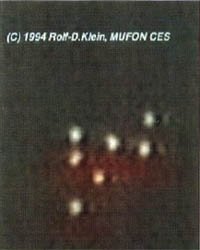
On the evening of 24 August 1990, between roughly 20:30 and 21:00, two groups of seven glowing spheres appeared in the sky over the Greifswalder Bodden, the shallow Baltic bay that sits beside the town of Greifswald and the Soviet-operated nuclear power station at Lubmin, in what was still, for six more weeks, East Germany. This case file covers what witnesses reported, the official narrative, and a two-pass assessment with its evidence tier.
What did witnesses see at Greifswalder Bodden?
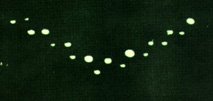
On the evening of 24 August 1990, between roughly 20:30 and 21:00, two groups of seven glowing spheres appeared in the sky over the Greifswalder Bodden, the shallow Baltic bay that sits beside the town of Greifswald and the Soviet-operated nuclear power station at Lubmin, in what was still, for six more weeks, East Germany. The first and brighter group formed a ring and was seen from Greifswald at an elevation of about 13 degrees. A second group, a little higher at about 20 degrees, looked from several vantage points like the letter Y. The display lasted long enough that dozens of independent people grabbed cameras, and that is what makes Greifswald unusual: it is one of the most heavily filmed UFO events in European history rather than a single shaky clip.
The MUFON-CES image-analysis group eventually gathered six separate videos and eleven photographs from witnesses who did not know each other. Among the people who filmed or photographed the lights were Juergen Luchterhand near Greifswald, the Iwanowa couple in the town, the Soviet interpreter Waleri Winogradow in the Eldena area, and Irmgard and Ingo Kaiser at the harbour of Lauterbach on Ruegen. Forty schoolchildren and teachers on holiday at Mukran on Ruegen, sitting at a campfire outside their hostel, watched both formations and reported that the individual spheres inside each group drifted independently of one another and seemed to pass smaller glowing objects back and forth.
The behaviour described by witnesses is what lifted the case above an ordinary string of lights. Observers in Trassenheide, the Ladwig family, watched smaller luminous objects fly out of a formation, halt a short distance away, then fly back into the group. A witness in Greifswald who was himself a pilot, recorded as Gerald D., described a smaller light approaching the Y-group on a dead-straight horizontal path at very high speed, coming to a stop inside the cluster and instantly flaring up as bright as the others. He estimated the closing speed at least the speed of sound, very probably three or four times that. On the original video soundtrack you can hear Luchterhand, plainly not a believer, saying "Sowas hab ich noch nie gesehen. Das ist das erste Mal in meinem Leben" (I have never seen anything like this, it is the first time in my life), and "ich halt ja nichts von UFOs und son Quatsch. Aber sowas hab ich echt noch nie gesehen" (I do not think much of UFOs and that nonsense, but I have honestly never seen anything like this).
At 20:47 several witnesses filmed a flash igniting a few hundred metres from the Y-group at the same height. The lights then died one by one toward 21:00, the way burning illumination would. But about five minutes later the seven-object formation reappeared, slightly to the north-east of where it had vanished, in roughly the same shape and a little brighter. A physics teacher named Schwedhelm, driving away from Poseritz on Ruegen after the lights had gone out, watched the whole structure swell back into being "scheinbar heller und groesser (und naeher) als zuvor" (apparently brighter and larger and nearer than before), and held it in view another ten minutes. The reappearance was logged as far away as Neubrandenburg, about 100 km off, where a caretaker watched it from a tower-block balcony.
More footage and images of this sighting

What is the official explanation?
There was no contemporaneous government investigation. East Germany's armed forces, the NVA, were weeks from dissolution, and the airspace over the Baltic coast sat in a jurisdictional vacuum during the run-up to reunification on 3 October 1990. The case was instead worked by two private German bodies that pulled in opposite directions, and the contest between them is the whole story.
The skeptical reading was driven by Werner Walter of CENAP (the Centrales Erforschungsnetz aussergewoehnlicher Himmelsphaenomene) in Mannheim, set out at length in the journal Skeptiker, issue 4 of 1999, published by the GWUP, and later carried forward on site by his colleague Hansjuergen Koehler. Their conclusion was military illumination flares fired during a Warsaw Pact night exercise in what former East German air force people called Luftschiesszone II, the firing zone east of Ruegen. The decisive witness for this reading was Dr Lueder Stock, a physician and former NVA officer who was out on his sailboat near the lights that evening. Stock described "kleine Raketen" launched from a warship that then "gemaechlich an ueberdimensionalen Fallschirmen in der aufsteigenden Thermik der aufgeheizten Ostsee dahinsegelten" (drifted gently on oversized parachutes in the rising thermals of the heated Baltic). In NVA jargon, he said, these targets were called "Tannenbaeume" (Christmas trees) and served as "Uebungsziele fuer Infrarotspuerkopf-Boden-Luft-Raketen" (practice targets for infrared-seeking surface-to-air missiles). Several other locals supplied the same reading after the case hit television: ferry captain Erwin Kollath called them "an Fallschirmen haengende Leuchtbomben" (flares hanging from parachutes) and dismissed the UFO talk as "Quatsch," saying he had watched the identical thing many times; a Frau Peitersen recognised "Leuchtraketen der Armee" (army illumination rockets) with shells passing through the formation. The 20:47 flash, with its intensity falling to nothing inside about an eighth of a second, was read as the signature of a surface-to-air missile. A separate Usedom military historian, who told the ufo-information.de team he did not want his name attached to the subject, independently concluded the trigger was illumination bombs of the SAB-250 type used as practice targets by the Czechoslovak air force. The resolution reached the public when ARD television broadcast it on 24 October 1994 and BILD ran it for the new federal states.
The pro-anomaly reading came from MUFON-CES, the Central European section of the Mutual UFO Network, in a long technical report by the physicist Illobrand von Ludwiger, "Die leuchtenden Kugeln bei Greifswald." MUFON-CES did the photogrammetry the skeptics did not. By triangulating multiple films, including a badly underexposed one of the Y-group, the analysts (Rolf-Dieter Klein, 1995, and Klein with von Ludwiger, 1997) put the objects about 30 km from Greifswald and about 14 km from Trassenheide, gave each sphere a diameter of roughly 12 metres at a ten percent error tolerance, and estimated the Y-group at around 300 times brighter than a film-studio floodlight. Crucially, MUFON-CES rejected the flare answer and put up 3,000 DM in 1999 for anyone who could identify the unit that fired them, money never claimed. They listed reasons the flare identification did not hold: the objects all winked out and then reappeared shifted to a new position to the west; captains of the German maritime rescue service, Uwe Kroeger and a Captain Schuhmacher, said on the record that the televised lights did not match the target-practice flares they routinely watched, in which the parachutes are always clearly visible; the Luftwaffenamt in Cologne and the fleet command in Flensburg told MUFON-CES the Bundeswehr neither needs nor uses long-burning illumination of this kind; and a representative of the flare maker Silbermuehle, since absorbed into the firm NICO, confirmed flares burn at most about ten minutes, while extending that to twenty would push the unit cost from 8,000 DM toward 50,000 DM. Von Ludwiger also questioned Dr Stock directly, and Stock conceded he had not actually seen any warships in the darkness, only assumed they must be the source. When the ufo-information.de team asked the Bundesarchiv-Militaerarchiv in Freiburg for the NVA central command records (stock DVL 4-6, ZGS-14) that would document Czechoslovak use of the firing zone on 24 August 1990, the archive replied it holds no foreign-forces records, that "Ende August 1990 keine Uebungen mehr von der NVA durchgefuehrt" (no more exercises were carried out by the NVA at the end of August 1990) and that the relevant files for 1990 simply are not preserved.
What did the witnesses think it was?
The witnesses were ordinary and numerous, and several of them did not believe in UFOs even while filming. Juergen Luchterhand's running commentary on his own tape, captured live with his daughter beside him asking "Ist das explodiert?" (Did that explode?) and his brother-in-law pointing out the nearby nuclear plant, is the record of a man genuinely baffled by what he was watching rather than a man selling a story. His "ich halt ja nichts von UFOs und son Quatsch" line is now the most quoted sentence in the German case literature precisely because it comes from a skeptic in real time.
What the witnesses believed was, for the most part, modest. The pilot Gerald D. and the families at Trassenheide and Mukran did not claim spaceships; they reported lights that behaved in ways aircraft and flares do not, smaller objects darting out and back like a ping-pong game, a high-speed insertion into a stationary cluster, formations that vanished and rematerialised elsewhere. MUFON-CES, the body that championed the case, classified it as a relatively low-strangeness "Class-B" object sighting and was careful to say no scientific explanation had been established, not that it was extraterrestrial. The corroboration is the real strength here: the same two formations, the same Y-shape, the same elevation figures, were recorded independently from Greifswald, Trassenheide, Mukran, Poseritz, Prora and Neubrandenburg, a spread of well over a hundred kilometres, and the same kind of formation with the same detaching-and-returning behaviour turned up again on film over Usedom on 23 May 1993 and was reported by a German couple on Cyprus in August 1994.
The hostile testimony cuts the other way and has to be weighed as such. Dr Lueder Stock, the former NVA officer, was a genuinely informed witness, but he later admitted to von Ludwiger that he saw no warship and inferred the naval origin. Captain Kollath's "Quatsch" is the confidence of a man who has seen flares, but he was describing the television clip, not the full multi-station dataset. The Usedom historian who fingered the SAB-250 flares would not be named and would not be interviewed, which leaves his identification untestable. So the witness picture is split: a large body of consistent civilian observers reporting genuinely odd behaviour, and a smaller body of military-literate locals who say, with real expertise but without the paper to prove it, that they have seen exactly this and it was target flares.
The dispute
The mundane explanation on record is that the Greifswald lights were military illumination flares, parachute flares fired during a Warsaw Pact night exercise in the firing zone east of Ruegen. The case for that reading was driven by Werner Walter of CENAP (the Centrales Erforschungsnetz aussergewoehnlicher Himmelsphaenomene), with supporting testimony from Dr. Lueder Stock, a former NVA officer who described "kleine Raketen" launched from warships that drifted on oversized parachutes in rising thermals, from ferry captain Erwin Kollath who called them "flares hanging from parachutes," and from a Usedom military historian who identified them as the "SAB-250 type" used by the Czechoslovak air force. This is the explanation that reached the public when ARD broadcast the footage on 24 October 1994.
The problem the page documents is that the flare hypothesis was never confirmed by any method or record, and several of its own pillars buckle on inspection. No involved air or naval force has ever produced a record of firing anything that night, and the Bundesarchiv-Militaerarchiv confirmed the NVA had stopped exercising by late August 1990, weeks before the sightings. A representative of the flare maker Silbermuehle (since absorbed into NICO) confirmed flares burn at most about ten minutes, while the display ran roughly thirty minutes from about 20:30 to 21:00 and then reappeared afterward. Rescue captains familiar with target flares said this was not what they were looking at. And Dr. Stock, the flare reading's most authoritative voice, admitted he had not actually seen any warships and only assumed they must be the source.
Against that, MUFON-CES performed the photogrammetry the skeptics did not, triangulating multiple independent civilian films to place the objects roughly 30 km from Greifswald, near the Soviet-operated nuclear power station at Lubmin, and to estimate them at roughly twelve metres across, a scale and behavior (hovering, exchanging smaller lights, vanishing and re-forming elsewhere) that drifting parachute flares do not match. So the dispute does not close the case. By this archive's method, a flare attribution that was asserted rather than demonstrated, with no firing record, no firing unit even present by the relevant date, a burn time too short for the duration observed, and front-line witnesses who rejected the comparison, is a contested claim rather than a verdict. The flare reading remains plausible but unproven, the anomalous reading is supported by actual triangulation, and the case stands as Disputed and unresolved.
Is the Greifswald Lights real? The two-pass assessment
Pass one, the entirely ordinary reading. The strongest mundane explanation is the one the German skeptics built: Warsaw Pact illumination flares fired as practice targets over the Baltic firing zone in the chaotic last weeks of the East German military. The mechanism is concrete and was supplied by people who knew it first hand. A former NVA officer described the "Tannenbaeume," parachute flares lofted by small rockets and drifting on thermals as infrared missile targets; a ferry captain and other locals independently recognised army illumination; a military historian named a specific munition, the SAB-250. The 20:47 flash with sub-second decay fits a surface-to-air missile, which is exactly what such flares exist to attract. The slow drift, the descent in formation, the eventual extinction one light at a time, and the timing during a known annual late-summer training window all fit burning illumination seen across water at twilight. This is a serious, method-shown civilian explanation, not an official hand-wave, and it is why this case is filed Disputed rather than Unknown.
But the ordinary reading has real holes that its own proponents never closed, and honesty requires logging them. No involved air or naval force has ever produced a record of firing anything that night; the Bundesarchiv-Militaerarchiv confirmed the NVA had stopped exercising by late August 1990 and holds no Czechoslovak records. The maker of the flares said its product burns about ten minutes, yet the display ran far longer and, more awkwardly, the whole formation extinguished and then reappeared relocated to the north-east, which spent flares cannot do. Rescue-service captains who watch target flares for a living said on the record that this was not what they were looking at, in part because the tell-tale parachutes were absent. MUFON-CES offered 3,000 DM to anyone who could name the shooters and no one collected. The named historian would not be named. So the flare hypothesis is plausible and well-argued but unconfirmed, and it leaves the reappearance and the high-speed insertion unexplained.
Pass two, if the prosaic explanation is wrong, what is left is a long-lasting, widely witnessed formation of glowing spheres roughly 12 metres across by MUFON-CES's triangulation, hovering, exchanging smaller lights, vanishing and re-forming elsewhere, parked over a nuclear power station. That is the von Ludwiger reading, and it rests on actual photogrammetry rather than vibes, which is why the case has never simply collapsed.
The verdict is Disputed, tierClass contested. There is independent, civilian, method-shown analysis pointing hard at military illumination flares, which is enough to keep this off any "verified unexplained" pedestal. But that analysis never produced the documentary smoking gun, was contested point by point by the equally civilian MUFON-CES photogrammetry, and rests partly on an anonymous source and on a key witness who admitted he was inferring. A counter-explanation exists and is strong; it does not close the case. That is the definition of Disputed, and it is where Greifswald honestly sits.
Sources
- archiv.mufon-ces.org/text/deutsch/greifswald.htm
- www.gwup.org/skeptiker-artikel/ufos/das-ufo-phaenomen-von-greifswald-ein-deutscher-klassiker-skeptiker-41999/
- alien.de/cenap/greifswald/greifswald.htm
- www.ufo-information.de/index.php/aktuelles/weblog/257-greifswald-ufos
- archiv.mufon-ces.org/img/classb04a.jpg
- archiv.mufon-ces.org/img/classb02.jpg
More cases from this region: UFO sightings in Germany