The 1952 Flying Saucer Talk: Edward Ruppelt's Beacon Hill Briefing Tape and the Fight to Recover It
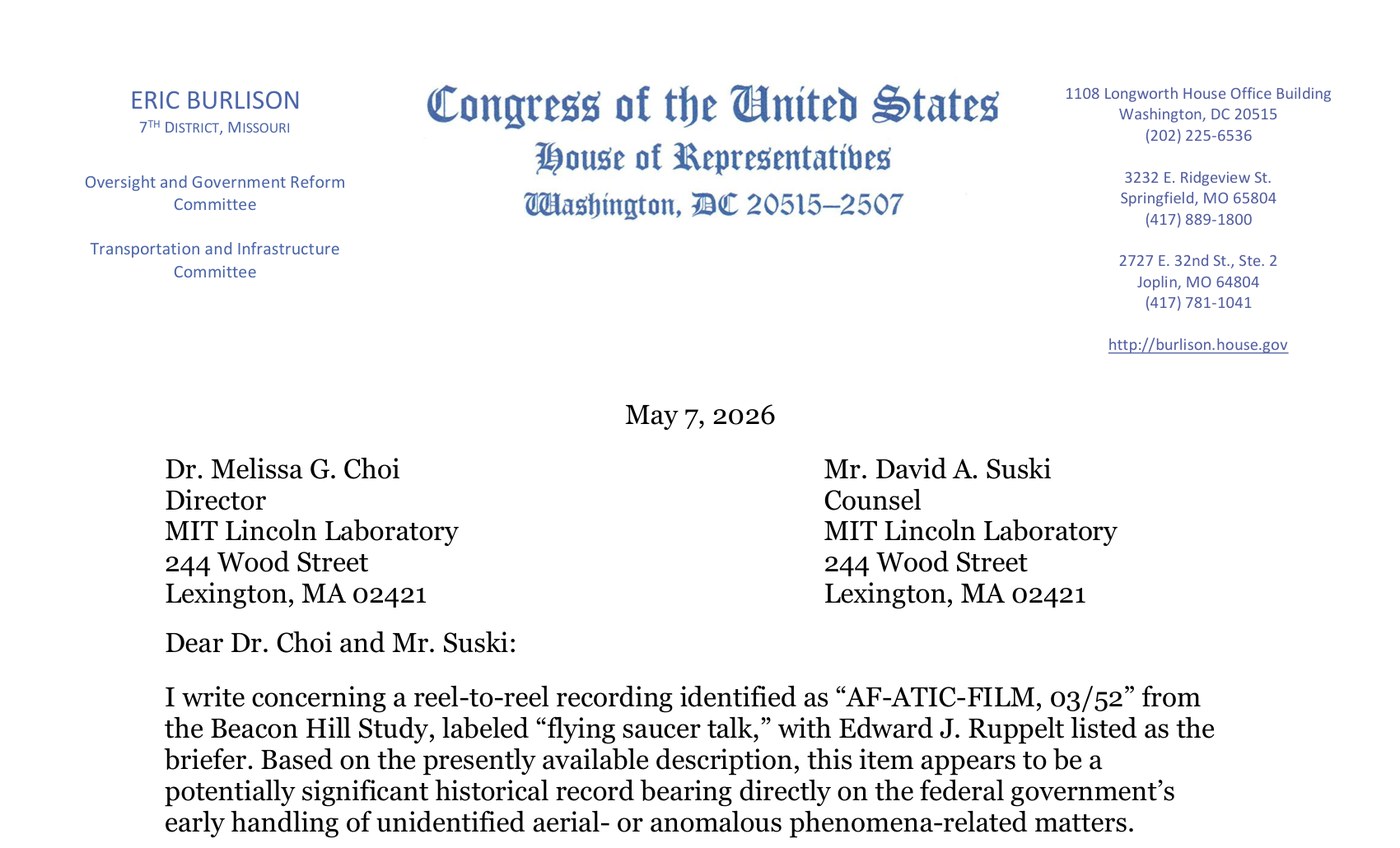
In May 2026 a congressman went looking for a reel of tape catalogued as AF-ATIC-FILM, 03/52, labelled flying saucer talk. Reporting turned it into a briefing on the July 1952 Washington sightings, which was chronologically impossible, and this archive said so. On 18 September 2026 the Department of War released the recording: 65 minutes of audio and a 19 page transcript of Captain Edward Ruppelt briefing an unnamed audience on 26 March 1952. It is not about Washington. It is the Air Force explaining, two weeks before the wave began, that 20 percent of its 800 cases had no answer.
What happened
In May 2026 a member of Congress went looking for a single reel of tape. The recording is catalogued as AF-ATIC-FILM, 03/52, and it carries the label flying saucer talk.
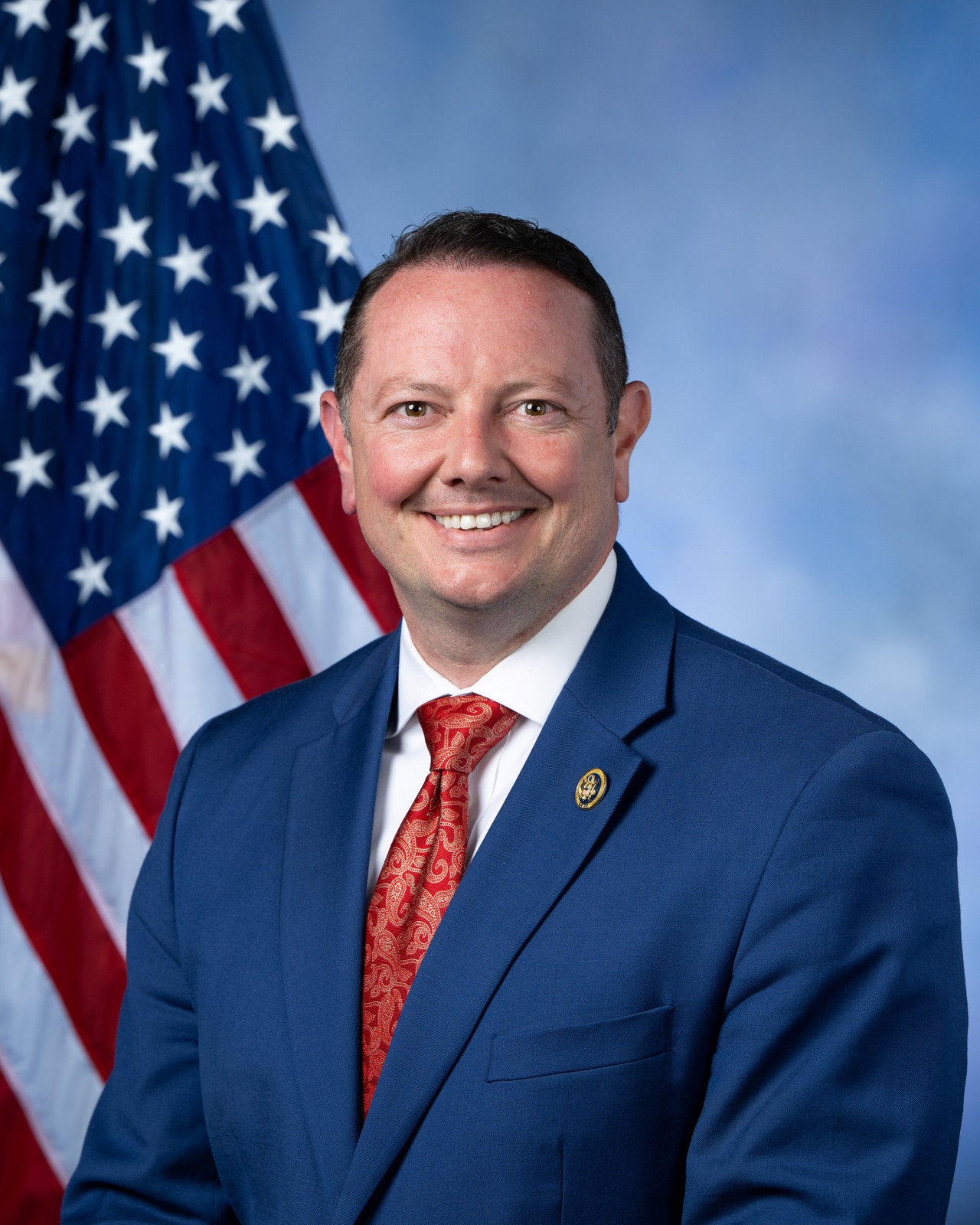
The description comes from the congressman's own letter, which is the primary document for this case and can be read line by line. On 7 May 2026 Representative Eric Burlison of Missouri's 7th district wrote to Dr. Melissa G. Choi, Director of MIT Lincoln Laboratory, and to David A. Suski, the laboratory's counsel, at 244 Wood Street in Lexington, Massachusetts. His opening sentence sets out everything that is actually known about the artifact: "I write concerning a reel-to-reel recording identified as AF-ATIC-FILM, 03/52 from the Beacon Hill Study, labeled flying saucer talk, with Edward J. Ruppelt listed as the briefer."
Four elements of that identifier carry weight, and each one can be checked against something outside the letter. AF-ATIC points to the Air Technical Intelligence Center, the Air Force unit at Wright-Patterson that ran the service's unidentified flying object investigation. The 03/52 reads as March 1952. The Beacon Hill Study was a real and now declassified undertaking. And Edward J. Ruppelt was the officer in charge of that investigation at exactly that moment.
The Beacon Hill Study is not folklore. Its final report, titled Beacon Hill Report: Problems of Air Force Intelligence and Reconnaissance, Project Lincoln, Massachusetts Institute of Technology, was released to a requester in 2014 under a Mandatory Declassification Review, case number 13-MDR-079, and runs to 239 pages. The Air Force records sheet bound into the front of the scan gives the call number K146.02-9 and a publication date of 15 June 1952. The transmittal letter to the Chief of Staff explains the origin: the study of intelligence and reconnaissance problems "was first proposed to the Massachusetts Institute of Technology in May 1951," was folded into the scope of Project Lincoln in July 1951, and was carried out by "a group of civilian consultants" assembled under the chairmanship of Dr. Carl F. J. Overhage. The work is remembered today mainly because it pointed toward the very high altitude reconnaissance aircraft that became the U-2.
What the released Beacon Hill Report does not contain is any discussion of flying saucers. A search of all 239 pages of the sanitized copy returns zero occurrences of "saucer," zero of "unidentified," and zero of "Ruppelt." It returns the Air Technical Intelligence Center on 35 pages. So the report and the tape are two different things: the report is the group's published product, and the tape, if it exists, is a recording of a briefing given to the group by the Air Force officer who ran the saucer project.
One thing that is genuinely unsettled is what kind of recording it is, and the coverage has been looser about this than the document. The letter calls it a "reel-to-reel recording" and then asks the laboratory to preserve, among other categories, both "audio recordings" and "motion-picture film," which is the language of someone who does not yet know which he is dealing with. The identifier itself points the other way from tape, because the string is AF-ATIC-FILM. Press accounts have gone further still and called it a video: Cybernews reported on 25 June 2026 that the laboratory "has agreed to disclose a historical UFO video from 1952" and described footage showing Ruppelt briefing scientists and officers. No source consulted here establishes the medium. It is safest to say that the item is a recording of some kind, that its catalog string contains the word FILM, and that whether anyone will see Ruppelt or only hear him is not yet known.
A small detail confirms that the letter was drafted quickly rather than copied from a catalog record. The identifier is given correctly as AF-ATIC-FILM on page one and misspelled as "AF-ATIC-FLIM" in the numbered questions on page two.
UPDATE, 18 SEPTEMBER 2026. THE RECORDING HAS BEEN RELEASED.
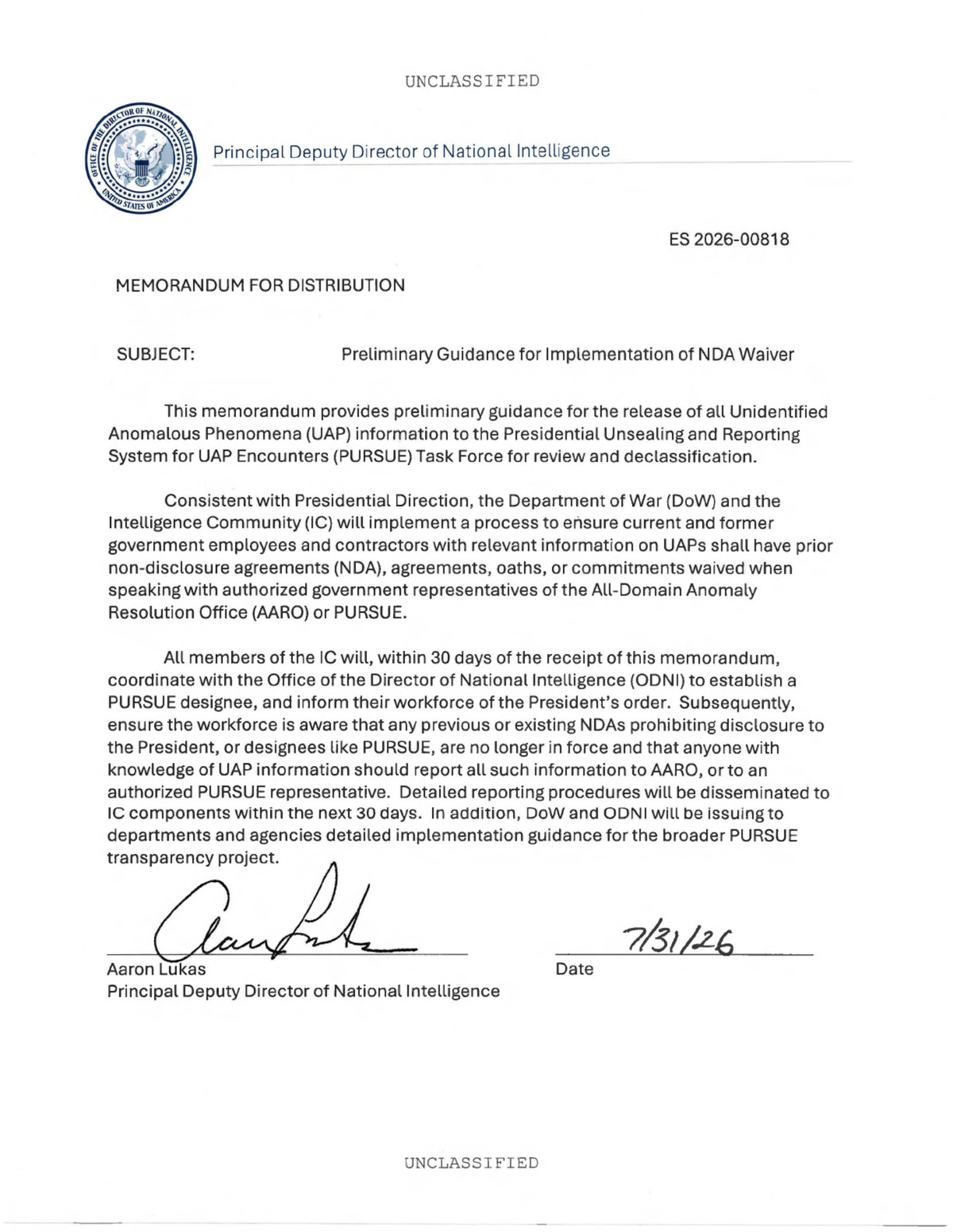
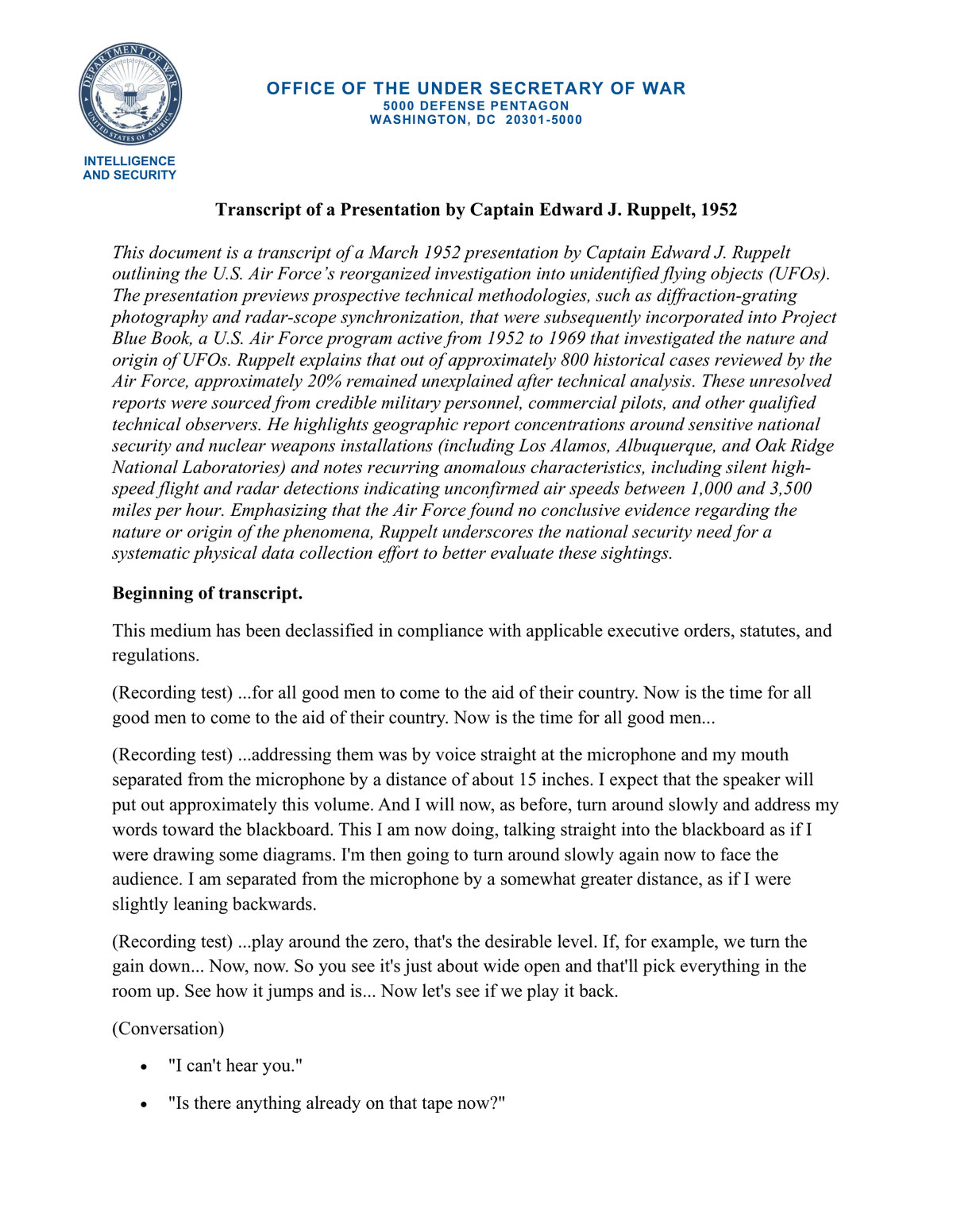
The Department of War published the recording and a transcript of it in the sixth PURSUE tranche on 18 September 2026. They appear as two records. DOW-UAP-PR160 is the audio, running 1 hour 5 minutes and 13 seconds, and it is the only audio record in the entire tranche of 72. DOW-UAP-D154 is a 19 page transcript. The manifest dates both to 26 March 1952 and gives the location as Boston, Massachusetts.
The medium question that this case had to leave open is now settled. The congressional letter that started the search described a "reel-to-reel recording" while the catalog string contained the word FILM and at least one outlet called it a video, and this archive recorded the medium as genuinely unsettled rather than picking one. It is audio. The Department types the record AUD, and the transcript itself opens with several minutes of a sound engineer setting levels, including the line "Now is the time for all good men to come to the aid of their country" repeated into the microphone, a speaker describing his distance from it as "about 15 inches", and a voice asking "Is there anything already on that tape now?" That is a room being wired for sound in 1952, and it is the strongest possible internal evidence of what the object is.
The subject question is settled too, and it settles in favour of the correction this archive made on 5 September 2026. The recording is not about the July 1952 Washington National sightings. It is Ruppelt giving a general briefing on the reorganised Air Force investigation: its history since 1947, what the files contained, what the Air Force thought it had, and what it planned to do next. A March recording could not have covered a July event, this archive said so before the recording was available, and the released transcript confirms it.
Documents and images
What is the official position?
No agency has published the recording, and no agency has confirmed its contents. What exists officially is a statutory framework, a congressional demand, and a set of published catalogs that do not yet list the item.
The statutory framework is the one Burlison cites. Sections 1841 through 1843 of the National Defense Authorization Act for Fiscal Year 2024, now codified at 44 U.S.C. 2107 note, require federal agencies to identify, review, organize and transmit records on unidentified anomalous phenomena to the National Archives and Records Administration for inclusion in a UAP Records Collection. The Archives established that collection as Record Group 615. The letter argues that a government-funded recording held by a federally funded research and development center falls inside that mandate, and asks that the item be treated as potentially responsive and preserved accordingly.
The letter's specific demands are worth stating precisely, because they define what a compliant answer would look like. Burlison asked the laboratory to determine whether the recording is extant, identify its custodial status, preserve the original medium and all associated documentation, and arrange "preservation-grade digitization and transmission of the resulting digital copy and associated metadata to NARA for inclusion in Record Group 615, the UAP Records Collection." He asked for an immediate preservation hold on accession records, audio logs, inventories, correspondence, records schedules and prior duplication efforts, warning that "destruction, alteration, or unmanaged disposition of potentially responsive material would be inconsistent with the transparency and archival purposes reflected in federal law and guidance." He set a 30 day deadline and posed six numbered questions, including whether the item has been digitized and when, and whether any classification, contractual or export-control restriction applies. The letter copies Michael D. Thomas, Director of the Information Security Oversight Office at the National Archives, and names Aaron Jenks of Burlison's staff as the point of contact.
The office publicized the request the following day. A press release dated 8 May 2026, headed "Burlison Requests Review of Identified 1952 UAP Recording," repeats the identifier and the Ruppelt attribution and quotes the congressman saying that "the American people deserve transparency and proper preservation of historically significant government records." On 26 May 2026 the same office announced a second and broader action, sending legislative interrogatories to The MITRE Corporation and stating explicitly that the MITRE requests "build on Congressman Burlison's recent letter to MIT Lincoln Laboratory concerning historical UAP-related records associated with the Beacon Hill Study and the reel-to-reel recording identified as AF-ATIC-FILM, 03/52." That release carries the framing argument for the whole effort: federally funded research centers "cannot become private vaults for federal records."
Seven weeks later the congressman said the laboratory had given way. On 24 and 25 June 2026, around the Capitol Hill disclosure forum, Burlison posted on x.com that "we told MIT Lincoln Labs we know the exact video file you are holding, by name, and we want it. They admitted it exists and agreed to turn it over." He drew the tactical lesson himself, that naming the exact file by its identifier is what produced cooperation where general requests had not. Two outlets carried the quote at the time. What has not been produced since is the item: no reel, no transfer notice, and no statement from the laboratory itself appears in any source consulted here. The laboratory's own account of the matter, in its own words, is absent from the public record.
The National Archives has published a page listing the moving images and sound recordings in the UAP Records Collection. It is a substantial list, running from Major General John A. Samford's statement on flying saucers in Record Group 111 through the Project Blue Book motion picture films and the sound recordings relating to Project Blue Book investigations in Record Group 341. No item on that page corresponds to AF-ATIC-FILM, 03/52, to the Beacon Hill Study, or to a Ruppelt briefing. As of this writing the recording is not in the public catalog.
One further claim is in circulation and could not be verified here. On 4 and 5 September 2026 a widely upvoted post on r/UFOs quoted Burlison saying his office had received confirmation from the Archives that the recording "has been digitized, fully declassified, and is set to be released by the Trump administration in an upcoming tranche of UAP records." No primary source for that statement could be reached from this desk. The congressman's press release index carries no such announcement, a Google News query for Burlison and the Archives returned no outlet carrying it, and the two routes that would settle it were both closed: x.com requires a logged-in session that is not available here, and reddit.com returned HTTP 429 with zero-byte bodies on every request during this run. The claim is therefore recorded as an unverified attribution, not as fact, and it should be checked against the congressman's own channels before anyone relies on it.
On 18 September 2026 the Department of War released the recording itself, as DOW-UAP-PR160, together with a transcript as DOW-UAP-D154, under the Presidential Unsealing and Reporting System for UAP Encounters. Both carry the declaration "This medium has been declassified in compliance with applicable executive orders, statutes, and regulations."
The Department's own summary of the recording states that Ruppelt reviewed approximately 800 historical cases of which approximately 20 percent remained unexplained, that he highlighted report concentrations around Los Alamos, Albuquerque and Oak Ridge, and that he noted "radar detections indicating unconfirmed air speeds between 1,000 and 3,500 miles per hour". Having read the transcript, this archive records that the summary is accurate but compressed. Ruppelt does say that Air Defense Command radars "tracked objects going anywhere from 1,000 up to about 3,500 miles an hour", and the Department preserves his hedge by calling the speeds unconfirmed. What the summary does not convey is that Ruppelt attaches his own deflation immediately: "We've never been able to determine, however, that these weren't malfunctions in the radar set or due to some type of atmospheric phenomena." In two of the three places the figure of 3,500 miles an hour appears in his talk, he is describing cases he then explains away, including the Fort Monmouth incident, which he resolves as a large balloon seen by T-33 pilots plus a radar crew who "got a little bit flustered" while giving a demonstration to a group of colonels.
What the people involved say
The strongest corroboration for this recording does not come from 2026 at all. It comes from the man named on the label, writing in 1956, and it appears to have gone unmentioned in the coverage of Burlison's request.
Edward J. Ruppelt ran the Air Force's unidentified flying object investigation through the period the tape is dated to, and in 1956 he published a memoir of that work, The Report on Unidentified Flying Objects. In it he describes an outreach program in which his project sought scientific advice: "my people in Project Blue Book were contacting various scientists in the U.S., and indirectly in Europe, telling them about our data, and collecting opinions." He describes giving classified briefings to cleared government groups, and then he names the group directly:
"Colonel S. H. Kirkland and I once spent a whole day briefing and talking to the Beacon Hill Group, the code name for a collection of some of the world's leading scientists and industrialists. This group, formed to consider and analyze the toughest of military problems, took a very serious interest in our project and gave much good advice."
That is the briefer confirming the briefing, in print, seventy years before the congressional letter. It also supplies a second name that appears nowhere in the 2026 correspondence: Colonel S. H. Kirkland, who was in the room with him. Ruppelt's phrase "a whole day" is consistent with an artifact substantial enough to fill a reel, whatever its medium turns out to be, and he notes elsewhere in the same passage that "in many instances we would arrive at a place to find that a whole day had been set aside to talk about UFO's."
Ruppelt also establishes, in the same chapter, that his briefings were recorded as a matter of ordinary practice. Describing the session he gave to the technical staff at the Atomic Energy Commission's Los Alamos laboratory, he writes that "the theater where this briefing took place wouldn't hold all of the people who tried to get in, so the briefing was recorded and replayed many times." A recording of a Ruppelt briefing is therefore not an extraordinary object. It is the expected byproduct of how he worked.
The same memoir fixes the month. Ruppelt writes: "By March 1952, Project Grudge was no longer just a project within a group; we had become a separate organization, with the formal title of the Aerial Phenomena Group. Soon after this step-up in the chain of command the project code name was changed to Blue Book." March 1952 is thus the precise hinge at which the Air Force effort was reorganized and renamed, and it is the month stamped on the tape.
Two limits should be stated plainly. Ruppelt does not date the Beacon Hill briefing in his book, so the March 1952 date for this case rests on the 03/52 element of the tape's own catalog identifier as quoted in the letter, not on the memoir. And nobody outside the custodial chain has heard the recording; its contents are entirely unknown.
The released transcript is Ruppelt in his own voice, and what it shows is a cautious officer, not a believer or a debunker. Speaking of the possibility of extraterrestrial origin he says: "They may be from Mars, but if they are, we don't want to think they are. We don't want to think they're all balloons. I mean, we try to stay right in the middle of the road."
On the state of the files he is precise and unromantic. Of roughly 800 cases on record, he puts about 2 percent down to "actual hoaxes or psychopathological people", allows that misinterpretation of known objects "could possibly account for all of them", immediately adds that "it's a little bit doubtful", and settles on about 20 percent being "very good reports offered by very reliable people and are just absolutely no conclusions can be drawn". He notes that the press had not been playing the subject up for around three years "and still the reports continue to come in", which he treats as evidence against mass hysteria as a complete explanation.
He describes the plan the Department's summary calls prospective technical methodologies, and it is disarmingly practical. The idea, which he credits to Dr. Kaplan, was to fit diffraction gratings to inexpensive cameras and hand them to the guards who stand outside around the clock at Sandia, White Sands and similar installations, so that a spectrum could be captured the moment anything unusual appeared. He also recounts the 1949 review in which the Air Force put its roughly 300 reports to a set of outside specialists, and he names them: Dr. J. A. Hynek, an astronomer at Ohio State, Dr. G. Valley of the Scientific Advisory Board, a Dr. Fitz of the Aeromedical branch, the RAND Corporation, Air Weather Service, Cambridge Field Station and the Weather Bureau. Their conclusions varied, he says, but "they all agreed that they didn't know exactly what" the reports represented.
The talk is plainly live and unrehearsed, which is itself a mark of authenticity. He takes questions from the audience, and he makes small errors of the kind a polished document would not contain, placing Kenneth Arnold's June 1947 sighting "out in Idaho" when it was made over Washington State.
Is the 1952 Flying Saucer Talk: Edward Ruppelt's Beacon Hill Briefing Tape and the Fight to Recover It real? The two-pass assessment
Pass one, the mundane reading. There is a version of this story in which nothing surprising is on the tape. Ruppelt briefed many cleared audiences in 1952, his standard briefing was a survey of the Air Force's case files and its statistical work, and he says in the same book that he wanted the material public and considered it largely unclassifiable except for a few radar items. A recording of one such briefing to a group of reconnaissance consultants would then be a valuable historical document and nothing more: a snapshot of what the Air Force was telling scientists in the spring of 1952. It is also entirely possible that the reel is gone. Magnetic tape from 1952 is fragile, the Beacon Hill group's administrative records are seventy years old, and a catalog entry proves that something was once described, not that it survives. The most likely single outcome remains that the item is located, digitized, and turns out to be an interesting and unsensational briefing.
Pass two, if the record is what it says it is. Even on the modest reading, the artifact has a specific evidential value that no later document has. Everything the public knows about what the Air Force privately believed in early 1952 is filtered through paperwork written for the file, or through Ruppelt's own later memoir, which he wrote as a civilian and which his critics have always been free to treat as recollection. A contemporaneous recording of Ruppelt speaking to scientists who held clearances, in a setting where he was asking for their help rather than managing public perception, is a different class of evidence. It would capture tone, emphasis and the questions the scientists asked, none of which survive in the written record. That is why the item is worth a congressional letter.
The chronology is where the public account of this story goes wrong, and it is worth correcting carefully. Since June 2026 the tape has been widely described as a briefing about the July 1952 Washington sightings, the radar and interceptor episode the newspapers of the day called the Invasion of Washington. The attribution chain for that framing can be traced exactly, and it is worth doing because the claim hardened as it travelled. It originates with Jordan Flowers, executive director of the Disclosure Foundation, around the forum held in the Russell Senate Office Building on 25 June 2026. The Hill reported it on 29 June 2026 and attributed it properly and hedged it: "Disclosure Foundation Executive Director Jordan Flowers told NewsNation the document is believed to be a reel-to-reel audio tape recording about the Washington, D.C., incidents." Note that both contested elements, the medium and the subject, enter the record in that one sentence, and both are carried on the word "believed". Downstream retellings dropped the hedge and the attribution, and the assertion became a fact about the tape rather than a view held by one person who is not the custodian. It cannot be right as stated. The tape's own identifier dates it to March 1952. The Washington National Airport sightings took place on the nights of 19 to 20 and 26 to 27 July 1952, four months later. The Beacon Hill Report itself was published on 15 June 1952, more than a month before the Washington events, so the group's active study period had closed before there was anything to brief about. A March 1952 recording cannot be a briefing on a July 1952 incident. At least one careful secondary treatment reached the same conclusion independently, noting that the Washington link is "a credible read" rather than a verified fact and that Flowers is "not on the letter, not the custodian, and not the lab."
What the correct chronology gives back is more interesting than what it takes away. March 1952 is the month Ruppelt's organization was restructured and renamed Blue Book, and it sits at the front edge of the 1952 wave: Ruppelt records that reports had roughly doubled to about twenty a month since December 1951, that March slackened slightly, and that April brought ninety-nine. So the tape, if it is what its label says, catches the Air Force's saucer project talking to a panel of the country's leading scientists in the weeks just before the biggest sighting wave in American history, and before the subject became a national controversy. It is a document of what officials believed before the pressure arrived, not after it.
The verdict is Unknown, and it has to be. No official narrative exists because no official body has described the recording's contents. The existence of the briefing is well supported, by Ruppelt's own published account and by the documented reality of both the Beacon Hill Study and his briefing program. The existence and survival of a recording of it rests on a catalog description quoted in a congressional letter, which is a serious source but is not the same as the object. Whether the reel is found, what it contains, and whether the September 2026 claim that it has been digitized and declassified is accurate are all open questions that later runs should revisit against the congressman's own channels and the National Archives catalog.
RESOLUTION OF THIS CASE'S OPEN QUESTIONS, 18 SEPTEMBER 2026.
This case previously closed by listing three open questions: whether the reel would be found, what it contained, and whether the reported claim that it had been digitized and declassified was accurate. All three are now answered, and the answer to the third is yes. The recording was published by the Department of War on 18 September 2026.
The contents are broadly what the label promised and what Ruppelt's own memoir implied. What the release adds beyond the transcript's substance is a piece of independent corroboration for the Beacon Hill identification, and it comes from inside the recording. Ruppelt refers in passing to a co-presenter: "Another thing, Colonel Kirkland referred to this newspaper clipping service, we hope to get that started before this Life magazine article comes out." Ruppelt's 1956 memoir names the officer who accompanied him to the Beacon Hill briefing, writing that "Colonel S. H. Kirkland and I once spent a whole day briefing and talking to the Beacon Hill Group". The same officer is present at the same kind of event, and the recording shows the two of them presenting in sequence rather than Ruppelt appearing alone.
That same sentence dates the recording independently of the manifest. The Life magazine article Ruppelt is waiting for is "Have We Visitors From Space?", published on 7 April 1952. He speaks of it as forthcoming, and of a True magazine piece expected "sometime within the next couple months" that "will be slanted the other way". So the talk predates 7 April 1952 on its own internal evidence, which is consistent with the Department's date of 26 March 1952.
Two honest limits have to be stated against all of that. First, the transcript never uses the words Beacon Hill. It does not name its audience at any point, it does not mention MIT, and it does not mention Lincoln Laboratory. The identification of this recording as the Beacon Hill briefing remains an inference built from the date, the location, the presence of Colonel Kirkland and Ruppelt's own published account, and it is a strong inference rather than a documented fact. Second, the Department gives the location as Boston, Massachusetts, where this case has carried MIT Lincoln Laboratory at 244 Wood Street in Lexington, about 15 miles away, on the strength of the congressional correspondence that located the reel there. The archive is not treating that discrepancy as resolved. A custodial location and an event location are different things, and the manifest's city may be an approximation.
The tier stays Unknown. What has changed is that the object at the centre of the case is no longer a catalog description quoted in a letter. It is 65 minutes of audio and 19 pages of transcript that anyone can now read and hear.
Sources
- burlison.house.gov/sites/evo-subsites/burlison.house.gov/files/evo-media-document/mit-lincoln-lab_uap-tape-letter.pdf
- burlison.house.gov/media/press-releases/burlison-requests-review-identified-1952-uap-recording
- burlison.house.gov/media/press-releases/burlison-presses-mitre-answers-uap-records-ffrdc-accountability-and-compliance
- www.governmentattic.org/12docs/USAF-BeaconHillReport_1952.pdf
- www.gutenberg.org/cache/epub/17346/pg17346.txt
- www.archives.gov/research/topics/uaps/moving-images-and-sound
- www.archives.gov/records-mgmt/uap-guidance
- www.archives.gov/research/topics/uaps/faqs
- defensescoop.com/2026/05/27/rep-eric-burlison-request-for-uap-records-mitre/
- thehill.com/homenews/5944717-ufo-washington-invasion-evidence/
- uaplogbook.com/burlison-1952-washington-flyover-link/
- www.abovethenormnews.com/2026/06/24/mit-lincoln-lab-flying-saucer-talk/
- cybernews.com/news/burlison-ufo-uap-project-blue/
- www.war.gov/UFO/
- www.war.gov/medialink/ufo/sept-18/release-06/assets/DOW-UAP-D154_Transcript-of-a-Presentation-by-Captain-Edward-J-Ruppelt-1952.pdf
- www.dvidshub.net/video/1023407/dow-uap-pr160-presentation-captain-edward-j-ruppelt-1952
- www.cbsnews.com/news/ufo-files-uap-pentagon-6th-release/
More cases from this region: UFO sightings in United States