Trees Stripped in a Diamond Pattern, Salisbury, Massachusetts (1968)
The entire case rests on a single first-person narrative signed only with the initials "A.J.C." and published on the UFO Casebook website. This case file covers what witnesses reported, the official narrative, and a two-pass assessment with its evidence tier.
What did witnesses see at Salisbury?
The entire case rests on a single first-person narrative signed only with the initials "A.J.C." and published on the UFO Casebook website. In it, the writer says he received the case by telephone: "I got a case from a phone call. They seemed to be frightened by a loud noise about 3 AM in April of 1968." The residents had gone outside after the noise and found damage to trees on the property.
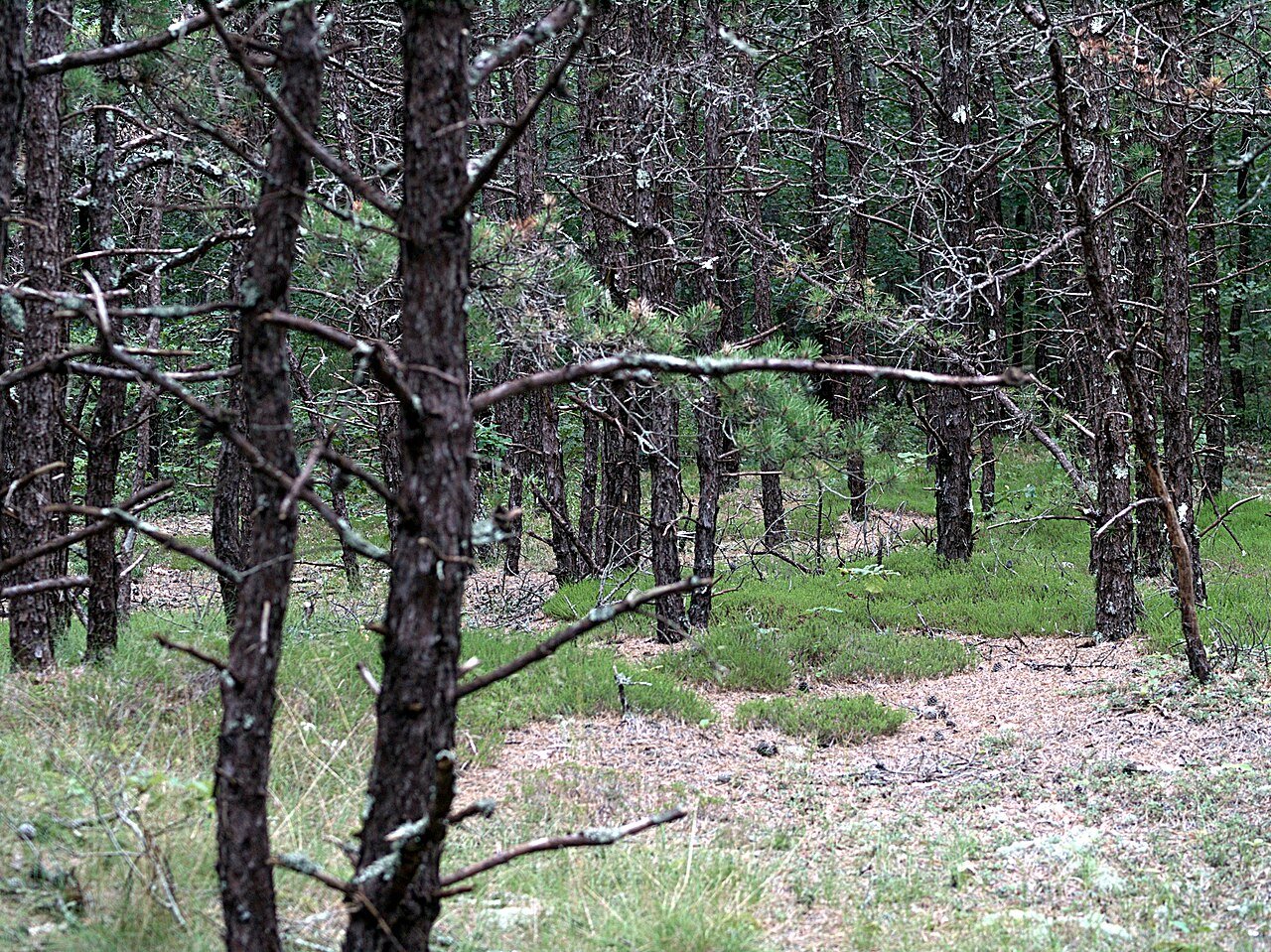
According to the account, four trees were involved, arranged in a diamond. The writer describes it plainly: "Four trees were involved. They formed a diamond shaped area much like a baseball field bases, or 2 Vs facing each other." All four trees had been stripped of their branches from above downward, and the bark was scarred and torn away on the interior side of the trunks. Some branches still hung from the trees, unbroken and pointing down, while many lay on the ground.
The fallen branches are the strangest part of the report. The writer states that the branches on the ground "were scarred from heat and looked burnt although none had a burnt smell to them. They smelled a lot like sulfur." He describes a strong sulfur odor not only on the branches but on the ground vegetation and surrounding plant matter. He says he put on leather gloves before handling anything, collected pieces of bark, strips of wood, and branch samples into a sealed cloth bag, and photographed the trees and the surrounding area.
When he asked the residents whether they had touched or moved anything before he arrived, the answer was "NO." He notes there was no crater, no hole, no rock, and no hard object anywhere that could account for four separate trees losing their branches at a downward angle. By his own description, the damage pattern suggested something came straight down onto all four trees and then was simply gone, leaving the ground undisturbed. No craft, no light, and no moving object was reported by anyone; the witnesses heard only a loud noise and found the damage afterward. This is a discovery case, not a sighting.
What is the official explanation?
There is no official record of this event. No Project Blue Book file, no Air Force investigation, no police or fire department report, and no municipal record for an April 1968 tree-damage incident in Salisbury has been located. Project Blue Book was still operating in 1968 and closed in December 1969, but nothing in its index corresponds to this case, which is consistent with the event never having been reported to any official body. The writer says he handled it himself and forwarded the material to a civilian group, not to the Air Force.
The only investigative body named in the account is APRO, the Aerial Phenomena Research Organization, the Tucson-based civilian group run by Jim and Coral Lorenzen. The writer states he mailed his samples, photographs, and a written event report to APRO: "APRO got the samples and thanked me for the event report." He reports that APRO's reading of the evidence was that "there was every indication that the branches from all four trees were hit with the same object and at a downward angle." That is the entire extent of the so-called official finding, a single secondhand sentence relayed by the same person who submitted the samples. No APRO Bulletin article, no APRO case number, no laboratory analysis, no correspondence, and no APRO acknowledgment has ever surfaced to confirm that APRO received the package, examined it, or recorded any conclusion. APRO dissolved in 1988 and much of its file system is scattered or lost, so the claim cannot be checked against the organization's own paper.
The case is also absent from the standard reference works where a physical-trace event of this kind would be expected to appear. Ted Phillips, who from 1968 onward built the most exhaustive catalog of UFO physical traces in association with J. Allen Hynek, did not list a Salisbury, Massachusetts, 1968 tree-damage case in his preliminary catalog. The well-documented New England investigators of that period, including Raymond Fowler, who chaired the NICAP Massachusetts subcommittee and logged dozens of regional cases, left no file on this event either. In short, no apparatus, official or civilian, ever produced an independent record of this incident. Everything traces back to one anonymous writer.
What did the witnesses think it was?
The residents who heard the noise and found the damaged trees are never named. The writer does not give their names, the street, or even the exact part of Salisbury. They are described only as people who phoned for help, were frightened by a loud sound near 3 AM, and reported that they had not disturbed the scene. No corroborating witness, neighbor, or second party is mentioned. There is no second account of the noise, no one who saw a light or an object, and no follow-up from anyone in the area.
The writer himself believed the cause was a real physical object that came straight down out of the sky, struck all four trees at once, and then vanished without hitting the ground. His enduring puzzle, repeated through the piece, is the absence of any upward exit and any impact mark: in his words there was "nothing indicating ANYTHING WENT UP," no rock or hard object, and yet four trees lost their branches at a downward angle and the fallen wood smelled of sulfur and looked heat-scarred without smelling burnt. He found the combination inexplicable and says he still wondered about it long after.
The difficulty for any reader is that the witness, the investigator, the sample collector, the photographer, and the narrator are all the same unnamed person, identified only as "A.J.C." There is no independent voice anywhere in the record. The frightened residents cannot be located or interviewed, the photographs the writer says he took have never been published or found, the physical samples he says he mailed have never been produced, and APRO's claimed assessment cannot be verified because no APRO document about the case is known to exist. The testimony is sincere in tone and internally coherent, but it stands completely alone.
Is the Trees Stripped in a Diamond Pattern, Salisbury, Massachusetts (1968) real? The two-pass assessment
Pass one, how could this be entirely ordinary. Four trees stripped of branches from the top down, in a rough diamond, after a loud nighttime noise, fits several mundane causes far better than it fits a craft. A microburst or a tight wind shear can shear branches off the windward and upper sides of trees and leave the trunks scarred where bark is torn away, and such events arrive with a violent roar in the small hours. A lightning strike, especially a multi-tree side flash, can blow bark off the interior faces of nearby trunks, throw scorched branches to the ground, and leave a sharp odor; lightning commonly produces ozone, but witnesses frequently describe a sulfur or burnt-match smell at strike sites, and lightning can do its work and be gone in an instant with no crater and nothing "going up," which is exactly the writer's central mystery. A snapped high-tension line, a transformer arc, or even an aircraft shedding ice or debris are lesser possibilities. None of these can be tested now, because the only evidence the writer says ever existed, the photographs and the wood samples, was mailed away decades ago to an organization that no longer exists and has never been seen since. There is no soil analysis, no botanical report, no meteorological record cited, and no named location to check against weather archives. The "downward angle on all four trees" reads at least as naturally as wind or lightning damage as it does as an impact.
Pass two, if real, what is it. Taken at face value, the account describes a localized, high-energy, downward event that damaged four trees in a geometric pattern, scorched the wood without combustion, left a sulfurous residue across the vegetation, and produced no ground impact and no exit, which is genuinely anomalous and would be a textbook physical-trace UFO case if any of it could be substantiated. But that is the problem. This case has none of the supports that lift a trace case toward the unexplained. It has no named witnesses, no contemporaneous newspaper, no police or official file, no surviving photographs, no recovered samples, no laboratory work, no APRO publication, and no entry in the standard physical-trace catalogs. It survives as one anonymous first-person reminiscence, written from memory after the fact, in which the same person is the only witness to the investigation, the only handler of the evidence, and the only conduit for APRO's supposed conclusion. The secondary retellings cannot even agree on the basic facts, some saying two trees, the original saying four, which is the signature of a story passed along rather than a documented event.
None of that makes the writer dishonest. There is no confession, no recovered hoax prop, no debunker who has shown a method, and no positive identification of a specific real-world cause, so the case cannot be pushed toward Disputed, and an official-apparatus debunk never existed here because no apparatus ever touched it. Equally, nothing is authenticated or officially documented, so it cannot be called Verified Unexplained. The case rests on a single uncorroborated account and a vanished evidence trail. That is the definition of the Unknown tier: no official narrative exists, and the event stands or falls on one witness whose materials cannot be examined. It is logged here as Unknown, an unverifiable physical-trace claim that is interesting precisely because of how thin the paper behind it turns out to be.
Sources
More cases from this region: UFO sightings in United States