The Tamames Encounter off Formentera, 6 February 1979
Twenty men on a gas tanker turned toward the lights because they thought somebody was in distress, and the Spanish Air Force gave the file a number and no answer.
What did witnesses see at Aguas de Baleares?
The crew of a Spanish gas tanker reported being surrounded by lights for about six hours off Formentera on 6 February 1979. The ship was the Tamames and her radar recorded returns throughout.
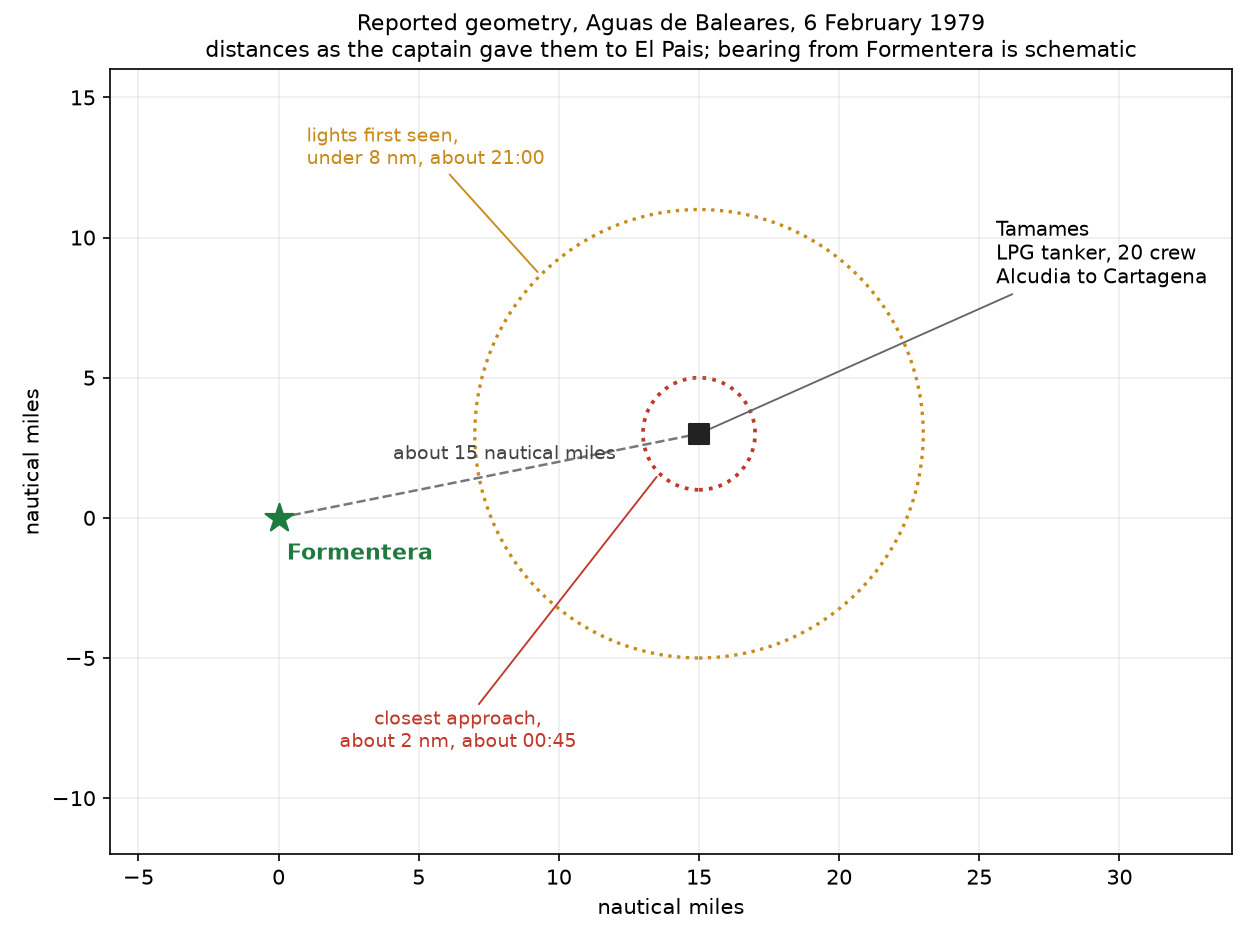
The Tamames was a butane carrier owned by Cepsa, running from Alcudia on Mallorca to Cartagena on the mainland with twenty men aboard. At about nine in the evening the sailor on watch saw something unusual and called the rest of the crew.
What they described were yellowish lights, not holding still, at less than eight miles from the ship. Their first reading of them was not that they were strange but that they were a cry for help. The lights resembled distress flares closely enough that the crew altered course toward them, believing a vessel was in trouble and intending to render assistance. That detail is the most human thing in the file and it is also evidence: these were working mariners whose immediate interpretation was an ordinary and urgent one.
The ship's radar was showing something. The captain, Jose Luis Gonzalez, put it in plain terms: for an hour and a half the returns on the screen were enormous. The most striking phase came at around a quarter to one in the morning, when the lights closed to about two miles from the ship.
By the captain's account more than fifty objects ringed the Tamames across roughly six hours of the crossing.
What is the official explanation?
The episode was reported to the naval authorities and absorbed into the Spanish Air Force's OVNI files, where it was given a number and, in time, declassified.
The expediente exists and its cover page can be read. It is headed AVISTAMIENTO DE FENOMENOS EXTRANOS (EXPEDIENTES OVNI), and carries EXPEDIENTE NUMERO: 790206, LUGAR: AGUAS DE BALEARES, FECHA: 06 de Febrero de 1979. It is held by the Biblioteca Central del Ejercito del Aire at the Cuartel General del Ejercito del Aire, Romero Robledo 8, Madrid. The file number is simply the date written backwards, which is how the Spanish series is indexed.
That cover is the limit of what this archive has read. The document runs to six pages and only the first is retrievable from the copy published online by the Ibiza newspaper Noudiari; the interior pages are behind an access control that returns an authorisation error to every automated request tried here. So the Air Force's own narrative, its investigating officer and its conclusion are not quoted on this page, because they have not been read. That gap should be closed by anyone who can reach the Biblioteca Central holdings directly.
The declassification this file belongs to was a substantial one. Noudiari describes the released set as eighty reports running to some 1,900 pages and covering sightings from 1962 to 1995. Four of those concern the Balearics. Three were resolved: a sighting on 24 October 1978 over Menorca, one on 14 February 1979 at Andratx, and one on 31 July 1972 at Soller were all attributed to a meteor passing or to air force fighters crossing the routes of the commercial flights that reported them.
The fourth is this one, and it was not resolved. Noudiari's summary of the position is that the Formentera events still have no reasonable explanation. That is the newspaper's characterisation rather than a sentence quoted from the file, and it is reported here as such.
What did the witnesses think it was?
The testimony that survives in public is the captain's, carried in the Spanish press within three days of the event.
El Pais ran the story in its printed edition of Friday 9 February 1979 under the headline that the crew of a ship claimed to have seen UFOs near Formentera. Jose Luis Gonzalez described the opening of the encounter directly: at about nine at night, when they were some fifteen miles from Formentera, lights like flares appeared before them that did not stay still, yellowish in colour, at less than eight miles away.
Two things in his account are internally consistent in a way that is worth checking rather than assuming. He placed the event on "el pasado martes", the previous Tuesday. The 6th of February 1979 was a Tuesday, and the 9th, the date of the printed edition, was a Friday. The newspaper's own publication date and the captain's own relative phrasing agree with the date the Air Force wrote on the file. Three independent records line up on one day.
The crew numbered twenty and the account is of a shared observation over hours, not a glimpse. No individual crew member other than the captain is named in the material reachable here.
Is the Tamames Encounter off Formentera, 6 February 1979 real? The two-pass assessment
Pass one, how could this be mundane. The strongest prosaic reading is the one the crew themselves reached first, that they were looking at flares or at the lights of other vessels, and it should be taken seriously precisely because experienced mariners reached it unprompted.
It does not survive the duration or the count. Pyrotechnic distress flares burn for a short time, and a parachute flare is measured in minutes, not in six hours. A sequence of more than fifty of them, sustained across most of a night crossing and ending without any vessel being found in distress, is not what a real emergency looks like. Fishing fleets working lights are a better candidate for persistence, and the Balearic channel carries traffic, but lights that close to within two miles of a moving tanker and then leave without a single vessel being identified do not fit that either.
Three further candidates are available and none can be tested from here. Military exercise activity in the western Mediterranean is plausible in principle, and the same declassified set shows the Air Force was willing to attribute other Balearic cases to its own fighters when that was the answer, which cuts slightly against it being the unstated answer in this instance. Atmospheric refraction can lift distant lights above the horizon and make them appear to hover and move, and the Balearic channel in February is a reasonable place for it. Astronomical objects seen through haze account for many single lights but not for fifty.
The radar is the part that resists all of these. The captain reported large returns over an hour and a half, which moves the case out of the category of purely visual misidentification and into a class where an instrument independent of the human eye also registered something. That is a substantial claim and it is also the claim most in need of the primary document, because what a 1979 marine radar screen showed, how it was interpreted, and whether sea clutter or anomalous propagation was considered, are all questions the expediente may address and this page cannot.
Pass two, if it is real. What is documented is a sustained, multi-witness, instrument-accompanied encounter at sea, filed by a state air force, numbered, archived and then released without a resolution attached to it, in the same batch in which comparable cases were resolved. The contrast within that batch is the single most useful thing about the case. An institution that was willing to write "meteor" and "our own fighters" against three Balearic files, and did not write anything equivalent against this one, is telling you something about the difficulty of the fourth.
There is also a point of housekeeping that belongs on this page, because the case is being actively misdescribed as of this month. A wave of coverage in November 2026, including an Italian outlet, has attached this Formentera material to a date of 22 May 1974 and presented it as part of the current United States declassification programme. The date is wrong. The Spanish file is 6 February 1979 and says so on its cover, the press report is February 1979, and the captain's own "last Tuesday" fixes the same day. The 1974 Ibiza item referred to in the Spanish reporting is a separate matter concerning American documents. UAP Globe pulled the full Department of War PURSUE manifest on 16 November 2026, all 478 records across seven releases, and searched it: it contains no record whose location or title refers to Spain, Ibiza, Formentera or the Balearics, and the only 1974 items in it are a CIA history of the U-2 and OXCART programmes covering 1954 to 1974 and a file of FBI correspondence spanning 1967 to 1974. Whatever the 1974 Ibiza reference turns out to be, it is not a PURSUE record, and it is not this case.
The tier is Unknown. There is no official explanation on the record, the case was declassified without one while its neighbours received one, and the archive has not read the interior of the file that might change that.
Sources
- www.noudiari.es/local-ibiza/defensa-desclasifica-un-expediente-ovni-ocurrido-a-15-millas-de-formentera/
- www.noudiari.es/noticias-ibiza-formentera-sidebar/estados-unidos-vuelve-a-desclasificar-archivos-ovni-y-sus-documentos-historicos-recogen-un-avistamiento-en-ibiza-en-1974/
- www.scribd.com/document/328574276/1979-02-06-Avistamiento-en-Aguas-de-Baleares-Ministerio-de-Defensa
- www.war.gov/Portals/1/Interactive/2026/UFO/uap-data.csv
More cases from this region: UFO sightings in Spain