The Virginia Coast Maritime Swarm: 100 Airborne UAP and Two Uncrewed Surface Craft (AARO FY2025 Report)
In its Fiscal Year 2025 annual report, the Pentagon's UAP office disclosed a single maritime case: U.S. Navy assets off the coast of Virginia reported roughly 100 airborne UAP together with two likely uncrewed surface craft, and AARO says it is still actively investigating.
What did witnesses see at Off the coast of Virginia (Virginia Capes operating area)?
In a single paragraph buried in a fourteen-page government statistics report, the U.S. military disclosed one of the most striking maritime UAP accounts it has ever put on the record. The All-domain Anomaly Resolution Office (AARO), the Department of War office that catalogues and investigates unidentified anomalous phenomena, published its Fiscal Year 2025 Consolidated Annual Report on Unidentified Anomalous Phenomena with an information cut-off of May 30, 2025. Inside it, AARO wrote:
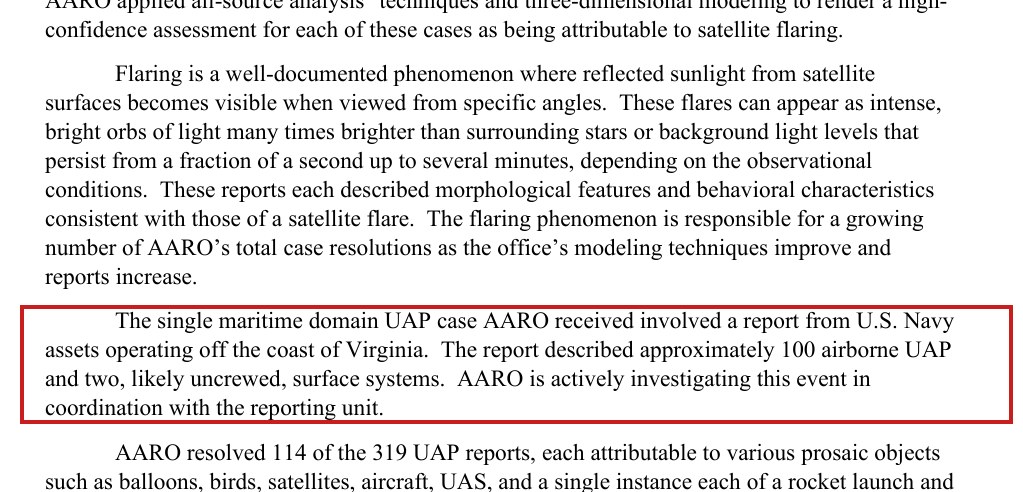
"The single maritime domain UAP case AARO received involved a report from U.S. Navy assets operating off the coast of Virginia. The report described approximately 100 airborne UAP and two, likely uncrewed, surface systems. AARO is actively investigating this event in coordination with the reporting unit."
That is the entire official description. What it establishes, in the government's own words: U.S. Navy assets were operating off the coast of Virginia; those assets reported roughly one hundred airborne unidentified objects at once; and alongside the aerial swarm there were two objects on or in the water that the Navy assessed as "likely uncrewed" surface systems. AARO classified it as the one and only maritime-domain UAP case in its entire FY2025 holdings, out of 319 reports the office received during the reporting period (June 2, 2024 to May 30, 2025).
What AARO did not disclose is nearly as notable as what it did. The report gives no date for the encounter, no time of day, no named vessel or aircraft, no duration, no imagery, and no assessment of what the objects were. The word AARO chose for the aerial objects is not "drones" but "airborne UAP," its neutral term for something that has not been identified. And rather than close the case as prosaic, as it did with 114 of the 319 reports that year, AARO explicitly left this one open and said it is "actively investigating."
The pairing is what has drawn attention: a large number of airborne objects appearing together with two apparently unmanned surface craft in the same maritime event. That combination echoes a category the UAP community calls "transmedium" activity, objects associated with more than one domain (air and sea) in a single incident, though the AARO paragraph itself makes no such claim and describes the air and surface objects only as observed, not as a coordinated system.
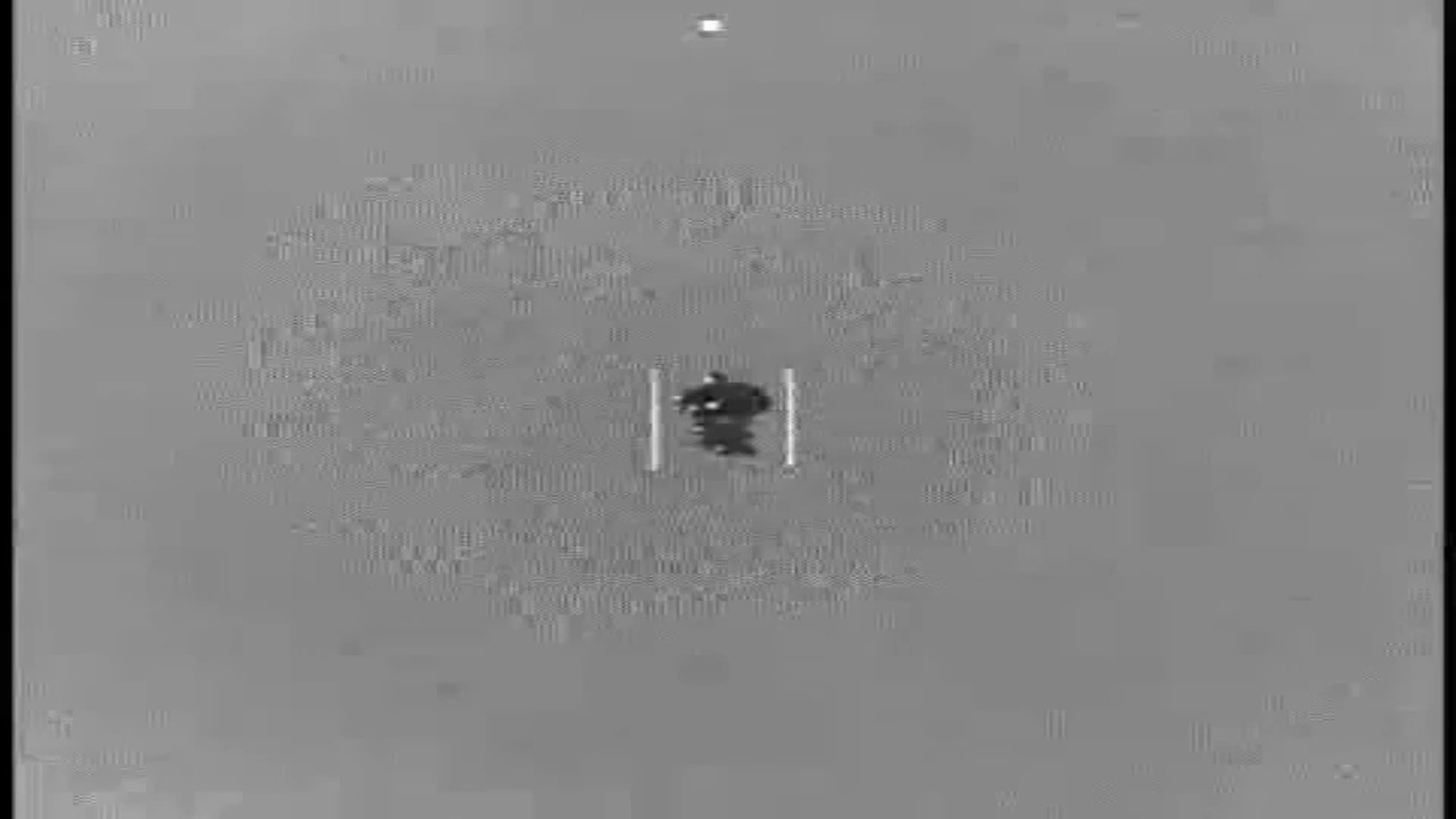
More footage and images of this sighting
What is the official explanation?
The source is a primary U.S. government document: AARO's "Fiscal Year 2025 Consolidated Annual Report on Unidentified Anomalous Phenomena," published on the AARO website (aaro.mil) under the Department of War, with an information cut-off of May 30, 2025 and a public release the week of July 20, 2026. AARO produced it in coordination with the Military Services, the Department of War, and Intelligence Community partners, as required by statute.
The report frames the Virginia case within its overall FY2025 numbers. AARO's case holdings reached 1,870 reports; during the reporting period it received 319 new UAP reports, of which it assessed 274 as air-domain, 44 as space-domain, and exactly one as maritime-domain. That single maritime case is the Virginia coast event. AARO resolved 114 of the 319 reports as prosaic objects (balloons, birds, satellites, aircraft, drones, plus one rocket launch and one manned jet pack), transferred 191 to its "active archive" for want of corroborating data, and flagged nine reports as meriting further analysis by Intelligence Community and science-and-technology partners. The Virginia case was neither resolved nor archived, it was singled out as under active investigation "in coordination with the reporting unit."
AARO also stated a bottom-line finding for the whole reporting period: "None of the cases AARO resolved indicate advanced foreign adversarial capabilities or breakthrough technologies in any domain." That statement is carefully limited to the cases AARO resolved. The Virginia event was not among them, so it falls outside that reassurance.
The case first reached the public through defense-trade reporting. DefenseScoop's Brandi Vincent surfaced the maritime paragraph on July 21, 2026, noting that AARO was "actively investigating this event in coordination with the reporting unit," and other outlets followed, characterizing it as a swarm of about one hundred objects off the U.S. coast. No agency has released any sensor imagery, track data, or a case-designation number for the event, and AARO has not commented publicly beyond the paragraph in the report.
What did the witnesses think it was?
There is no named witness and no first-person testimony in the public record. AARO attributes the report only to "U.S. Navy assets operating off the coast of Virginia," language that could mean a ship, an aircraft, a sensor system, or a combination, without identifying which. Neither the reporting unit, the platform, nor any individual operator is named, and AARO explicitly says it is coordinating the investigation "with the reporting unit," confirming a specific military source exists but withholding its identity.
The waters off Virginia are among the most heavily trafficked military operating areas in the world. The Virginia Capes (VACAPES) operating area, offshore of Naval Station Norfolk (the largest naval base on the planet) and Naval Air Station Oceana, hosts near-constant carrier, surface, submarine, and aviation training. That context cuts two ways: it means highly capable sensors and trained observers were plausibly present, and it means the airspace and sea surface routinely carry drones, target craft, balloons, and aircraft. AARO released none of the underlying data that would let an outside analyst weigh those possibilities, so no independent witness account or corroborating footage is available to cite as of publication.
Is the Virginia Coast Maritime Swarm: 100 Airborne UAP and Two Uncrewed Surface Craft (AARO FY2025 Report) real? The two-pass assessment
Two-pass assessment.
Pass one, mundane candidates. The most economical reading is that the Virginia event is a swarm of small uncrewed systems rather than anything exotic. The VACAPES range routinely runs drone and target operations; a formation of roughly a hundred small aerial objects is consistent with a launched swarm of UAS, and "two, likely uncrewed, surface systems" reads naturally as unmanned surface vessels or target boats, which the Navy itself operates and tests in these waters. Foreign or commercial drone incursions near Norfolk are also a documented concern in this period. Critically, AARO used the label "UAP" only because the objects were not identified at the time of reporting, not because their performance was shown to be anomalous, the paragraph reports no measured speed, altitude, acceleration, or transmedium behavior. If the airborne objects were a known swarm exercise or an identified drone incursion, this would collapse to a prosaic (if operationally serious) event. The absence of any released kinematics means nothing exotic can be demonstrated from the public record.
Pass two, if genuinely unidentified, what it implies. Even read conservatively, the file supports a real and unusual claim: the U.S. Navy reported approximately one hundred airborne unknowns together with two apparently unmanned surface craft in one maritime encounter, and AARO, an office that resolved a third of its caseload that year as ordinary objects, chose not to resolve this one and to keep investigating it. If the objects were confirmed friendly drones, closing the case would be trivial; the decision to keep it open suggests the reporting unit could not identify them and AARO could not yet either. The scale (a hundred objects) and the air-plus-surface pairing are what make it stand out from the office's usual single-object lights and spheres. Nothing in the record establishes non-human or exotic origin, and the swarm-of-drones explanation remains the leading candidate, but until AARO releases data or an identification, the honest tier is Unknown: a large, officially acknowledged, actively investigated maritime UAP event whose nature the government has not stated.
Sources
- www.aaro.mil/Portals/136/PDFs/FY25%20UAP%20Annual%20Report/AARO_FY2025_Consolidated_Annual_Report_on_UAP.pdf
- defensescoop.com/2026/07/21/pentagon-investigating-ufo-uap-event-near-virginia-coast/
- www.dailywire.com/news/massive-swarm-of-mysterious-objects-off-u-s-coast-sparks-pentagon-investigation
More cases from this region: UFO sightings in United States (Atlantic waters off Virginia; exact position undisclosed)