The Abilene Blue Green Glow: Incident 231, Abilene, Texas (1 January 1948)
Twice in five minutes on New Year's morning 1948, a brilliant blue green glow rose from the western horizon over Abilene, Texas. The Air Force filed it as Incident 231, and J. Allen Hynek wrote that it had no astronomical explanation.
What did witnesses see at Abilene?
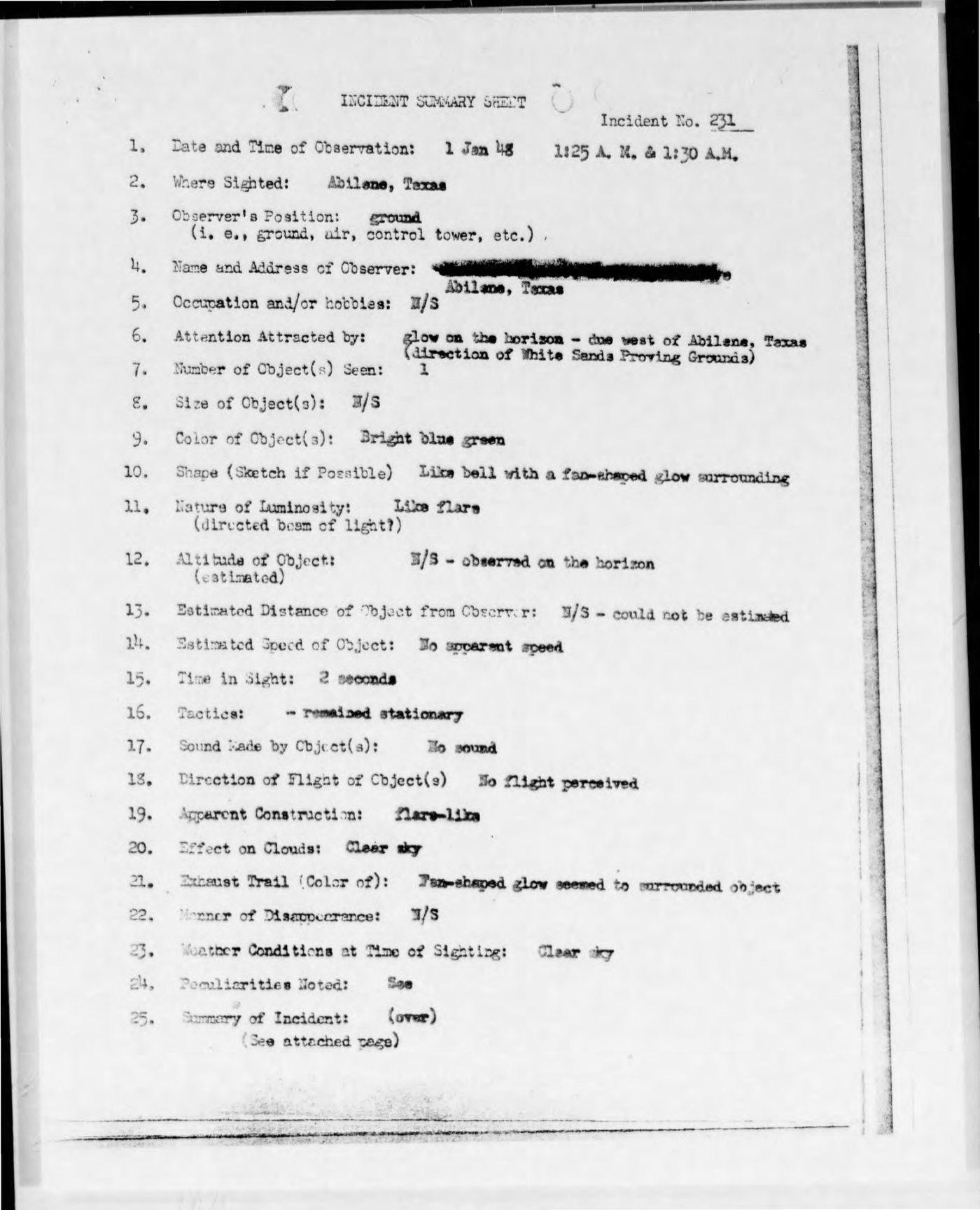
At 1:25 on the morning of Thursday 1 January 1948, a resident of Abilene, Texas saw a brilliant blue green glow appear low on the western horizon. It lasted roughly two seconds and was gone. Five minutes later, at 1:30, it happened again: the same colour, the same place, the same brief duration. The Air Force's record card fixes both times to the minute and in Central Standard Time, "0125 & 0130 CST", and gives the source simply as "Male Civilian". The sky was perfectly clear on both occasions and neither event made any sound.
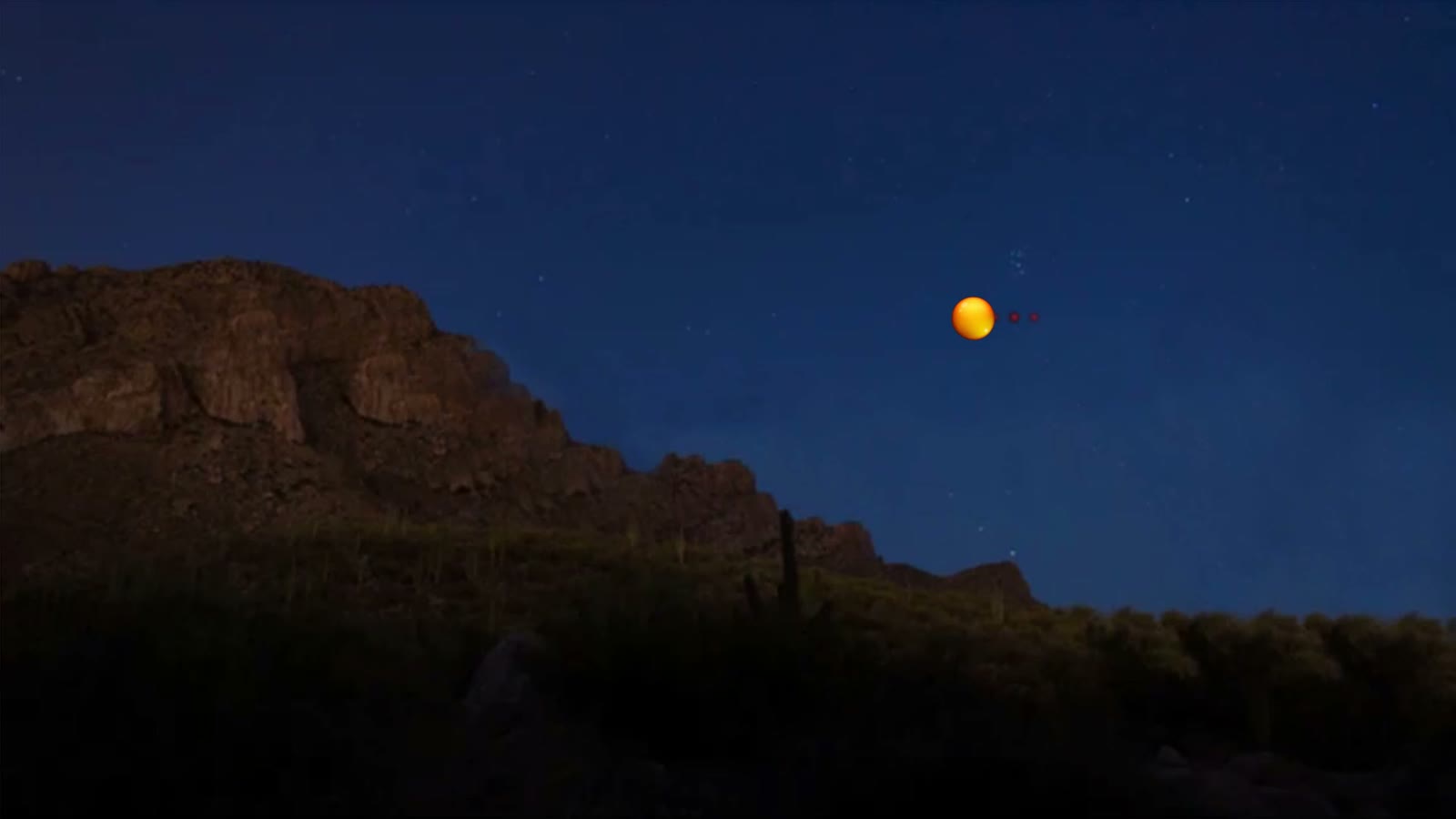
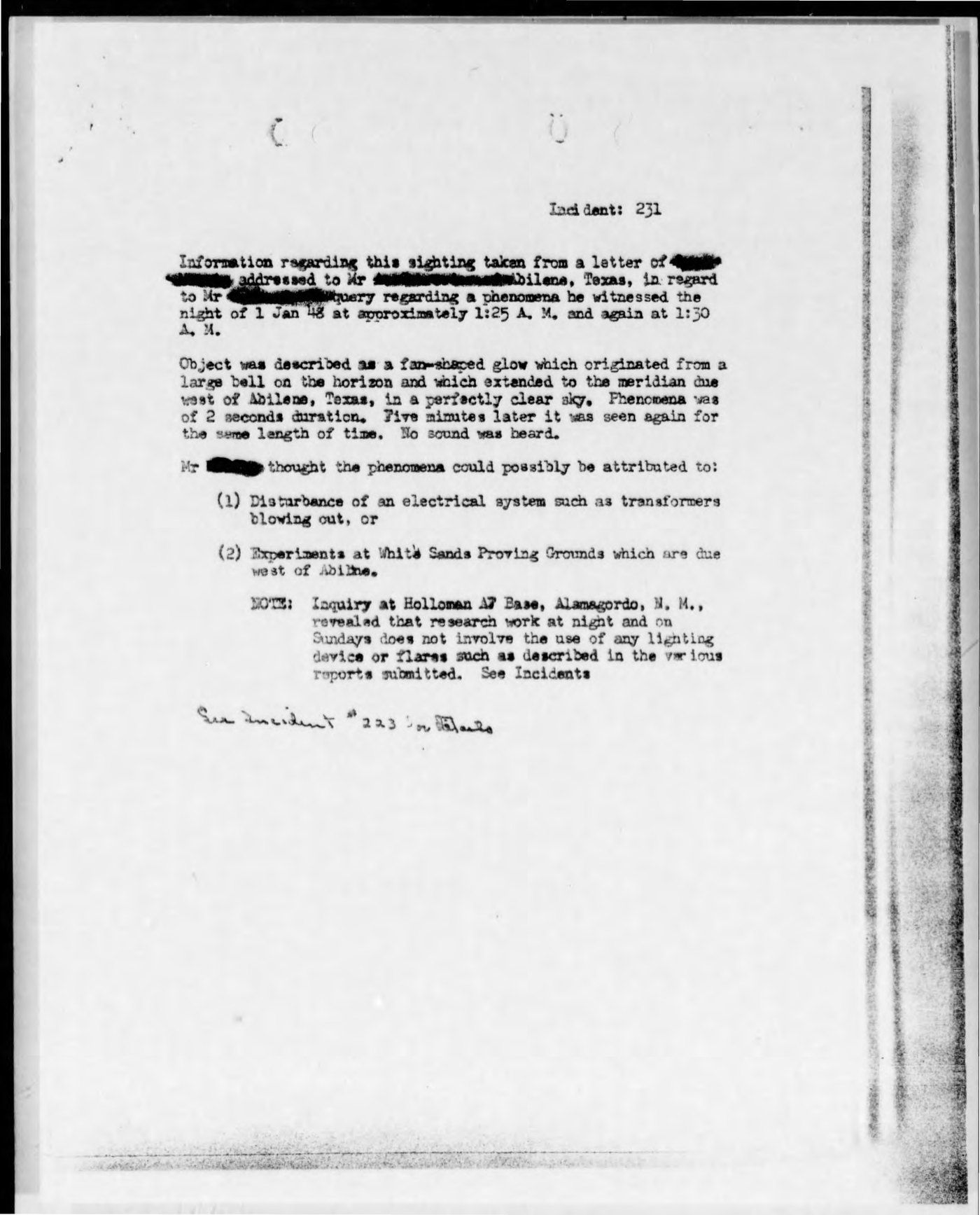
The shape is the part of the account that has kept the case interesting for nearly eighty years. The witness did not describe a point of light or a streak. He described a glow that fanned outward from what he called a large bell sitting on the horizon. The Air Force summary records it this way: the object was "described as a fan-shaped glow which originated from a large bell on the horizon and which extended to the meridian due west of Abilene, Texas, in a perfectly clear sky." On the numbered incident summary sheet the shape field reads "Like bell with a fan-shaped glow surrounding", the colour field reads "Bright blue green", the nature of the luminosity is given as "Like flare", and the apparent construction as "flare-like".
What the form does not record is as striking as what it does. Field 7 gives the number of objects seen as one. Field 14, estimated speed, reads "No apparent speed". Field 16, tactics, reads "remained stationary". Field 18, direction of flight, reads "No flight perceived". Field 17 records no sound, and fields 20 and 23 both give the sky as clear. Size, altitude and distance are all marked N/S, not stated, with the notes "observed on the horizon" and "could not be estimated". Whatever this was, it did not move, did not travel, and could not be ranged.
The angular extent is the detail that resists easy explanation. The glow did not sit on the skyline. It reached from the horizon up to the meridian, which is to say most of the way across the visible sky, and it did so twice, for two seconds each time. J. Allen Hynek, writing his astronomical evaluation for the Air Force, put it as a glow "that extended momentarily from the horizon to the zenith". A silent, stationary, blue green fan of light spanning ninety degrees of sky, appearing and vanishing inside two seconds, then repeating itself five minutes later, is not a common thing to have to account for.
More footage and images of this sighting
What is the official explanation?
The sighting is Incident No. 231 in the numbered incident summary series compiled by the United States Air Force's early unidentified flying object projects, the sequence that ran through Project Sign and Project Grudge and was later folded into the Project Blue Book record. The file is short, nine pages of working documents, and every one of them is in the archive's hands.
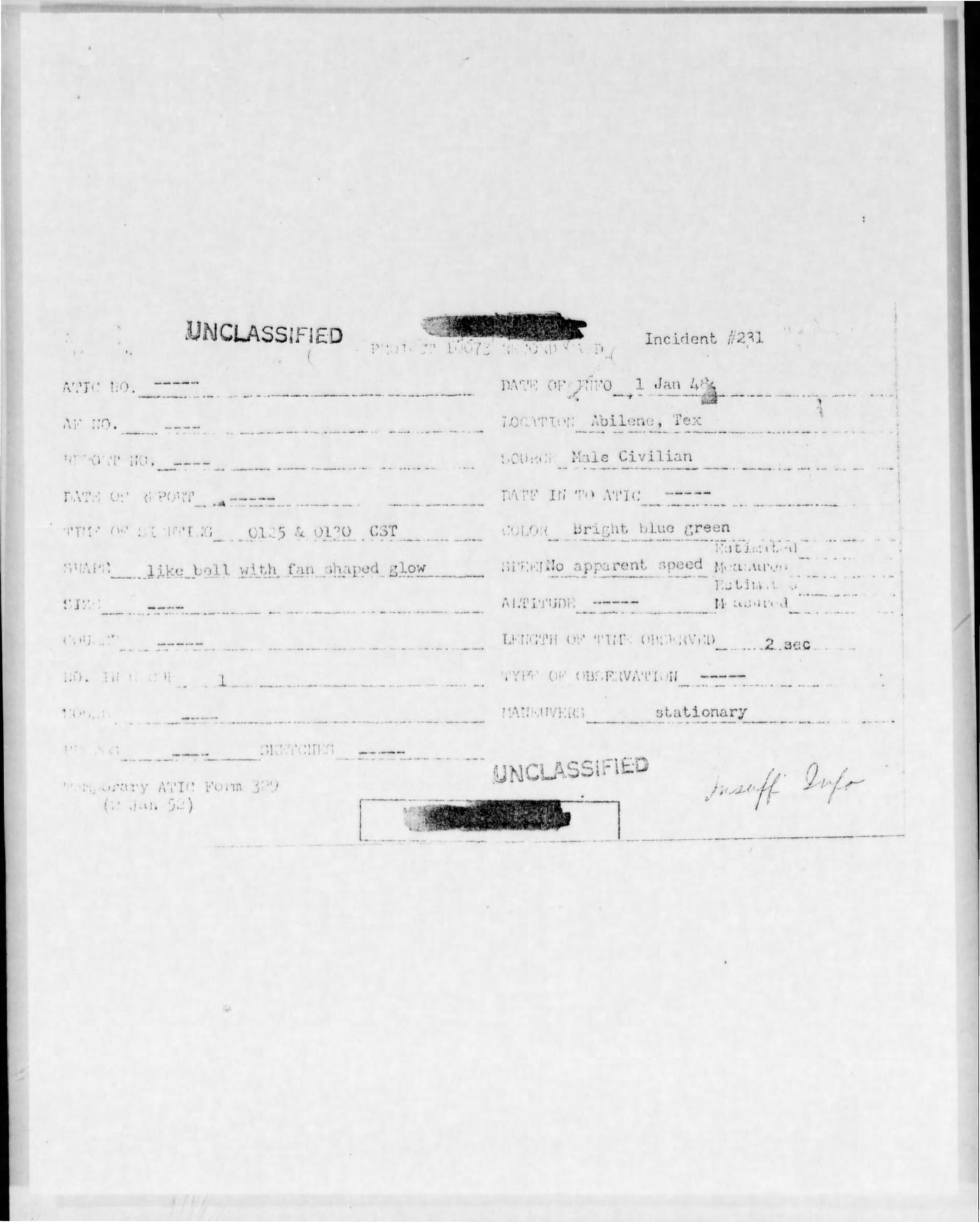
The case carries a formal disposition, and it is the least satisfying one the Air Force had available. The PROJECT 10073 RECORD CARD for Incident #231, typed on a Temporary ATIC Form 329 dated 22 January 1952 when the Air Technical Intelligence Center went back and carded the older incidents, records the date of sighting as 1 Jan 48, the location as Abilene, Tex, the source as "Male Civilian", the time of sighting as "0125 & 0130 CST", the colour as "Bright blue green", the shape as "like bell with fan shaped glow", the speed as "No apparent speed", the length of time observed as "2 sec" and the manoeuvres as "stationary". The altitude, size and type of observation fields are all left blank. In the bottom right corner, in handwriting rather than type, is the evaluation: "Insuff Info". Insufficient information. That is the Air Force's final word on the case, and it is a statement about the quality of the report rather than about the object.
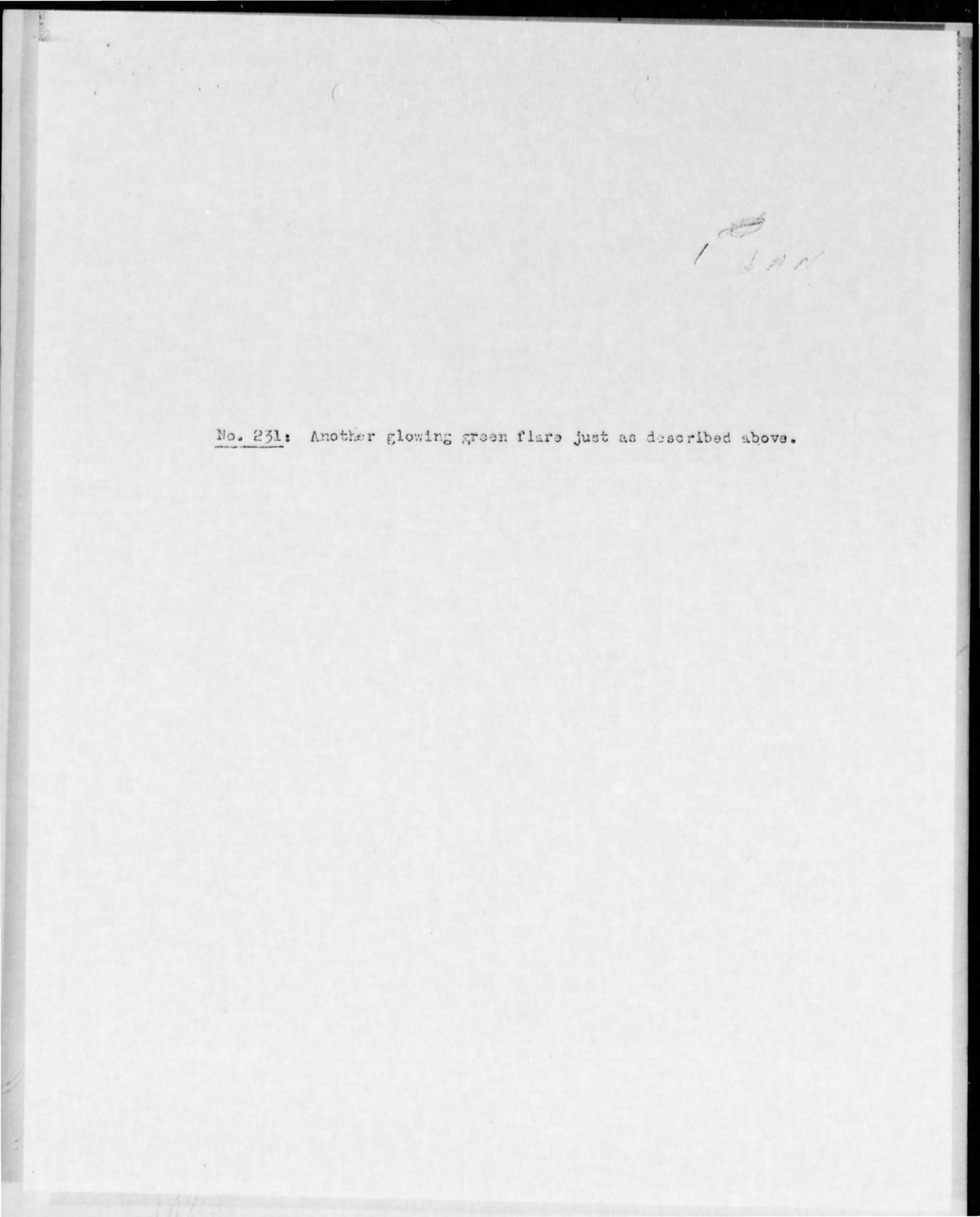
The file also shows that Abilene was not treated as an isolated event. A comment sheet in the same batch carries a single line against this case: "No. 231: Another glowing green flare just as described above." The word "another" is doing a lot of work. Incident 231 was one of a run of green flare reports being assessed together, which is why the Holloman inquiry below is phrased in the plural, and it means the case should be read as one member of a cluster rather than as a solitary oddity.
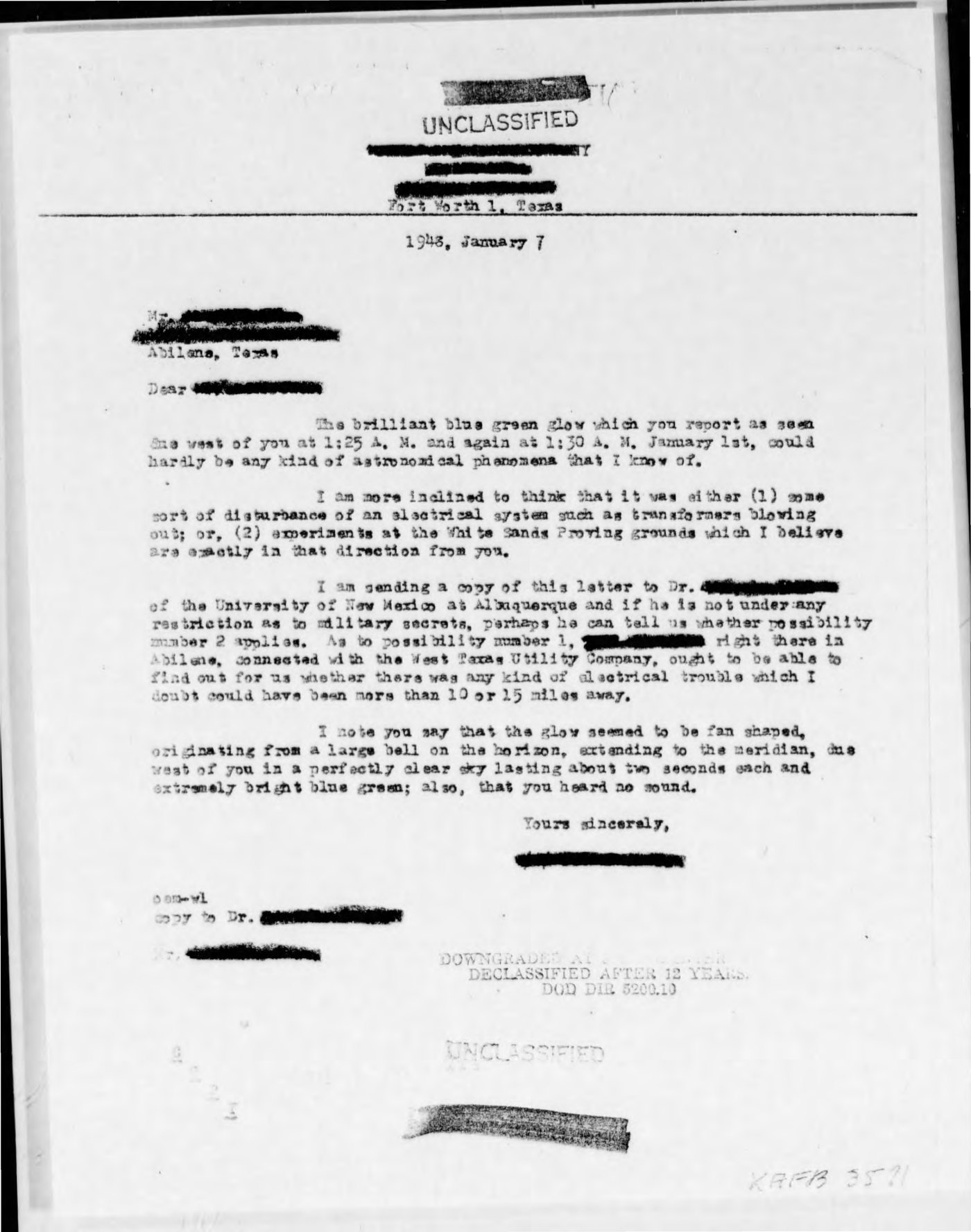
The Air Force did not take the report from the witness directly. The summary page states that "Information regarding this sighting taken from a letter of [name withheld] addressed to Mr [name withheld] Abilene, Texas, in regard to Mr [name withheld] query regarding a phenomena he witnessed the night of 1 Jan 48 at approximately 1:25 A. M. and again at 1:30 A. M." The letter itself is in the file, typed on 7 January 1948 from Fort Worth 1, Texas, and it carries a declassification stamp reading "DOWNGRADED AT [illegible] DECLASSIFIED AFTER 12 YEARS. DOD DIR 5200.10".
One line of actual investigation appears in the file, and it was aimed at the witness's own preferred theory. A note under the summary reads: "Inquiry at Holloman AF Base, Alamagordo, N. M., revealed that research work at night and on Sundays does not involve the use of any lighting device or flares such as described in the various reports submitted." The phrasing matters. The inquiry was made on behalf of a batch of reports, not this one alone, and it rules out lighting devices and flares specifically. It does not address rocket firings, and it does not address a Thursday that happened to be New Year's Day.
A second check ran more than a year later. A letter from Headquarters, Air Weather Service, Andrews Air Force Base, dated 11 May 1949 and addressed to the Commanding General, Air Materiel Command at Wright Patterson, records that "The incident summaries 173 through 233 have been checked against routine weather-balloon ascents made by the Air Force, Navy and Weather Bureau." Incident 231 fell inside that range. Nothing in the file indicates the balloon check resolved it.
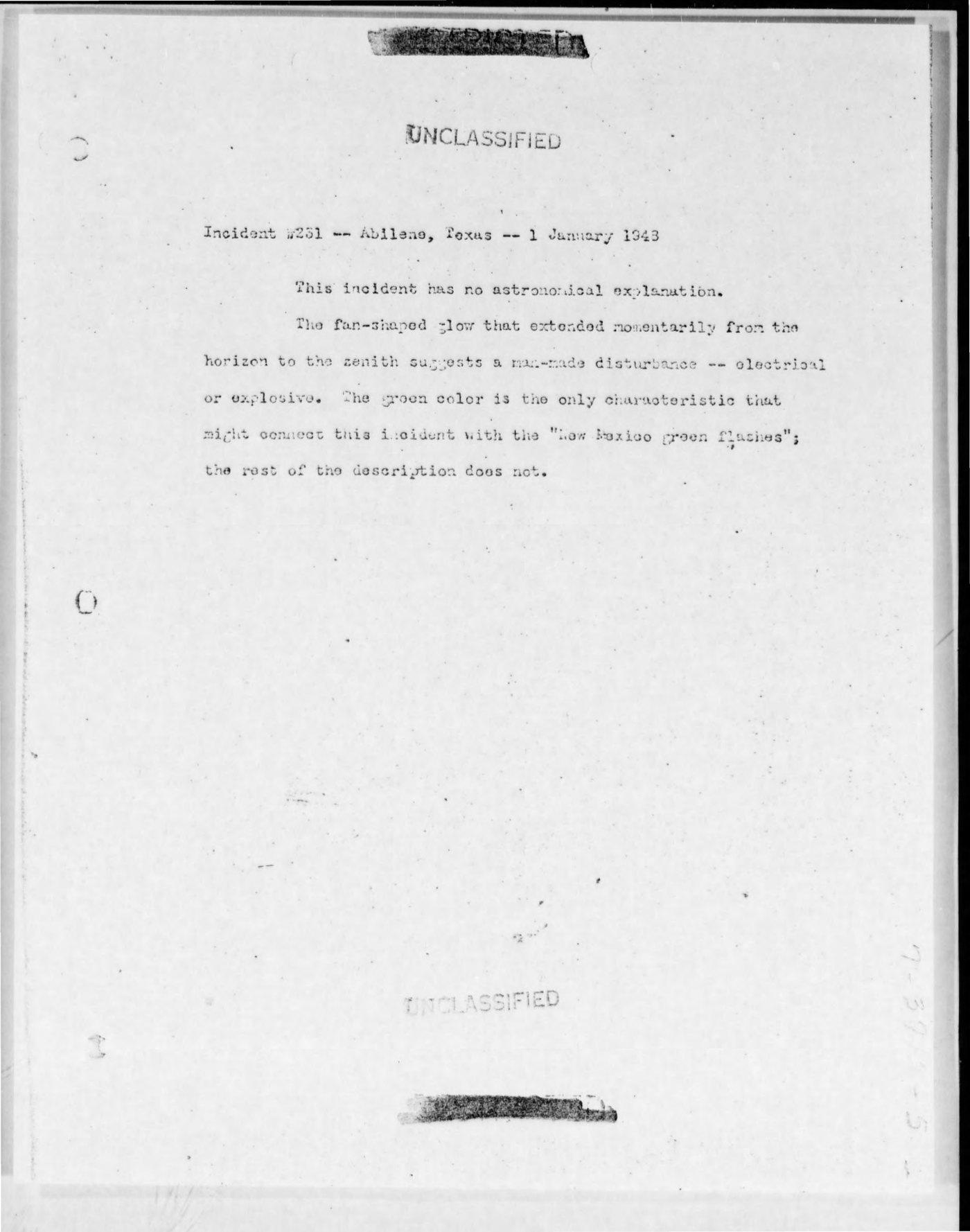
The most consequential document is Hynek's. Writing his astronomical evaluations for the Project Grudge report, the astronomer who would spend the next quarter century as the Air Force's consultant on these cases set down four sentences on Abilene: "Incident #231 -- Abilene, Texas -- 1 January 1948. This incident has no astronomical explanation. The fan-shaped glow that extended momentarily from the horizon to the zenith suggests a man-made disturbance -- electrical or explosive. The green color is the only characteristic that might connect this incident with the 'New Mexico green flashes'; the rest of the description does not."
That is the whole of the official position, and it is worth being precise about what it is and is not. Hynek excluded the astronomical category, which was his brief and his competence. He then offered a guess outside it, that the cause was man made and either electrical or explosive, and he offered it as a suggestion rather than a finding. No document in this file records anyone testing that guess. The only formal evaluation the case ever received is the handwritten "Insuff Info" on the record card, and it is worth being clear about what that does and does not mean: it closes the file without identifying a stimulus. It is not a finding that the object was a flare, a meteor or an electrical fault. Nothing in these nine pages says the case was solved.
What did the witnesses think it was?
The witness is anonymous in the copy of the file held by the Internet Archive's Project Blue Book collection. Field 4 of the incident summary sheet, name and address of observer, is blacked out, leaving only "Abilene, Texas" legible beneath the redaction, and the same hand has blacked the name out of the salutation and address block of the covering letter. Field 5, occupation and hobbies, is marked N/S. When Abilene's KTXS reported the case on 11 May 2026, working from the Pentagon's own online release rather than the microfilm, it gave the observer's name as A. Schroeder. This archive has not seen a copy of the document in which that name is legible, so it is recorded here as KTXS reported it and not as something independently confirmed.
The correspondence is more revealing than the form. The witness did not go to the Air Force. He wrote to someone with astronomical knowledge, in Fort Worth, asking what he had seen, and it was that reply, dated 7 January 1948, that the Air Force eventually filed. The reply opens by closing off the obvious door: "The brilliant blue green glow which you report as seen due west of you at 1:25 A. M. and again at 1:30 A. M. January 1st, could hardly be any kind of astronomical phenomena that I know of."
The correspondent then set out the two candidates that shaped everything the Air Force later did with the case: "I am more inclined to think that it was either (1) some sort of disturbance of an electrical system such as transformers blowing out; or, (2) experiments at the White Sands Proving grounds which I believe are exactly in that direction from you."
He also tried to get both of them checked, which is more than the Air Force managed. He wrote that he was sending a copy of the letter to a doctor at the University of New Mexico at Albuquerque, "and if he is not under any restriction as to military secrets, perhaps he can tell us whether possibility number 2 applies", and he named a contact "right there in Abilene, connected with the West Texas Utility Company", who "ought to be able to find out for us whether there was any kind of electrical trouble which I doubt could have been more than 10 or 15 miles away". Both names are redacted. Neither enquiry's answer is in the file.
The letter closes by playing the description back to the witness, which is how the archive knows the account was not reshaped in the retelling: "I note you say that the glow seemed to be fan shaped, originating from a large bell on the horizon, extending to the meridian, due west of you in a perfectly clear sky lasting about two seconds each and extremely bright blue green; also, that you heard no sound." That paragraph, written six days after the event by someone with no stake in a flying saucer story, is the closest thing this case has to a contemporaneous witness statement, and it agrees in every particular with the form the Air Force typed up later.
Is the Abilene Blue Green Glow: Incident 231, Abilene, Texas (1 January 1948) real? The two-pass assessment
Pass one, how could this be mundane.
The strongest prosaic candidate is a bright meteor. Blue green is a classic bolide colour, two seconds is a classic bolide duration, and a fireball low on the horizon can throw exactly the sort of fan of light the witness described. Two things cut against it. The first is that it happened twice, five minutes apart, in the same part of the sky, for the same length of time. Meteors do not repeat on a schedule, and two unrelated bolides in the same azimuth inside five minutes is a coincidence worth resisting. The second is that the one professional astronomer who examined the report rejected the whole astronomical category. Hynek's "This incident has no astronomical explanation" is not a hedge, and it was written by a man whose job at that point was to clear cases off the Air Force's desk, not to keep them open.
The correspondent's own first choice, an electrical fault, holds up better than it might sound. A high voltage flashover or a transformer failure throws an intense blue green arc, is silent from any distance, is over in a second or two, can illuminate cloud or haze into a fan, and above all can repeat as a circuit re trips. It is the one candidate that naturally explains the five minute repeat. The file shows the question being asked and never being answered: the West Texas Utility Company contact was identified and, so far as the documents go, never reported back. This remains the most plausible unexcluded explanation, and the honest position is that it was never actually excluded because nobody checked.
The White Sands hypothesis is the one this archive can test, and the geometry is more interesting than expected. White Sands Proving Ground lies at a bearing of 271 degrees from Abilene, which is due west to within about a degree, so the witness and his correspondent were right about the direction. The distance is roughly 633 kilometres, or 394 miles. For anything at White Sands to appear on Abilene's horizon at that range it would have to be at least about 27 kilometres up, around 88,000 feet, allowing for standard atmospheric refraction. That does not rule the idea out. The V-2 rockets the Army was firing at White Sands in this period routinely passed 80 kilometres and sometimes exceeded 160, and an object at those altitudes is above Abilene's horizon with hundreds of kilometres to spare. What rules it out is everything else: launches were daylight operations, 1 January 1948 was a New Year's Day holiday, a rocket does not appear for two seconds and vanish, and it certainly does not do it twice. The Holloman inquiry's answer, that night and Sunday research did not involve lighting devices or flares, points the same way without quite closing the door.
The cluster is the piece of context that most changes the odds, and it comes from one line on a comment sheet: "No. 231: Another glowing green flare just as described above." Abilene was being assessed alongside other green flare reports, not on its own. A run of similar reports in the same period is a strong hint at a common cause, and common causes tend to be prosaic. It also explains why the Holloman inquiry was framed around "the various reports submitted" in the plural. Whatever was producing brilliant green flare like lights in this window was producing several of them, and the Air Force never named it.
Hynek's own cross reference deserves care, because it is routinely overstated. He raised the "New Mexico green flashes", the green fireball phenomenon that would preoccupy the Air Force and the astronomer Lincoln LaPaz from late 1948 onward, and then immediately limited the comparison: "The green color is the only characteristic that might connect this incident with the 'New Mexico green flashes'; the rest of the description does not." He is noting a shared colour and rejecting the identification. Anyone citing this file as an early green fireball case is citing the half of Hynek's sentence that suits them.
Pass two, if the account is accurate, what is left.
Strip away the candidates and the residue is narrow but real: a silent, stationary, extremely bright blue green light that fanned from the horizon to the zenith, lasted two seconds, and did it again five minutes later on a perfectly clear night. The repetition is the anomaly that matters. It is the detail that defeats the meteor, and it is the detail that makes an electrical fault attractive, which is precisely why the unanswered utility company enquiry is the hole in the middle of this file.
The case is tiered Unknown, and the tier is doing real work here rather than papering over a gap. This is not a case where an official explanation exists and the archive disputes it. It is one where the Air Force asked two sensible questions, got a partial answer to one of them from Holloman, never got an answer to the other from the utility company, ran a routine balloon check a year later that changed nothing, accepted an astronomer's note that ruled out his own field and speculated politely outside it, and then closed the file with two handwritten words meaning it had not gathered enough to decide. "Insuff Info" is an administrative outcome, not an explanation, and it should not be quoted as though the Air Force identified anything. Eighty years on, the most likely answer remains an electrical fault that nobody confirmed, made more likely by the fact that Abilene was one of several green flare reports in the same batch, and the honest label for a case in that condition is Unknown.
Sources
- archive.org/details/1948-01-9669757-Abilene-Tex-231-
- archive.org/download/1948-01-9669757-Abilene-Tex-231-/1948-01-9669757-Abilene-Tex-231-.pdf
- ktxs.com/news/local/abilene-ufo-sighting-mentioned-in-newly-released-government-documents
More cases from this region: UFO sightings in United States