The Alfena UFO Photographs (1990)
On the morning of Monday 10 September 1990, at about 8:30 a.m., people in São Vicente de Alfena, a parish in the municipality of Valongo just east of Porto, reported a slow, low object hanging over a football field that was then under construction, near the Café Ferreira and an adjacent warehouse. This case file covers what witnesses reported, the official narrative, and a two-pass assessment with its evidence tier.
What did witnesses see at São Vicente de Alfena?
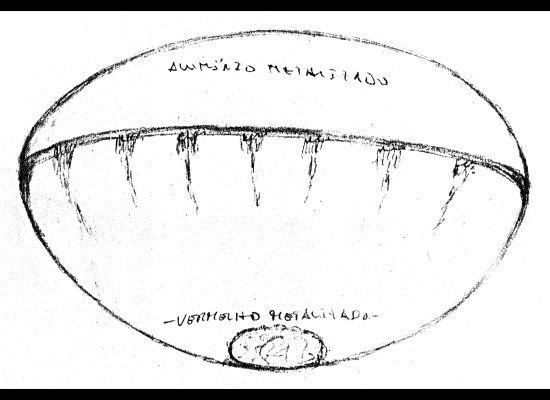
On the morning of Monday 10 September 1990, at about 8:30 a.m., people in São Vicente de Alfena, a parish in the municipality of Valongo just east of Porto, reported a slow, low object hanging over a football field that was then under construction, near the Café Ferreira and an adjacent warehouse. The first to notice it were children, described in several accounts as playing marbles ("berlinde") in the street. They called adults, and the crowd grew. Witnesses said the thing came down so low that they thought it was going to land, hovering at one point only about a meter above the field. It was described as roughly circular or spherical, metallic and reflecting the sun, perhaps four meters across, with several strange appendages hanging from it that people compared to legs or rods. Some counted five "legs," which is why the object later picked up the nickname "the flying jellyfish" (a medusa voadora). Witnesses also reported small window-like features around its rim. Reaching for everyday comparisons, people likened it to a concrete mixer, a kite, even a turtle with legs.
The object did not behave like a fixed balloon. Accounts agree it drifted slowly, alternating between hovering and bursts of faster movement, and over roughly fifty minutes it traversed something on the order of 500 meters, heading off toward Santo Tirso and Paços de Ferreira. The most cited single detail is that construction workers (called "trolhas" locally) and other witnesses threw stones at it. By the accounts collected at the time, the object briefly froze in mid-air when stoned, then climbed and accelerated away at speed, changing toward a more ovoid shape as it went.
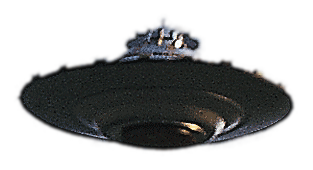
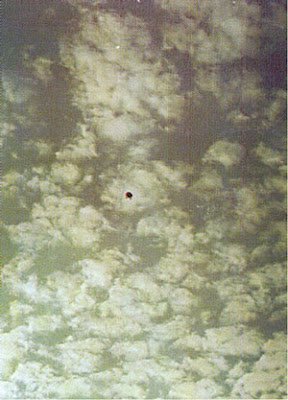
A newspaper collaborator named Manoel Gomes de Moura, present during the event, photographed the object as it pulled away, taking four frames on film. In the surviving images the object reads as a small dark form against a heavily clouded sky, with the leg-like appendages visible on enlargement. Moura retained the original negatives, which became the core physical evidence of the case. Estimates of the number of witnesses run from a couple of dozen named observers up to "more than a hundred," with people in neighboring localities reporting they saw the same object pass.
What is the official explanation?
Portugal had no government UFO office, so the investigation fell to a civilian body, the Comissão Nacional de Investigação do Fenómeno OVNI (CNIFO), whose investigators reached Alfena quickly. The two researchers most associated with the case are the historian Joaquim Fernandes, later of the Centro Transdisciplinar de Estudos da Consciência (CTEC) at Fernando Pessoa University in Porto, and Mário Neves (also linked to Portuguese UFO investigation, PUFOI). Both were interviewed by the Jornal de Notícias, which put the sighting on its front page on 11 September 1990. The case was subsequently documented in CTEC's own journal, ANOMALIA. Other CNIFO figures named in period and retrospective coverage include José Sottomayor, Luís Ribeiro, and Carlos Oliveira, with academic involvement later attributed to Raul Fernandes Berenguel.
The central official-style finding concerns the photographs. The negatives were submitted for technical examination, and across the accounts the consistent result is that no manipulation or fraud was detected. Kodak and analysts connected to NASA are repeatedly cited as having examined the images and found them authentic, with the American vision scientist Richard Haines (long associated with NASA and with photographic UAP analysis) named as one consultant. On the Portuguese side, the then Instituto Nacional de Engenharia e Tecnologia Industrial (variously rendered INETI or LNETI) is reported to have found no signs of tampering and to have been unable to identify the object. The national Institute of Meteorology and Geophysics is cited as ruling out a meteorological balloon. Further analyses are attributed to specialist centers in Lisbon, Porto, France (a center for atmospheric re-entry research, often linked to Toulouse), Germany, and the United States. The recurring official-grade conclusion across these bodies, as reported by RTP and the Portuguese press, is that the photographed object bore no resemblance to known objects such as balloons or probes, and that the origin of the phenomenon could not be determined. In RTP's words, it was "não foi possível conhecer a génese do fenómeno aéreo não identificado" (it was not possible to know the genesis of the unidentified aerial phenomenon).
Military authorities, when asked, denied that any of their aircraft were in the area, which closed off the most obvious mundane attribution at the time.
What did the witnesses think it was?
The witnesses and the investigators who took their statements treated this as a real, structured craft, not a trick of light. Named first-hand witnesses include David Silva, identified as the guard of the football field, and Manuel Gomes, said to have been alerted by the children (a separate person from the photographer despite the overlapping surnames). The photographer, Manoel Gomes de Moura, maintained that what people saw in the Alfena sky was exactly what appeared on his negatives, and he held onto those negatives as proof. The volume of independent observers, spread across more than one locality and reporting the same slow-moving object over the same window of time, is what convinced the CNIFO investigators the event was genuine. Joaquim Fernandes and Mário Neves, asked about it for years afterward, kept describing it as unexplained rather than solved.
The case has stayed alive in Portuguese culture and continues to draw fresh inquiry. Carlos Oliveira, a former CNIFO member, has called it the one object he genuinely accepts deserves the label OVNI. In 2021 a new civilian body, the Centro de Investigação de Fenómenos Aeroespaciais (CIFA), founded that July and led by Vítor Moreira, named Alfena as one of the most striking Portuguese cases, citing the dozens of local witnesses plus photographs that were studied and found authentic rather than faked. More recently the artist Willian Ferreira built an entire photobook and research project around it, "A Medusa Voadora de Alfena" (The Flying Jellyfish of Alfena), supported by the Ci.CLO photography platform and CTEC, which reproduces the original photographs, the negatives, trajectory studies, dome-detail enlargements, witness drawings from 1993, and the ANOMALIA coverage, and which logs the precise site at about 41 degrees 13 minutes 58 seconds north, 8 degrees 32 minutes 37 seconds west.
The dispute
The dispute over the Alfena event of 10 September 1990 rests on three competing ordinary readings of a roughly circular, four-meter metallic object with leg-like appendages that hovered low over a Valongo football field for about 50 minutes before accelerating away toward Santo Tirso. The first is a balloon reading, advanced not by any agency but by an AstroPT astronomy-forum commenter, who argued that the hanging appendages "look exactly like the rigging lines and attachment points of a meteorological or cluster balloon." This is an eyeball comparison with no model identified and no test performed, and it is directly undercut by the record itself: the Portuguese meteorological institute is reported to have specifically ruled out a met balloon, and witnesses described the object freezing when stones were thrown at it and then departing under apparent power, behavior a free-floating balloon does not show.
The second reading is the remotely piloted vehicle or early-drone hypothesis. French astrophysicist Pierre Guerin reportedly floated an RPV interpretation, and Vitor Moreira of CIFA, the Centro de Investigacao de Fenomenos Aeroespaciais, candidly suggested the object might have been a prototype aircraft or an early drone. Both are named figures, which gives this branch more weight than an anonymous forum post, but neither produced a demonstration. No specific 1990-era airframe was matched to the photographs, and as the archive notes, a low, stone-throwable, leg-bearing, rotor-less craft loitering over a Portuguese village in 1990 has no documented match. The third reading, a hoax, fares worst of all: no one has shown a method, and the original negatives were examined by Kodak, by NASA-associated photographic analyst Richard Haines, and by Portugal's INETI/LNETI, with the repeated finding being no manipulation, no tampering, and an object they could not identify.
Crucially, there is no official-apparatus verdict here at all, in either direction. Portugal had no government UFO office; the only formal institutional response on record is the military denying that any of its aircraft were in the area, which removes a candidate explanation rather than supplying one. The civilian investigators of CNIFO, weighing the volume of independent observers across more than one locality reporting the same slow object over the same window, treated the event as a genuine structured craft. By this archive's method, none of the three counter-explanations clears the bar: each is either an unsupported assertion, a named-but-undemonstrated hypothesis, or a hoax charge with no technique shown, and the institutional photo analyses cut against fraud rather than for it. A counter-explanation exists but does not close the case, which is the Disputed shape, and the case largely stands.
Is the Alfena UFO Photographs (1990) real? The two-pass assessment
Pass one, the ordinary explanations. The leading prosaic candidate is a balloon. On the AstroPT astronomy forum a commenter argued the hanging "legs" look exactly like the rigging lines and attachment points of a meteorological or cluster balloon, and that slow wind-borne drift over fifty minutes fits a balloon well. The counter to this is that the Portuguese meteorological institute is reported to have specifically ruled out a met balloon, and witnesses described the object freezing when stoned and then accelerating away under apparent power, which a free balloon does not do. A second candidate is a remotely piloted vehicle. The French astrophysicist Pierre Guérin reportedly floated an RPV reading, and decades later even a UFO investigator, CIFA's Vítor Moreira, candidly suggested it might have been a prototype aircraft or an early drone tested by some company, comparing it to UAV shapes like the Cypher. The weakness there is timing: a low, stone-throwable, leg-bearing rotor-less craft loitering over a Portuguese village in 1990 has no documented match, the military denied any of its aircraft were present, and the institutional analyses could not match it to any known RPV. A third candidate is a hoax. But no one has shown a method: the original negatives were examined by Kodak, by analysts linked to NASA including Richard Haines, and by Portugal's INETI/LNETI, and the repeated finding was no manipulation, and there is a large, geographically spread body of independent witnesses, which is hard to stage. A simple model-on-a-string is also a poor fit for an object many dozens of people tracked across 500 meters of open sky.
Pass two, if it was a real unidentified object. Then Alfena is a rare thing: a mass-witnessed daylight low-altitude object, photographed on film, with the negatives surviving and passing fraud analysis, investigated promptly by a civilian body and later documented in an academic journal. The object's reported behavior, hovering low, reacting to thrown stones, then climbing away at speed and morphing toward an ovoid, is internally consistent across independent retellings and does not map cleanly onto any one conventional aircraft, balloon, or known drone of 1990.
The tier is Disputed, tierClass contested. There are concrete counter-explanations on the table, the balloon-rigging reading of the appendages and the prototype-drone hypothesis, and they are serious enough that the case cannot be called cleanly Verified Unexplained. But none of them has been demonstrated. No analyst has shown the method by which a balloon or a specific drone produced these exact images and this exact fifty-minute, stone-reactive performance, and the institutional photographic analyses that were done pointed the other way, finding no fraud and no match to balloon, probe, or RPV. A counter-explanation exists but does not close the case, which is precisely the Disputed shape. There is no civilian, method-shown discredit-grade analysis here, so this is not a proposed discredit.
Sources
- www.rtp.pt/noticias/pais/ovni-visto-em-alfena-em-1990-continua-por-explicar_n220224
- ufoportugal.blogspot.com/2009/11/ovni-en-alfena-portugal-1990.html
- ufoportugal.blogspot.com/2011/09/ovni-de-alfena-portugal-21-anos-de.html
- www.nit.pt/fora-de-casa/portugal-ja-foi-visitado-por-ovni-eles-querem-descobrir-toda-verdade
- www.amedusavoadoradealfena.com/en
- ufos-wilson.blogspot.com/2019/08/comentando-foto-de-ovni-alfena-portugal.html
- expressodasilhas.cv/desporto/2009/05/16/extraterrestres-ovni-visto-em-alfena-em-1990-continua-por-explicar/9215
More cases from this region: UFO sightings in Portugal