The Apollo 17 "Fourth of July" Lights (PURSUE Files)
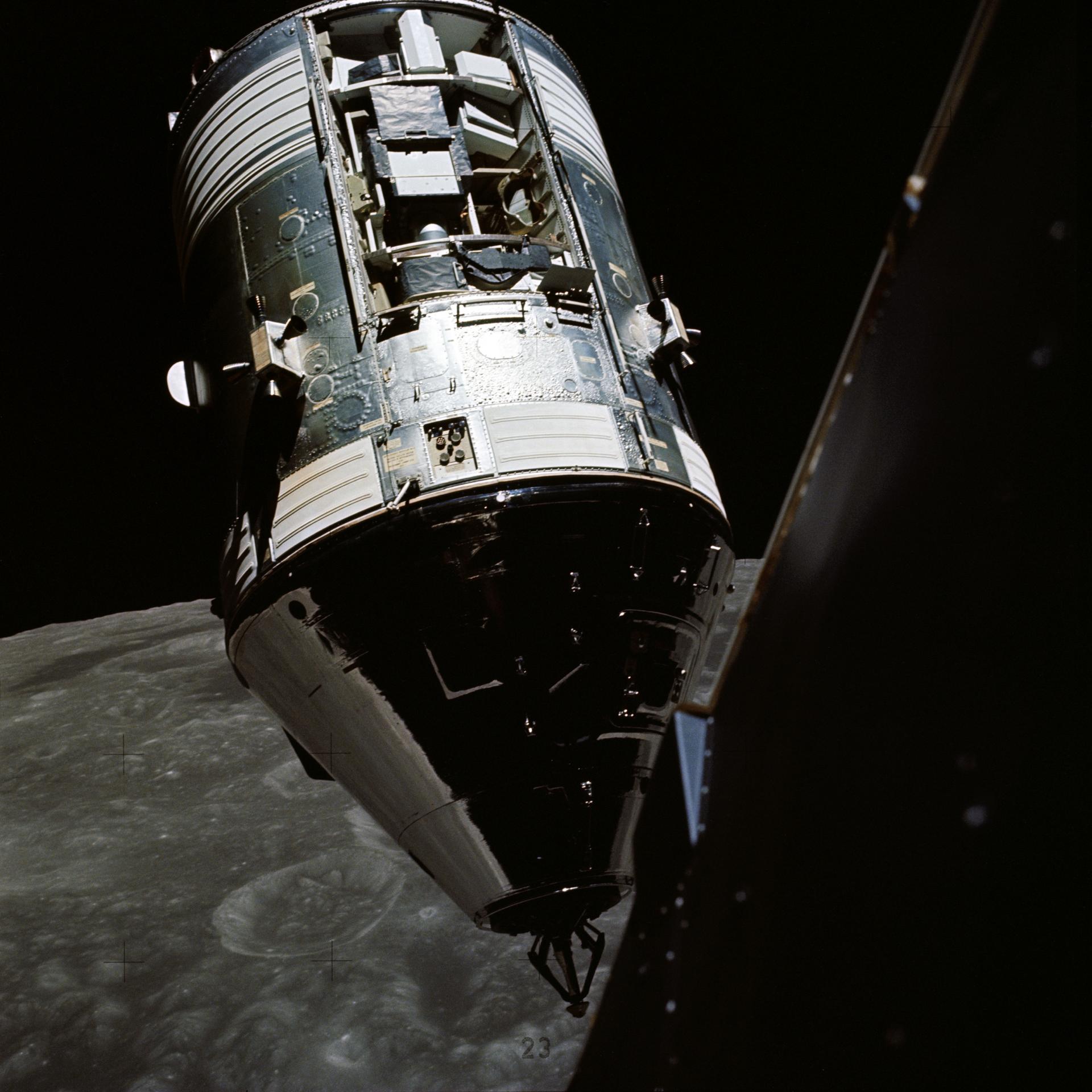
The last men to walk on the Moon logged bright drifting "particles," hours of flashing lights, and a photo with three dots in a triangle; the Pentagon has now catalogued the frame as unresolved.
What did witnesses see at Cislunar space (Apollo 17 translunar coast and lunar orbit)?
In December 1972, during Apollo 17, the last crewed flight to the Moon, all three astronauts logged sightings of bright lights and drifting objects that the mission's air to ground transcripts recorded in plain language. Those transcripts, together with an onboard photograph, were catalogued decades later inside the Presidential Unsealing and Reporting System for UAP Encounters (PURSUE) and posted publicly on war.gov/UFO, where the Apollo 17 photograph carries the file label NASA-UAP-VM6.
On the outbound translunar coast, Command Module Pilot Ronald Evans radioed Mission Control that "now we've got a few very bright particles or fragments or something that go drifting by as we maneuver." Lunar Module Pilot Harrison "Jack" Schmitt, the geologist on the crew, added the line that later gave the episode its nickname: "There's a whole bunch of big ones on my window down there, just bright. It looks like the Fourth of July out of Ron's window."
Mission Commander Eugene Cernan reported a separate and, to him, more troubling phenomenon. He had difficulty sleeping after seeing a flash he compared to an "imposing" train headlight, and over roughly the next three hours he described several flashing, rotating events that he assessed as corresponding to physical objects out in space rather than to a purely optical effect inside the cabin or his own eyes.
A photograph taken during the mission shows three small dots arranged in a triangular formation in the lower right quadrant of the lunar sky, a feature that becomes clearly visible when the image is magnified. It is that frame, not a video, that the Department of War singled out for re-examination.
What is the official explanation?
The material sat in the public domain for decades. The transcripts are part of NASA's released Apollo record and the photograph has circulated among researchers and image analysts for years, a point stressed by several journalists after the disclosure: the Apollo imagery was not, as some coverage implied, "newly declassified." What is new is the government's decision to pull these specific items into the PURSUE catalogue and to attach a fresh analytic note to them.
On the triangular dots photograph the Department of War's assessment is deliberately narrow. The released language states that "there is no consensus about the nature of the anomaly," while a preliminary analysis found that the feature "could be a physical object" in the scene rather than a flaw introduced by the film or the camera. That is an admission of uncertainty, not a claim of a craft.
The Apollo 17 items are a small part of the first PURSUE tranche, released 8 May 2026, one of three batches that also went out on 22 May and 12 June 2026. AARO, the Pentagon's All-domain Anomaly Resolution Office, has said publicly that roughly 40 percent of the reports it has reviewed lack a satisfactory conventional explanation and remain unresolved; the office has not placed the Apollo 17 observations in a resolved category, nor has it declared them extraterrestrial.
What did the witnesses think it was?
The Apollo 17 crew were disciplined test pilots and, in Schmitt's case, a trained field scientist, reporting in real time on an open loop to Houston. Their descriptions are careful and hedged: Evans says "particles or fragments or something," not a craft; Schmitt reaches for a familiar image, fireworks, rather than an aircraft or a saucer. That restraint is part of why the transcripts read as credible primary testimony rather than embellished after the fact recollection.
Cernan's account carries the most weight because he explicitly rejected the easy explanation. A commander who has spent days in the spacecraft knows the difference between a reflection on the window and something moving against the star field, and he stated that what he saw over those hours behaved like objects with their own motion. Whether he was right is a separate question from whether he believed it, and the transcript preserves that he believed it.
It is worth separating the three strands the case blends together: the daytime drifting particles Evans and Schmitt narrated, the nighttime flashes that kept Cernan awake, and the single still frame with the three dots. They may have three different causes. Coverage that folds them into one "Apollo 17 UFO" loses that structure, and the honest reading keeps them apart.
Is the Apollo 17 "Fourth of July" Lights (PURSUE Files) real? The two-pass assessment
Pass one, the mundane reading, is strong for two of the three strands. The bright drifting "particles or fragments" that Evans and Schmitt watched are almost certainly the halo of ice crystals, frozen vented fluids, insulation flecks and paint chips that surrounds every crewed spacecraft and lights up brilliantly against black space when the sun catches it. This is the same effect John Glenn famously called "fireflies" on Mercury Friendship 7 in 1962, and it was seen on Gemini and throughout Apollo. "It looks like the Fourth of July" is, if anything, a textbook description of that debris cloud.
Cernan's sleepless flashes have an equally concrete candidate, and one Apollo 17 was uniquely equipped to test. The crew flew the Apollo Light Flash Moving Emulsion Detector (ALFMED), a helmet of nuclear emulsion plates worn in darkness to see whether the light flashes astronauts had reported since Apollo 11 coincided with cosmic ray particles passing through the head. During the Apollo 17 experiment about seventeen flashes were reported and, with part of the plate area analysed, investigators found definite correlations between the flashes and the tracks of heavy cosmic ray nuclei, evidence that high energy particles crossing the retina and visual system were triggering the sensations. Cernan's "imposing train headlight" flashing fits that phenomenon closely, which complicates his own reading that the flashes were external objects.
Pass two, what survives if the prosaic answers are not the whole story, rests almost entirely on the photograph and on Cernan's insistence. The debris explanation does not obviously account for three point sources holding a fixed triangular geometry in one frame, and the government's own analysts declined to write the feature off as a film artifact, allowing that it "could be a physical object." That is a modest statement, but it is the government committing, in writing, to not knowing. Set against a body of thousands of Apollo frames with well understood specks and flares, a single ambiguous triangle is weak evidence for anything exotic; set against a blanket dismissal, it is a reason the file stays open.
The honest verdict is Disputed. There are powerful, specific, physics based explanations for the drifting lights and the flashes, one of them validated by an instrument the mission carried for exactly that purpose, and the imagery has been public and pored over for fifty years without producing a craft. At the same time the Department of War has now catalogued the photograph as unresolved and possibly a real object, and a mission commander went on record that some of what he saw moved like something physical. No official narrative calls this proof of anything, and neither does this file.
Sources
- www.war.gov/ufo/
- www.cbsnews.com/news/ufo-files-apollo-17-crew-mysterious-objects-1972-mission/
- www.newsnationnow.com/space/ufo/ufos-on-the-moon-apollo-17-astronauts/
- www.space.com/space-exploration/search-for-life/these-apollo-ufo-images-have-been-public-for-decades
- interestingengineering.com/culture/new-pentagon-ufo-archives-apollo-17
- ntrs.nasa.gov/citations/19760044009
- www.nasa.gov/history/afj/ap17fj/10_day04_part2_light_flash.html
- www.sciencenews.org/article/cosmic-rays-apollo-astronauts-light-flashes