Red Lights and Ground to Air Firing in the Berlin Air Corridor, 10 to 11 August 1953
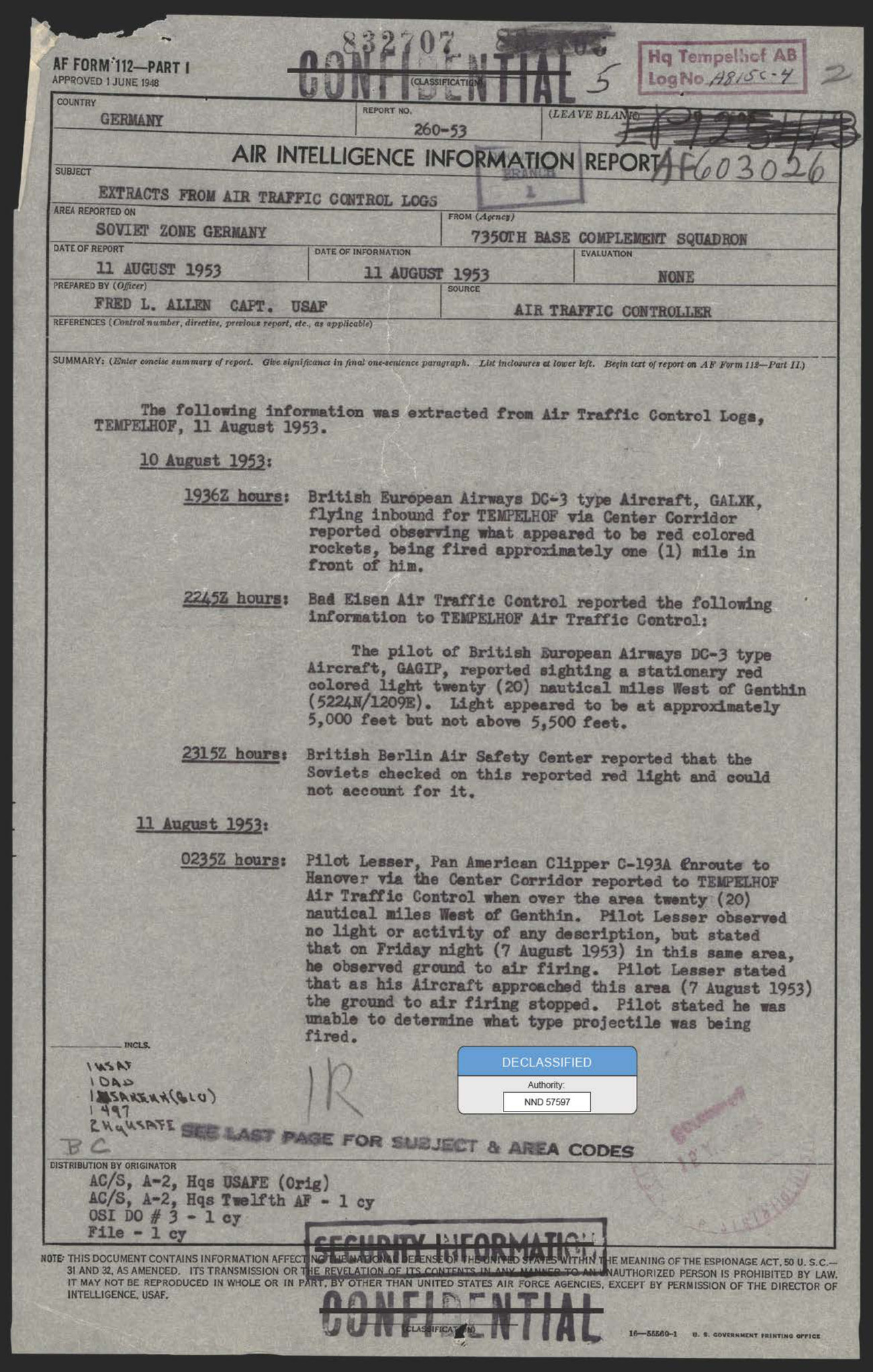
Two British airliners reported red lights over the Soviet zone, the Soviets were asked about one of them and said they could not account for it, and a Pan American pilot reported that ground fire stopped as he flew in.
What did witnesses see at Centre Corridor near Genthin?
Air traffic control at Tempelhof in West Berlin logged a short run of reports on the night of 10 to 11 August 1953. They came from civil aircraft flying the Centre Corridor across the Soviet zone of Germany, and the log extracts were transcribed into an Air Intelligence Information Report by the 7350th Base Complement Squadron and sent to United States Air Forces in Europe. The document was declassified under authority NND 57597 and published by the Department of War on 23 October 2026 as DOW-UAP-D159, in the seventh tranche of the PURSUE release programme.
The form is an AF Form 112 numbered 260-53, carrying the handwritten control number AF603026 and a Headquarters Tempelhof Air Base log number A815C-4. The subject line reads Extracts From Air Traffic Control Logs, the area reported on is Soviet Zone Germany, and both the date of report and the date of information are 11 August 1953. It was prepared by Captain Fred L. Allen of the United States Air Force, the Air Intelligence Officer. The source is given as "Air Traffic Controller" and the evaluation block reads NONE. It was originally classified CONFIDENTIAL and also bears the marking SECURITY INFORMATION. Distribution was to A-2 at Headquarters USAFE, A-2 at Headquarters Twelfth Air Force, OSI District Office 3 and file.
Four entries make up the whole document, and they are reproduced here in the order the log recorded them.
What is the official explanation?
The log entries, as transcribed in the report:
10 August 1953, 1936Z hours. British European Airways DC-3 type aircraft, GALXK, flying inbound for Tempelhof via Center Corridor, reported observing what appeared to be red coloured rockets being fired approximately one mile in front of him.
10 August 1953, 2245Z hours. Bad Eisen Air Traffic Control reported to Tempelhof Air Traffic Control that the pilot of British European Airways DC-3 type aircraft, GAGIP, reported sighting a stationary red coloured light twenty nautical miles west of Genthin, given as 5224N/1209E. The light appeared to be at approximately 5,000 feet but not above 5,500 feet.
10 August 1953, 2315Z hours. British Berlin Air Safety Center reported that the Soviets checked on this reported red light and could not account for it.
11 August 1953, 0235Z hours. Pilot Lesser, Pan American Clipper C-193A, en route to Hanover via the Centre Corridor, reported to Tempelhof Air Traffic Control when over the area twenty nautical miles west of Genthin. Pilot Lesser observed no light or activity of any description, but stated that on Friday night, 7 August 1953, in this same area, he observed ground to air firing. Pilot Lesser stated that as his aircraft approached this area on 7 August the ground to air firing stopped. The pilot stated he was unable to determine what type of projectile was being fired.
The second page records that as of the date of the report the originating office had been unable to contact Pan American Airlines pilot Lesser to obtain any further information. No evaluation was assigned, and the published file contains no follow-up.
What did the witnesses think it was?
There are four separate reporting parties in this document and they are worth separating, because they do not all describe the same thing.
The crew of the first British European Airways Dakota, registration G-ALXK, described something active rather than static: what appeared to be red coloured rockets being fired about a mile ahead of the aircraft, while inbound to Tempelhof through the corridor.
The crew of the second British European Airways Dakota, registration G-AGIP, described something static: a stationary red light twenty nautical miles west of Genthin, with an estimated altitude bracketed between 5,000 and 5,500 feet. That altitude estimate is the most useful number in the file, because it places the light below the corridor's upper airspace and within the band where ground-launched pyrotechnics would burn.
The Soviet response is the third party, and it came through the Berlin Air Safety Center, the one body in divided Berlin where Soviet, American, British and French representatives sat together to manage corridor traffic. The record that the Soviets checked and could not account for the light is therefore not an American characterisation of a Soviet position; it is a report passed through a quadripartite body thirty minutes after the sighting was logged.
The fourth party, Pan American pilot Lesser, is in the file twice over. On the night in question he flew the same patch of sky and saw nothing at all, which is a negative observation and belongs in the record as one. What he volunteered about a different night is the more striking item: that three nights earlier, on Friday 7 August 1953, he had seen ground to air firing in that same area, and that the firing stopped as his aircraft approached. He could not identify the projectile.
Is the Red Lights and Ground to Air Firing in the Berlin Air Corridor, 10 to 11 August 1953 real? The two-pass assessment
Pass one, how could this be mundane.
The prosaic reading is strong here and the document largely builds it. In August 1953 the Centre Corridor ran across the territory of a Soviet occupation force that was, at that moment, extremely jumpy. The 17 June uprising across East Germany had been put down by Soviet troops eight weeks earlier. Anti-aircraft units, signal flares, practice gunnery and live firing exercises were all routine in the zone, and the corridor overflew them.
Read that way, the file describes gunnery rather than craft. Red objects rising ahead of an aircraft, a stationary red light hanging between 5,000 and 5,500 feet, and an independently reported episode of ground to air firing three nights earlier in the same area, all fit flares, tracer and rocket ordnance. A parachute flare in particular holds near-stationary as it descends and burns red to orange, which matches the second report closely. Pilot Lesser's detail that firing stopped as his aircraft approached fits a ground unit on an exercise ceasing fire for traffic in a civil corridor, which is what a disciplined unit would do.
The Soviet denial does not weigh as heavily as it first appears. The report says the Soviets checked and could not account for the light. In the Cold War corridor environment there are several ordinary reasons a Soviet duty officer would be unable to account at short notice for an event involving his own forces, from a unit not reporting upward to a simple unwillingness to confirm live firing near a civil air route to a British enquiry. It is evidence that no explanation was offered, not evidence that none existed.
Pass two, if real, what is it.
What the file does establish, and what makes it worth preserving as a case, is narrower and more interesting than any object. Over about seven hours, two separate British civil crews independently reported red aerial phenomena along the same stretch of the Centre Corridor, the second with an altitude bracket; a quadripartite body put the question to the Soviets and recorded that they could not account for it; and a third pilot from a different airline reported ground to air firing in that same area on an earlier night, which stopped when he flew in. The Air Force recorded all of it, assigned no evaluation, and could not reach the one pilot who might have said more.
The tier is Unknown. No official narrative was published, the evaluation block was left as NONE, and the most likely explanation, Soviet ordnance over the corridor, is reasoned rather than demonstrated, since no Soviet exercise record has been produced here to confirm it. The transcription spells the reporting station "Bad Eisen", which this archive reproduces as written while noting it has not confirmed the station's identity.
Sources
- www.war.gov/medialink/ufo/release-07/documents/DOW-UAP-D159-Air_Intelligence_Information_Report_Germany-1953.pdf
- www.war.gov/UFO/
- www.war.gov/Portals/1/Interactive/2026/UFO/uap-data.csv
More cases from this region: UFO sightings in Germany