The Cash-Landrum Encounter
On the night of 29 December 1980, Betty Cash, 51, Vickie Landrum, 57, and Vickie's seven-year-old grandson Colby Landrum were driving home along Farm to Market Road 1485, a dark two-lane road through the piney woods north of Houston near Huffman and New Caney, Texas. This case file covers what witnesses reported, the official narrative, and a two-pass assessment with its evidence tier.
What did witnesses see at Farm to Market Road 1485 near Huffman?
On the night of 29 December 1980, Betty Cash, 51, Vickie Landrum, 57, and Vickie's seven-year-old grandson Colby Landrum were driving home along Farm to Market Road 1485, a dark two-lane road through the piney woods north of Houston near Huffman and New Caney, Texas. The time was around 9 PM. According to the case file John Schuessler opened on 4 March 1981 for Project VISIT, the group had been out looking for an open bingo game and had stopped for dinner, and were heading back when the road ahead lit up.
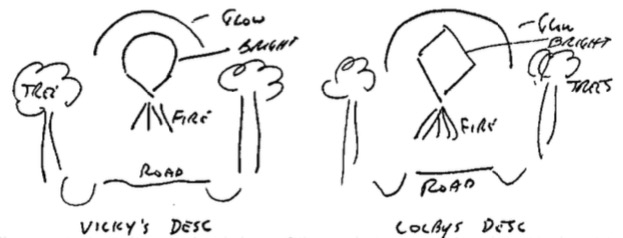
A large luminous object hung over the road in front of them. In her own words at the Bergstrom Air Force Base interview on 17 August 1981, Betty Cash described it as diamond-shaped and enormous: "maybe it was as large, if not larger than a water tower." Vickie Landrum agreed it was "about the size of ah, I'd say a BIG water tower, it was long, it wasn't no short, it was long." Cash estimated the object hung "60 to 80 feet" above the ground while they stopped the car "about 130 to 133 feet from it." The thing was so bright that, as Schuessler recorded in the 1981 case file, Betty "couldn't see details of the object." The two adults reported a hot, glowing mass that at intervals shot a cone of reddish flame downward toward the asphalt, accompanied by a beeping sound and a roar. Vickie compared the noise to a hurricane and said that each time the flame came it was "swoosh, swoosh like a flame thrower."
Betty Cash got out of the car to look. Vickie Landrum, with Colby terrified in the back seat, stayed near the open door. The flames and heat were intense enough, the witnesses said, that the car's metal grew too hot to touch comfortably, and Vickie reported the dashboard vinyl was left with a handprint where she pressed down. After several minutes the object lifted and moved off to the southwest, and as it went, the witnesses said the sky filled with helicopters that seemed to converge on it. Betty Cash counted what she put at 23 aircraft; Vickie counted as many as 26. Crucially, at Bergstrom, when Captain John Camp asked whether the helicopters carried markings, Cash answered: "Yes, they sure did. They had United States Air Force." She and Landrum described twin-rotor machines, "a double deal on the top," matching tandem-rotor heavy-lift helicopters like the CH-47 Chinook. The whole encounter, by Cash's estimate, lasted "15 to 16, 17 minutes."
They drove home shaken. Within hours all three felt ill. Over the next days Betty Cash, who had spent the longest time outside the car and closest to the object, became the most severely affected: nausea and vomiting, a pounding headache, diarrhea, a burning sensation, and then her skin broke out in blisters and welts. Her eyes swelled shut, she lost patches of skin and clumps of hair, and she was taken to a Houston-area hospital where she remained, by the accounts logged in the case file, for many days across more than one admission. Vickie Landrum suffered hair loss and scalp pain; both women later described damaged fingernails. Colby fared best of the three but reported eye irritation and skin trouble. The pattern of symptoms, sunburn-like skin damage, hair loss, gastrointestinal illness, eye injury, led investigators and several physicians to wonder aloud about a radiation exposure.
What is the official explanation?
There was no Project Blue Book to receive this report. Blue Book had closed in 1969, and the Air Force told the witnesses directly it no longer investigated UFOs. The first official contact came not from an investigation but from a damage claim. On 17 August 1981 Cash, Landrum, and Colby travelled to Bergstrom Air Force Base in Austin, where they were interviewed in the base law library by Captain John Camp, Acting Staff Judge Advocate, Captain Terry Davis, Claims Officer, and Pat Wolf, Assistant Claims Officer. The Air Force took their statements but provided only damage-claim forms and reiterated that it did not investigate such incidents. That transcript, preserved by the Computer UFO Network (CUFON), is one of the cleanest primary records of what the witnesses said under questioning by federal officers.
Because the witnesses insisted the helicopters were military, the matter went to the U.S. Army. Lt. Col. George C. Sarran of the Department of the Army Inspector General conducted a formal inquiry, interviewing the witnesses and canvassing units that might have been flying that night. His report concluded that there was no evidence Army, National Guard, or Army Reserve helicopters were involved, writing that the investigating officer "tried to concentrate on any reason or anyone in or organization which might have been flying helicopters that particular evening in the general area," and that "there was no evidence presented that would indicate that Army, National Guard, or Army Reserve helicopters were involved." Significant for the case, Sarran did not dismiss the women as cranks. Having interviewed Cash and Landrum himself, he described them as credible witnesses. The official finding was therefore narrow: the government could find no record of its own aircraft over FM 1485 that night, while the people reporting them struck the investigating officer as honest.
The Texas Department of Health, Bureau of Radiation Control, also looked into the matter. Investigator Charles Russ Meyer met with Schuessler on 10 September 1981 and conducted a field survey of the road on 16 September 1981. His report, dated that month, found no residual radiation along the route. The State offered to take the investigation further by having its own physicians examine the witnesses' medical records, an offer that, per the documents later surfaced by researcher Curt Collins, was not taken up.
With no official body accepting responsibility, the witnesses sued. Represented pro bono by attorney Peter Gersten, Betty Cash, Vickie Landrum, and Colby Landrum filed suit against the United States in the U.S. District Court for the Southern District of Texas, Civil Action No. H-84-348, seeking 20 million dollars in damages under the Federal Tort Claims Act. On 21 August 1986 a U.S. District Court judge dismissed the case. The grounds were not that nothing had happened to the plaintiffs but that they had failed to demonstrate the craft or the helicopters belonged to or were operated by the United States government. With no proof of government ownership, there was no basis for federal liability. The three remain among the very few people ever to sue the U.S. government over injuries attributed to a UFO encounter.
What did the witnesses think it was?
Betty Cash and Vickie Landrum never wavered from their account. To them this was not a light in the sky but a physical machine that had burned them. Vickie Landrum, a deeply religious woman, reportedly told Colby during the encounter that the light might be Jesus returning, and held to a conviction that whatever it was, it had been real and solid. Betty Cash bore the heaviest cost. Her health collapsed after the encounter: repeated hospitalizations, skin sores, weight loss, and eventually cancer. She died on 29 December 1998, the eighteenth anniversary of the encounter, a coincidence noted in her obituary in The Anniston Star the following day. Vickie Landrum lived on into the 1990s and continued to give interviews insisting the event happened as described.
The witnesses believed the helicopters were the key. They were certain the aircraft were American military and that the helicopters were escorting, chasing, or trying to contain the burning object, which to them implied the government knew about it. That belief drove the lawsuit. The chief investigator, John F. Schuessler, then a NASA contractor working on the Space Shuttle program and a senior MUFON figure, came to share it. After the Army Inspector General found no Army aircraft, Schuessler did not abandon the helicopter element; he proposed the aircraft might have been operating from a vessel, and he continued to argue across his 1998 book The Cash-Landrum UFO Incident that the witnesses had run into something the government would not own. His decades of advocacy, and his stewardship of the medical records, kept the case alive as a flagship physical-effects encounter.
Independent corroboration is thinner than the case's fame suggests, and this is one of its weak points. The original VISIT file records that Schuessler appealed through the media for additional witnesses, and that Bill English of APRO cited a Liberty, Texas newspaper account of three other people who saw the object, but that story could not be located. A neighbor in a trailer home near the route said they were in bed by 8 PM and heard nothing. Popular retellings name an oilfield worker, Jerry McDonald, who reportedly saw a diamond-shaped object with twin torches, and an off-duty Dayton police officer and his wife, but these accounts are not securely tied to the primary case file and should be treated as second-hand until a contemporary document surfaces. What is firmly documented is the testimony of the three principals, their medical history, and the official paper trail their complaint generated.
The dispute
The dispute in this case does not come from the government, which mostly stood aside. The Air Force declined to investigate under its post-1969 no-UFO policy, and the U.S. Army Inspector General, Lt. Col. George C. Sarran, found no evidence that Army, National Guard, or Army Reserve helicopters were involved, yet judged the three witnesses credible. The Texas Department of Health's investigator Charles Russ Meyer found no residual radiation along the route in a September 1981 field survey, and a 1986 federal court dismissed the witnesses' 20 million dollar suit only because they could not prove government ownership of the craft or helicopters, not because the event was found false. None of that is a debunk of the encounter itself; the official apparatus produced denials and a non-finding, and by this archive's method an apparatus assertion is a claim, not a verdict.
The substantive challenge comes instead from independent civilian analysts, and it is method-shown rather than asserted. Skeptic Gary Posner, MD, and, separately, Brad Sparks working with radiation oncologist Dr. Richard Niemtzow for APRO in the early 1980s, concluded the reported symptoms do not match ionizing-radiation sickness. Posner's argument is quantitative: a dose heavy enough to blister skin and drop hair within hours would have been fatal, yet both women survived for years and Colby is still alive, so by definition no one took a lethal dose and the injuries must have another cause. Posner also noted that a photo of Betty Cash's arms showed discrete round sunburn-pattern marks that no distant radiating object could produce, and floated, as a hypothesis only, self-inflicted lesions and the term Munchausen syndrome, an idea that has never been confirmed because the medical records were never released. On the physical-trace side, Alan Hendry's 1981 report for the Fund for UFO Research recorded that later examination showed no marks on the pavement, and researcher Curt Collins documented that the exact sighting spot was never pinpointed and, in 2017, that the fleet of marked tandem-rotor Chinooks could not be substantiated as physical aircraft at all despite being trivially traceable had they flown over suburban Houston.
This is the rare case where the counter-evidence is real, named, and shown by method, and it genuinely wounds the case: the radiation diagnosis is medically inconsistent, the scorched-road traces were never actually documented, the sighting location was never fixed, and the 23-plus marked helicopters have never been traced. What it does not do is close the case. No analyst demonstrated that the event was staged or that the witnesses lied; Posner's Munchausen line is an unconfirmed hypothesis resting on records that remain sealed, and no one has produced a balloon, re-entry, aircraft, ordinary object, or hoax method that reproduces the whole report of a glowing diamond venting flame downward and burning its witnesses. Against the debunk stands a hard core the skeptics do not dissolve: three people including a child gave a consistent, detailed account within weeks and never recanted across nearly twenty years, the one government officer who met them found them credible, and Betty Cash's illness was real and documented through repeated hospital admissions. The dispute therefore strips the case of its load-bearing physical evidence without settling it as ordinary or as a hoax, which is why it stands as Disputed rather than discredited.
Is the Cash-Landrum Encounter real? The two-pass assessment
Pass one, how this could be ordinary. The most damaging facts come not from debunkers but from the case's own document trail, surfaced largely by researcher Curt Collins. Texas Department of Health investigator Charles Russ Meyer recorded on 17 September 1981 that Schuessler could only place the sighting "on the straight portion of FR 1485 between a beer joint and some kind of highway warning sign," meaning the exact spot was never actually pinpointed. Alan Hendry, writing his 1981 report for the Fund for UFO Research, noted that "later examination showed no marks on the pavement." This guts the physical-trace claim: there are no photographs of a scorched road, no soil or pavement samples in evidence, despite Schuessler having stated on television in later years that the witnesses returned to a clearly heat-damaged spot. If the location was never fixed and no marks were ever documented, the case's physical evidence is testimony alone.
The radiation story is equally fragile. Skeptic Gary Posner, MD, and, independently, Brad Sparks, working for the Aerial Phenomena Research Organization in the early 1980s with radiation oncologist Dr. Richard Niemtzow, concluded the reported symptoms do not match ionizing-radiation sickness. Sparks wrote in 1999 that it "does NOT appear that the Cash-Landrum symptoms were due to ionizing radiation." Posner's point is mathematical: a dose heavy enough to blister skin and drop hair within hours would have been fatal, yet both women survived years and Colby is still alive, so by definition no one received a fatal dose, and the symptoms must have another cause. Posner went further, noting that a photograph of Betty Cash's arms showed discrete round sunburn-pattern marks that no distant radiating object could produce, and floated the possibility of self-inflicted lesions, raising the term Münchausen syndrome. That is a hypothesis, not a finding, and it has never been confirmed because the medical records have never been released. The withholding of those records, even after Betty Cash's death, is itself a problem: the case leans on her injuries as proof while refusing the documentation that could test the claim. As for the 23 marked helicopters, a fleet of tandem-rotor Chinooks over suburban Houston during Christmas week should have been trivially traceable on radar, by noise complaints, and by maintenance and flight records, and after the Army Inspector General's canvass and decades of searching, not one has been located. Curt Collins, examining the CH-47 hypothesis in 2017, concluded the helicopter element cannot be substantiated as physical aircraft at all.
Pass two, if real, what it would be. Set against all that is the hard core the skeptics do not dissolve. Three people, one a small child, gave a consistent, detailed account within weeks of the event and never recanted across nearly twenty years. The Army's own Inspector General, Lt. Col. George Sarran, interviewed the women and judged them credible. Betty Cash's illness was real and documented through repeated hospital admissions; something put her in the hospital, even if its nature is disputed. No prosaic single object neatly fits a glowing diamond that hovers, vents flame downward, and burns its witnesses, and no one has produced a model, a balloon, a re-entry, an aircraft, or a hoax method that reproduces the whole report. If the encounter happened as described, it was a genuine unknown, possibly a craft whose exhaust or emissions injured the witnesses, with the helicopters a real but unacknowledged military response, which is precisely what Schuessler argued for the rest of his life.
The verdict is Disputed. There is a serious, method-shown body of independent civilian analysis, Sparks, Niemtzow, Posner, Hendry, and Collins, that undermines the case's strongest pillars: the radiation diagnosis is medically inconsistent, the physical traces were never actually documented, the sighting location was never fixed, and the marked-helicopter fleet has never been traced. None of that, however, demonstrates that the core event was staged or that the three witnesses lied, and the one government officer who met them found them credible while their injuries were real. The counter-explanations wound the case badly without closing it. It stands as Disputed: a famous physical-effects encounter whose load-bearing evidence has not survived primary-source scrutiny, but whose central testimony has never been shown to be false.
Sources
- web.archive.org/web/20260802212300/http://www.cufon.org/cufon/cashlani.htm
- www.blueblurrylines.com/2018/02/the-original-cash-landrum-case-file.html
- www.blueblurrylines.com/2013/11/the-cash-landrum-incident-suppressed.html
- www.blueblurrylines.com/2013/07/resource-guide-for-cash-landrum-ufo-case.html
- www.blueblurrylines.com/2017/09/the-cash-landrum-ufo-prime-suspect-ch.html
- ufologie.patrickgross.org/htm/cashlandrumsarran01.htm
- skepticalinquirer.org/wp-content/uploads/sites/29/2014/03/p28.pdf
- www.blueblurrylines.com/2022/12/the-nsa-cash-landrum-ufo-document.html
More cases from this region: UFO sightings in United States