The Chiles-Whitted Sighting
At about 2:45 in the morning on 24 July 1948, an Eastern Air Lines DC-3 was on a scheduled run from Houston to Atlanta, cruising at around 5,000 feet about twenty miles southwest of Montgomery, Alabama. This case file covers what witnesses reported, the official narrative, and a two-pass assessment with its evidence tier.
What did witnesses see at About 20 miles southwest of Montgomery?
At about 2:45 in the morning on 24 July 1948, an Eastern Air Lines DC-3 was on a scheduled run from Houston to Atlanta, cruising at around 5,000 feet about twenty miles southwest of Montgomery, Alabama. In the cockpit were Captain Clarence S. Chiles, a former Army Air Forces pilot with thousands of flying hours, and First Officer John B. Whitted. By Chiles' own account, given to an Air Technical Intelligence Center team a few days later, he first saw "a light dead ahead and closing fast." His instinct was that it was a jet, but in the next instant he understood that no jet could close on him that quickly. He tapped Whitted on the arm and pointed. The object was almost on top of them. Chiles racked the airliner into a tight left turn, and as the thing flashed past about 700 feet to the right, the DC-3 hit a patch of turbulent air. Whitted twisted around in time to watch the object pull up into a steep climb and disappear into the clouds above.
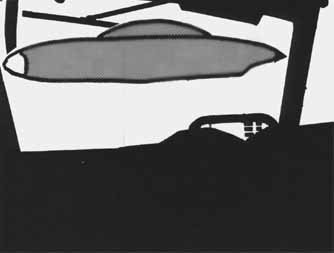
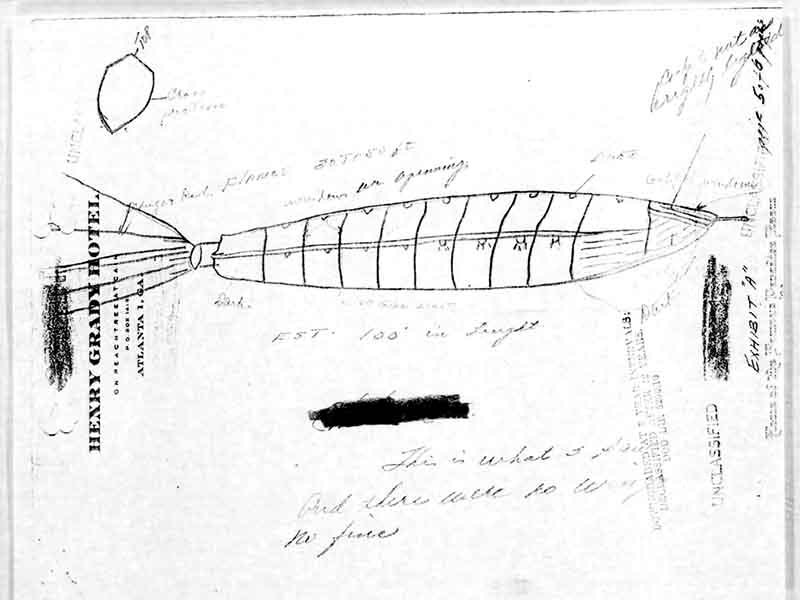
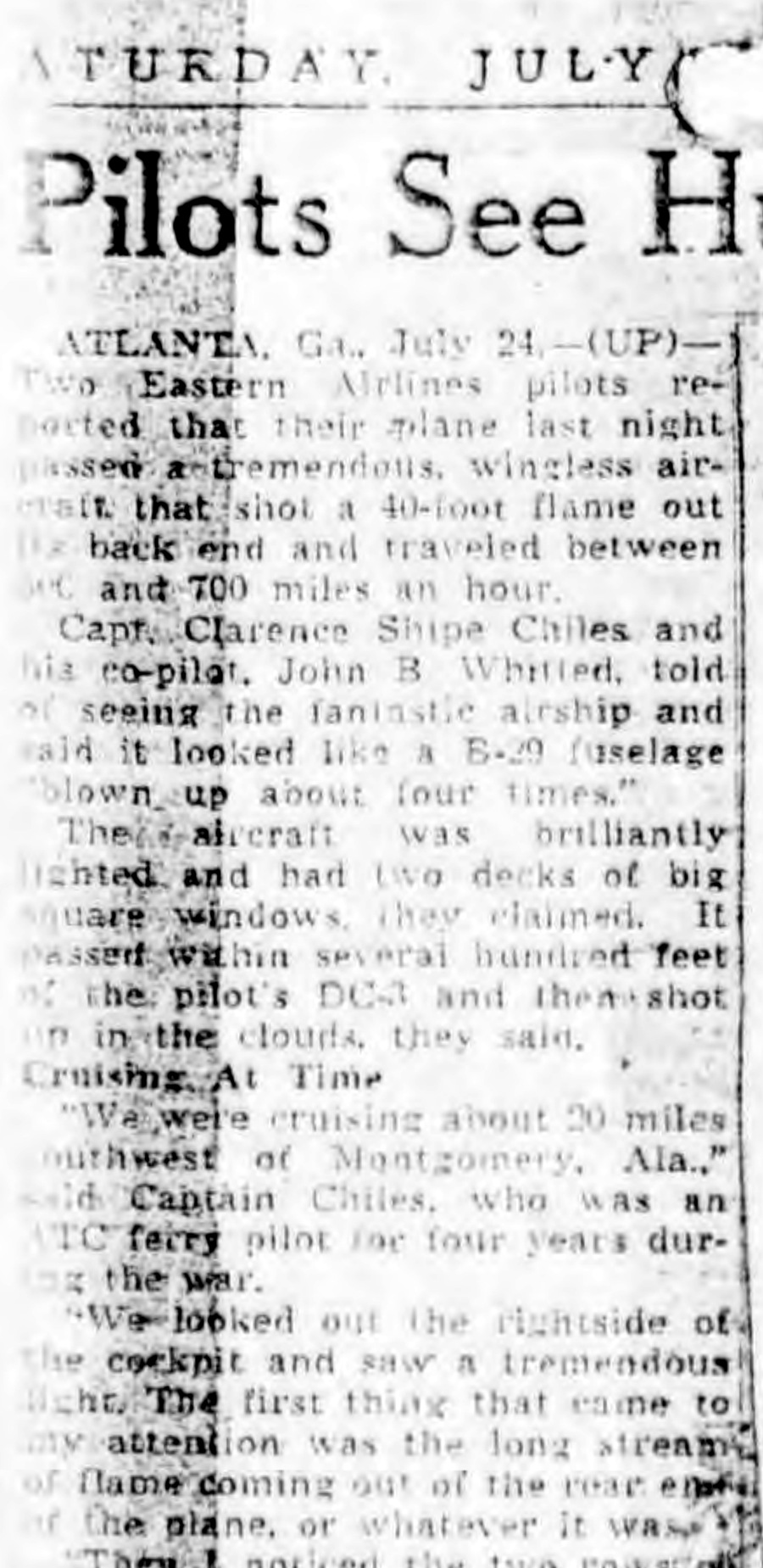
Both men had a clear look, and both described nearly the same thing. They reported a wingless, cigar or torpedo-shaped object roughly the size and shape of a B-29 fuselage, about a hundred feet long. The underside carried what Ruppelt recorded as a "deep blue glow." Down the side ran "two rows of windows from which bright lights glowed," and out of the tail shot a "50-foot trail of orange-red flame." Chiles put it plainly in his statement: "It was clear there were no wings present, that it was powered by some jet or other type of power, shooting flame from the rear some 50 feet." Whitted described "a ship approximately 100 feet long, cigar-shaped," with the two rows of square, brightly lit windows. The pilots stressed that this was no faint dot. It was close, it was structured, and it was gone in seconds.
There was a passenger witness too. Only one of the twenty people aboard happened to be looking out a window at that hour. The ATIC investigators interviewed him: passenger Clarence L. McKelvie, who reported a "strange, eerie streak of light, very intense," but no detail. He said it was over before his eyes could adjust to the dark. There were also ground reports the same night. A crew chief at Robins Air Force Base near Macon, Georgia, ground crewman Walter Massey, reported seeing an extremely bright light pass overhead at high speed, and a few days later a pilot flying near the Virginia-North Carolina line reported a "bright shooting star" in the direction of Montgomery at about the time the DC-3 was buzzed. When investigators plotted the airliner's encounter on a map, the object's heading would have carried it almost directly over Macon after it passed the plane, lining up with the Robins AFB sighting.
More footage and images of this sighting
What is the official explanation?
The case landed at Project Sign, the Air Force's first formal UFO study and the predecessor to Project Grudge and Project Blue Book. Sign investigators, working out of Wright-Patterson Field, treated it as a top-tier event. Edward Ruppelt, who would soon run the program, wrote that "according to the old timers at ATIC, this report shook them worse than the Mantell Incident. This was the first time two reliable sources had been really close enough to anything resembling a UFO to get a good look and live to tell about it." The Robins AFB ground report and the Virginia report seemed, in the words of the file, to confirm rather than contradict the pilots. The investigation is filed as Project Sign Case 144, and the witnesses' own signed statements and their 26 July sketches are preserved in the surviving Project Blue Book record.
The Chiles-Whitted encounter, together with the Mantell crash in January 1948 and the Gorman "dogfight" that October, became the three cases Ruppelt called "The Classics." They pushed Sign personnel toward a startling internal conclusion. As Ruppelt recorded it: "A few days after the DC-3 was buzzed, the people at ATIC decided that the time had arrived to make an Estimate of the Situation. The situation was the UFO's; the estimate was that they were interplanetary!" He described the physical document precisely: "It was a rather thick document with a black cover and it was printed on legal-sized paper. Stamped across the front were the words TOP SECRET." It collected the strongest cases the Air Force had, each one an unknown from credible observers, and concluded the objects were interplanetary craft. The estimate was typed, approved, and sent up the chain. It reached the Air Force Chief of Staff, General Hoyt S. Vandenberg. Ruppelt: "The general wouldn't buy interplanetary vehicles. The report lacked proof. A group from ATIC went to the Pentagon to bolster their position but had no luck." Then the closing line that made the document famous: "The estimate died a quick death. Some months later it was completely declassified and relegated to the incinerator. A few copies, one of which I saw, were kept as mementos."
With the interplanetary verdict killed at the top, the official explanation shifted to the natural world. The Sign consultant astronomer, Dr. J. Allen Hynek of Ohio State, argued the pilots had seen an exceptionally bright meteor or fireball, noting that meteor activity was elevated on the night of 23 to 24 July. Hynek's own analysis contained a revealing limit: confronted with the rectangular windows the pilots both drew, he wrote that "it will have to be left to the psychologists to tell us whether the immediate trail of a bright meteor could produce the subjective impression of a ship with lighted windows." There was also a brief Cold War turn. A December 1948 Air Force assessment floated that some UFOs might be Soviet reconnaissance craft probing US air defenses. The meteor explanation eventually won out as the formal disposition, and by 1959 the Air Force listed the Chiles-Whitted object as a meteor, even though the early Sign files had carried it as unexplained. The surviving Project Sign paperwork for Incident 144 is more specific than the summaries usually built on it, and three documents in it are worth quoting directly.
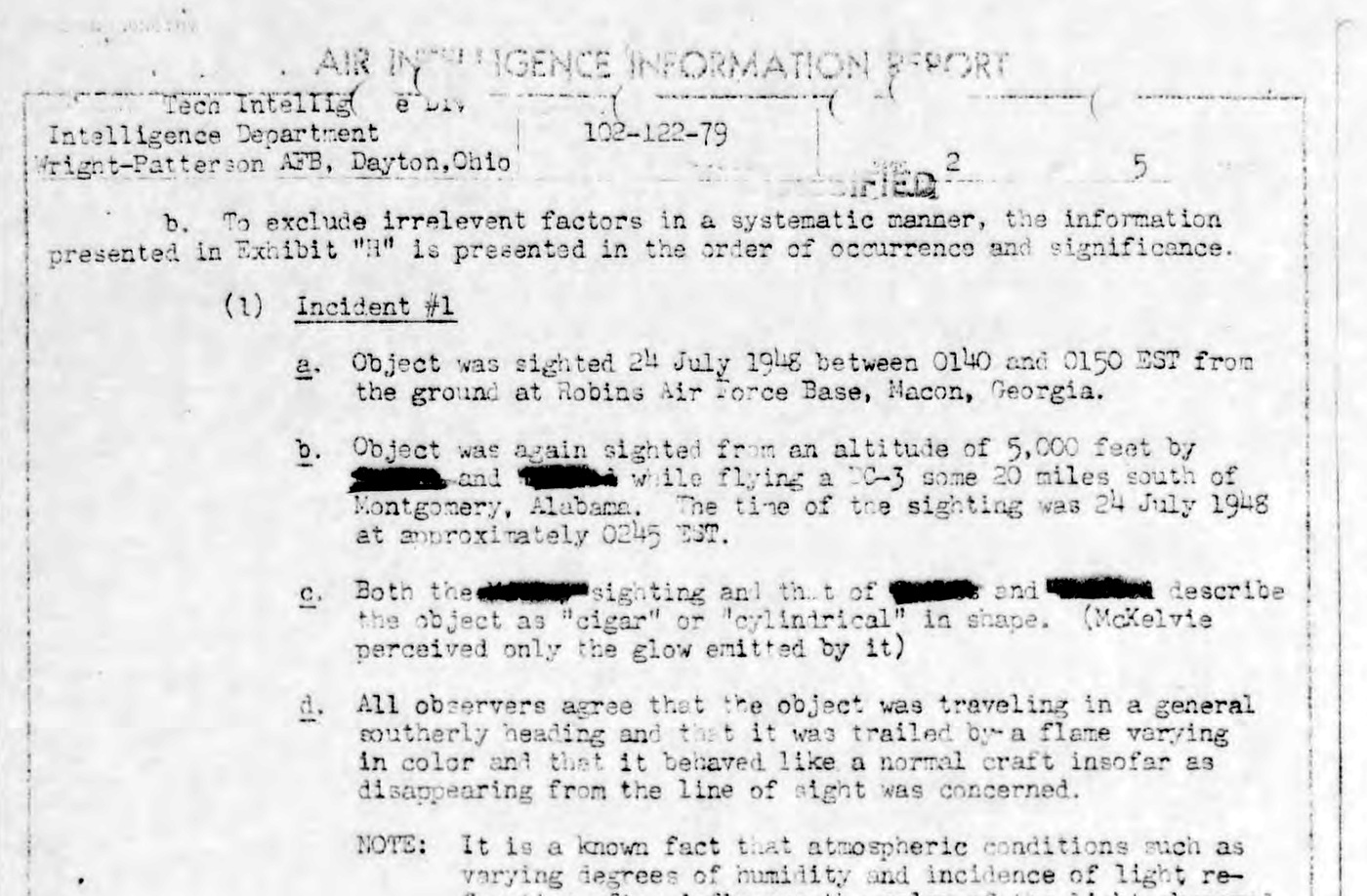
The first is an Air Intelligence Information Report from the Technical Intelligence Division at Wright-Patterson, filed under reference 102-122-79, which lays the night out as a numbered sequence. Its Incident #1 records that the object was first sighted on 24 July 1948 between 0140 and 0150 EST from the ground at Robins Air Force Base, Macon, Georgia, and that it was "again sighted from an altitude of 5,000 feet" by the two pilots flying the DC-3 "some 20 miles south of Montgomery, Alabama" at approximately 0245 EST. Note the discrepancy, which the secondary literature tends to smooth over: this document says south of Montgomery, while the pilots' own press account and Ruppelt both say southwest. The report has all observers agreeing the object held a general southerly heading and was "trailed by a flame varying in color," and it records that the object "behaved like a normal craft insofar as disappearing from the line of sight was concerned." It notes that the shape was given as "cigar" or "cylindrical," and that the passenger, named in the clear as McKelvie where the aircrew names are blacked out, "perceived only the glow emitted by it."
Two findings in that same report speak to the quality of the testimony. It states that "Four witnesses to this sighting are involved; three are trained observers. In no instance were there any indications of subversive or ulterior influences involved." It also records that the accounts "were officially made within a period of time that would preclude any chance of impressions being gained from radio or newspaper reports," which is a documented finding on witness contamination, not a later assumption.
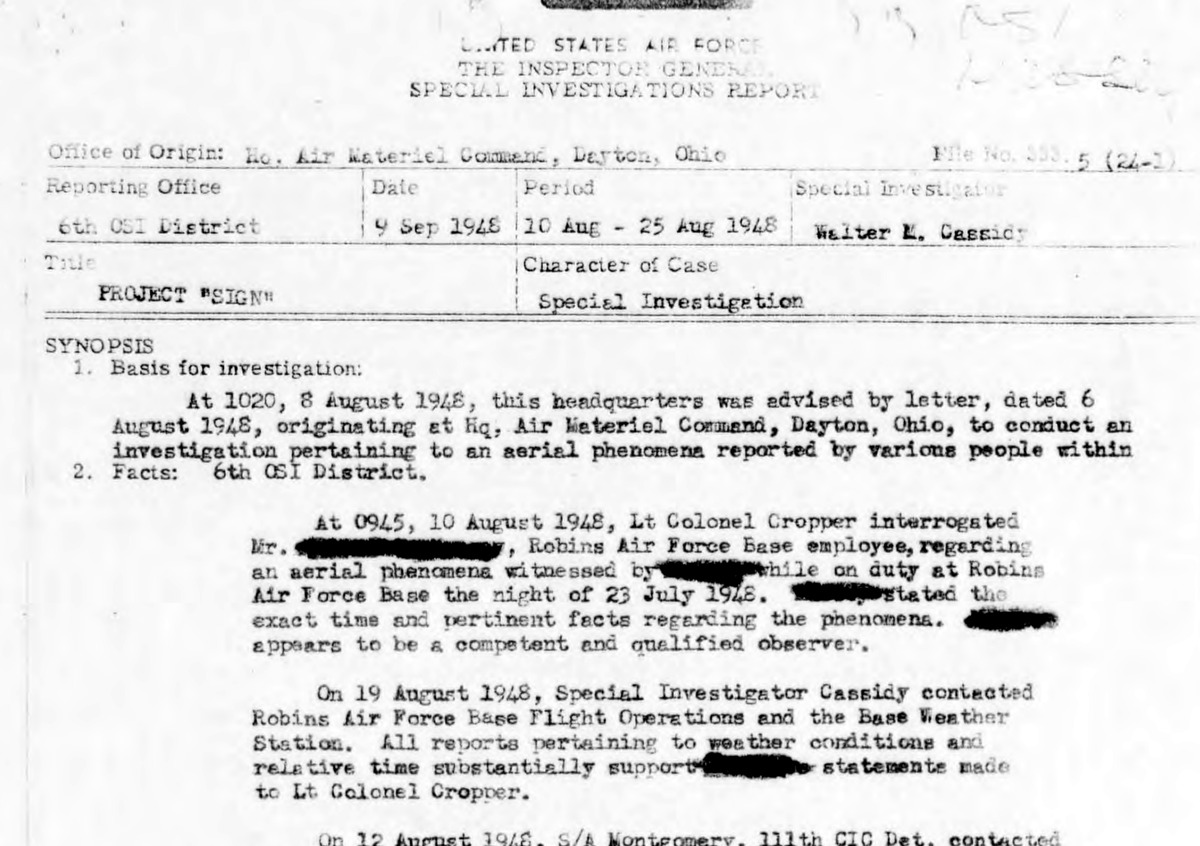
The second document is a United States Air Force Inspector General Special Investigations Report from the 6th OSI District, dated 9 September 1948, covering the period 10 to 25 August 1948, with Walter M. Cassidy as special investigator and approval signed by Lt Col Eugene C. Cropper. It records that investigators canvassed Robins AFB flight operations and its base weather station and found that the weather and timing records "substantially support" the witness statements. Its most quotable line concerns a separate canvass at the Atlanta Naval Air Base, where "it was generally agreed that the phenomena resembled a shooting star, despite the fact that course and altitude did not correspond to the characteristics of such an aerial phenomena." That is the Air Force's own investigators writing down, in 1948, that the meteor answer did not fit the observed course and altitude.
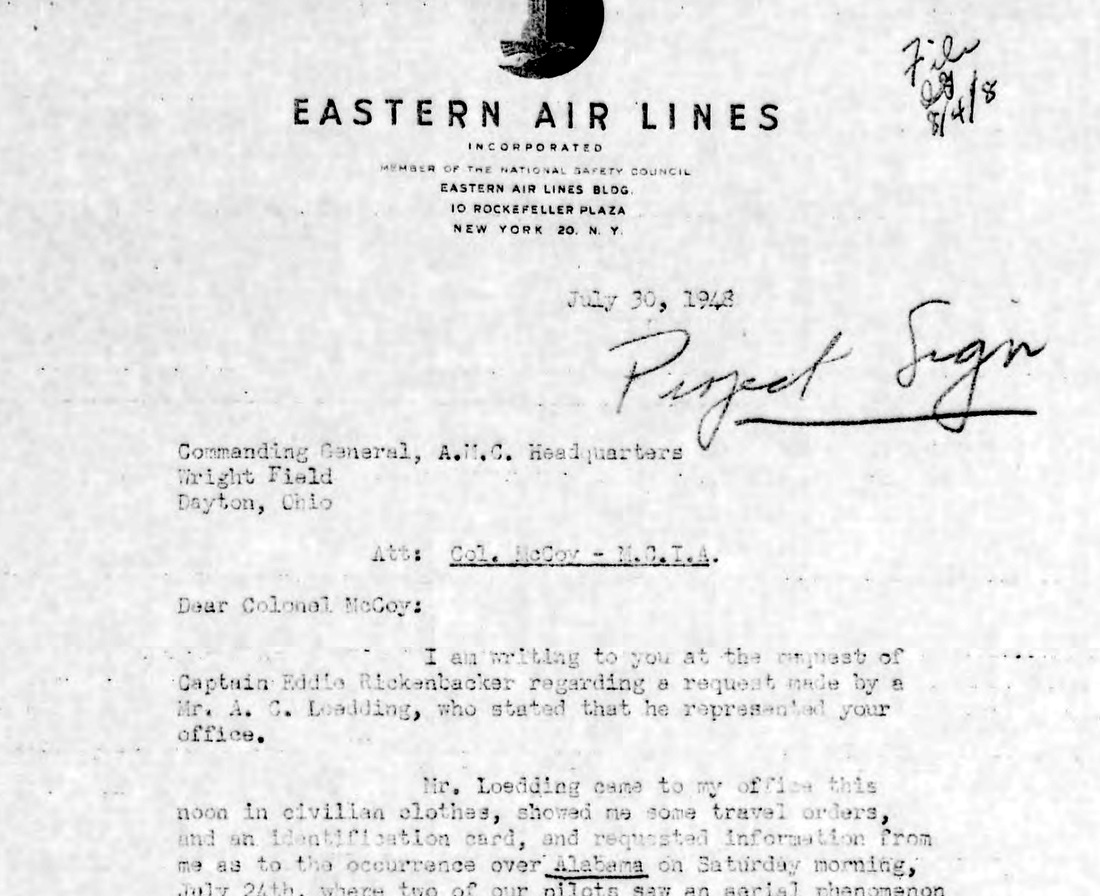
The third is a short administrative letter that shows how seriously the airline took it. On 30 July 1948, on Eastern Air Lines letterhead from 10 Rockefeller Plaza, a company vice president wrote to the Commanding General at Air Materiel Command headquarters, Wright Field, for the attention of Col. McCoy, saying he was writing at the request of Captain Eddie Rickenbacker. A Mr. A. C. Loedding had come to his office in civilian clothes with travel orders and an identification card, asking for information "as to the occurrence over Alabama on Saturday morning, July 24th, where two of our pilots saw an aerial phenomenon on their flight path." Rickenbacker had asked for written confirmation before anything was handed over. Loedding was the Sign engineer closest to the interplanetary reading of the data, and the file is annotated in pencil "Project Sign."
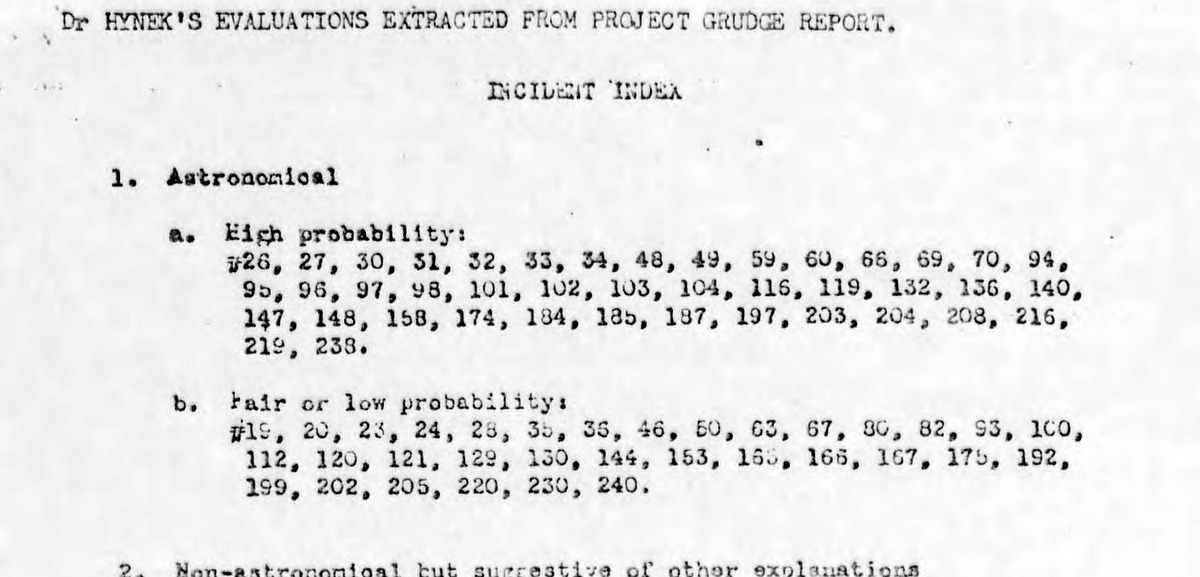
There is also a precise correction to make about Hynek. The evaluation index extracted from the Project Grudge report sorts every numbered incident into categories, and Incident 144 does not appear in the astronomical high probability list. It appears in the second line, "Fair or low probability." Hynek's meteor reading of Chiles-Whitted was, on his own filing, a weak astronomical candidate rather than a confident identification.
What did the witnesses think it was?
Chiles and Whitted were not casual observers. Both were professional airline pilots, Chiles a former military flier, and they reacted as airmen do to a possible mid-air collision: Chiles physically threw the DC-3 into an evasive turn before anyone had time to theorize. They did not describe a falling star. They described a powered machine that came at them head-on, passed close on one side, and then climbed away and pulled up into a cloud bank, a flight path no meteor follows. Within roughly thirty-six hours they sat down separately at an Atlanta hotel and drew what they had seen for Project Sign. The two sketches, made on 26 July 1948, show the same thing: a wingless tube with a row of square windows down the side and flame trailing from the tail. The close agreement between two men drawing independently is part of why the case rattled the investigators.
Both men held to their account for the rest of their lives. In the 1960s the atmospheric physicist Dr. James E. McDonald, a serious scientific critic of the Air Force's handling of UFO reports, tracked down and re-interviewed Whitted. Whitted again insisted the object had moved up and into the clouds, behavior McDonald flatly rejected as impossible for a meteor. The computer scientist and astronomer Jacques Vallee reached the same view, fastening on the same detail: an object that climbs and enters a cloud deck is not falling space debris. The corroborating witnesses point the same direction without proving anything exotic. Passenger Clarence McKelvie confirmed a sudden intense light at the right moment from inside the cabin. Ground crewman Walter Massey at Robins AFB reported a fast, very bright light overhead on a heading consistent with the object continuing past the airliner toward Macon, and a pilot near the Virginia-North Carolina line logged a brilliant "shooting star" toward Montgomery at about the same time. The witnesses believed, and said for decades, that they had nearly collided with a structured craft under power, not a rock burning up in the atmosphere.
One piece of the corroboration usually attached to this case has to be given back, and the Air Force's own analysts are the ones who took it. The Air Intelligence Information Report treats the sighting from near the Virginia and North Carolina line as Incident #2, logged at 0230 hours on 24 July 1948 between Blackstone, Virginia and Greensboro, North Carolina, and it deliberately holds it apart from the airliner encounter. Its stated reasoning is that the descriptions of speed as "meteoric" or "terrific," the manner of travel described as an arc or horizontal, and the fact that it "faded like a meteor" all "seem to indicate that the object seen was not the one observed in Incident 1." So the report that Ruppelt and much of the later literature present as a third confirming data point was, in the contemporary file, assessed as a probably different object, and most likely an actual meteor. Removing it does not weaken the pilots' account, but it does mean the case rests on the DC-3 crew, the passenger and the Robins AFB ground observer, not on a four-point track across three states.
The same document carries a third event that rarely gets mentioned at all. Its Incident #3 covers an object seen between 2100 and 2300 hours on 26 July 1948 at Chamblee and Augusta, Georgia, of which the report says plainly that it "was not thought to be a meteor in that it maneuvered," with a glow "varied in color but predominantly brilliant blue-white" on a generally southern course.
The dispute
The dispute is the meteor explanation. Project Sign's astronomical consultant, Dr. J. Allen Hynek of Ohio State University, argued in 1948 that Chiles and Whitted had seen an unusually bright meteor or fireball, citing elevated meteor activity on the night of 23 to 24 July. The US Air Force adopted this as the formal disposition and by 1959 officially listed the object as a fireball-type meteor. The skeptic Philip J. Klass later endorsed the meteor reading, and researcher Kevin Randle, after reviewing the file, concluded a bolide was "the most likely answer," pointing to the well-documented 1968 Zond IV re-entry as a case where multiple credible witnesses described a "cigar-shaped craft with windows" that was in fact a spacecraft burning up. The argument is that a near-zenith fireball can mimic a structured craft: the glowing fragment train reads as a row of windows, the long trail reads as exhaust, and the absence of any night-time range cue makes a distant object seem close and seem to "pull up." On this reading the Robins AFB ground witness and the Virginia "shooting star" report are simply the same fireball seen along its track.
The reason this counts as a dispute and not a closing is that it was never converted from a plausible reconstruction into a positive identification. No specific fireball was ever traced and matched to this exact time and trajectory, no debris was recovered, and the explanation runs straight into the detail both pilots insisted on: the object climbed and pulled up into a cloud bank, which meteors do not do. Hynek's own write-up conceded the weak point, leaving it "to the psychologists to tell us whether the immediate trail of a bright meteor could produce the subjective impression of a ship with lighted windows." That is an admission that the central feature of the sighting was not explained by the physics, only deferred to an unproven perceptual argument.
Two serious investigators who actually interviewed the witnesses rejected the meteor. The atmospheric physicist Dr. James E. McDonald re-interviewed Whitted in the 1960s, and Whitted again described the object moving up and into the clouds, which McDonald regarded as impossible for a meteor. Jacques Vallee independently reached the same conclusion on the same ground. So the case has a named counter-explanation with genuine astronomical support on one side, and on the other the witnesses' consistent core observation plus the Air Force's own early treatment of the event as unexplained and important enough to seed a Top Secret interplanetary estimate. A contested psychological-misperception argument and an official assertion without a traced, identified object do not meet the bar for a strong dispute, so the case is Barely Disputed and largely stands on the testimony.
Is the Chiles-Whitted Sighting real? The two-pass assessment
Pass one, the ordinary reading. The most-developed natural explanation is a bright fireball or bolide. The night of 23 to 24 July 1948 carried elevated meteor activity, and a brilliant meteor can leave a glowing trail, fragment into a string of luminous points that the eye can read as "windows," and vanish in seconds, which fits the ten-second duration. The same fireball crossing the sky could plausibly account for the Robins AFB ground sighting near Macon and the "bright shooting star" reported near the Virginia line, all roughly along one luminous track. This is the line Hynek took in 1948, the disposition the Air Force formalized by 1959, and the conclusion later defended by Philip Klass and, with reservations, by researcher Kevin Randle, who points to the 1968 Zond IV re-entry as a proven case where witnesses reported a "cigar-shaped craft with windows" that was really a spacecraft breaking up. A near-zenith fireball can also create a powerful but false impression of nearness and of an object that "pulls up," because the human eye has no true range cue at night against a black sky. None of this requires anything unknown.
Pass two, if it was a real structured object. Then two experienced airline pilots correctly reported a wingless, fuselage-shaped craft about a hundred feet long, with two rows of lit windows and a 50-foot exhaust flame, that closed head-on, passed within a few hundred feet, rocked their aircraft with turbulence, and then climbed and entered a cloud bank under apparent control. That last behavior, climbing and pulling up into clouds, is the crux, because meteors do not climb. The pilots said it, the co-pilot repeated it to McDonald twenty years on, and both McDonald and Vallee, who actually talked to the witness, rejected the meteor on exactly that point.
The weight of the dispute is real but it does not close the case. The meteor explanation is an official assertion plus a plausible reconstruction, not a demonstrated identification: there is no recovered object, no traced specific fireball matched to this track and time, and Hynek himself had to hand the central anomaly, the windows, to "the psychologists." The official side of the story is also telling in the other direction. The Air Force's own investigators were so impressed they drafted a Top Secret Estimate concluding the objects were interplanetary, and the case was carried as unexplained in the early files before the meteor label was applied. An apparatus that has to write, then incinerate, an interplanetary estimate is reacting to an event it found real enough to take seriously. Because a genuine, named counter-explanation exists and has astronomical support, but it rests on an unproven psychological argument and is contradicted by the witnesses' core observation, this sits in Barely Disputed, not Strongly Disputed and not Verified Unexplained.
Two things in the primary file sharpen this verdict since it was first written here. The first cuts against the case: the "bright shooting star" reported near the Virginia and North Carolina line, long cited as independent confirmation, was separated out by the Air Intelligence Information Report as Incident #2 and judged probably not the same object, on the reasonable grounds that it arced, faded like a meteor and moved at meteoric speed. Anyone citing it as corroboration is citing against the contemporary analysis.
The second cuts the other way and is heavier. The meteor explanation was never as firm as its later status suggests. Hynek's own evaluation index in the Project Grudge report files Incident 144 under astronomical "fair or low probability," not high probability. The 6th OSI District investigators recorded that observers at the Atlanta Naval Air Base agreed the phenomenon resembled a shooting star "despite the fact that course and altitude did not correspond to the characteristics of such an aerial phenomena." So the disposition the Air Force settled on by 1959 was, in 1948, a weak astronomical candidate that its own investigators noted did not match the observed course and altitude. That is a long way from a demonstrated identification, and it is the reason this case holds at Barely Disputed rather than sliding further toward a solved file.
Sources
- web.archive.org/web/20260630133549/https://www.gutenberg.org/cache/epub/17346/pg17346.txt
- www.history.com/articles/ufo-chiles-whitted-soviet-spycraft-air-force-coverup
- www.theblackvault.com/documentarchive/project-blue-book-the-chiles-whitted-ufo-encounter-july-24-1948-montgomery-alabama/
- theufodatabase.com/incidents/chiles-whitted-ufo-encounter
- theufodatabase.com/docs/chiles-whitted-incident-chiles-witness-statement
- sohp.us/history-of-the-usaf-ufo-programs/4-project-sign.php
- kevinrandle.blogspot.com/2016/01/chiles-and-whitted-revisited.html
- science.howstuffworks.com/space/aliens-ufos/ufo-government1.htm
- archive.org/details/1948-07-9670642-20Mi-SofMontgomery-Ala--144-
- archive.org/details/thereportonunide17346gut
- archive.org/details/ProjectGRUDGE
More cases from this region: UFO sightings in United States