The Death of Thomas Mantell
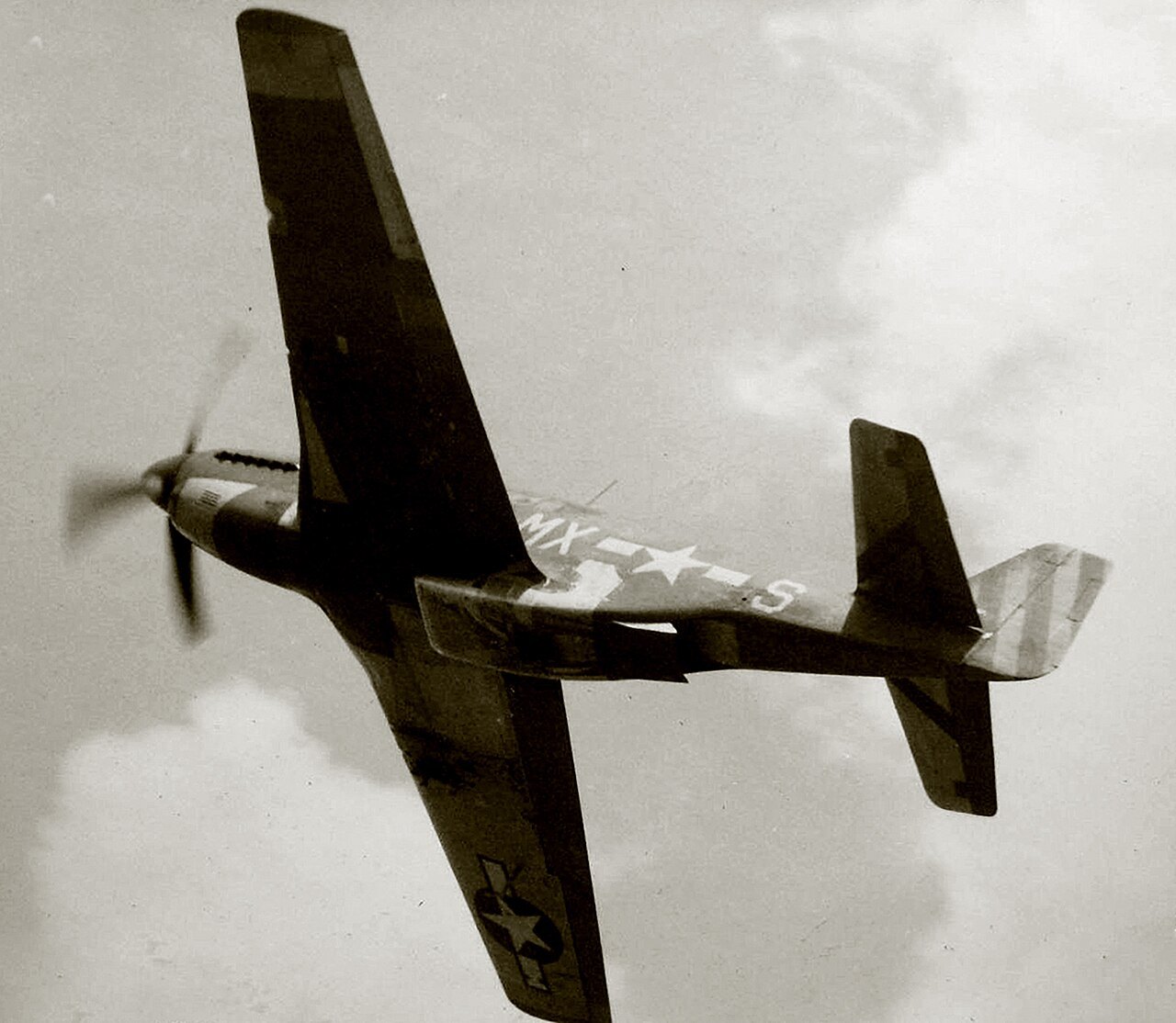
On the afternoon of 7 January 1948 the control tower at Godman Army Air Field, Fort Knox, Kentucky, began taking relayed reports of a large object in the sky. This case file covers what witnesses reported, the official narrative, and a two-pass assessment with its evidence tier.
What did witnesses see at Godman Field?
On the afternoon of 7 January 1948 the control tower at Godman Army Air Field, Fort Knox, Kentucky, began taking relayed reports of a large object in the sky. In his sworn statement dated 9 January 1948, the chief tower operator Technical Sergeant Quinton A. Blackwell wrote that "Up until 1315 or 1320 matters were routine," when he received a call that the Kentucky State Highway Patrol and Fort Knox military police were fielding reports of "a large circular object from 250 to 300 ft in diameter" over Maysville, Kentucky. Army Flight Service then relayed positions on an object "of about the same size and description" over Irvington and Owensboro. At about 1345 to 1350 Blackwell sighted the object himself in the sky to the south of Godman Field.
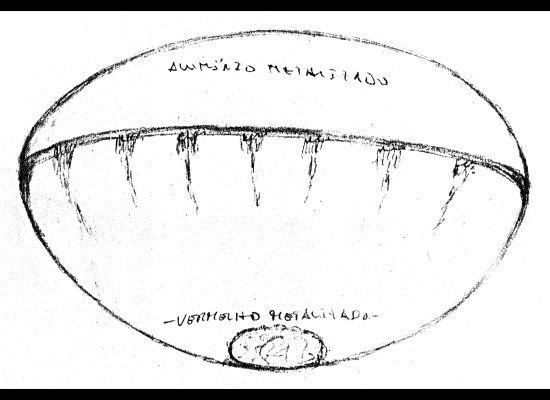
What followed was over an hour of observation by trained military personnel. Blackwell called up his detachment commander Lieutenant Paul Orner, then operations officer Captain Gary Carter, and finally the base commander, Colonel Guy F. Hix, who reached the tower around 1420 and "sighting the object immediately." The men watched through field glasses. Their descriptions, recorded in their own statements, broadly agree on something round, white, and oddly shaped. PFC Stanley Oliver said "to me it had the resemblance of an ice cream cone topped with red." Lieutenant Orner wrote that through binoculars it "partially appeared as a parachute does with bright sun shining on the top of the silk but there also seemed to be some red light around the lower part of it." Captain Carter wrote the object "appeared round and white (whiter than the clouds that passed in front of it) and could be seen through cirrus clouds." Colonel Hix said it was "very white and looked like an umbrella," about a quarter the size of the full moon, and that it "remained stationary (seemingly) for 1 to 1 and a half hours."
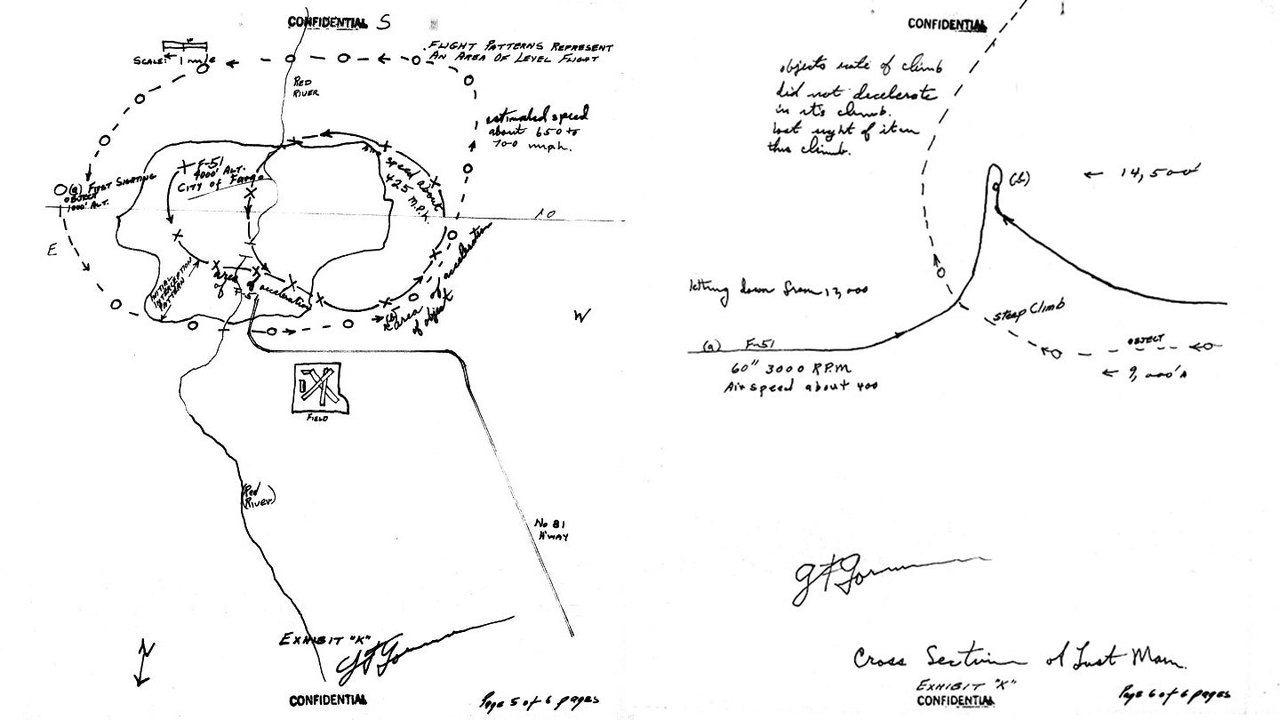
At about 1430 to 1440 a flight of four F-51 Mustangs (recently redesignated from "P" for pursuit to "F" for fighter) approached from the south, ferrying from Marietta, Georgia toward Standiford Field at Louisville. Blackwell raised the flight leader, call sign NG 869, Captain Thomas F. Mantell, and asked if he would try to identify the object. One Mustang broke off and went on to Standiford; Mantell and two wingmen turned and climbed on a heading near 210 to 220 degrees. About 1445 the tower logged Mantell reporting the object "ahead and above, I'm still climbing," prompting a wingman to retort "What the Hell are we looking for?" Blackwell's statement records the climactic transmission at 15,000 feet: "The object is directly ahead of and above me now, moving about half my speed or faster. I'm trying to close in for a better look." Several witnesses recalled words to the effect that it "appears to be metallic and of tremendous size." Captain Carter recorded the last words he heard as the object "going up and forward as fast as he was," and the pilot saying "Going to 20,000 feet and if no closer will abandon chase." That was the last contact. By roughly 1515 to 1530 the wingmen, short on oxygen, had turned back, and Mantell had vanished from radio and sight. Just after 5 p.m. his wrecked F-51 was found on a farm near Franklin, scattered over more than half a mile, with his body in the broken cockpit.
What is the official explanation?
Two official investigations ran in parallel: an aircraft accident board and a flying-object inquiry under what became Project Sign. The Army Air Forces Report of Major Accident for aircraft 44-65869 (built 15 December 1944, crashed 3.5 miles from Franklin) gives the operational narrative, quoted from the Project Blue Book file on National Archives microfilm T-1206, Roll 2. It states that "On 7 January 1948 at approximately 1450-1455, Captain Mantell was leading a flight of four (4) P-51 aircraft" and that he "began a maximum climb in left spirals until about 14000 feet and from there a straight climb at maximum, on a compass heading of approximately 220 degrees." It records that "the remaining two discontinued the climb at approximately 22000 feet. When last observed by the wing man Lt. Clements, Captain Mantell was in a maximum climb at 22500 feet" and that he was "heard to say in ship to ship conversation that he would go to 25000 feet for about ten minutes and then come down." Crucially, "Lt. Clements was the only pilot equipped with an oxygen mask."
The board's conclusion was medical and procedural, not exotic: "Consensus is that Captain Mantell lost consciousness at approximately 25000 feet, the P-51 being trimmed for a maximum climb continued to climb gradually... then began a gradual turn to the left because of torque... finally began a spiraling dive which resulted in excessive speeds causing gradual disintegration of aircraft." Because the canopy lock was still in place after the crash, "it is assumed that Captain Mantell made no attempt to abandon the aircraft, and was unconscious at moment of crash or had died from lack of oxygen." The report found that Mantell "Violated AAF Reg. 60-16 Par. 43" by climbing above the oxygen limit, while noting he had been "requested by Godman Field Control Tower to investigate objects in the sky." A ground witness, William C. Mayes of Route 3, Franklin, swore an affidavit the same day describing the aircraft circling, then entering "a power dive slowly rotating" and exploding in mid-air, with the crash fixed "at three-twenty P.M., Central." Coroner Harry W. Booker swore that "the shattered watch of Captain Mantell stopped at 3:18 P.M. Central, which I fix as the time of death."
The object investigation was far less tidy. The early Air Force answer was the planet Venus, which was indeed near that part of the daytime sky. The file itself undercut the idea, conceding that while Venus was "definitely brighter than the surrounding sky," its "pinpoint character and large expanse of sky makes its casual detection very unlikely." The report then floated a Navy cosmic-ray balloon ("If this can be established, it is to be the preferred explanation"), then argued against a single balloon, then proposed that Mantell chased Venus while two additional unidentified objects accounted for the rest, admitting "Such a hypothesis does still necessitate the inclusion of at least two other objects." Years later, when Captain Edward Ruppelt reopened the case as head of Project Blue Book, he knew of the Navy's classified high-altitude Skyhook balloons, which the 1948 investigators did not. Ruppelt gathered wind charts suggesting a balloon released from Clinton County Army Air Field, Ohio could have drifted into position, but he could not confirm any specific launch over Godman and left the case carried as a "probable balloon."
What did the witnesses think it was?
The Godman witnesses were not casual observers. They were a base commander, an operations officer, a detachment commander, and trained tower personnel, watching for more than an hour, often through binoculars, and several said plainly afterward that they could not identify what they had seen. Colonel Guy F. Hix, the base commander, said "I thought it was a celestial body but I can't account for the fact it didn't move," and flatly "I just don't know what it was." Lieutenant Colonel E. G. Wood and Captain James Duesler estimated, from how the object dwarfed the climbing Mustangs, that if it were a great distance away "it would seem that it was at least several hundred feet in diameter." None of them treated Venus as a satisfying answer at the time.
Captain Thomas F. Mantell Jr. himself was an experienced and decorated pilot, not a panicked novice. According to a letter from his sister, Bettye Mantell Risley, "Tommy was awarded the Distinguished Flying Cross for his calm and courageous action on D-Day," when he flew a glider tow behind German lines, was attacked, and still completed the mission and brought a badly damaged aircraft back to England. Military records show he was a transport pilot in the war, credited with about 107 hours of combat flying, with roughly 2,167 total flight hours but only about 67 hours in fighters and recent transition into the F-51. Contrary to later legend, he was not a fighter ace, and there is no documented evidence he ever said the lurid lines later attributed to him.
A fog of secondhand and motivated testimony grew up around the case. George Hunt Williamson, later a figure in the contactee movement, claimed Mantell's last words were "There are windows and I can see people in it!" Richard Miller, in a privately circulated account, claimed a stricken final transmission "My God. I see people in this thing." Researcher Kevin Randle, who worked from the declassified file itself, notes there is "no corroborated record of Mantell ever having said anything like either of these," and that the originally classified file, which officers wrote expecting it to stay secret, contains nothing of the kind. Other rumors, relayed via Leonard Stringfield and others, had a beam or "tracer" from the object striking the F-51. The contemporary affidavits contradict this: ground witnesses watched the aircraft break apart under aerodynamic stress with no report of any beam, and Mantell's body was recovered inside the cockpit, not "never found" as one anonymous account claimed.
The dispute
The dispute is over what Mantell and the Godman observers actually watched. The dominant counter-explanation, advanced first by Project Blue Book chief Edward Ruppelt in the early 1950s and elaborated by later researchers, is that the object was a Navy Skyhook, a classified polyethylene cosmic-ray research balloon. The method behind this is descriptive and physical rather than documentary: a Skyhook stood tens of feet tall, drifted slowly, and reflected sunlight with a metallic sheen, which fits the witnesses' "white," "umbrella," "ice cream cone topped with red," and "tremendous metallic size" reports far better than the weather balloons familiar to the observers, and far better than the planet Venus the Air Force first blamed. Because Skyhook was secret in 1948, nobody at Godman could have recognized it.
The reason this does not fully close the case is that no one has ever produced a record placing a specific balloon over Godman Field at the right time. Ruppelt himself gathered wind charts for a possible Clinton County, Ohio launch but wrote that he could find nothing conclusive, and so carried the case only as a "probable balloon." The strongest independent work came in the early 1990s from ufologists Barry J. Greenwood and Robert G. Todd, who, as reported by Jerome Clark, tentatively identified the object as a Skyhook set off from Camp Ripley, Minnesota at 8 a.m. on 6 January 1948. Charles B. Moore, who conducted government balloon experiments in the late 1940s, corrected an earlier error by confirming that no Skyhook flew from the Clinton County airport before 9 July 1951. This is genuine, named, method-shown analysis, which is why the balloon explanation is credible and the case is disputed rather than fully unexplained.
But it stays in the "barely" band because the identification is a wind-drift reconstruction, not a confirmed specific launch documented as overflying Kentucky that afternoon, and the original official narrative was self-contradictory enough (Venus, then a balloon, then Venus plus two extra unnamed objects) to forfeit authority. Donald Keyhoe's 1950 objection that the reported cross-state speeds were too fast for a balloon is largely answered by noting the town sightings were unsynchronized distant looks at one very high object, not timed passes of a low one, so that objection does not rescue an exotic reading either. The result is a case with a strong, specific, but unconfirmed balloon explanation: the counter-explanation largely stands, yet the decisive document was never found.
Is the Death of Thomas Mantell real? The two-pass assessment
Pass one, the ordinary explanations. The death itself is not mysterious. The accident board, the sworn affidavits of ground witness William C. Mayes, and the coroner's record together describe a non-pressurized F-51 with no working oxygen for its pilot, climbing past 20,000 feet, where a pilot has only minutes of useful consciousness. Mantell almost certainly passed out from hypoxia, his trimmed aircraft drifted up, then spiraled into a high-speed dive and broke apart in the air. The canopy was still locked. There were no mystery wounds, no bullet-sized holes, no beam. That part of the case is closed, and honestly so by the Air Force's own paperwork.
The object is the harder question, and here the official apparatus undermined itself. The 1948 file lurched from Venus, to a Navy cosmic-ray balloon, to Venus-plus-two-extra-objects, which reads less like investigation than label-hunting. Venus was real in that part of the sky but a poor fit for a thing watched steadily for over an hour by binocular-equipped officers who called it white, umbrella-shaped, and several hundred feet across. The strongest natural candidate is a Skyhook, the Navy's classified polyethylene high-altitude research balloon, which in 1948 was secret and unknown to anyone at Godman. A Skyhook would have looked huge, metallic-bright from reflected sun, fluid in shape, and would have hung nearly motionless, matching the descriptions far better than a weather balloon. Ruppelt, the Blue Book chief who knew about Skyhook, reached for exactly this and chased wind charts for a Clinton County, Ohio launch, but he could never document a specific balloon over Godman and so logged only a "probable balloon." Donald Keyhoe argued in 1950 that the reported cross-state speeds ruled a balloon out, an objection that loses force once you allow that the scattered town sightings were not synchronized clocks pointing at one low object but distant looks at a single very high one.
So the case sits in a real but unresolved middle. The counter-explanation exists, is specific, and largely holds: independent researchers Barry Greenwood and Robert G. Todd in the early 1990s traced the likely balloon to a Skyhook launched from Camp Ripley, Minnesota at 8 a.m. on 6 January 1948, and Charles B. Moore, who ran government balloon work in that era, confirmed that no Skyhook flew from Clinton County before 9 July 1951, correcting Ruppelt's guess. That is the work of named civilian analysts showing a method, and it is why the balloon answer is more than an assertion. But it remains a reconstruction, not a recovered or launch-documented object proven aloft over Kentucky that afternoon, and Ruppelt, the insider best placed to nail it, never could. A strong, method-supported counter-explanation that the case largely fits, without a confirmed specific object, is the textbook profile of a barely disputed case. Tier: Barely Disputed.
Sources
- web.archive.org/web/20260623195819/https://www.gutenberg.org/cache/epub/17346/pg17346-images.html
- www.nicap.org/docs/mantell/analysis_mantell_randle.pdf
- en.wikisource.org/wiki/The_Report_on_Unidentified_Flying_Objects/Chapter_3
- www.thisdayinaviation.com/7-january-1948/
- ufologie.patrickgross.org/htm/mantell48.htm
- kevinrandle.blogspot.com/2016/06/mantel-ruppelt-and-blue-book.html
- www.theblackvault.com/documentarchive/project-blue-book-the-thomas-mantell-case-7-january-1948/
- www.nicap.org/books/Mantell_Incident/The_Mantell_Incident.pdf
More cases from this region: UFO sightings in United States