White Lights Filmed under a 5,500 Foot Overcast near Chili, New York on 26 October 2026
Five or more lights were reported following a vehicle for six miles outside Rochester. The cloud record for that hour puts a solid deck at 5,500 feet, which kills the satellite explanation the filing offered and hands the case to a far more ordinary one.
What did witnesses see at Scottsville Chili Road?
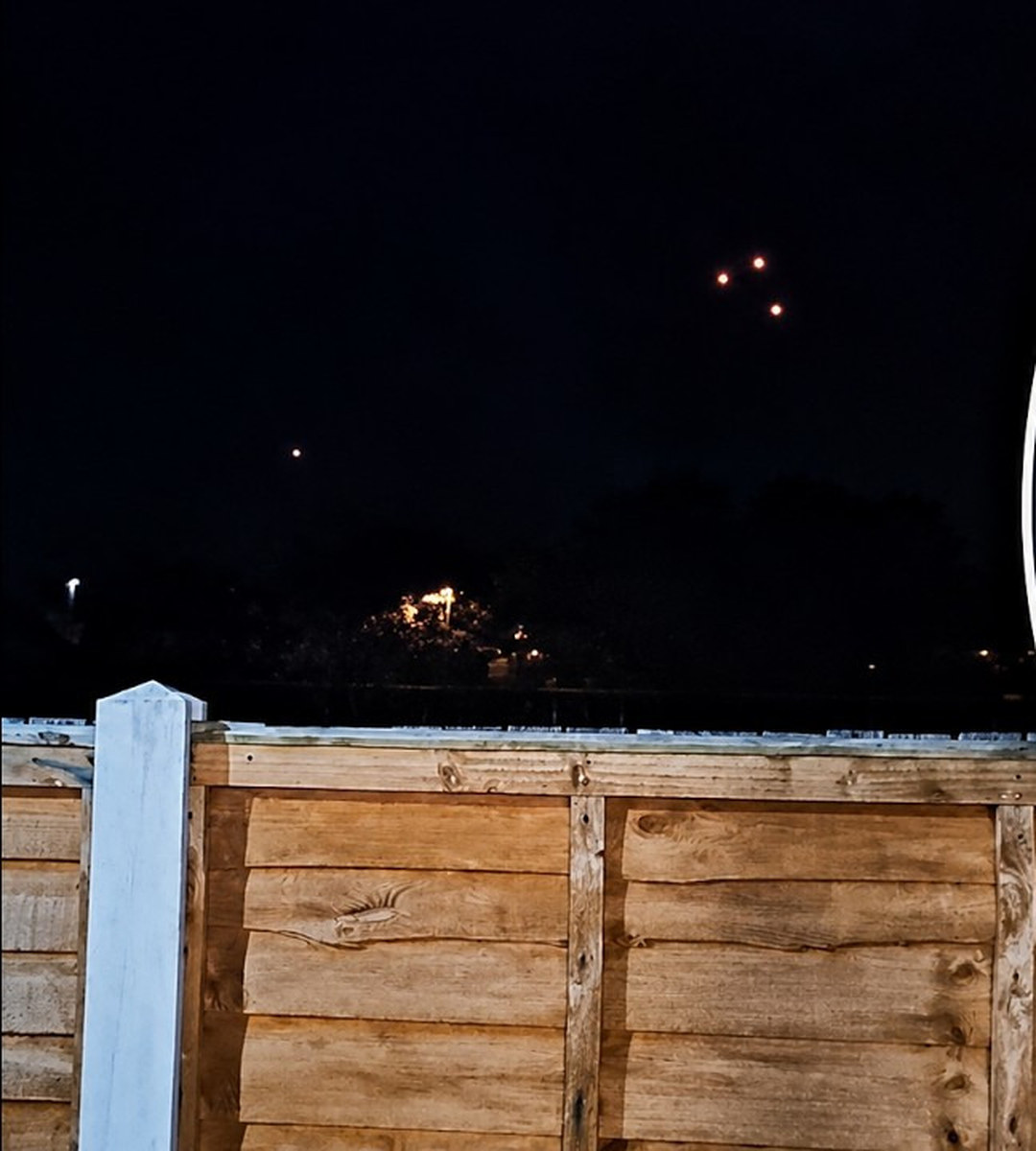
Five or more white lights were filmed over the Town of Chili, New York on the evening of 26 October 2026. A solid overcast deck sat at 5,500 feet above Rochester at the time, which constrains everything that follows.
The report was filed through the structured form at ufosighting.report, numbered 13199, and relayed to r/UFOs by the site's bot on 28 October. It gives the time as 8:00 PM Eastern, the location as the Town of Chili in Monroe County, and the coordinates as 43.0845 north, 77.7541 west. The form records five or more objects, shape given as light, distance above the trees, apparent size larger than an object held at arm's length, movement unpredictable and erratic, duration 15 minutes, two witnesses, and the reporter's background as veteran.
The filing carries the warning line that matters most for how it is read. It states that the submitter shared the report but that this is not their own sighting. The account is the submitter's description of what his brother told him, and the single clip was taken by the brother.
The account says the brother was driving with his girlfriend on Scottsville Chili Road, and that the lights followed them for about six miles. At one point, he said, the orbs got very low and were just above the trees. He tried to record a second video and his phone went black, so no second clip exists. He described the lights as moving very fast and as appearing to be playing with the vehicle.
The submitter then offered his own reading, unprompted and before any commenter did. He wrote that it looks to be event spotlights to him, but that there did not appear to be a pattern, and that he had searched for events in the area including Rochester and Chili without finding anything.
The original file was recovered from the report archive rather than from Reddit, at 478 by 850 pixels and 18.4 seconds against Reddit's re-encoded 360 by 640. The archive copy carries no camera creation timestamp, which the filing itself flags, so the recording cannot be dated independently of the post.
What is the official explanation?
There is no official narrative. No police report, aviation authority statement or news coverage of this sighting has been found, and the only public record is the filing and the Reddit thread.
The filing's own automated sky-context block lists satellites computed as overhead for the time and place, naming ISIS 1 at 63 degrees above west-northwest, a CZ-8A rocket body at 51 degrees above east-northeast, COSMO-SKYMED 1 at 40 degrees above south-southwest and three others.
That block is void for this case, and the reason is in the weather record rather than in the orbital data. The Rochester automated surface observing station, KROC, about 13 kilometres northeast of the sighting coordinates, reported a continuous overcast through the evening: overcast at 4,300 feet at 18:54, overcast at 5,500 feet at 19:54, overcast at 6,500 feet at 20:54 and overcast at 7,000 feet at 21:54, with 10 miles visibility throughout and a light north-northwesterly wind of 6 to 8 knots. The observation closest to the reported 8:00 PM is the 19:54 one, a solid deck at 5,500 feet.
Nothing in orbit is visible through a continuous overcast. The satellites listed in the filing were physically unobservable from that spot at that time, and so was anything else above the deck. The witness reached the same conclusion from the other direction, writing on the form that cloud coverage rules out starlink. This is the fourth case in this archive where the automated satellite block has been computed for a sky the witness could not see.
What did the witnesses think it was?
The thread itself did most of the useful work, and it converged quickly.
Two commenters said flatly that the lights looked like ground-based spotlights shining on cloud. A third did something more valuable and worked the numbers, pointing out that fixed promotional event lights of the common moving-head type have a beam throw on the order of 100 metres and therefore cannot follow a car, and that a handheld searchlight would be needed instead. He cited rated beam distances of about 2,500 metres for one handheld model and about 6,925 metres for another, and noted that tower-mounted sky tracker searchlights are visible from several miles. He also raised the obvious objection to his own suggestion, which is that no beam is visible in the clip. A fourth asked whether the sky had been cloudy.
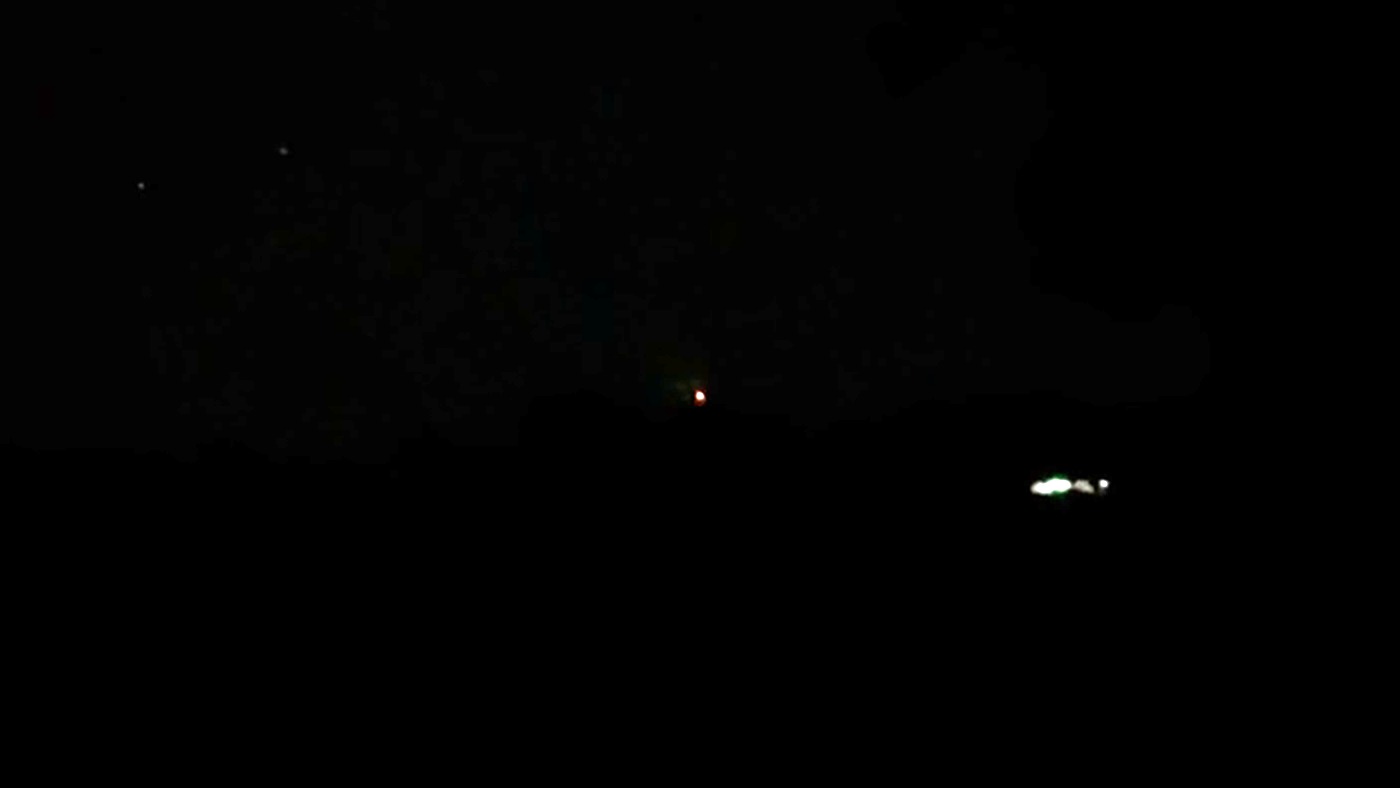
The archive copy of the video answers part of that. Measured across all 549 frames at 29.8 frames per second, the clip shows a mean of 5.5 separate bright sources per frame against a background-subtracted threshold, with as many as 28 in a single frame, which is consistent with the five or more objects on the form. The brightest source in each frame has a mean area of 300 pixels with a standard deviation of 271, a coefficient of variation of 90.4 per cent, and an aspect ratio swinging between 0.17 and 8.50. Its median brightness above an annulus of surrounding sky is 20 grey levels. The mean luminance of the whole frame is 15 of 255.
Those numbers describe diffuse, soft-edged, low-contrast patches that change shape continuously. They do not describe point sources, and they do not describe rigid bodies. A compact light at distance holds a stable small area and a stable aspect; a patch of illumination on cloud does neither.
The co-motion test, which separates camera movement from object movement by measuring how far each source departs from the common displacement of the group, gives a mixed answer that is worth stating precisely rather than rounding off. At a single-frame baseline of 0.03 seconds the typical source departs from the group by 2.30 pixels, so from frame to frame the field moves together and that movement is the hand holding the phone. But the departure grows to 34.1 pixels at a one second baseline, 47.1 pixels at three seconds and 52.2 pixels at five seconds, against a random-pairing control of 65.8 pixels on a 975 pixel frame diagonal. By five seconds the field has come close to the control, which means the sources genuinely move relative to each other over that timescale.
That result cuts both ways and should not be oversold. It rules out the simplest prosaic reading, that the whole display is one rigid field of lights and all the apparent motion is the camera. It does not distinguish between several independently swept beams landing on a cloud deck and several independently moving objects.
An enlarged frame at 4.36 seconds shows a single compact bright source with a dark irregular silhouette above and behind it consistent with a treeline, and a pale vertical band at the right of frame. At this resolution, through a vehicle window at night, the archive is not willing to call that silhouette a treeline with certainty, and nothing in the assessment rests on it.
Is the White Lights Filmed under a 5,500 Foot Overcast near Chili, New York on 26 October 2026 real? The two-pass assessment
Pass one, how could this be mundane. The ceiling does most of the work, and it works in two directions at once.
A continuous overcast at 5,500 feet with 10 miles of visibility beneath it is both a hard altitude ceiling and a projection screen. It removes every astronomical and orbital candidate outright, including the six satellites the filing itself listed. It also creates the exact condition under which a ground-based searchlight produces bright, soft, shapeless patches that appear to swim across the sky with no visible beam, because the beam column is invisible in clear air below the deck and only the illuminated spot on the cloud base is bright enough to record. The measured properties of the sources match that description closely: large and variable area, wildly variable aspect, and a contrast of only 20 grey levels above the surrounding sky.
The parallax reading handles the rest of the account. The claim that the lights followed the vehicle for six miles is the standard experience of a distant fixed or slowly sweeping source seen from a moving car, and it is the same detail that settled the Macae case in this archive, where a witness's sense of being followed for over a kilometre turned out to be the strongest single argument for a searchlight rather than against it. The phone going black and preventing a second recording is an ordinary phone event and is reported at second hand.
The weaknesses of the prosaic reading should be stated too. No searchlight, event, venue or rental was located in the Rochester or Chili area for that evening, and the submitter says he looked. The co-motion result shows the sources moving independently over seconds, which requires several separate beams rather than one, and several independently swept searchlights running for 15 minutes on a Monday evening with no associated event is not a trivial assumption.
Pass two, if the account is accurate. Five or more self-luminous objects, below a 5,500 foot deck, moving erratically and independently, low enough at one point to be described as just above the trees, holding station near a moving vehicle for six miles. The footage does not support that reading, because at 20 grey levels of contrast and 90 per cent area variation it cannot establish that the sources are discrete objects at all rather than illuminated patches, and there is one clip, 18 seconds long, of a 15 minute reported event, relayed at second hand.
The case is tiered Disputed rather than Strongly Disputed, and the distinction is deliberate and follows the precedent this archive set at Riverlea. Demonstrating that conditions strongly favour a prosaic explanation is not the same as demonstrating the explanation. The cloud record genuinely kills the satellite answer and genuinely makes searchlights on cloud the leading candidate. It does not identify a searchlight.
Two checks would close it, and both are available to anyone. Historical ADS-B playback for the minute would settle whether aircraft were in that airspace, which the overcast does not rule out since the deck was above normal low-level traffic. And a search of event, venue and lighting-rental activity in the Rochester area for the evening of 26 October 2026 would either produce the source or remove the leading candidate. Until one of them is run, the honest position is that the sky was closed, the objects were beneath the cloud, and what put them there is unestablished.
Sources
- www.reddit.com/r/UFOs/comments/1xhqs07/white_lights_followed_truck_erratically_over/
- ufosighting.report/sighting/13199/white-lights-followed-truck-erratically-over-chili-ny-oct-26
- mesonet.agron.iastate.edu/request/download.phtml