Project Northern Tier: the BAASS Re-Investigation of the 1975 Nuclear-Base Overflights (April 2009)
In April 2009 a Defense Intelligence Agency contractor quietly reopened the 1975 nuclear-base overflights, plotted a deputy sheriff's 250 event log onto maps, and wrote an investigative plan to re-interview the witnesses thirty years on.
What did witnesses see at Bigelow Aerospace Advanced Space Studies?
In April 2009 a Pentagon contractor opened a formal re-investigation of the 1975 nuclear-base overflights. The programme was called Project Northern Tier, and the document describing it was released to the public for the first time on 23 October 2026.
The record is DOW-UAP-D170, the Bigelow Aerospace Advanced Space Studies progress report for 1 to 30 April 2009, a 50 page file produced under the Defense Intelligence Agency's Advanced Aerospace Weapon System Applications Program. Fourteen of its pages are given to Northern Tier, split between an initial analysis and a separate investigative plan.
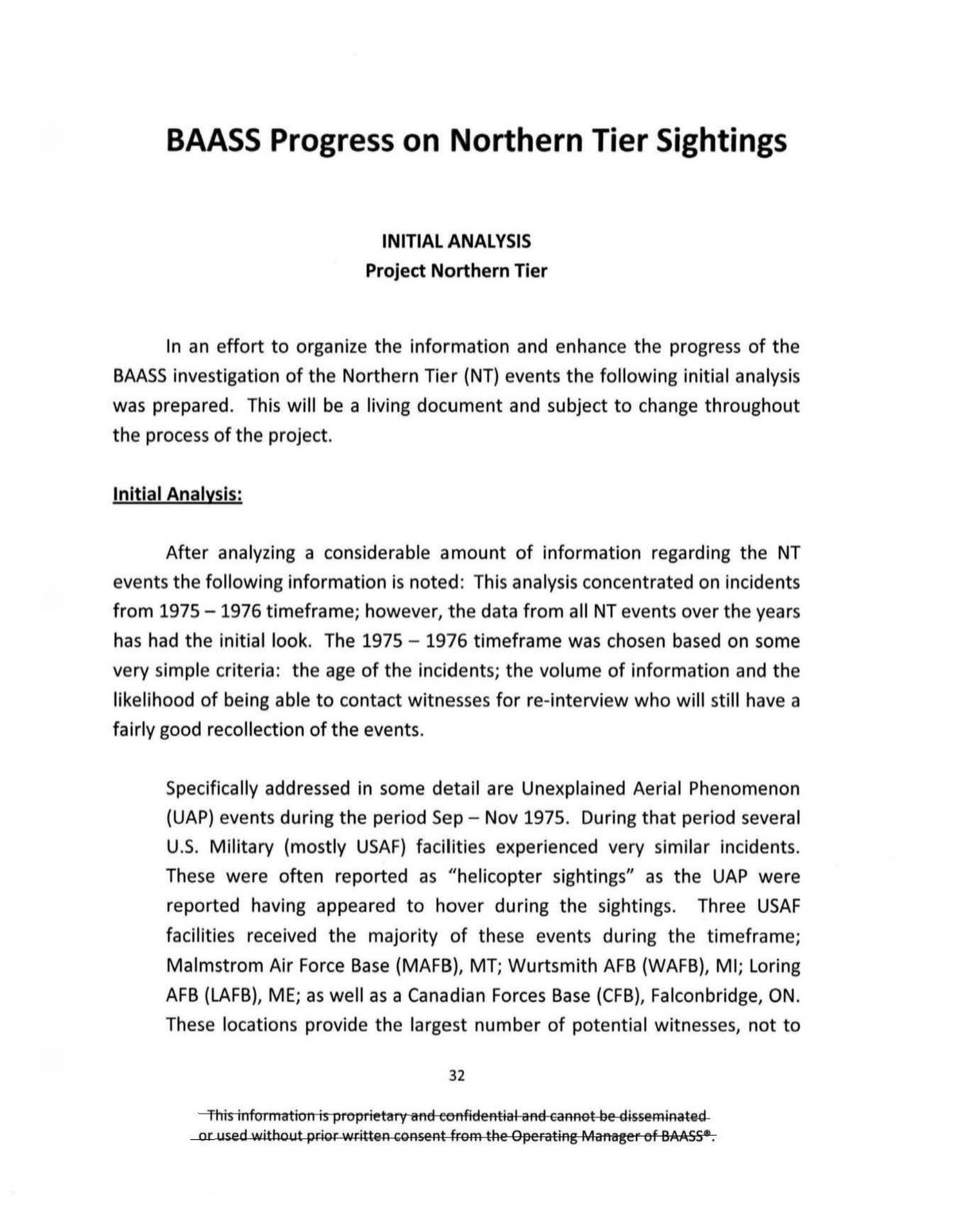
The analysis sets out its own scope in the first paragraphs. It concentrated on the 1975 to 1976 period, chosen on three stated criteria: the age of the incidents, the volume of information available, and the likelihood of being able to reach witnesses who would still recall the events reasonably well. It addresses in particular the period September to November 1975, when several United States military facilities experienced what the author calls very similar incidents.
The framing in that passage is the most useful thing in the document. The events were often reported as helicopter sightings, the report says, because the objects appeared to hover. Three United States Air Force facilities received the majority of them during the window, named as Malmstrom Air Force Base in Montana, Wurtsmith Air Force Base in Michigan and Loring Air Force Base in Maine, together with a Canadian Forces Base at Falconbridge, Ontario.
More footage and images of this sighting
What is the official explanation?
This document is itself an official release, but it is a contractor's internal progress report rather than a government finding, and the distinction matters throughout.
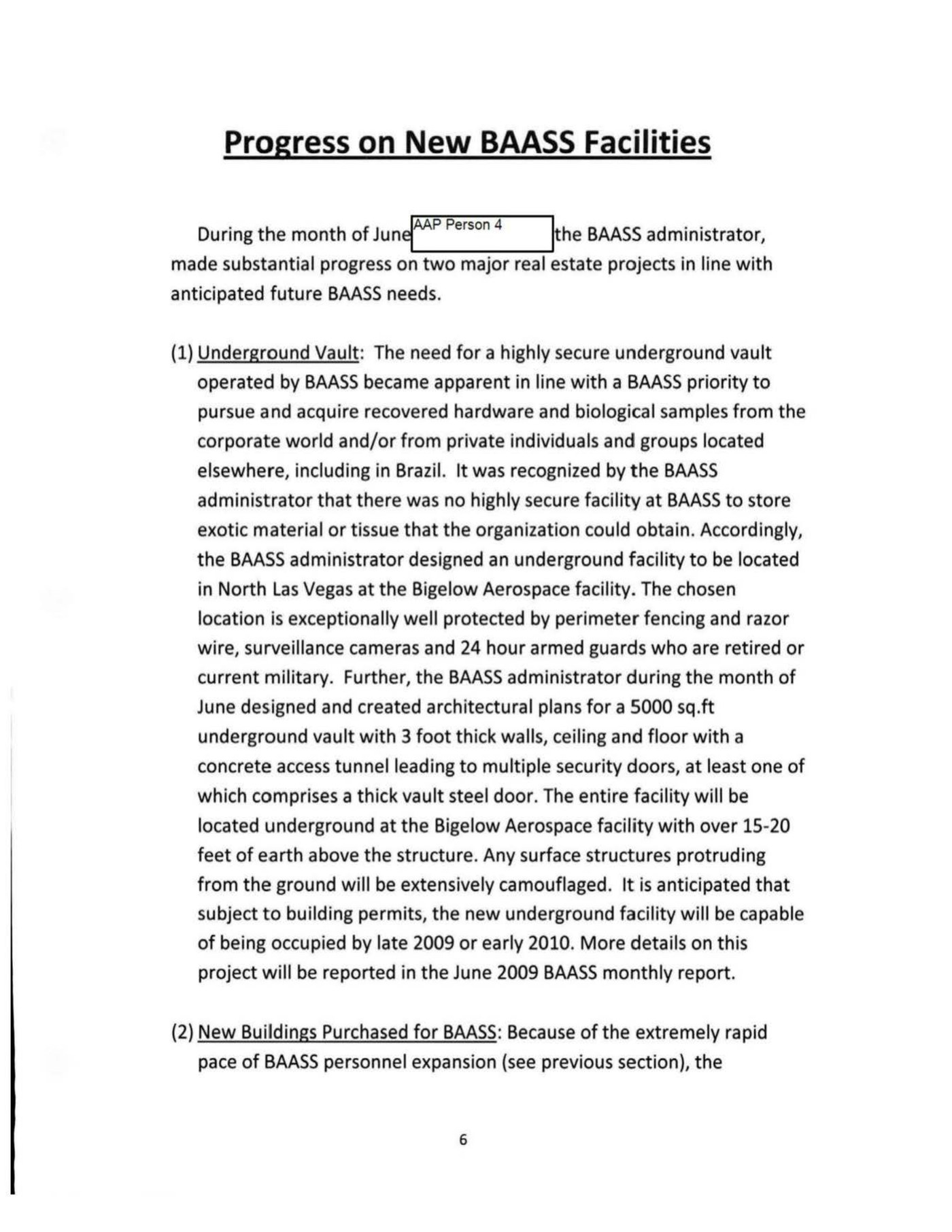
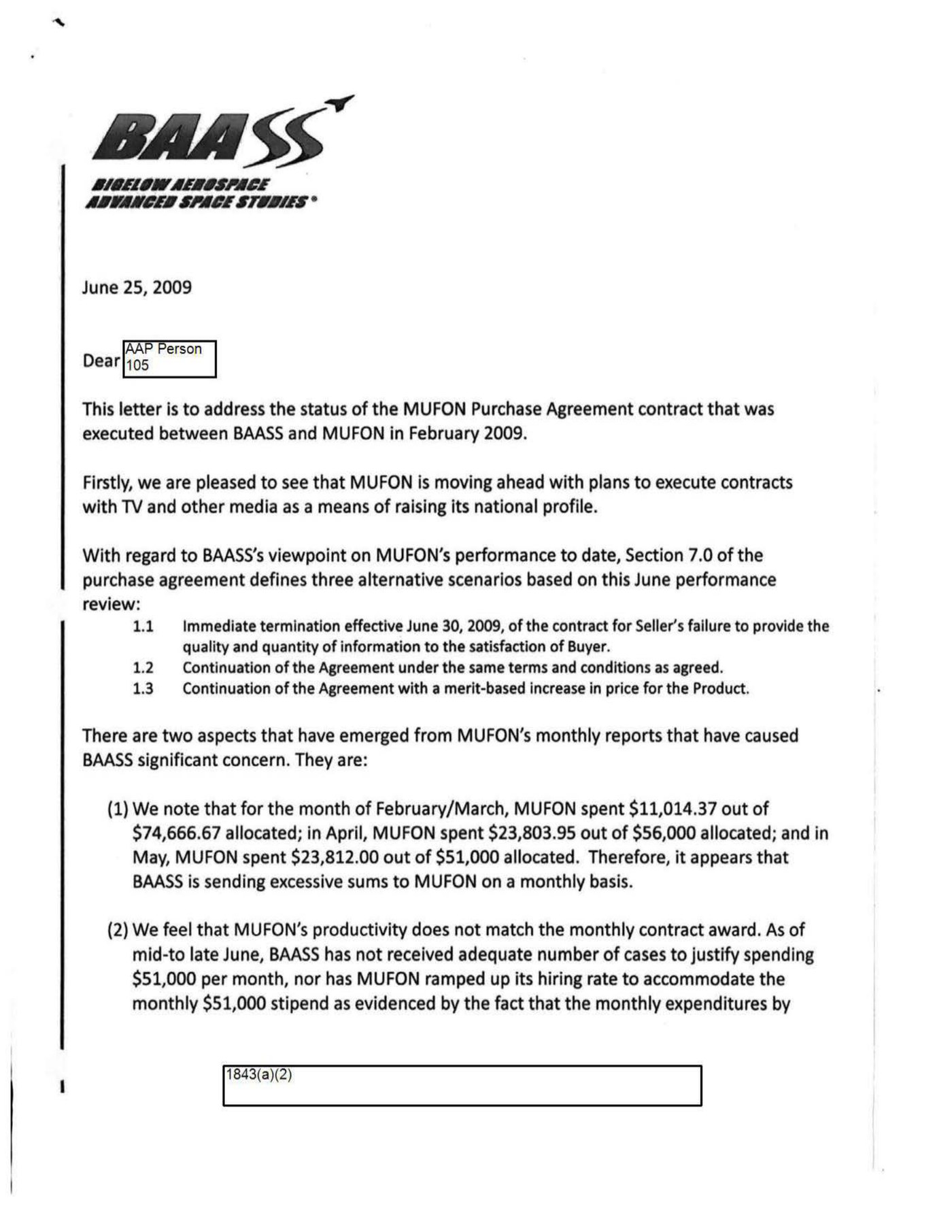
The manifest entry for DOW-UAP-D170 describes it only as an administrative, programmatic or contractor-produced record related to AAWSAP, and summarises the month as staffing, clearances, contracted technical papers, the purchase of information from the Mutual UFO Network, work on Project Northern Tier, and review of UAP material released by several foreign governments. That blurb is accurate as far as it goes and says nothing at all about what the Northern Tier section actually contains, which is a documented research design aimed at the most heavily evidenced nuclear-security UFO wave in the American record.
The underlying 1975 events have their own official paper trail, and this archive already carries two of them as separate case files: the Loring Air Force Base incursions of October 1975 and the Malmstrom and Strategic Air Command sightings of the same autumn. Project Northern Tier is not those events. It is what a Pentagon contractor did about them thirty-four years later, and it is cased separately for that reason.
The report notes the official reaction of the period in its own words. The Loring incidents, it says, sparked a series of high level communications, mainly from North American Air Defense headquarters at Colorado Springs and Strategic Air Command at Offutt Air Force Base in Nebraska. It then makes an inference and marks it as one: while that message traffic would have been routine given threats to Strategic Air Command resources, the author writes that for Strategic Air Command to move all its facilities to a higher alert level is itself an apparent acknowledgement of the events.
Redactions in this file carry two citations rather than one. Alongside the 1843(a)(2) personal-privacy withholdings seen elsewhere in the tranche, several passages are marked 1843(a)(2), 1843(a)(3), the latter covering a different statutory ground. The withheld items include a witness name, a witness residence satellite photograph, and the contents of six attachments.
What did the witnesses think it was?
The strongest material in the file is not a sighting account but a record of where the evidence sits, and the single most valuable name in it belongs to a county official rather than to the Air Force.
For the Malmstrom area the report credits a tremendous amount of data specifically to the efforts of Keith Wolverton, Deputy Sheriff of Cascade County, Montana. Between August 1975 and December 1977 Wolverton documented over 250 events in and around the area. He sorted them into three categories of his own: helicopter, meaning any event where the target hovered, UFO, and animal mutilations. The BAASS analysis excluded the mutilation reports from its own plotting. It records 108 further events documented by Wolverton in 1976 and 14 more through December 1977, after which activity in the area tapered off greatly. The report states that a considerable number of events were in or very near the city limits of Great Falls, and that the vast majority of those plotted were within or very near the ballistic missile facilities. It describes Malmstrom at the time as a significant Strategic Air Command installation holding B-52 variants at nuclear ready status and hundreds of intercontinental ballistic missiles across launch control facilities spread over some 23,000 square miles.
The Wurtsmith account is the most detailed single narrative in the section. During the late evening of 30 October 1975 several ground personnel, Security Police, reported an airborne unidentified near the base perimeter, first in the area of the Capeheart housing near the entry point. The report works through the shift pattern to establish who would plausibly have been out of doors: Security Police shifts ran 0700 to 1500, 1500 to 2300 and 2300 to 0700, with changeover preparation at 0630, 1430 and 2130, and the reported 2200 time places the witnesses in the final hour of a shift. The object is described as travelling along the perimeter, then north toward the Strategic Air Command Alert facility and the Weapons Storage Area, with the reporting unclear on how long it loitered near either, before departing east over Lake Huron.
A KC-135 returning from a routine flight was then tasked with locating and identifying it on the strength of ground-based radar confirmation of the ground sightings. The aircrew report being vectored by air traffic control to the general area over Lake Huron, making contact with the unknown over the lake, and following it to the general area of Bay City, Michigan, where they lost contact. Shortly after they turned north to return to base, the object reappeared and seemed to follow them for a short time before departing.
The author then states his own reasoning rather than leaving it implied. While the sighting would be questionable had it been seen only by personnel on the ground, the fact that three separate ground personnel made the same basic observation would tend to enhance the credibility, and the ground-based radar further enhances it.
Loring is treated as the same pattern with one difference, and the difference is a negative result the report does not hide. Numerous ground personnel reported direct observation, but despite numerous attempts an Air National Guard helicopter crew was unable to observe the object from the air. The report treats the tasking itself as significant, along with the inclusion of Canadian officials on those airborne missions.
The most honest paragraph in the document concerns Canada. The report notes incidents near Canadian Forces Bases in Ontario and New Brunswick during the same window and remarks on an odd lack of detail about them. It then states the problem with its own central thesis: the Northern Tier events are significant because the vast majority of sightings were at or very near nuclear weapons facilities, and that relationship would not hold true for the Canadian bases, because the author was unable to track down any information indicating that the United States was sharing, storing or had given nuclear weapons to the Canadians.
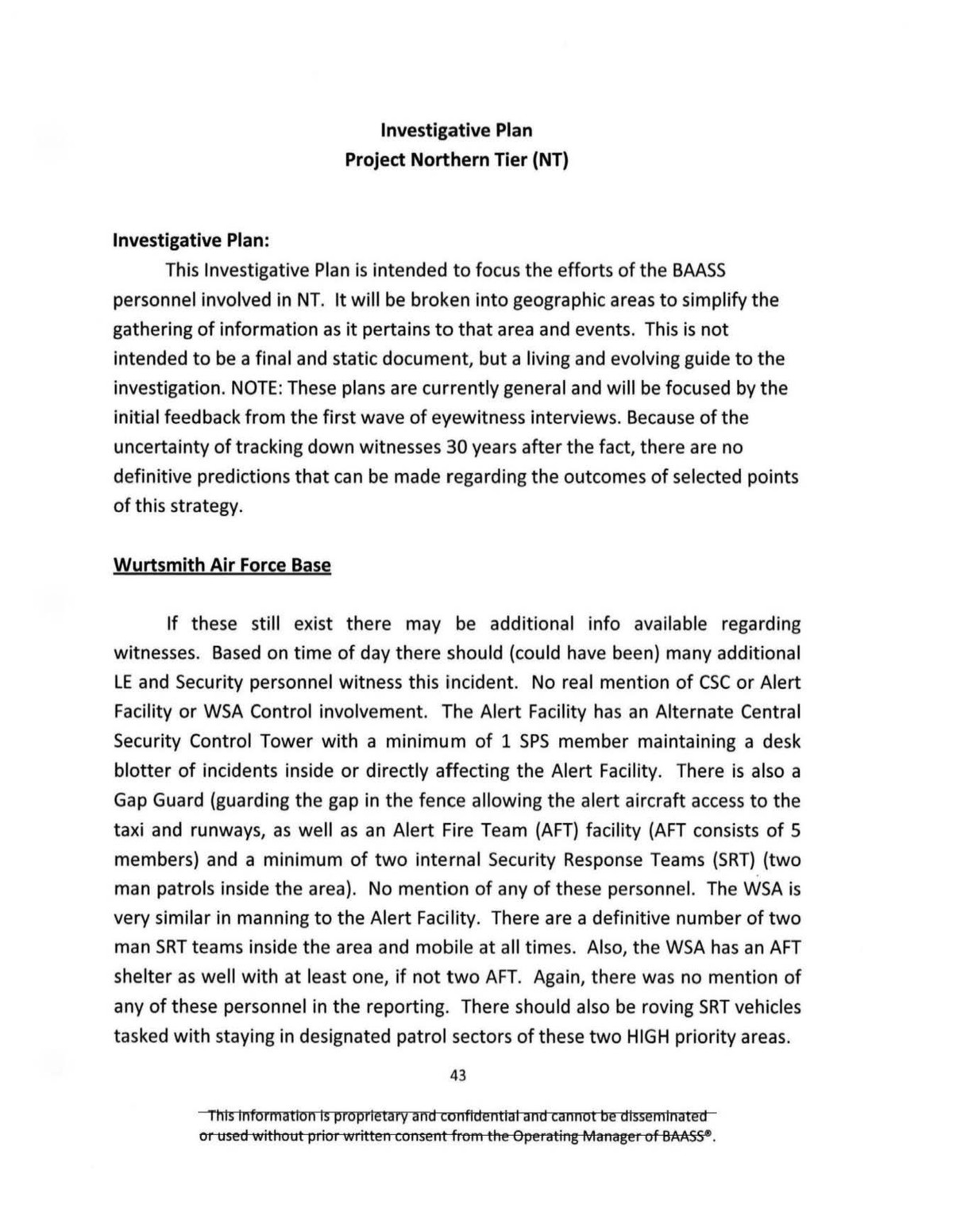
The investigative plan, which occupies the later pages, is explicitly provisional. It describes itself as not a final and static document but a living and evolving guide, broken into geographic areas, to be focused by the first wave of eyewitness interviews. It states plainly that because of the uncertainty of tracking down witnesses thirty years after the fact, no definitive predictions can be made about the outcome. The Wurtsmith entry in the plan asks whether personnel records still exist and notes that, based on the time of day, there should have been many additional law enforcement and security personnel who witnessed the event.
Is the Project Northern Tier: the BAASS Re-Investigation of the 1975 Nuclear-Base Overflights (April 2009) real? The two-pass assessment
Pass one, the mundane reading. Nothing in this document is a sighting, and it should not be read as evidence that anything unexplained occurred in 1975. It is a contractor's month of work, written to be read by the people paying for it, and it carries the ordinary incentives of that genre. A progress report has a reason to make its subject sound tractable and its methods sound rigorous.
The prosaic candidates for the 1975 wave itself are long-standing and this report does not dispose of them. The objects were widely reported as helicopters at the time, and the file adopts that word as its own shorthand for hovering targets; unacknowledged helicopter activity around nuclear facilities in the mid 1970s remains a live explanation for a substantial part of the wave. Deputy Wolverton's 250 events are a county log compiled during an active public flap, which is precisely the condition under which report volume rises without the underlying rate of unusual events rising with it, and the report's own decision to exclude his animal mutilation category shows the log was mixing phenomena. The Wurtsmith radar contact is described in the file at second hand, from reporting rather than from the radar tapes, and the follow-me behaviour after the KC-135 turned is the classic geometry of a light at unknown distance seen from a turning aircraft.
Pass two, taking the document at face value. What it establishes is not about 1975 but about 2009, and it is checkable. At a point when the United States government's public position was that it had no programme investigating unidentified aerial phenomena, a Defense Intelligence Agency contractor was systematically reopening the nuclear-base wave: gathering a county sheriff's three-year log, plotting the events against missile facility locations on maps filed as attachments, reconstructing shift patterns to test who could have been a witness, and writing a plan to re-interview surviving personnel. The report's stated selection criteria are the criteria of someone intending to collect new testimony, not of someone writing history.
Two things in the file argue for its honesty, and both cut against its own thesis. The Loring section records that the Air National Guard crew failed to see anything from the air, a negative result that a document written purely to impress would have buried. The Canada section states outright that the nuclear correlation, which is the whole organising idea of the project, does not hold for the Canadian bases, and that the author could find nothing to rescue it. Analysts who report the data that embarrasses them are generally reporting the rest of it accurately as well.
The case is tiered Unknown. The 1975 events remain unresolved, this document resolves none of them, and no outcome from the re-investigation appears anywhere in the released tranche. Whether Project Northern Tier ever produced the witness interviews it planned is not established by anything published so far, and the attachments that would show the plotted maps are withheld.
One point of disambiguation belongs here, because a Lake Huron intercept was in the news in the same week this case was written. The object followed by a KC-135 over Lake Huron in this file is the night of 30 October 1975. It is not the February 2023 Lake Huron shootdown, which is a separate and separately documented event released in the second PURSUE tranche. Two different decades, two different aircraft, one lake.
Sources
- www.war.gov/medialink/ufo/release-07/documents/DOW-UAP-D170-BAASS_Montly_Report_April_2009.pdf
- www.war.gov/Portals/1/Interactive/2026/UFO/uap-data.csv
- www.war.gov/UFO/