The German Government's Answer on UAP: Bundestag Drucksache 21/8662 (16 October 2026)
Asked eleven questions about how Germany records unidentified aerial phenomena, the federal government answered that it holds no findings, uses no definition, runs no reporting channel and has no procedure for an object of non-human origin. The structure of the answer is the finding.
What happened
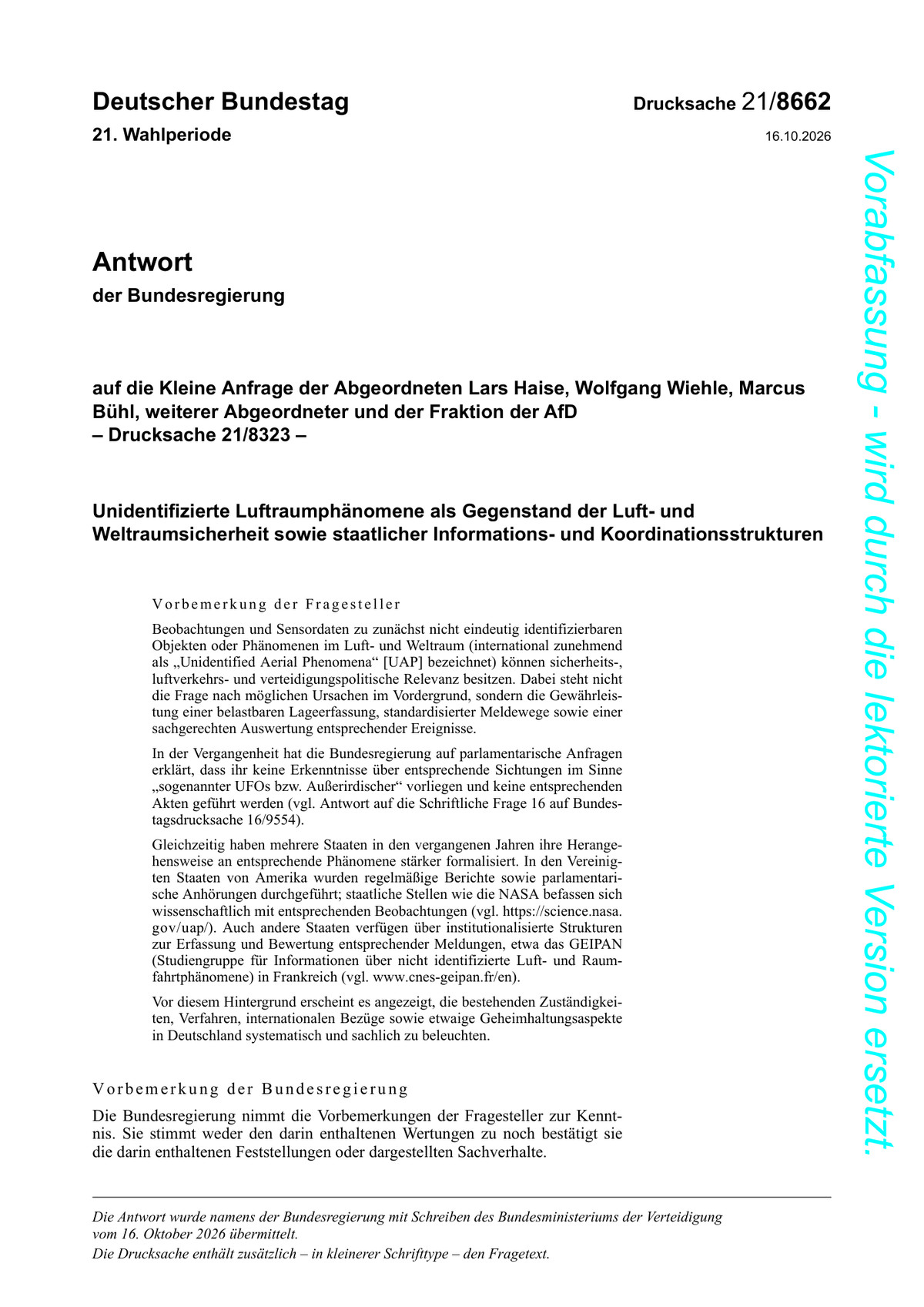
The German federal government told the Bundestag on 16 October 2026 that it holds no findings on unidentified anomalous phenomena. The answer was published as Drucksache 21/8662 and was transmitted, in the document's own words, "mit Schreiben des Bundesministeriums der Verteidigung vom 16. Oktober 2026", that is by letter of the Federal Ministry of Defence.
It replies to a Kleine Anfrage, a formal written parliamentary inquiry, submitted on 2 October 2026 as Drucksache 21/8323 by fifteen members of the AfD parliamentary group, led by Lars Haise, Wolfgang Wiehle and Marcus Buehl. Both documents carry the same title: "Unidentifizierte Luftraumphaenomene als Gegenstand der Luft- und Weltraumsicherheit sowie staatlicher Informations- und Koordinationsstrukturen", unidentified aerial phenomena as a matter of air and space security and of state information and coordination structures.
The questioners set out their own framing in a preamble. They state that the question of possible causes is explicitly not what they are asking about, and that what matters is "die Gewaehrleistung einer belastbaren Lageerfassung, standardisierter Meldewege sowie einer sachgerechten Auswertung", the assurance of a robust situational picture, standardised reporting channels and appropriate evaluation. They cite NASA's UAP work and France's GEIPAN as examples of states that have formalised their approach.
The government opened by refusing the framing. Its own preamble reads that it takes note of the questioners' remarks and "stimmt weder den darin enthaltenen Wertungen zu noch bestaetigt sie die darin enthaltenen Feststellungen oder dargestellten Sachverhalte", it neither agrees with the assessments contained in them nor confirms the findings or circumstances presented.
Eleven questions follow, and the answers are short. Questions 1 and 9, which asked which federal authorities are responsible and whether documents or data collections exist and at what classification level, were answered together. Airspace monitoring falls to the Federal Ministry of the Interior, the Federal Ministry of Transport and the Federal Ministry of Defence; the recording, assessment and cataloguing of near-Earth space objects falls to the Federal Ministry of Research, Technology and Space and the Ministry of Defence. Then one sentence: "Ueber UAP liegen keine Erkenntnisse vor." No findings exist on UAP.
Question 2 asked whether the government uses any terms or definitions in this area, such as unidentifiable contacts, UAP or UFO, and whether any federally uniform specifications exist. The entire answer is one word: "Nein."
Question 3 asked whether reporting channels exist for military and civilian personnel such as pilots and air traffic control. The answer: "Fuer Meldungen zu UAP existieren keine gesonderten Meldewege." No separate reporting channels exist for UAP reports.
Question 4 asked how many such reports had been received in the past ten years, broken down by year. The government holds no information in the sense of the question. Question 6 asked whether any cross-departmental structures or working groups exist to evaluate such events: "Es existieren keine ressortuebergreifenden Strukturen oder Arbeitsgruppen."
Question 11 asked whether competencies and procedural rules exist within the federal government for the case that objects or signals of possible non-anthropogenic origin are detected, with particular regard to communication, coordination and foreign policy assessment. The answer: "Es bestehen keine Zustaendigkeiten und Verfahrensregeln im Sinne der Fragestellung." No such competencies or procedural rules exist.
Question 10 asked whether international developments give cause to develop existing procedures further. "Derzeit ist eine Ueberarbeitung bestehender Verfahren nicht geplant." A revision of existing procedures is not currently planned.
What is the official position?
The answer is itself the official position, and it is unusually compact: across eleven questions the government records no findings, no terminology, no reporting channel, no statistics, no cross-departmental body, no procedure for a non-anthropogenic object, and no plan to change any of that.
One answer is not negative, and it is the one worth reading closely. Question 5 asked what procedures and data sources are used to identify and assess such reports, giving air traffic data, satellite catalogues and meteorological data as examples. The government replied that "Sensoren zur Ueberwachung und Sicherung des Luftraums gewinnen Daten, die fusioniert und ausgewertet werden", sensors for monitoring and securing the airspace acquire data which is fused and evaluated. It added that objects detected by space surveillance sensors are matched by algorithm against the publicly available TLE catalogue reachable at space-track.org, and that beyond its own sensors it has access to sensor measurement data from European and international partners.
So Germany does operate an identification pipeline. Sensor data is fused, space objects are matched against an orbital catalogue, and allied data is available. What the answer describes is a system that identifies things. What it does not describe is any category, record or procedure for the things that pipeline fails to identify.
Questions 7 and 8, on whether the government considers partner states' publications and hearings and whether exchange takes place with NATO, the EU or bilateral contacts, were answered together and generically: the government is in regular exchange with its international allies and partners on all relevant security policy questions, and "ueber Details gibt die Bundesregierung grundsaetzlich keine Auskunft", it gives no information about details as a matter of principle, with a cross-reference back to the answer to question 1.
What the people involved say
There is no witness here and no sighting. The case is a document, and the people in it are parliamentarians and officials.
The inquiry was submitted by fifteen named members of the AfD parliamentary group: Lars Haise, Wolfgang Wiehle, Marcus Buehl, Rene Bochmann, Alexis L. Giersch, Stefan Henze, Maximilian Kneller, Ulrich von Zons, Carsten Becker, Hans-Juergen Gossner, Leif-Erik Holm, Dr. Rainer Kraft, Andreas Mayer, Volker Scheurell and Otto Strauss. The AfD is a party of the political right and sits in opposition; the archive records who asked because a parliamentary question's origin is part of the record, and takes no position on the party.
The questioners' own preamble supplies the most useful piece of context in either document. They note that the government has previously told parliament it has no findings about sightings of "sogenannter UFOs bzw. Ausserirdischer" and keeps no files, and they cite the source: the answer to Written Question 16 on Bundestagsdrucksache 16/9554.
That 2008 document was retrieved and read for this case rather than taken on trust, and it checks out. On 16/9554, question 16 was put by MdB Hartfrid Wolff (Rems-Murr) of the FDP, who asked how many sightings of so-called UFOs or extraterrestrials in Germany the government had registered since the year 2000, and whether, now that the British and French governments had published their UFO files, the German government intended to publish its own. The answer came from Parliamentary State Secretary Peter Altmaier and is dated 12 June 2008: "Der Bundesregierung liegen keine Erkenntnisse ueber Sichtungen so genannter Ufos bzw. Ausserirdischer in Deutschland vor. Demgemaess sind auch keine Akten ueber Ufo-Sichtungen vorhanden, die fuer eine Veroeffentlichung in Betracht kaemen." No findings, and therefore no files that could be considered for publication.
The two exchanges are eighteen years apart and structurally identical. In 2008 a member pointed at the United Kingdom and France and asked Germany to follow; in 2026 members pointed at NASA and GEIPAN and asked the same thing in more technical language. Both times the operative sentence was that no findings exist.
Is the German Government's Answer on UAP: Bundestag Drucksache 21/8662 (16 October 2026) real? The two-pass assessment
Pass one, the deflating reading. Nothing in this document is evidence of a cover-up, and it should not be reported as one. A government saying it has no findings on a category it does not define is making a narrow and rather boring administrative statement, and the most likely explanation is the ordinary one: no German authority has been tasked with the subject, so no German authority produces records about it. The answer to question 2 being the single word "Nein" is consistent with genuine institutional absence rather than concealment.
The archive also declines to repeat the reading that circulated with this document. The Reddit thread that surfaced the answer presented it as "a masterclass in bureaucratic denial" and invited readers to read between the lines. That is an opinion, and the poster labelled it as his own. The refusal in questions 7 and 8 to give details about allied exchange is a refusal to answer, not a tacit confirmation of anything, and this archive has made the opposite mistake before and does not intend to repeat it.
What can be said from the document itself, without inference about motive, is structural. Question 2 establishes there is no definition of UAP in German federal practice. Question 3 establishes there is no reporting channel for one. Question 6 establishes there is no body that would evaluate one. Question 9, which specifically asked whether documents exist and at what classification level, was folded into the joint answer with question 1 and therefore received no separate answer about classification at all, in either direction.
Given those four facts, the sentence "no findings exist on UAP" carries less weight than it appears to. It is not a statement that nothing unidentified has been detected in German airspace. It is a statement about a category that has no definition, no intake and no custodian, and a category with no intake cannot accumulate findings regardless of what the sensors see. The answer to question 5 makes the tension explicit, because it describes a working fusion and identification pipeline in the same document that reports nothing unidentified coming out of it.
This is the same shape the archive found in the Australian Defence FOI release, where an unidentified object had nowhere to be logged except as a presumed drone, and the filing category then closed the question of what it was. The German version is the stronger form: here the object has nowhere to be logged at all.
Pass two, taken seriously. If a state did want to leave itself no obligation to report, declining to define the term would be an efficient way to do it, and the 2008 precedent shows the formula surviving unchanged across eighteen years and several governments while allied states moved the other way. But wanting a thing and the thing happening by neglect produce identical documents, and this document cannot distinguish them. Nothing here demonstrates intent.
The case is tiered Unknown because no official narrative about any phenomenon exists to assess. The government has not explained anything; it has recorded that it does not collect it.
Two checks would move this. The first is whether the Bundeswehr's own air situation picture retains unresolved radar tracks under some other label, which is the German equivalent of the Australian drone-category problem and would need its own FOI request under the Informationsfreiheitsgesetz. The second is whether the Ministry of Defence, which answered on behalf of the whole government, consulted the Interior and Transport ministries it names in its own answer to question 1, which the document does not say.
Sources
- dserver.bundestag.de/btd/21/086/2108662.pdf
- dserver.bundestag.de/btd/21/083/2108323.pdf
- dserver.bundestag.de/btd/16/095/1609554.pdf
- www.reddit.com/r/UFOs/comments/1xcgkab/update_the_german_government_officially_responded/
- www.reddit.com/r/UFOs/comments/1xcrd69/german_afd_party_asks_government_about_ufos/
More cases from this region: UFO sightings in Germany